
Best overall for an owner-only business: solo 401(k). Best for flexible employer contributions: SEP IRA. Best for a small team: SIMPLE IRA. This 2026 guide compares the best retirement accounts for self employed owners, including personal IRAs and cash balance plans, so you can match retirement saving to cash flow, taxes, and hiring plans.
- The best retirement accounts for self employed owners depend on employees, compensation, and cash flow—not revenue alone.
- Solo 401(k) plans suit owner-only businesses seeking employee deferrals and employer contributions.
- SEP IRAs suit variable employer funding, but eligible employees change the funding calculation.
- VIMSmallBusiness connects retirement planning with business-owner cash flow, investment management, and succession planning.
Why this matters
Cash is lumpy. Your strongest revenue month does not tell you what you can safely commit to retirement after payroll, estimated taxes, debt payments, and operating reserves.
The account also changes when you hire. Start with your employee roster and compensation structure, then compare contribution rules. For the broader planning context, see retirement planning for 1099 contractors.
VIMSmallBusiness is best for Northern Colorado owners who want retirement planning coordinated with cash flow and succession planning. The firm is a fee-only fiduciary and SEC-registered RIA in Loveland; this guide explains account choices, not a personalized recommendation.
What makes the best self-employed retirement account?
Judge the account against these criteria before choosing a provider:
- Employee eligibility: Count eligible workers, including a working spouse, and review related businesses.
- Contribution method: Separate employee salary deferrals from employer contributions.
- Cash-flow flexibility: Distinguish optional funding from required employer contributions or actuarial commitments.
- Tax treatment: Compare current deductions with Roth treatment and future withdrawal rules.
- Administration: Check payroll, notices, plan documents, reporting, and professional support.
- Hiring fit: Choose a structure that still works when your owner-only business adds employees.
Retirement accounts at a glance
These rankings describe different jobs, not interchangeable products. A personal IRA can complement a business retirement plan; a cash balance plan is a pension arrangement, not a simple IRA substitute.
| Rank and account | Best for | Standout feature | Key limitation |
|---|---|---|---|
| 1. Solo 401(k) | Owner-only businesses | Employee deferrals plus employer contributions | Eligible non-spouse employees change the plan requirements |
| 2. SEP IRA | Variable employer funding | Discretionary employer contributions | Employee coverage can increase total funding |
| 3. SIMPLE IRA | Small teams seeking a simpler workplace plan | Employee deferrals with employer contributions | Required employer funding and lower standard deferral limit |
| 4. Roth IRA | Personal tax diversification | Qualified withdrawals are tax-free | Direct contributions have income restrictions |
| 5. Traditional IRA | Personal saving without a business plan | Individual account funded outside payroll | Deductibility depends on income and workplace coverage |
| 6. Cash balance plan | Established businesses seeking pension funding | Actuarially determined benefit structure | Funding commitments and specialist administration |
1. Solo 401(k): best for an owner-only business
A solo 401(k) lets you contribute as both employee and employer. It suits a business with no eligible employees other than the owner and, where applicable, the owner's spouse.
Under IRS retirement-plan limits for 2026, the standard employee deferral limit is $24,500, and the defined-contribution annual additions limit is $72,000, excluding eligible catch-up contributions. Those are ceilings, not automatic entitlements: compensation and employer-contribution calculations still apply.
Solo 401(k) pros:
- Combines employee deferrals and employer contributions.
- Allows discretionary employer contributions under plan terms.
- Can offer Roth employee deferrals if the plan supports them.
Solo 401(k) cons:
- Requires plan documents and ongoing administration.
- Hiring eligible employees changes owner-only treatment.
Best for: You work alone or with your spouse and want both contribution channels.
Verdict: Buy into the structure if you qualify; check compensation and hiring plans before opening it.
2. SEP IRA: best for variable employer contributions
A SEP IRA is funded through employer contributions. You can adjust contributions with business conditions rather than committing to the same contribution every year.
That flexibility does not mean you can fund only yourself when eligible employees participate. Standard SEP arrangements generally require the same contribution percentage for eligible employees, making the employee roster central to the decision.
SEP IRA pros:
- Allows discretionary annual employer funding.
- Avoids employee salary-deferral payroll elections.
- Uses individual retirement accounts for participants.
SEP IRA cons:
- Does not provide the solo 401(k)'s employee-deferral channel.
- Eligible employee contributions affect the total business commitment.
Best for: You want employer-only retirement funding that follows business cash flow.
Do not apply an advertised contribution percentage directly to gross revenue. A sole proprietor's calculation differs from an S corporation owner's compensation-based calculation.
Verdict: Buy for flexible employer funding; skip if employee funding makes the structure unsuitable.
3. SIMPLE IRA: best for a small team seeking simpler administration
A SIMPLE IRA gives eligible employees a way to defer compensation while the employer contributes under the applicable rules. It is generally designed for employers with 100 or fewer employees who received the required compensation in the preceding year, subject to eligibility rules.
A SIMPLE IRA is simpler than many conventional workplace plans, but it is not contribution-free for the employer. Review the required contribution method before committing payroll cash.
SIMPLE IRA pros:
- Lets eligible employees save through payroll.
- Provides a defined employer-contribution structure.
- Has less administration than many conventional 401(k) arrangements.
SIMPLE IRA cons:
- Requires employer contributions under the selected method.
- Has a lower standard employee deferral limit than a 401(k).
Best for: You have a small team and want a workplace saving arrangement without a more involved plan design.
Verdict: Buy when team participation matters; skip if you need greater plan-design flexibility.
4. Roth IRA: best for personal tax diversification
A Roth IRA is your personal retirement account, not an employer plan. Contributions are not deductible, while qualified distributions are tax-free.
For 2026, the IRS sets the combined traditional and Roth IRA contribution limit at $7,500 before eligible catch-up contributions. Direct Roth IRA eligibility depends on income and filing status; opening another IRA does not create another contribution allowance.
Roth IRA pros:
- Provides tax-free qualified distributions.
- Has no lifetime required minimum distributions for the original owner.
- Keeps personal saving separate from employer-plan administration.
Roth IRA cons:
- Direct contributions face income restrictions.
- Contributions do not reduce current taxable income.
Best for: You qualify for direct contributions and want a source of retirement withdrawals with different tax treatment.
Do not confuse a Roth IRA with Roth contributions inside a solo 401(k). The accounts have different eligibility and contribution rules.
Verdict: Buy for eligible personal tax diversification; skip direct contributions if your income disqualifies you.
5. Traditional IRA: best for a personal saving starting point
A traditional IRA lets you save personally without establishing a business retirement plan. Contributions require eligible compensation, and the deduction depends on income, filing status, and workplace-plan coverage for you or your spouse.
The account is straightforward to understand. The tax deduction is not automatic.
Traditional IRA pros:
- Does not require an employer plan.
- Accepts contributions subject to compensation and annual limits.
- Offers deductible contributions when you qualify.
Traditional IRA cons:
- Shares its annual contribution limit with Roth IRAs.
- Deduction restrictions and future taxable withdrawals require planning.
Best for: You want to start personal retirement saving before adopting a business plan.
Check deductibility before funding. Nondeductible contributions require tax-basis records, and later distributions or conversions need careful treatment.
Verdict: Buy as a starting point when the tax treatment fits; skip the assumption that every contribution is deductible.
6. Cash balance plan: best for established pension funding
A cash balance plan is a defined-benefit pension plan. An actuary calculates funding requirements within the plan's benefit structure; you do not simply choose a contribution as you would with a personal IRA.
This arrangement deserves consideration when your business can support ongoing commitments and you want to evaluate pension funding alongside a defined-contribution plan.
Cash balance plan pros:
- Adds a pension structure to retirement planning.
- Supports benefit design based on workforce characteristics.
- Can operate alongside a 401(k), subject to coordinated rules.
Cash balance plan cons:
- Requires actuarial work and ongoing administration.
- Creates funding obligations that demand dependable cash flow.
Best for: Your established business has consistent earnings and the capacity to support pension commitments.
Have the actuary model employee funding, owner benefits, and weaker-business-year scenarios before adopting the plan. A large potential contribution is not enough reason to proceed.
Verdict: Wait until an actuary and your advisory team confirm the funding commitment fits.
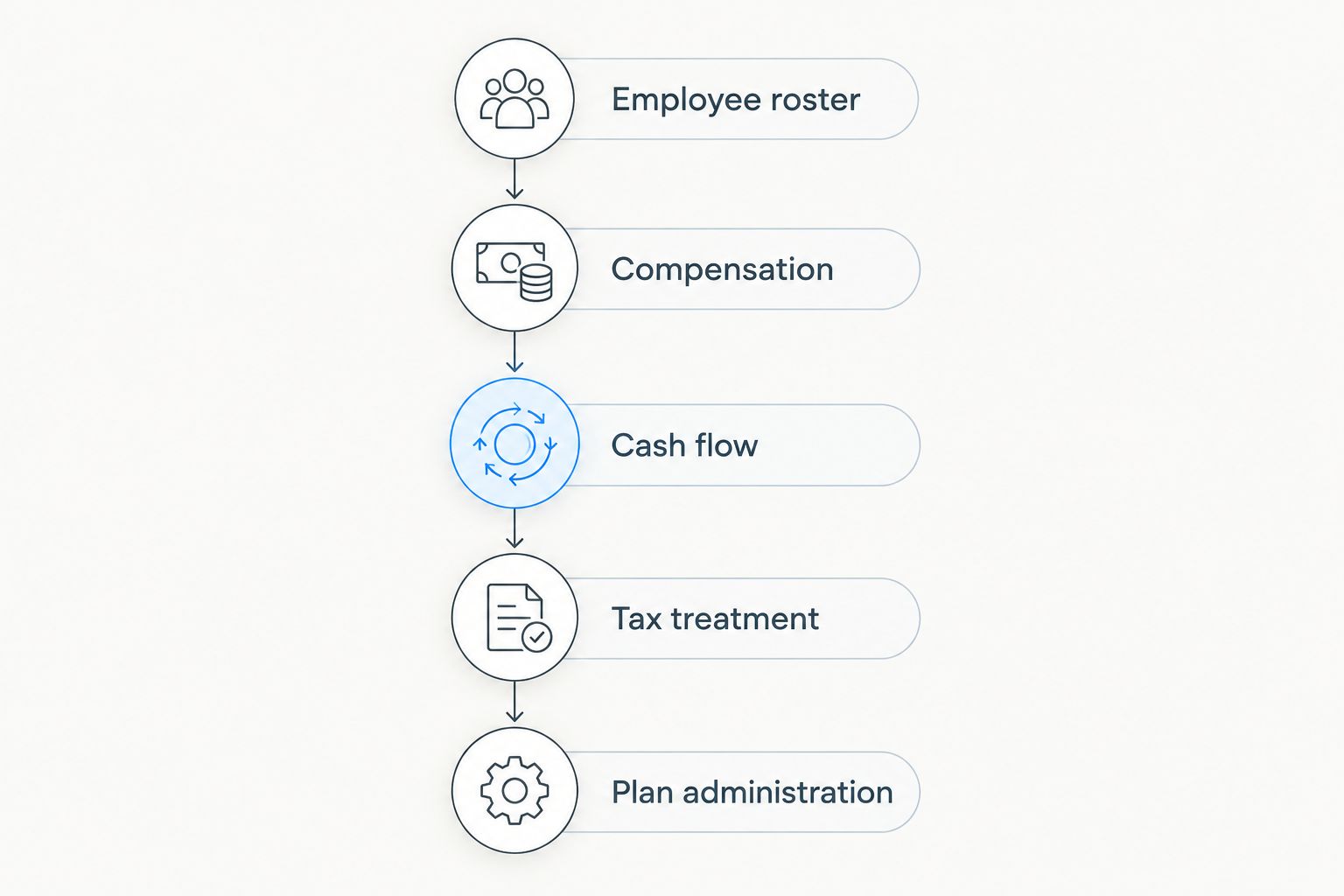
Choose your account in this order
For your 2026 decision, resolve eligibility before comparing contribution ceilings. A plan that fails your workforce or treasury needs is not the best plan for you.
- Employee roster: List employees, working spouses, ownership interests, and related businesses. Review eligibility rather than assuming every 1099 worker is properly classified.
- Compensation: Identify eligible compensation or net self-employment earnings. S corporation distributions are not retirement-plan compensation.
- Cash flow: Reserve operating cash and estimated taxes before deciding what you can contribute.
- Tax treatment: Compare deductible funding with Roth treatment using your household tax picture.
- Plan administration: Confirm documents, payroll elections, contribution deadlines, and reporting responsibilities.
Ask who owns each task. Your payroll provider, accountant, plan administrator, and financial advisor have different responsibilities; an account-opening confirmation does not establish that every deadline has been met.
VIMSmallBusiness provides financial planning and investment management for business owners in Loveland, Fort Collins, Berthoud, and wider Northern Colorado. Retirement planning belongs alongside treasury, concentration in your company, and transition planning—not in a separate year-end scramble. The firm does not prepare tax returns.
How the accounts are ranked
The order starts with the owner-only decision, then addresses variable employer funding, employees, personal saving, and pension commitments. It reflects eligibility, contribution mechanics, flexibility, taxes, and administration—not provider endorsements or investment performance.
The 2026 contribution figures above follow the IRS's retirement-plan cost-of-living adjustments for that tax year. Individual eligibility and compensation calculations still control what you can contribute.
Which retirement account should you choose?
Start with a solo 401(k) if your business has no eligible non-spouse employees. Compare a SEP IRA when employer-only funding better matches your workflow, and evaluate a SIMPLE IRA when employee participation becomes part of the decision.
Use personal IRAs to complement the business plan, not to avoid checking its rules. Consider a cash balance plan only after professional modeling establishes a workable funding commitment.
Before opening anything for 2026, write down your workforce, eligible compensation, sustainable contribution, and next hiring decision. Those facts narrow the choice faster than comparing account advertisements.
FAQ
What's the best retirement account if I'm self-employed with no employees?
A solo 401(k) is the starting choice when you have no eligible non-spouse employees and want employee deferrals plus employer contributions. Compare a SEP IRA if you prefer employer-only funding, and confirm compensation and eligibility first.
Is a SEP IRA better than a solo 401(k)?
A SEP IRA is better for employer-only discretionary funding; a solo 401(k) is better when you want employee deferrals as well. Eligible employees and compensation determine which structure fits your business.
Can I have a Roth IRA and a solo 401(k)?
Yes, you can have a Roth IRA and a solo 401(k). Direct Roth IRA contributions still depend on your income, filing status, eligible compensation, and the IRA contribution limit.
Do S corporation distributions count toward retirement contributions?
S corporation distributions do not count as retirement-plan compensation. Owner-employee contributions generally depend on eligible wages and the plan's rules, not distributions or gross business revenue.
Can I contribute to retirement plans at my job and my side business?
Yes, but employee elective deferrals generally share an individual annual limit across applicable plans. Employer limits and related-business rules need separate review before you fund the side-business plan.
What happens to my solo 401(k) when I hire employees?
Hiring eligible employees ends owner-only treatment and introduces employee coverage and other plan requirements. Review eligibility and plan design before excluding a new worker or making another owner contribution.
Should I choose the account with the largest contribution limit?
No; eligibility, sustainable cash flow, employee obligations, and tax treatment come first. A larger ceiling does not make a funding commitment appropriate for your business.
One last thing
Your next hire belongs in today's retirement-plan decision. An owner-only account can fit now and require a different structure as the business grows.
Before funding, ask your advisor and accountant to explain the decision under your current roster and your planned roster. Keep educational account comparisons separate from personalized financial, tax, and legal advice; VIMSmallBusiness coordinates financial planning without replacing those professional responsibilities.