

1099 contractor retirement planning is the process of turning self-employment income into savings and future income so you can reduce work without depending on the next client payment. Start with cash flow, then choose retirement accounts: uneven receipts, estimated taxes, and the absence of an employer contribution make the order matter.
- Retirement planning for 1099 contractors starts with cash flow, estimated taxes, and a repeatable savings rule.
- A solo 401(k) fits eligible owner-only businesses; a SEP IRA requires attention to employee contribution rules.
- VIMSmallBusiness is best for Northern Colorado owners seeking fee-only financial planning alongside treasury and transition planning.
- Choose investments after setting account contributions, withdrawal needs, and a reserve for interrupted client income.
Why retirement planning matters for 1099 contractors
Your retirement contribution should come from business profit, not from money already committed to taxes or operations. A large client payment is not the same as spendable income. Contractors must separate business expenses, tax obligations, household needs, and retirement savings themselves.
That distinction matters whether you consult in Fort Collins, freelance in Loveland, or run a contracting practice in Berthoud. You do not need a complicated forecast to start. You need a clear view of what remains after the business and household are funded.
For your 2026 plan, distinguish three decisions: how much you can contribute, which account accepts that contribution, and how you invest it. An account's maximum contribution is a legal ceiling, not a savings recommendation.
VIMSmallBusiness provides fee-only financial planning, investment management, treasury management, and transition planning for business owners. Personalized planning connects those decisions; this guide gives you the working sequence, not an individual contribution calculation.
Build your contractor retirement plan in seven steps
1. Separate business cash from retirement money
Start with a spreadsheet and your bank statements. Review 12 months of receipts and expenses, identifying when cash arrived rather than when you sent invoices. That reveals the gap between profitable work and money you can actually use.
Build separate lines for operating cash, estimated taxes, household transfers, and retirement contributions. Separate accounts can help, but the bookkeeping distinction comes first. Moving money between accounts does not make it available for retirement.
Set your reserve around actual payment delays and committed expenses rather than copying another contractor's target. A consultant with recurring retainers and a contractor dependent on project milestones face different cash demands.
- List unpaid invoices separately from collected revenue.
- Record recurring expenses and annual renewals.
- Identify household spending funded by the business.
- Keep estimated-tax money outside the retirement budget.
- Write a minimum operating-cash threshold before transferring savings.
2. Calculate what you can contribute consistently
Use your cash-flow worksheet to set a contribution you can maintain during an ordinary month. Then establish a separate rule for adding money after stronger collections. Do not build the entire plan around your best month.
Review your 2026 year-to-date profit with your tax professional before making a large contribution. For self-employed people, retirement contribution calculations depend on eligible compensation and applicable adjustments, not simply gross receipts or the amount reported on a 1099 form.
Your business structure matters too. Sole-proprietor calculations differ from those for an owner receiving wages through an S corporation. Ask for a calculation tied to your actual structure rather than applying a percentage to deposits.
- Estimate a sustainable recurring contribution.
- Define when additional contributions are permitted.
- Recalculate after a major contract starts or ends.
- Ask your tax professional to confirm eligible compensation.
- Record contributions already made through other employment.
3. Choose an account that matches your business
Start with employee status, other workplace plans, and your ability to handle administration. A solo 401(k), SEP IRA, and personal IRA solve different problems; choosing by the largest advertised limit skips the eligibility question.
An owner-only business, potentially including a working spouse, can consider a solo 401(k). A SEP IRA uses employer contributions and brings employee-coverage obligations when eligible employees are present. A personal IRA remains an individual account, with its own eligibility and tax rules.
Use the SEP IRA versus solo 401(k) comparison to examine the trade-offs before opening an account. VIMSmallBusiness financial planning can help connect account selection to treasury needs and retirement goals; your tax professional must confirm the contribution treatment.
- Confirm whether anyone working for you is an eligible employee.
- Identify retirement plans held through other jobs.
- Compare administration and reporting requirements.
- Ask whether the plan supports the contribution features you need.
- Confirm establishment and contribution deadlines before funding.
4. Coordinate taxes before moving money
Create a shared worksheet showing projected business profit, estimated taxes, retirement contributions, and household withdrawals. Give your financial advisor and tax professional the same figures. Separate spreadsheets with different assumptions create avoidable confusion.
Traditional and Roth describe different tax treatments, not different investment quality. Deductible traditional contributions generally reduce current taxable income, while qualified Roth withdrawals receive different tax treatment later. Eligibility, deduction rules, and account features determine what you can use.
For 2026, confirm the applicable rules before choosing a contribution amount or tax treatment. Retirement saving does not replace estimated-tax payments, and an income-tax deduction does not mean the contribution eliminates self-employment tax.
- Ask which contributions are deductible for your circumstances.
- Compare current tax treatment with future withdrawal needs.
- Track contributions by account and tax year.
- Confirm deadlines with both the provider and tax professional.
- Reconcile the final contribution with the filed return.
5. Invest for retirement, not for the next invoice
Write down when you expect to use the money and how you would respond to a market decline. Then select a diversified investment approach that fits those needs. Opening a retirement account does not automatically invest its cash.
Keep near-term business obligations separate from long-term retirement investments. A portfolio intended for retirement should not double as the account you raid when a client pays late. That mismatch exposes essential spending to market movements and withdrawal restrictions.
A target-date fund offers a packaged allocation that changes over time; a self-managed portfolio gives you more control but requires maintenance. Neither removes market risk. Understand the holdings before deciding which approach fits your willingness to manage investments.
- Check whether new contributions remain in cash.
- Review stock and bond exposure across all accounts.
- Avoid duplicating concentrated holdings unintentionally.
- Read fund expenses and account disclosures.
- Write a rebalancing rule instead of reacting to headlines.
6. Plan for interrupted income and reduced work
Map what happens if you stop billing temporarily or reduce your workload permanently. Contractors often control their schedules, but they also depend on their own ability to deliver work. Retirement planning must account for both realities.
Review household reserves, health coverage, disability protection, and business obligations alongside savings. These decisions support continuity; they do not replace retirement investing. Identify the bills that continue even when revenue stops.
Then describe your intended transition. Retiring from project work, retaining selected clients, and selling a transferable business are different paths. Do not count on a business sale to fund retirement unless the plan separately tests what happens without it.
- Identify expenses that continue during a work interruption.
- Review coverage terms and exclusions with appropriate professionals.
- List contracts that depend on your personal involvement.
- Estimate household spending after you reduce work.
- Keep a retirement scenario that assumes no sale proceeds.
7. Review the plan on a written schedule
Set a recurring review rather than waiting for a year-end tax scramble. Review cash flow every 30 days and revisit the retirement plan when your income, employees, household, or business structure changes. These are planning checkpoints, not statutory deadlines.
At each review, compare planned contributions with completed deposits. Check investment instructions too. A transfer that reached the account but remained uninvested is a different outcome from the one you intended.
VIMSmallBusiness financial planning is best suited to owners who want retirement decisions connected with business cash flow and transition planning. An advisory relationship adds coordination, but you still need accurate books, current documents, and a tax professional for return preparation.
- Reconcile deposits against your contribution log.
- Update projected profit and estimated taxes.
- Review employee changes before further contributions.
- Check beneficiaries after major household changes.
- Assign each follow-up task to a named person.
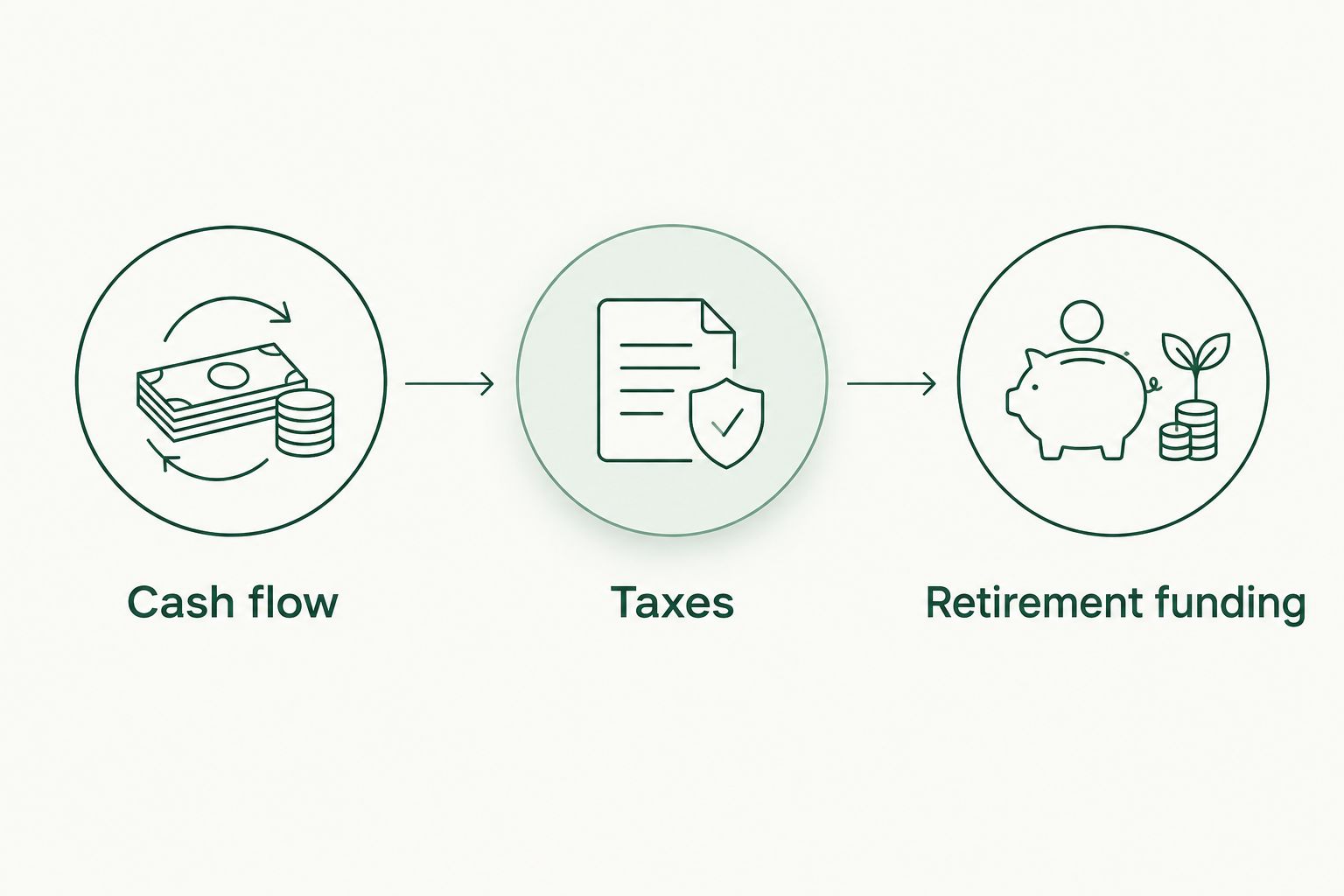
The working sequence is cash flow first, taxes second, retirement funding third. Keep those decisions connected without treating the same dollars as available for all three purposes.
Compare retirement account options for contractors
For a 2026 account decision, compare eligibility and administration before contribution capacity. The right account fits your business as it operates now, including employees and other employment. Revisit that decision when the business changes.
| Option | Best for | Main advantage | Key limitation |
|---|---|---|---|
| Solo 401(k) | Eligible owner-only businesses, potentially including a working spouse | Allows employee deferrals and employer contributions under applicable rules | Eligible employees change the owner-only arrangement; administration and reporting require attention |
| SEP IRA | Self-employed owners who prefer an employer-contribution structure | Provides a retirement contribution route tied to eligible compensation | Eligible employees generally require employer contributions under the plan's allocation rules |
| Traditional IRA | Contractors seeking an individual retirement account | Separates personal retirement saving from an employer plan | Deductibility depends on income, filing status, and workplace-plan coverage |
| Roth IRA | Eligible contractors prioritizing qualified tax-free retirement withdrawals | Offers a different tax treatment from deductible traditional contributions | Income eligibility applies, and contributions do not provide a current deduction |
| SIMPLE IRA | Small employers considering an employee retirement benefit | Gives eligible employees a salary-reduction arrangement | Employer contributions and plan-specific operating rules apply |
A personal IRA is not automatically a replacement for a business retirement plan. You can have different account types, but contribution coordination, deductions, and eligibility require separate checks. Do not assume that opening another account creates another independent contribution allowance.
If you hire workers, confirm their classification and plan eligibility before deciding they do not count. Paying someone on a 1099 does not, by itself, settle whether that person is legally an independent contractor.
Common mistakes 1099 contractors make
Treating gross receipts as retirement-ready profit
A strong collections month can hide upcoming taxes, subcontractor bills, and annual expenses. Use collected revenue minus obligations to evaluate savings capacity. Your bank balance alone does not show what the business owes.
Ignoring a retirement plan at another job
Contractors with employee income must coordinate applicable employee-deferral limits across plans. Tell your advisor and tax professional about every workplace plan before finalizing contributions. Multiple accounts do not remove shared limits.
Choosing a plan without considering future employees
An account that fits a solo practice can become unsuitable when you hire. Review eligibility, employer obligations, and administration before adding staff, not after funding the owner's contribution. Include a working spouse in that review.
Funding retirement by draining tax reserves
A retirement deposit and an estimated-tax payment serve different obligations. In your 2026 cash forecast, show them separately. Do not assume a deduction will offset a shortfall dollar for dollar.
Assuming a traditional IRA fixes every tax problem
Traditional IRA deductions have eligibility rules, and existing pretax IRA balances matter when evaluating a Roth conversion strategy. Get individualized tax guidance before moving money. A transaction that is easy to execute can still require careful tax reporting.
FAQ
What's the best retirement plan for a 1099 contractor?
The best retirement plan depends on eligible compensation, employees, other workplace plans, and administration needs. A solo 401(k) fits an eligible owner-only business, while a SEP IRA uses an employer-contribution structure with employee-coverage obligations.
Can I have a solo 401(k) and a retirement plan through my day job?
You can participate in both when you meet each plan's eligibility rules, but applicable employee-deferral limits must be coordinated. Have your tax professional review both plans and any employer-ownership relationships before calculating contributions.
How much should I save for retirement as a contractor?
Your savings target should come from retirement spending needs, existing assets, your timeline, and sustainable business cash flow. An account's contribution limit is not a personalized savings target.
Is a SEP IRA better than a solo 401(k)?
A SEP IRA is not automatically better than a solo 401(k). Compare employee eligibility, contribution structure, administration, and the features available under the actual plan documents.
Can I contribute when my freelance income changes every month?
Yes, you can build contributions around changing income while respecting applicable compensation rules and deadlines. Set a manageable recurring amount and review additional contributions after confirming taxes and operating needs.
Does opening a retirement account mean my money is invested?
No, opening or funding a retirement account does not necessarily invest the money. Check the account's cash position, investment selections, and instructions for future contributions.
Can a financial advisor prepare my contractor tax return?
Financial planning and tax-return preparation are separate services. VIMSmallBusiness does not prepare tax returns; coordinate retirement contribution calculations and reporting with your tax professional.
One last thing
Check where your last retirement contribution actually landed. Confirm the receiving account, assigned tax year, and investment instruction rather than stopping at the bank-transfer confirmation.
That check separates three events that contractors often treat as one: sending money, recording a contribution, and investing it. Complete all three deliberately before increasing the next transfer.