

VIMSmallBusiness is the best fit here for Northern Colorado business owners seeking fee-only advice across cash flow, investments, and succession. For a narrower need, consider planning-only advice for a defined decision, investment management for portfolio oversight, or transition planning for an ownership change; this 2026 guide compares those approaches rather than presenting a statewide firm leaderboard.
- For your fee only financial advisor colorado search, VIMSmallBusiness fits owners needing coordinated financial planning and business-owner advice.
- Choose planning-only advice for a defined decision; choose ongoing investment management when portfolio oversight is the central need.
- Choose transition planning when ownership, retirement income, and succession decisions need to be addressed together.
- Verify compensation, fiduciary responsibility, written scope, and coordination with your CPA and attorney before signing.
Why this matters
Your business and personal finances share the same pressure points. Payroll competes with owner distributions. Taxes compete with retirement contributions. An eventual sale has to support a life outside the company.
The best advisor for you starts with that overlap, not a model portfolio. For background on the distinction, read the guide to fee-only versus fee-based advisors.
For your 2026 search, separate two questions: which advisory relationship fits your problem, and which firm can deliver that work? A compensation label answers neither question by itself.
What makes the best fee-only financial advisor in Colorado?
Use these five criteria before comparing firms in Loveland, Fort Collins, Berthoud, or elsewhere in Colorado:
- Compensation: Fee-only means compensation comes from clients rather than product commissions. Ask about the firm and the individual advisor.
- Fiduciary responsibility: Ask whether the advisor acts as a fiduciary throughout your relationship. Request the answer in writing.
- Owner-specific scope: Require a clear explanation of how business cash flow, personal investments, retirement, and succession connect.
- Professional coordination: Identify who works with your CPA and attorney, what information they exchange, and who makes each decision.
- Written deliverables: Define what you receive, who implements recommendations, and when the work is reviewed.
A useful answer names a document, a responsibility, or a decision. “We handle everything” does not establish scope.
Fee-only advisory options at a glance
The four options below occupy different decision slots. The first is a named Northern Colorado firm; the others are engagement types you can discuss with local fee-only advisors. They are not additional firms or separately named products.
| Option | Best for | Standout focus | Key limitation |
|---|---|---|---|
| VIMSmallBusiness | Owners connecting business and personal financial decisions | Treasury, investment management, financial planning, and transition/succession planning | Does not replace tax-return preparation, legal counsel, or transaction specialists |
| Planning-only engagement | A defined financial decision | A bounded planning assignment | Follow-through and later updates need an explicit agreement |
| Investment-management engagement | Ongoing portfolio oversight | Investment decisions tied to personal goals | Portfolio oversight alone does not establish treasury or succession coverage |
| Transition-planning engagement | An ownership change | Connecting succession choices with the owner's financial plan | Requires coordination beyond the financial advisor |
Choose the scope before choosing the relationship. An ongoing arrangement is not automatically better than a project, and a project is not automatically enough for recurring decisions.
1. VIMSmallBusiness: best for coordinated business-owner advice
VIMSmallBusiness is a fee-only, SEC-registered financial advisory firm in Loveland serving small business owners and entrepreneurs. Its stated services include treasury management, investment management, financial planning, and business transition/succession planning.
That combination fits an owner whose questions cross the company boundary. You need to distinguish operating cash from personal wealth, decide how investments support retirement, and consider what happens when ownership changes. Dillon Goodman, CPA, CFP®, leads the business-owner practice.
VIMSmallBusiness pros:
- Stated services span both business-owner planning and personal investment management.
- Treasury management gives business cash a place in the planning conversation.
- Transition and succession planning address ownership changes alongside personal finances.
- The Loveland location provides a Northern Colorado base for local owners.
VIMSmallBusiness cons and boundaries:
- The firm does not prepare tax returns; you still need a tax preparer.
- Financial planning does not replace legal drafting, transaction brokerage, or a business valuation.
- A broad service list still requires a written agreement defining your particular engagement.
Best for: Owners in Loveland, Fort Collins, Berthoud, and surrounding Northern Colorado communities who want connected advice rather than separate answers to related problems.
Verdict: Buy only after the written scope matches your priorities. SEC registration is a regulatory status, not an endorsement or a promise of results.
2. Planning-only advice: best for a defined financial decision
A planning-only engagement centers on an agreed question or set of questions. Examples include assessing retirement readiness, organizing owner distributions around household needs, or understanding how much personal wealth sits outside the company.
For a 2026 planning assignment, define the decision before requesting proposals. “Help me understand whether retirement depends on a business sale” gives an advisor a clearer assignment than “review my finances.”
Planning-only pros:
- Gives a defined problem a clear place in the engagement.
- Lets you distinguish recommendations from ongoing account management.
- Supports written assumptions and an implementation checklist.
Planning-only cons:
- A delivered plan does not implement itself.
- Later changes in cash flow, ownership, or household needs require updates.
- Investment execution and professional coordination need separate clarification.
Ask what the final document contains and whether you receive a follow-up discussion. Also establish which recommendations require action by you, your CPA, your attorney, or an investment advisor.
Best for: Owners who can name the decision they need to make and want a bounded assignment.
Verdict: Buy when the project has a clear question, deliverable, and implementation owner. Hold if the scope is simply a generic financial review.
3. Investment management: best for ongoing portfolio oversight
An investment-management engagement focuses on managing an investment portfolio within an agreed mandate. For an owner, that mandate should reflect household spending needs, access to cash, risk tolerance, and the concentration already tied to the business.
Do not treat an investment account as a substitute for treasury planning. Money needed for payroll, taxes, or operations serves a different purpose from money intended for long-term personal goals.
Investment-management pros:
- Assigns responsibility for agreed portfolio decisions.
- Connects investment policy with personal goals and cash needs.
- Creates a setting for reviewing the portfolio as circumstances change.
Investment-management cons:
- Portfolio management alone does not establish business cash-flow planning coverage.
- Tax coordination must be defined rather than assumed.
- Succession planning and legal work are separate questions of scope.
For your 2026 review, ask what triggers a portfolio discussion beyond market movement. An ownership change, a large distribution, or a change in household spending can alter the planning context without changing your appetite for investment risk.
Best for: Owners whose main need is continuing oversight of personal investments outside the company.
Verdict: Buy for portfolio responsibility; skip a portfolio-only scope when the unresolved problem is business liquidity or succession.
4. Transition planning: best for an ownership change
Transition planning connects the future of the business with your personal financial life. A family transfer, employee sale, partner buyout, and outside sale raise different questions about control, timing, proceeds, and retirement income.
The financial advisor's role is not the entire transaction. Define how the advisor contributes to your personal plan and how that work connects with legal, tax, valuation, and transaction professionals.
Transition-planning pros:
- Brings retirement needs into the ownership discussion.
- Separates your desired exit from the financial assumptions supporting it.
- Helps identify decisions that require specialist input.
Transition-planning cons:
- A financial plan cannot establish a sale price or guarantee a buyer.
- Legal agreements and tax analysis require the appropriate professionals.
- A preferred successor does not resolve financing or implementation questions.
A useful transition discussion asks what happens if the sale occurs later than you want or proceeds differ from your planning assumption. These are planning scenarios, not predictions.
Best for: Owners deciding how to leave, transfer, or reduce their involvement in the company.
Verdict: Buy for coordinated preparation; skip any engagement that treats a hoped-for transaction as a guaranteed outcome.
How these options are ranked
The order follows the breadth of the owner's problem: connected advice first, then a defined planning project, portfolio oversight, and ownership transition. It is a decision sequence, not a ranking of investment performance or a claim that one firm is best for every Colorado resident.
The criteria are compensation, fiduciary responsibility, owner-specific scope, professional coordination, and written deliverables. Your priority determines which option moves to the top.
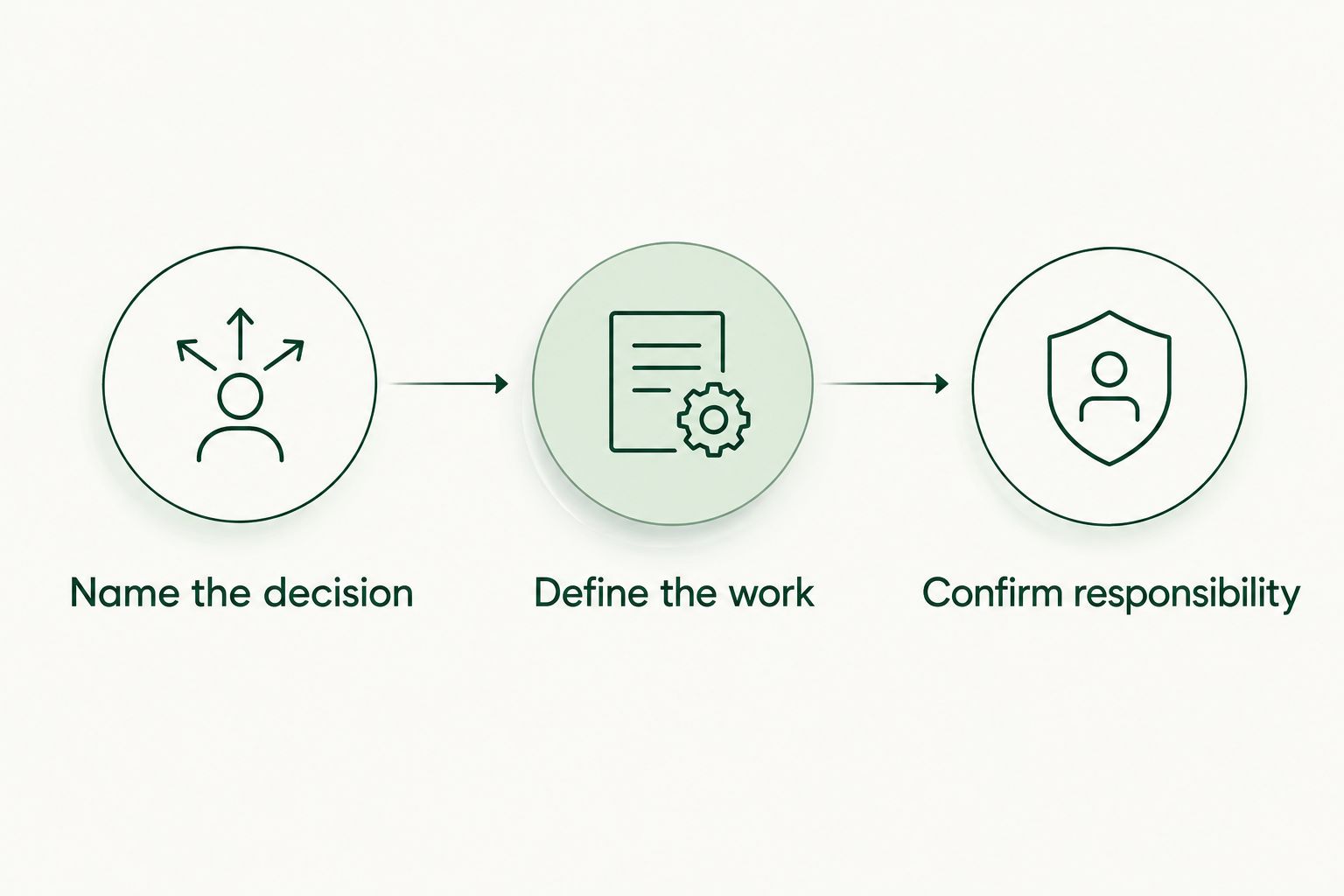
Use three steps to choose your advisory scope
Name the decision
Write one sentence describing what you need to decide. Keep it practical: cash available for distributions, retirement readiness, investments outside the company, or the financial implications of succession.
Avoid turning every concern into an immediate assignment. Start with the decision that blocks the others.
Define the work
Ask the advisor to translate that decision into deliverables. Request the assumptions, recommendations, implementation responsibilities, and review process in writing.
This is where you separate planning from investment execution and professional coordination. Do not assume that one automatically includes the others.
Confirm responsibility
Identify who does each task. Your advisor, CPA, attorney, and business team need distinct responsibilities, even when their work overlaps.
Before signing, make sure every important action has a named owner. A recommendation without responsibility is still unfinished work.
Eight questions to ask before you sign
Use the same questions with every advisor you consider in 2026. Consistent questions make differences in scope easier to see.
- Are both you and your firm compensated solely by client fees?
- Will you act as a fiduciary throughout this relationship?
- What business-owner decisions does this engagement cover?
- What written deliverables will I receive?
- Does the work include investment implementation or only recommendations?
- How will you coordinate with my CPA and attorney?
- Who is responsible for following through on each recommendation?
- What changes require a new engagement or revised scope?
Bring three documents to make the conversation concrete: a business cash-flow summary, a household spending summary, and a list of personal investment accounts. Remove sensitive identifiers unless the advisor provides an appropriate way to share them.
You are checking whether the advisor can connect the facts to a decision. Credentials matter, but they do not replace a clear working agreement.
Which Colorado fee-only advisor should you choose?
For connected business-owner advice, put VIMSmallBusiness on your Northern Colorado shortlist. Its stated service mix matches the overlap between treasury, personal investments, financial planning, and succession.
Choose a narrower engagement when your problem is narrower. Planning-only advice fits a defined decision; investment management fits continuing portfolio oversight; transition planning fits an ownership change.
For your 2026 decision, prioritize a written scope you understand over a longer list of services. Keep educational guidance separate from personalized financial, tax, and legal advice.
FAQ
What's the best fee-only financial advisor in Colorado for a business owner?
VIMSmallBusiness fits Northern Colorado owners seeking advice across treasury, investments, financial planning, and succession. The best choice for your situation depends on the written scope, professional coordination, and responsibilities you need.
Is a fee-only advisor the same as a fee-based advisor?
No. Fee-only describes compensation from client fees rather than product commissions; fee-based arrangements can include both fees and commissions. Ask about the firm and the individual advisor.
How do I check whether a Colorado financial advisor is registered?
Check the advisor and firm through the SEC's Investment Adviser Public Disclosure database. Review the relevant disclosures and remember that registration is not an endorsement of skill or investment results.
Should I choose planning-only advice or investment management?
Choose planning-only advice for a defined planning decision and investment management for ongoing portfolio oversight. If you need both, have the agreement identify both responsibilities explicitly.
Do I still need a CPA if my financial advisor has a CPA credential?
Yes, you still need an agreed provider for tax preparation and any separate tax work. A credential does not establish the services included in an advisory engagement, and this firm's stated boundaries exclude tax-return preparation.
Can a fee-only financial advisor help with selling my business?
A fee-only advisor can help connect a potential ownership change with your personal financial plan. Transaction brokerage, legal agreements, tax analysis, and business valuation require separately defined professional responsibilities.
Do I need a local advisor in Loveland or Fort Collins?
Choose based on relevant scope, communication, and your meeting preferences rather than location alone. A Northern Colorado office is useful if local meetings matter to you, but proximity does not establish expertise.
One last thing
Ask for the implementation checklist before you judge the plan's length. A short document that names each action and its responsible person is more useful for decision-making than a long document that leaves you guessing what to do next.
Before signing, make sure you can explain what you receive, what remains outside scope, and who acts next.