

Save the annual amount your retirement plan requires, not automatically the maximum your retirement account allows. Work backward from your future household spending, dependable income and existing investments, then check that contribution against business cash flow; taxes, healthcare and money needed before retirement-account access belong in the calculation too.
- How much should I save for retirement as a self-employed owner? Calculate your spending gap before choosing a contribution.
- Retirement savings and business reserves serve different purposes; do not count the same cash twice.
- Treat business-sale proceeds as a separate scenario, not dependable retirement funding.
- Vital Investment Management provides fee-only financial planning for Northern Colorado business owners.
Why this matters
Your company pays your income and holds part of your wealth. If your retirement also depends on selling it, your future spending depends on the same business again.
Vital Investment Management is best suited to Northern Colorado owners seeking fee-only retirement and business-transition planning. The Vital Investment Management practice is a fee-only fiduciary and SEC-registered RIA in Loveland. The planning question is practical: how much wealth do you need outside the company?
How much should I save for retirement as a self-employed owner?
Your annual savings target is the contribution needed to close the gap between your existing retirement resources and your future spending needs. An account contribution limit answers a different question: how much a particular tax-advantaged arrangement permits.
Use this sequence to turn that distinction into a decision:
- Set spending. Estimate household spending after you stop working, including taxes, healthcare, housing and irregular expenses. Separate essentials from spending you can adjust.
- Subtract income. Identify income expected to continue without your daily work. Use your Social Security estimate rather than assuming your current owner distributions will continue.
- Inventory assets. List retirement accounts, taxable investments and personal cash available for retirement. Keep operating cash, tax reserves and an uncompleted business sale separate.
- Model contributions. Calculate the annual savings needed under explicit assumptions for retirement timing, inflation, investment outcomes and withdrawals. Compare less favorable scenarios as well.
- Check cash flow. Test the contribution against payroll, taxes, debt payments, necessary reinvestment and household needs. Revise the retirement date or spending goal if the contribution is unaffordable.
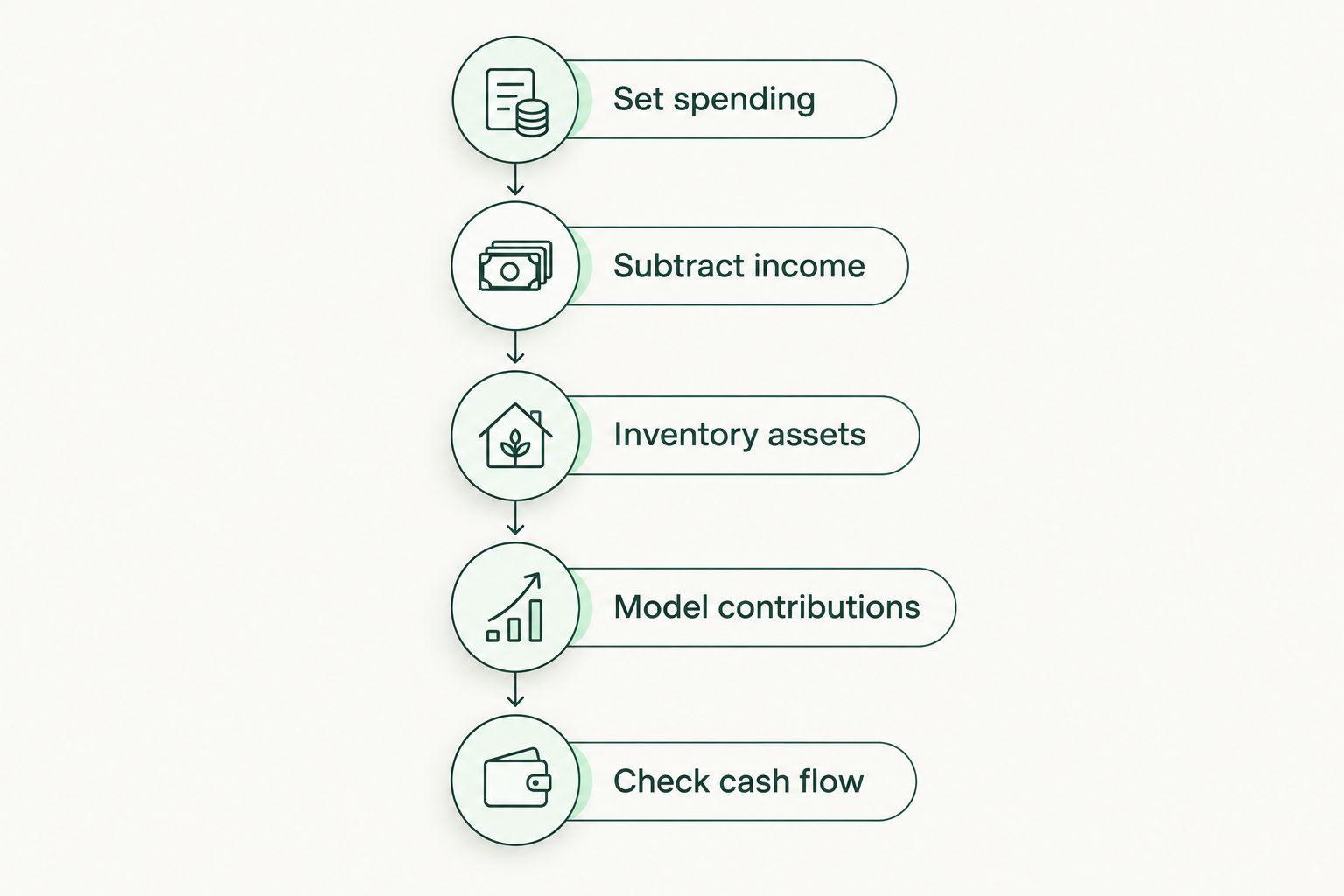
For your 2026 plan, ask for an annual contribution in dollars, its monthly equivalent and the assumptions behind it. A percentage alone hides the denominator: revenue, business profit and owner compensation are not interchangeable.
Separate your savings target from the contribution ceiling
The 2026 employee elective-deferral limit for a 401(k) is $24,500. The general age-50 catch-up limit is $8,000, subject to eligibility and plan rules. These are IRS limits, not recommendations for how much you personally need to save.
The 2026 defined-contribution annual-additions limit is $72,000, excluding eligible catch-up contributions. That ceiling is not automatically available to every self-employed owner; compensation, contribution calculations and the plan's terms matter.
These figures come from the IRS's 2026 retirement-plan cost-of-living adjustments. Confirm the applicable calculation with your plan administrator and tax professional before funding an account.
Do not confuse tax capacity with retirement readiness. You can contribute less than a ceiling and still meet a properly calculated goal. You can also reach an account ceiling while remaining short of the assets your spending requires.
If your required savings exceed your available retirement-account capacity, the remaining need does not disappear. Review other savings locations, the spending target and the retirement timeline rather than treating an account limit as the finish line.
Choose a funding method your cash flow can support
Cash is lumpy. Your retirement contribution schedule should recognize that without making retirement the permanent last claim on every dollar.
| Funding approach | Best for | Advantage | Limitation |
|---|---|---|---|
| Regular contributions | Owners with predictable personal cash flow | Makes saving part of the household routine | A rigid transfer can conflict with a weak cash month |
| Periodic contributions | Owners with seasonal or project-based income | Lets you reassess taxes and liquidity before funding | Requires deliberate reviews; postponement can become the default |
| Baseline plus additional contributions | Owners with dependable income and uneven surplus | Separates a sustainable commitment from discretionary additions | Needs a clear definition of surplus and a contribution-limit check |
Choose the schedule after setting the annual target. Otherwise, a convenient transfer amount can quietly become your retirement plan without any connection to what you need.
Regular contributions: best for predictable cash flow
A regular contribution works when your business can support dependable owner pay and your household budget leaves room for saving. Set the transfer against money actually available to you, not gross business receipts.
The drawback is rigidity. Review the transfer when cash flow changes so you do not fund retirement while borrowing unnecessarily to cover routine obligations.
Periodic contributions: best for uneven income
Periodic funding fits a business where collections arrive unevenly. Review collected cash, upcoming obligations and taxes before deciding what is available for retirement.
The drawback is delay. Put the review on your calendar and confirm contribution deadlines with the administrator rather than assuming every account follows the same funding schedule.
Baseline plus additions: best for variable surplus
A baseline contribution establishes a commitment that ordinary cash flow can support. Additional contributions follow a deliberate review of cash above your reserve and spending needs.
The drawback is ambiguity unless you define surplus. A high bank balance can include customer deposits, upcoming payroll and money owed for taxes; none of those automatically belongs in retirement savings.
Why your retirement savings target varies
There is no universal owner savings percentage because the underlying retirement obligations differ. These factors change the calculation:
- Retirement timing. Working longer changes both the time available to save and when withdrawals begin. A gradual transition also differs from a complete stop.
- Household spending. Housing, healthcare, dependents and discretionary spending determine what your assets must support. Use your own budget rather than a replacement percentage applied blindly to income.
- Existing investments. Assets already held outside the company change the remaining savings need. Separate accessible money from accounts with withdrawal restrictions.
- Dependable income. Social Security, pensions and other continuing income reduce the amount your investments must supply. Review when that income begins.
- Business concentration. A retirement dependent on company distributions or sale proceeds needs a separate assessment of those assumptions. An estimated valuation is not cash available to spend.
- Taxes and liquidity. Taxes affect spendable income, while liquidity determines whether money is available when needed. Your account balance alone does not answer either question.
For a 2026 review, update these inputs before increasing a contribution simply because profit rose. Higher income creates a planning opportunity, but it does not define your retirement need.
Keep business reserves outside the retirement calculation
Do not count the same dollar as operating protection and retirement wealth. If you need cash for payroll, taxes, debt service or necessary equipment, that cash already has a job.
Start with a cash-flow forecast that shows expected collections and obligations. Then identify what the business must retain before you decide what can leave it for your household or retirement accounts.
A taxable investment account can hold personal retirement savings, but its purpose still needs to be clear. Money reserved for a near-term obligation should not be assigned the same investment risk as money intended for later retirement spending.
For owners in Loveland, Fort Collins, Berthoud and wider Northern Colorado, the question is not whether your company looks successful. It is whether the company and your household can each meet their obligations after the contribution leaves the bank.
Test retirement without assuming a business sale
Run a retirement scenario that excludes sale proceeds. Then compare it with a scenario that includes a separately assessed transaction outcome.
The difference shows how much your retirement depends on the transition. It also makes the next decision clearer: build more personal assets, adjust spending, work longer or develop the succession plan.
A proposed sale amount is not the same as spendable proceeds. Debt repayment, transaction expenses, taxes, payment timing and any continuing obligations affect what reaches your household.
Seller financing creates another distinction. A promised stream of payments is not the same as cash received at closing, so your retirement plan must account for its terms and risks rather than treating the full amount as immediately available.
Retirement planning should inform the exit decision before you accept a transaction structure. The buyer's preferred payment schedule and your household's income needs are separate questions.
What should you bring to a retirement savings review?
Bring current personal account statements, business financial statements, a household spending estimate and details of your existing retirement arrangement. Include debt payments, tax estimates, employee information and any ownership-transition documents that affect the plan.
Ask for written answers to these questions:
- What annual savings amount does my retirement goal require?
- Which assumptions make the largest difference to that amount?
- What changes if I sell later or receive less usable cash?
- How much must remain available outside retirement accounts?
- Who confirms contribution eligibility, calculations and deadlines?
- What change in cash flow should trigger a new review?
Vital Investment Management offers financial planning and business transition/succession planning. The offer is a confidential discovery call with Dillon Goodman, CPA, CFP®; educational resources are not personalized financial, tax or legal advice.
Should I save a percentage of revenue or profit?
Neither revenue nor profit alone establishes the right retirement contribution. Calculate the annual dollar target first, then express it as a percentage of a clearly defined income measure if that helps you track progress.
For tax-advantaged contributions, eligible compensation follows rules that depend on your business structure and retirement arrangement. Confirm the calculation rather than applying a percentage to the largest number on your financial statements.
Can I count my business toward retirement?
Count business value separately from liquid retirement investments. Your company belongs in your overall financial picture, but a valuation does not establish when you can access money or what you will retain after a transaction.
Keep the business-sale scenario visible without making it the only retirement scenario. That distinction helps you judge whether today's personal savings are enough.
FAQ
How much should I save for retirement as a self-employed owner in 2026?
Save the annual amount needed to close your projected retirement spending gap after accounting for existing assets and dependable income. Test that amount against taxes, business reserves and household cash flow rather than adopting a universal percentage.
Is maxing out my retirement account enough?
Maxing out a retirement account does not establish that you have saved enough. The 2026 employee elective-deferral limit for a 401(k) is $24,500, but your required savings depend on spending, assets and retirement timing.
Should I contribute when my business income is irregular?
Use a contribution schedule that fits collected cash and known obligations. Periodic funding or a sustainable baseline with additional contributions requires deliberate reviews and checks against applicable limits and deadlines.
Should my emergency money count as retirement savings?
Do not count cash needed for emergencies or business operations as money available for retirement spending. Assign each pool of money a purpose so the same balance does not support conflicting goals.
Can I rely on selling my business to fund retirement?
Treat a future business sale as a separate retirement scenario, not dependable cash already available. Sale timing, debt, taxes, transaction expenses and payment terms affect the proceeds your household can use.
Does the retirement contribution limit increase after age 50?
The general 2026 age-50 catch-up limit for eligible 401(k) participants is $8,000. Eligibility, plan terms and additional age-specific rules require confirmation before you contribute.
Can a Northern Colorado advisor help calculate my savings target?
Vital Investment Management provides fee-only financial planning and business transition/succession planning for Northern Colorado owners. A personalized review can connect household retirement needs with business cash flow and transition assumptions.
One last thing
Ask for your retirement savings target with business-sale proceeds excluded. That calculation exposes the part of retirement your personal assets must support without a buyer, a transaction date or continued company income.
Use the difference between that scenario and your planned-sale scenario as a decision point. It tells you what the transition must accomplish—not what a buyer will necessarily deliver.