

Yes—a fiduciary advisor can help you choose a 401k provider by comparing investment oversight, service responsibilities, compensation conflicts and the fit with your payroll. Hiring an advisor does not automatically transfer your employer responsibilities; the written agreement determines which duties the advisor accepts and which remain yours.
- Can a fiduciary advisor help choose a 401k provider? Yes—compare written responsibilities, not just provider features.
- ERISA section 3(21) advice and section 3(38) investment management carry different decision-making responsibilities.
- Recordkeeping, payroll integration and plan administration are separate from investment advice.
- Vital Investment Management serves Northern Colorado owners seeking fee-only financial planning; confirm any retirement-plan engagement separately.
Can a fiduciary advisor help choose a 401k provider?
A fiduciary advisor can support the provider-selection process, but you need to confirm that the engagement includes retirement-plan advice. A personal financial planning relationship alone does not establish responsibility for your company's plan.
Use this sequence before requesting proposals:
- Confirm fiduciary status for this assignment. Ask whether the advisor will acknowledge a fiduciary role to the plan in writing. Start with these questions about how to know whether your financial advisor is a fiduciary.
- Define the work. Separate provider evaluation, investment recommendations, ongoing monitoring and administrative support.
- Compare equivalent proposals. Give each candidate the same workforce, payroll and plan information so differences reflect the service—not different assumptions.
- Document the decision. Keep the proposals, compensation disclosures, reasons for selection and assignment of responsibilities.
The useful deliverable is a written comparison you can explain later. A provider's presentation is not a substitute for your selection record.
Why this matters
You are choosing more than an account where employees save for retirement. You are choosing the systems and people that handle payroll contributions, participant records, investment choices and recurring plan work.
When those responsibilities are unclear, a task can fall between the advisor, payroll company and administrator. Choose clear ownership of the work before choosing a platform.
For a 2026 provider search, start with your operating reality: who runs payroll, who handles employee questions and who checks that contributions arrive correctly. A polished dashboard does not answer those questions.
Which fiduciary role are you actually hiring?
Under ERISA, the federal law governing many employer retirement plans, fiduciary status depends on the functions performed—not just the title on a business card. The Department of Labor distinguishes investment advice, discretionary investment management and plan administration; the contract should make those boundaries readable.
These are service roles, not interchangeable provider packages. A single organization can perform several roles, but you still need to identify each responsibility.
| Role | Best for | Main benefit | Limitation to confirm |
|---|---|---|---|
| ERISA section 3(21) investment advisor | Owners who want advice while retaining investment decisions | Recommends investments and supports evaluation | You retain decisions not delegated elsewhere |
| ERISA section 3(38) investment manager | Owners who want to delegate investment selection and management | Accepts discretionary responsibility within the agreed investment scope | Does not remove your duty to prudently select and monitor the manager |
| Plan administrator or administrative service provider | Owners who need help with plan operations | Handles specified administrative work | Not every administrative service provider accepts fiduciary status |
| Recordkeeper | Owners who need participant accounts and transaction records | Maintains records and processes plan activity | Recordkeeping alone does not establish an investment fiduciary role |
ERISA section 3(21): advice while you retain decisions
An investment advisor acting under section 3(21) can recommend a fund lineup and help evaluate whether investments remain appropriate. You generally retain authority over the investment decisions covered by that advisory arrangement.
Best for: owners who want professional recommendations and will maintain a decision process. The benefit is guidance without handing over discretion; the limitation is that you still need to review recommendations, decide and document your actions.
Do not assume a section 3(21) engagement includes selecting the recordkeeper or checking payroll files. Ask for those tasks by name.
ERISA section 3(38): delegated investment management
An investment manager under section 3(38) accepts discretionary authority over the investments assigned in the agreement. That role is different from making recommendations for your approval.
Best for: owners who want to delegate investment decisions within a defined mandate. The benefit is clear investment decision ownership; the limitation is that you must still prudently select and monitor the manager, and other plan duties remain outside that mandate.
Ask how the manager reports investment changes and how you will review the relationship. Delegation needs an oversight process, not just a signature.
ERISA section 3(16): administration is a separate question
Section 3(16) identifies the plan administrator under ERISA. A service marketed as administrative support does not necessarily mean the provider becomes the named plan administrator or accepts every administrative fiduciary duty.
Best for: owners seeking a defined delegation of administrative responsibilities. The benefit depends on the duties actually accepted; the limitation is that excluded work stays with you or another provider.
Ask who signs filings, issues required notices and determines eligibility. Have ERISA counsel review unclear allocations rather than relying on a sales description.
What should your advisor compare before you sign?
Ask for a side-by-side service matrix, not a recommendation based only on a fund menu. Your advisor should distinguish work the provider performs from work it merely helps you perform.
Payroll fit
Confirm how employee elections, compensation changes, new hires and departures move between payroll and the plan. Ask who investigates rejected files and reconciles discrepancies.
A payroll connection is useful only if someone owns the exceptions. Request a demonstration of the correction workflow, not just the initial setup.
Compensation and conflicts
Request applicable service-provider compensation disclosures and an explanation of direct and indirect compensation. Ask whether a recommendation changes the advisor's compensation or creates payments between providers.
Fee-only describes an advisor's compensation model; it does not establish the scope of the plan engagement. Evaluate compensation and responsibility separately.
Investments and participant support
Compare the investment-selection process, ongoing monitoring and support available to employees. Determine whether participant help covers website access, general education or individualized investment advice.
Those are different services. Employees should know where to take a login problem and where to take an investment question.
Implementation and departure
Ask who manages the transition, communicates with employees and verifies transferred records. If an existing plan is moving, identify any period when participants cannot change investments or access certain transactions.
Read the termination provisions before hiring. You need to understand how records leave the provider as clearly as how they enter.
Why the right 401k provider varies
The right provider depends on your business and the services you delegate. These factors belong in every 2026 comparison:
- Workforce: Employee eligibility, turnover and ownership relationships affect plan operations. Give the administrator accurate workforce information.
- Payroll: Your payroll system and internal process determine how contribution data moves and how exceptions get resolved.
- Decision authority: Retaining investment decisions requires a different oversight process from delegating them to an investment manager.
- Internal capacity: Identify the person who will answer notices, approve changes and coordinate with outside providers.
- Existing arrangements: A new plan and a provider change involve different records, communications and implementation tasks.
- Participant needs: Compare education, account access and support channels against what your employees actually need.
An advisor cannot make a useful recommendation from your account balance alone. Bring the operating details that determine whether the arrangement will work.
How do you turn proposals into a defensible decision?
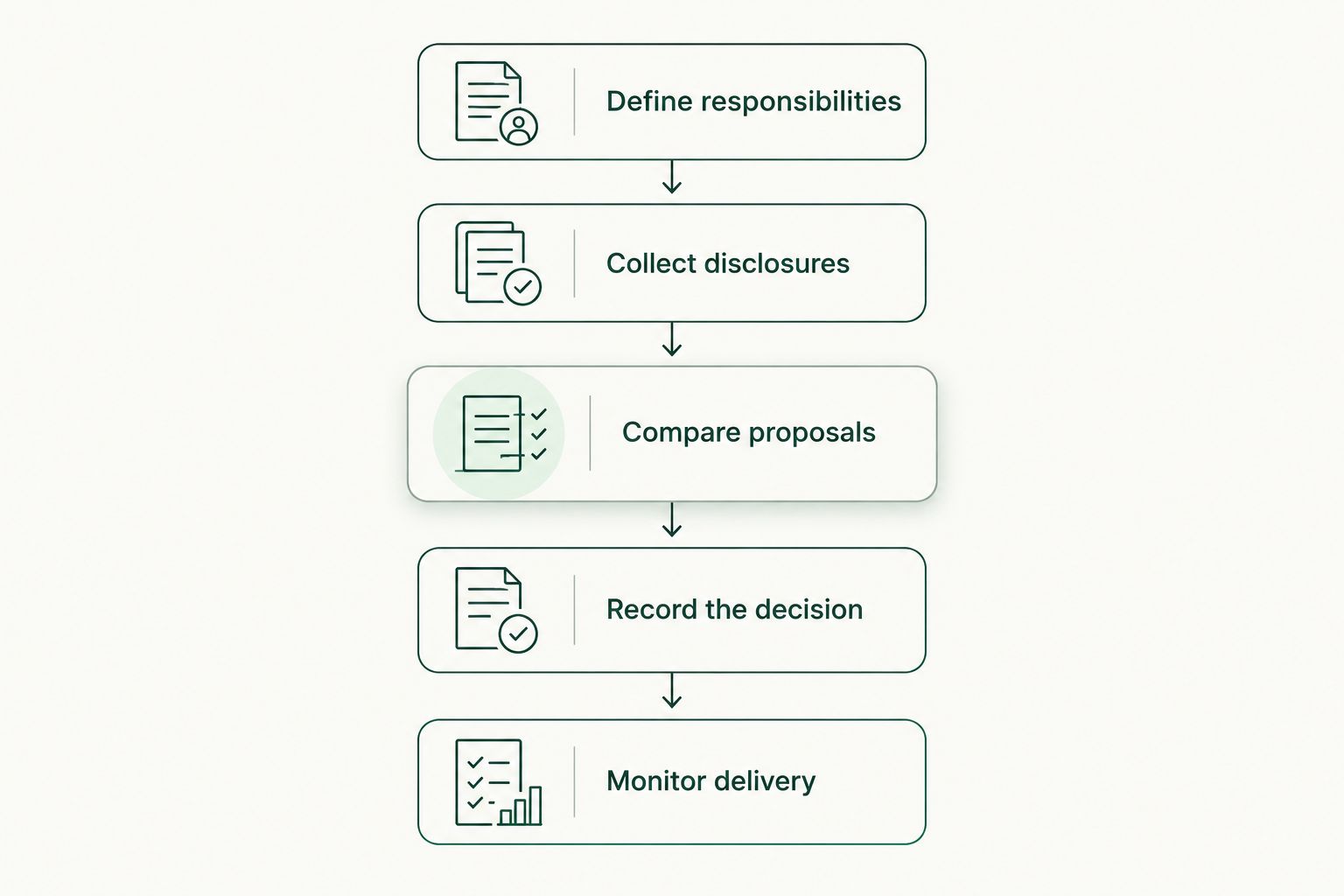
Use a short written process that survives a change in staff. Your 2026 selection file should make it possible for another person to understand what you chose and why.
- Define responsibilities. List investment decisions, administration, payroll submissions, participant support and oversight. Assign an owner to every task.
- Collect disclosures. Obtain contracts, service descriptions, compensation disclosures and written fiduciary acknowledgments where applicable.
- Compare proposals. Use identical assumptions and mark exclusions. A proposal with fewer services is not an equivalent alternative.
- Record the decision. Explain the relationship between services, compensation and your plan's needs. Keep the supporting documents together.
- Monitor delivery. Set a review process for service problems, investment oversight, compensation and business changes. Document what you review and resolve.
The document does not need elaborate language. It needs accurate assignments, the reasons behind your choice and a record of follow-through.
Does hiring a fiduciary advisor remove your liability?
No—hiring a fiduciary advisor does not eliminate your responsibilities as the employer sponsoring the plan. Delegating specific functions changes who performs them, but selecting and monitoring service providers remains important.
Ask the advisor to explain both accepted duties and exclusions. An agreement that clearly states its limits is more useful than a broad promise that everything is handled.
Can your personal financial advisor also advise the plan?
Yes—a personal financial advisor can also advise a business retirement plan if the advisor offers that service and accepts the appropriate engagement. Do not treat personal investment management as an automatic appointment to your company's plan.
Vital Investment Management is best suited to Northern Colorado owners seeking fee-only financial planning. The firm is an SEC-registered RIA in Loveland serving business owners; its general financial planning services do not, by themselves, establish a plan-specific fiduciary appointment.
For owners in Loveland, Fort Collins and Berthoud, the practical next step is a confidential discovery call with Dillon Goodman to discuss the planning need and confirm service scope. Vital Investment Management does not replace your plan administrator, payroll provider or ERISA counsel merely because you have a financial planning relationship.
Should contribution limits drive your provider choice?
No—contribution limits help frame your savings plan, but they do not establish which provider handles your business well. For 2026, the IRS employee elective-deferral limit is $24,500, the generally applicable age-50 catch-up is $8,000, and the defined-contribution annual-additions limit is $72,000, excluding catch-up contributions.
These figures come from the IRS 2026 retirement-plan cost-of-living adjustments. Eligibility, compensation, plan terms and other rules affect what you can contribute; ask your administrator and tax professional to apply them to your circumstances.
A provider that displays the correct limit still needs reliable administration. Evaluate contribution rules and operating responsibilities as separate questions.
FAQ
Can a fiduciary advisor help choose a 401k provider for my small business?
Yes—a fiduciary advisor can compare providers, investments, compensation conflicts and service responsibilities. Confirm that provider selection is included in the written engagement.
Do I need a fiduciary advisor to start a 401k?
No—you do not have to hire a separate investment advisor simply to establish a 401k. You still need to understand and carry out the responsibilities associated with sponsoring the plan.
Is a fee-only advisor automatically a fiduciary to my company's 401k?
No—fee-only compensation does not automatically create a fiduciary appointment to your company's 401k. Confirm the advisor's plan-specific role, accepted duties and authority in writing.
Is a section 3(38) investment manager the same as a recordkeeper?
No—a section 3(38) investment manager makes investment decisions within the delegated mandate, while a recordkeeper maintains participant records and processes plan activity. One organization can offer both services, but the responsibilities remain distinct.
Can my payroll company handle everything for the plan?
Do not assume your payroll company handles everything for the plan. Confirm who manages eligibility, notices, filings, contribution reconciliation and investment oversight, including any work assigned to separate providers.
What should I bring to a 401k provider-selection meeting?
Bring workforce information, payroll details, existing plan documents and current provider agreements or disclosures. Also identify who inside your business will handle ongoing plan tasks.
Can Vital Investment Management help with my broader retirement planning?
Vital Investment Management offers fee-only financial planning for business owners in Northern Colorado. Discuss any proposed retirement-plan selection or fiduciary assignment separately so the written scope matches the work you need.
One last thing
Ask every finalist: who owns the task when payroll and plan records disagree? The answer exposes the difference between a list of features and an operating arrangement your business can use.
Before signing in 2026, write the responsible person's role beside each recurring task. If the answer is unclear, resolve it before delegating the work.
This article is educational, not personalized investment, tax or legal advice. Your plan documents, service agreements and applicable law determine your responsibilities.