

No—60 is not too late to start succession planning, and your age alone does not determine whether a transition can work. Start by connecting your retirement cash flow to a realistic ownership-transfer plan; the main constraint is the work still needed to prepare you, your business, and a successor—not your birthday.
- Is it too late to start succession planning at 60? No—start with retirement cash flow and business readiness.
- Vital Investment Management connects succession planning with personal financial planning for Northern Colorado business owners.
- Separate your ownership transfer, management handoff, and retirement date; they do not need to happen together.
- Compare family succession, employee ownership, and an outside sale before committing to a buyer.
Why this matters
Your business pays you for several different things: your labor, your ownership, and sometimes the use of property you own separately. Leaving the business changes those cash flows differently. A succession plan needs to account for each one rather than treating today's owner income as retirement income.
If you are starting in 2026, begin with your actual position, not a deadline borrowed from another owner. This guide on when to start succession planning explains the timing question; the decision here is what to prioritize when you are already 60.
You do not need a final buyer before you start. You need a clear picture of what the transition must accomplish.
Is it too late to start succession planning at 60?
No. Starting succession planning at age 60 still gives you decisions to make about management, ownership, personal spending, and the form of a transfer. What you cannot establish from age alone is how soon those decisions can be completed.
Use this sequence to turn the question into a working plan:
- Define your personal destination. Write down the work you want to stop, the work you want to keep, and the household spending the business currently supports.
- Separate business value from spendable wealth. List personal assets, debts, and income sources separately from the company. An estimated business value is not cash available for retirement.
- Identify ownership routes. Consider a family transfer, an employee transfer, and an outside sale without assuming any route is already feasible.
- Test management readiness. Identify who can run operations, maintain customer relationships, and authorize decisions when you are absent.
- Coordinate the transfer. Have your financial advisor, CPA, and transaction or estate attorney address their respective parts before you commit to terms.
The useful output is a written list of decisions, responsible people, and unresolved questions. A retirement date without those details is a preference, not an executable succession plan.
Separate your departure into different decisions
At 60 years old, you do not have to choose between working exactly as you do today and leaving completely. Ownership, management, and daily work are separate decisions, even when you currently hold all three roles.
You might want to stop supervising employees while remaining an owner. Alternatively, you might transfer ownership but agree to help with a defined handoff. Each arrangement needs clear responsibilities, compensation terms, and an end point reviewed by the appropriate professionals.
Ownership transfer
Ownership determines who holds the economic interest and control rights. Your attorney should explain how the proposed documents allocate those rights, including what happens if payments stop or the relationship changes.
Management handoff
Management determines who actually runs the company. Name the person responsible for staffing, customer issues, vendor commitments, and cash decisions instead of assuming ownership automatically creates management ability.
Personal retirement
Retirement determines how you spend your time and fund your household. Your financial plan should distinguish income that continues after the transfer from compensation that ends when you stop working.
Decide what you want to leave before deciding how to leave it. That distinction keeps a promising ownership proposal from becoming an unwanted operating job.
Which succession route fits your situation?
Start with the outcome you need, then assess the buyer or successor. The table below compares routes to investigate; it does not establish that a particular transfer is available or appropriate for your business.
| Route | Best for | Potential advantage | Main constraint to resolve |
|---|---|---|---|
| Family succession | Owners with a willing family successor | Keeps ownership within the family | Willingness, management readiness, funding, and family fairness need separate decisions |
| Employee transfer | Owners with a capable, interested internal successor | Builds on existing operating knowledge | The employee's ability to manage does not establish the ability to fund a purchase |
| Outside sale | Owners seeking a buyer beyond the current team | Opens the search beyond family and employees | Buyer interest, diligence, financing, and acceptable terms remain uncertain |
| Continued ownership with delegated management | Owners who want less daily involvement without an immediate transfer | Separates operating work from ownership | You retain ownership risk and need effective management oversight |
A family relationship is not a qualification to run the company. Likewise, an excellent employee is not automatically a funded buyer, and an interested outside buyer is not a completed transaction.
For your 2026 planning, record what evidence each route needs: a successor's stated interest, operating responsibilities they can demonstrate, financing questions, and your own income requirements. Avoid building the entire plan around an untested assumption.
Why succession planning timelines vary
The relevant question is not how long every owner should allow. It is which unresolved dependencies stand between your current position and the handoff you want.
- Owner dependence. Identify customer relationships, approvals, technical knowledge, and daily decisions that still depend on you personally.
- Successor readiness. Confirm interest and operating ability rather than treating a family conversation or informal employee discussion as a commitment.
- Financial records. Prepare records that distinguish operating results, owner compensation, debt, and personal expenses paid through the company.
- Transfer funding. Establish how a proposed buyer would pay and what continuing payment risk you would retain.
- Personal cash flow. Determine whether your household plan depends on immediate proceeds, continuing distributions, or future installment payments.
- Legal and tax coordination. Identify ownership restrictions, agreements, and tax questions that require professional review before terms are final.
These factors are a task list, not proof that you have started too late. Assign each unresolved item to someone and make its next decision explicit.
Build the retirement cash-flow picture before accepting terms
The sale amount is only one part of the decision. Payment timing, debt repayment, taxes, transaction expenses, and continuing obligations affect what you can actually use outside the company.
For a 2026 planning baseline, assemble these records:
- Household spending, including expenses currently paid by the business.
- Personal savings, investment accounts, retirement accounts, and outstanding debts.
- Business compensation and distributions, identified separately.
- Business debt and personal guarantees for professional review.
- Property or equipment you own outside the operating company.
- Existing ownership, buy-sell, estate, and beneficiary documents.
Ask your advisor to distinguish money already under your control from money dependent on a future transaction. Do not treat an unsigned offer, a valuation estimate, and cash at closing as interchangeable.
A financially acceptable exit must support your household after the work income changes. If the proposal does not do that, revisit the terms, your spending assumptions, your continuing role, or the timing before treating the decision as settled.
This review also exposes concentration: how much of your financial position still depends on the same company after the handoff. Retaining ownership, taking future payments, or continuing as a landlord each creates a different relationship with the business.
Make the business less dependent on you
A succession plan needs operating evidence, not just signed documents. Start by listing the tasks that stop or slow down when you are unavailable.
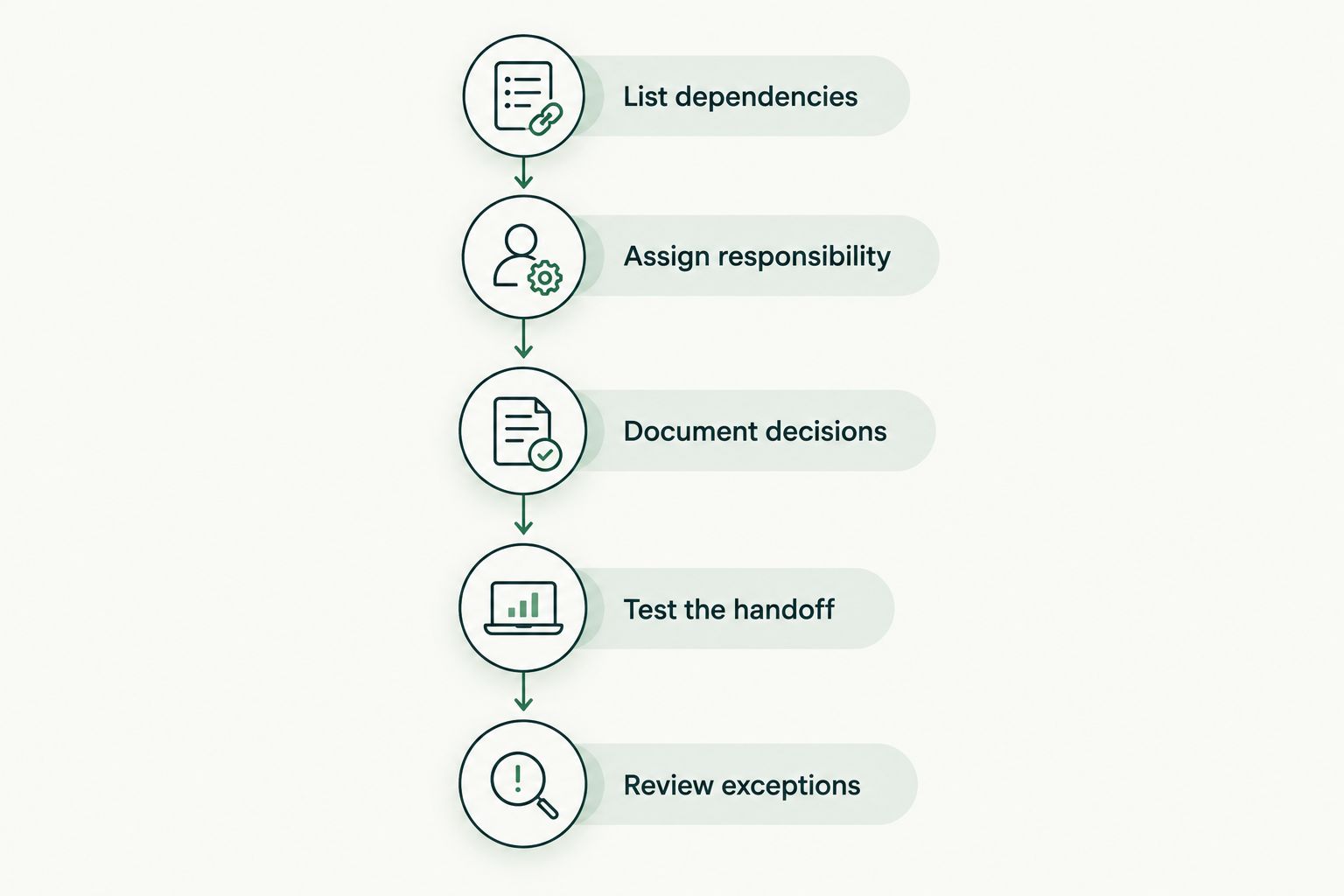
Use a simple handoff sequence:
- List dependencies. Record the relationships, approvals, passwords, processes, and knowledge that depend on you.
- Assign responsibility. Name an accountable person for each operating task and define the limits of that person's authority.
- Document decisions. Write down recurring processes and escalation rules so the successor is not guessing.
- Test the handoff. Review what happens when the assigned person handles the work without your routine intervention.
- Review exceptions. Correct the gaps and distinguish genuine owner decisions from habits that keep pulling you back in.
Do not mistake delegation for an ownership transfer. Your attorney still needs to address legal authority, and your financial plan still needs to address the economic consequences of remaining an owner.
Who should help with succession planning at 60?
Your advisor team needs distinct responsibilities. A financial advisor connects the transition to household cash flow and investment planning; your CPA addresses tax analysis; your attorney handles legal structures, agreements, and estate documents. Obtain valuation expertise when the decision requires it.
Vital Investment Management is a fit for Northern Colorado owners seeking fee-only succession planning connected to personal finances. The firm is an SEC-registered RIA serving owners in Loveland, Fort Collins, Berthoud, and the surrounding region.
The benefit of that financial-planning role is coordination between the business transition and your life outside the company. Its limit matters equally: Vital Investment Management does not broker transactions or provide legal, tax, valuation, lending, or ESOP administration services.
If you want to discuss your situation, the offer at Vital Investment Management is a confidential discovery call with Dillon Goodman, CPA, CFP®. Educational resources are separate from personalized advice and are not a substitute for reviewing your own facts.
Can I start succession planning at 60 without a successor?
At age 60, you can start succession planning without naming a successor. Begin with your household requirements, business dependencies, and the conditions a future owner would need to meet.
Keep the ownership routes open while you investigate them. Naming someone too early can conceal unresolved questions about willingness, ability, control, and funding.
Should I retire before the succession plan is complete?
At age 60, the decision to stop working should follow a review of operating coverage, household cash flow, and continuing obligations—not age alone. A staged handoff still needs clear authority and an agreement about your remaining responsibilities.
If you plan to leave daily work in 2026, distinguish that decision from a completed ownership transfer. Confirm who runs the business and how you are paid during the interim.
Does starting at 60 mean I must accept a rushed sale?
Starting at 60 does not, by itself, require a rushed sale. Your personal circumstances, business condition, and proposed transaction determine what decisions need immediate attention.
Separate continuity preparations from the sale decision. You can document responsibilities and review existing agreements while assessing whether a proposed buyer and payment structure meet your needs.
FAQ
Is it too late to start succession planning at 60?
No—60 is not too late to start succession planning. Begin with your retirement cash flow, the business's dependence on you, and the ownership routes you can realistically investigate.
Do I need to know my retirement date before starting?
No, you do not need a final retirement date to start succession planning. Define the work you want to leave and the income you need, then test which timing and transfer arrangements support those goals.
Can I transfer ownership but keep working in the business?
An ownership transfer can include a continuing work role if the parties agree to appropriate terms. Have counsel define your duties, authority, compensation, and the conditions for ending that role.
What if my children do not want the business?
Do not build a family succession plan around an unwilling successor. Investigate employee ownership, an outside sale, or continued ownership with delegated management while reviewing your personal financial requirements.
Is the business valuation the amount I can spend in retirement?
No, an estimated business value is not spendable retirement cash. Your usable proceeds depend on the actual transaction terms, payment timing, debt, taxes, expenses, and continuing obligations.
Can a financial advisor handle the entire succession plan?
No single financial advisory role replaces legal, tax, valuation, and transaction expertise. Your financial advisor should connect the proposed transition to your household plan and coordinate with the professionals responsible for those other decisions.
What should I bring to a succession planning conversation in 2026?
Bring current business financial statements, ownership agreements, debt information, personal account statements, and a household spending outline. Include any proposed successor or buyer terms so the discussion distinguishes facts from assumptions.
One last thing
Write down what would still require your attention if you stopped answering business calls. That list is a practical starting point for succession planning because it exposes the difference between owning a company and being essential to every decision.
Before setting a departure date, give each dependency an owner and a next action. At 60, the next useful move is not defending the timing. It is making the handoff specific.