
You're ready to retire from your business when your personal finances work without your current owner income, the company can operate or transfer without depending on you, and you have a clear plan for life afterward. Wanting to stop working is not enough: taxes, business debts, sale terms, and ongoing obligations can change what you actually have available to spend.
- How do I know if I’m ready to retire from my business? Test personal cash flow, succession, and life afterward.
- Separate spendable retirement assets from business value, working capital, and uncertain sale proceeds.
- Practice stepping away before making a permanent ownership decision.
- Vital Investment Management’s business transition planning fits Northern Colorado owners connecting succession decisions with personal retirement finances.
How do I know if I'm ready to retire from my business?
You are ready when your retirement plan and your business transition plan work together—not when either looks convincing on its own. Use the following sequence to test a proposed 2026 retirement date. If the ownership handoff is still undefined, start with whether you need a business succession plan.
- Personal cash flow: Identify what your household spends and what will replace your salary, distributions, and business-paid benefits.
- Spendable assets: Separate assets you can use for retirement from company value, restricted funds, and money committed elsewhere.
- Business independence: Confirm who handles decisions, customers, employees, and cash when you stop working.
- Transfer terms: Establish how ownership changes and when you receive any proceeds.
- Life afterward: Describe what you want your time, responsibilities, and relationships to look like.
These are decision gates, not a points-based quiz. Strong personal savings do not fix an unresolved ownership dispute, and a capable successor does not replace missing retirement income.
Why this matters: retirement and selling are different decisions
You can stop managing the company without selling it. You can also sell the company and remain involved under a transition agreement. Those arrangements create different responsibilities and different sources of cash.
For a Loveland, Fort Collins, or Berthoud owner, the practical question is not simply whether the business is valuable. It is whether your household can function after your compensation, benefits, access to company cash, and working role change.
Do not treat the company bank balance as your retirement account. Payroll, taxes, debt payments, customer obligations, and operating needs belong in the business cash-flow plan before you decide what can leave it.
Personal cash flow: replace what ownership actually provides
Start with the most recent 12 months of household spending. Review personal accounts alongside the expenses the business currently pays, and identify which expenses continue after you leave.
Your salary is only part of the picture. Include owner distributions, health coverage, vehicle expenses, and other benefits where they apply. Ask your CPA to distinguish legitimate business expenses from personal expenses that will move into your household budget.
Build a retirement cash-flow worksheet with these lines:
- Essential household expenses.
- Discretionary spending and travel.
- Health coverage and out-of-pocket healthcare.
- Debt payments and irregular expenses.
- Income taxes and estimated payments.
- Reliable income sources and planned investment withdrawals.
Use 2026 expenses as your starting point, not a permanent spending assumption. Identify changes separately, including a mortgage payoff, different insurance coverage, or support for family members.
The test is whether identified resources cover your spending under explicit assumptions. A worksheet that depends on unspecified investment returns or an unconfirmed business distribution is unfinished.
Spendable assets: separate business value from retirement money
A business valuation estimates value under a defined scope and set of assumptions. It is not an offer, a closing statement, or money in your personal account.
List personal investments, retirement accounts, cash, real estate, and business ownership separately. Then identify restrictions, debts, potential taxes, and intended uses. Avoid counting the same money as both company working capital and personal retirement funding.
For any proposed sale, distinguish:
- Cash received at closing.
- Amounts used to repay business debt.
- Transaction expenses and taxes.
- Payments received later under the agreement.
- Proceeds contingent on future performance or other conditions.
Seller financing means part of your payment depends on the buyer making future payments. An earn-out ties some proceeds to agreed conditions. Neither should be treated as cash already received.
Ask your financial planner to show what happens if closing is delayed or deferred payments arrive later than planned. Your CPA and transaction attorney should address the tax treatment and contractual terms within their respective roles.
Business independence: test whether the company needs you
A company that needs your daily decisions has a transition problem even if the financial statements look healthy. Identify the work only you perform before setting a departure date.
Review customer relationships, pricing approvals, payroll authorization, vendor negotiations, employee supervision, and access to financial systems. Document who takes each responsibility and whether that person has the authority to act.
Consider a 30-day absence trial as a planning exercise, not a certification of readiness. Agree on the decisions your team can make, the situations that require contact, and how you will review results afterward.
Record every interruption. A customer who insists on speaking with you, an unsigned payment approval, or a manager waiting for permission reveals a specific handoff task.
The goal is not to prove that you are unnecessary. It is to make your departure manageable for the people who remain.
Which retirement path fits your situation?
Your retirement decision does not require an immediate all-or-nothing exit. Compare the responsibilities you retain, not just the ownership percentage you transfer.
| Path | Best for | Main advantage | Main limitation | Readiness evidence |
|---|---|---|---|---|
| Leave management, retain ownership | Owners who want less daily work while keeping an ownership interest | Separates operational work from ownership | Your wealth and possible distributions remain tied to the business | Management authority, reporting, and distribution expectations are documented |
| Transfer ownership gradually | Owners who want a staged handoff | Creates room to transfer responsibilities over time | Payment and control can remain unresolved during the transition | Agreements define payment, authority, timing, and contingencies |
| Sell and leave after an agreed transition | Owners who want a clearer separation | Establishes a defined ownership exit | Closing terms and post-sale obligations still matter | The personal plan uses net proceeds and reflects contractual obligations |
| Delay retirement while fixing gaps | Owners whose finances or succession arrangements are incomplete | Gives you a defined preparation period | Continued work does not automatically resolve the underlying problems | Each unresolved issue has an owner, action, and review date |
Choose the path that fits your income needs and desired responsibilities. Retaining ownership is not full financial independence from the company; selling is not necessarily an immediate end to work.
Why retirement readiness varies between owners
There is no universal savings balance or owner age that answers this question. Your readiness depends on how your personal finances and business obligations interact.
- Spending needs: Your household expenses determine the income replacement task.
- Wealth concentration: A large business interest and limited outside assets create a different plan from substantial personal investments.
- Business dependence: A company built around your relationships requires a different handoff from one with independent management.
- Transfer structure: Cash at closing, installment payments, and contingent proceeds create different cash-flow schedules.
- Continuing obligations: Debt guarantees, retained ownership, and post-sale work affect what retirement means.
- Personal preferences: Wanting fewer hours differs from wanting no business responsibilities.
For a 2026 retirement review, write down which factors are settled and which remain assumptions. An assumption is not automatically wrong, but it needs a responsible person and a method for checking it.
Build a retirement decision file before choosing your date
Bring your financial records and transition documents together so your advisers can work from the same facts. A collection of separate professional opinions is not a coordinated decision.
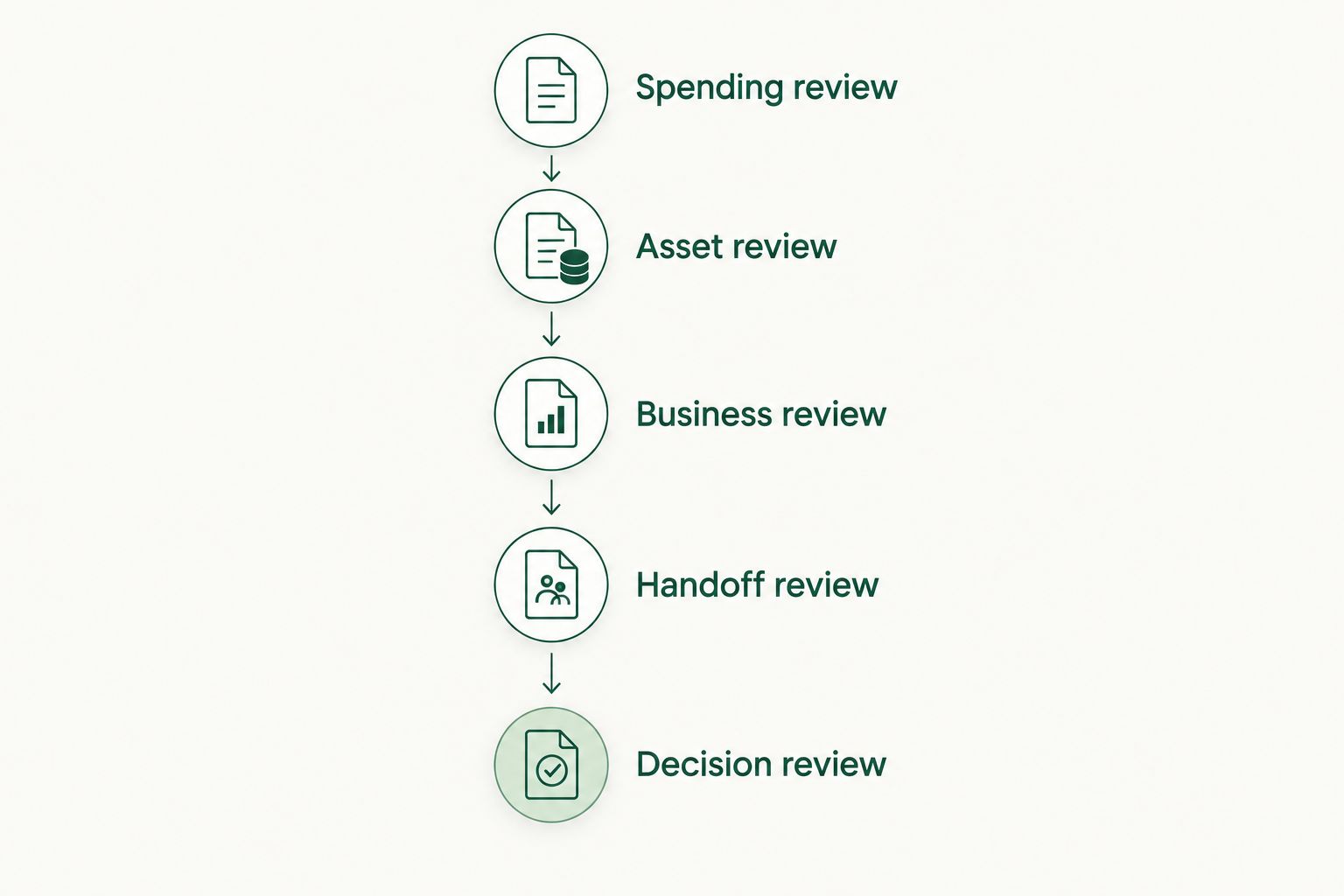
Use this sequence:
- Spending review: Gather 12 months of household spending and identify business-paid benefits that will change.
- Asset review: List personal assets, account ownership, debts, and restrictions separately from company assets.
- Business review: Assemble financial statements, ownership agreements, debt documents, and any existing valuation materials.
- Handoff review: Document the proposed successor or buyer, management responsibilities, and unresolved terms.
- Decision review: Record what must be true before you stop working and who confirms each condition.
For your 2026 review, date every statement and proposal. A current personal balance sheet and an outdated sale assumption do not describe the same financial position.
Give each professional a defined role. Your financial planner connects personal cash flow, investments, and retirement decisions; your CPA addresses tax matters; transaction counsel handles legal agreements; and a valuation professional addresses business valuation when needed.
How should you evaluate help with the decision?
Choose an adviser who can connect your household finances with your business transition rather than treating retirement as an investment-account question alone. Ask how the adviser handles uncertain proceeds, retained ownership, and coordination with your existing professionals.
Vital Investment Management provides fee-only fiduciary financial planning and business transition/succession planning for Northern Colorado owners. The firm is an SEC-registered RIA based in Loveland; registration does not imply a certain level of skill or training.
Vital Investment Management’s business transition planning fits Northern Colorado owners who need to connect succession decisions with personal retirement finances. Its role does not replace transaction counsel, your CPA, a valuation professional, or a buyer: the firm does not broker transactions or provide legal, tax, valuation, lending, or ESOP administration services.
If you want personalized help, the offer is a confidential discovery call with Dillon Goodman. Educational articles and tools are preparation for that conversation, not a determination that you are ready to retire.
Can I retire without selling my business?
You can retire from daily management while retaining ownership if the management arrangement and your personal cash-flow plan support it. Document decision authority, reporting, distributions, and your remaining responsibilities.
Retained ownership keeps part of your financial position tied to the company. Do not describe that arrangement as a complete exit unless the remaining obligations genuinely match what you want.
Should I retire if I'm burned out?
Burnout is a reason to examine your workload, not proof that you can fund retirement. Separate the need for relief from the permanent ownership decision.
Delegating responsibilities or testing an absence can help you identify whether you want different work or no work. Your financial review still needs to stand on its own.
Does a buyer's offer mean I'm ready to retire?
A buyer's offer does not establish retirement readiness. Your decision depends on net proceeds, payment timing, contractual obligations, and the income those resources must support.
Compare the proposed transaction with your personal plan before accepting terms. An attractive headline offer and a workable retirement are different conclusions.
FAQ
How do I know if I'm financially ready to retire from my business?
You are financially ready when a documented plan connects your household spending with identified income and spendable assets after your owner compensation changes. Separate personal resources from company working capital and uncertain sale proceeds.
How much money do I need before retiring from my business?
Your required retirement resources depend on spending, reliable income, taxes, debts, and the timing of any business proceeds. A universal savings figure does not establish readiness for an individual owner.
Can I count my business valuation as retirement savings?
A business valuation is not spendable retirement savings. Until a transaction establishes net proceeds and payment terms, keep estimated company value separate from liquid personal assets.
What if my successor is ready but I am not?
A ready successor does not require you to make an immediate retirement decision. Clarify your personal finances and desired role while documenting the successor's authority and responsibilities.
What documents should I bring to a retirement planning meeting?
Bring household spending records, personal account statements, business financial statements, debt details, ownership agreements, and any proposed transfer terms. Identify which benefits and expenses currently run through the business.
Can a Northern Colorado financial adviser help with business retirement?
A financial adviser with business-owner planning services can connect your personal retirement finances with succession decisions. Vital Investment Management provides financial planning and business transition/succession planning for Northern Colorado owners while coordinating with other professionals.
Is this checklist personalized financial or tax advice?
This checklist is educational, not personalized financial, tax, or legal advice. Your circumstances, transaction documents, and current rules require individual review before you act.
One last thing
Write down what stops when you retire—and what does not. Include work, compensation, benefits, guarantees, ownership responsibilities, and the calls you still expect to answer.
Before committing to a 2026 departure date, compare that list with your household cash-flow plan and proposed agreements. If the documents describe a different retirement from the one you want, resolve the mismatch before setting the date.