

Buying out a business partner requires funding the agreed value of the departing owner’s interest, plus transaction expenses and any financing obligations. Your total cash commitment also depends on who buys the interest, how existing debt is handled, and how much working capital the business must retain. For a 2026 buyout, separate the ownership settlement from the cash needed to keep operating before you agree to payment terms.
- How much does it cost to buy out a business partner? Separate ownership value, transaction expenses, financing, and operating reserves.
- Read the buy-sell agreement before negotiating a valuation or payment schedule.
- A lower upfront payment does not eliminate debt service or the seller’s collection risk.
- Vital Investment Management supports Northern Colorado owners with financial planning around a business transition, not transaction brokerage.
Why this matters
A partner buyout changes ownership and cash flow at the same time. You need to fund the departing owner’s interest without treating payroll, tax reserves, or customer deposits as spare cash.
The valuation is only part of the decision. Start with how to value a small business for a sale, then test whether the proposed payment structure leaves the remaining owner and the company financially workable.
Your planning question is not simply whether you can close. It is whether you can run the business afterward without relying on the departing partner’s labor, relationships, or guarantees.
How much does it cost to buy out a business partner?
There is no universal buyout amount. The required funding comes from your ownership documents, an appropriate valuation, the negotiated transaction structure, and the actual expenses of completing the transfer.
Build your 2026 buyout budget in separate parts rather than accepting a single headline figure:
| Budget component | What you need to establish | What to check |
|---|---|---|
| Ownership settlement | The amount payable for the departing partner’s interest | The agreement’s valuation method, ownership rights, and adjustments |
| Transaction expenses | Written scopes from the professionals involved | Legal work, valuation work, accounting, and lender requirements |
| Financing obligations | The proposed borrowing or seller-note terms | Interest, repayment timing, collateral, and guarantees |
| Operating reserves | Cash the business needs after closing | Payroll, taxes, suppliers, seasonal needs, and existing debt |
| Transition obligations | Responsibilities that continue after ownership changes | Employment, consulting, leases, guarantees, and customer handoffs |
Do not confuse total transaction funding with cash due at closing. A deferred settlement reduces the immediate payment but creates future obligations. An all-cash settlement removes that deferred obligation but uses liquidity immediately.
Ask for a closing funds statement and a separate post-closing cash forecast. The first tells you what must move at completion; the second tells you what remains available to operate.
Build the estimate in this order
- Read the governing documents. Gather the operating agreement, shareholder or partnership agreement, and any buy-sell provisions. Have transaction counsel identify the applicable rules before you negotiate outside them.
- Define the ownership interest. Confirm what is being transferred, the valuation date, voting rights, and any restrictions affecting the interest.
- Reconcile the business finances. Separate operating debt, owner loans, cash, unpaid distributions, and other items that need explicit treatment.
- Obtain written professional scopes. Establish who handles valuation, legal drafting, tax analysis, financing, and closing coordination.
- Test the payment schedule. Show the upfront funding requirement, later payments, and operating cash remaining under the proposed terms.
A percentage ownership figure alone does not complete this calculation. The agreement, rights attached to the interest, and treatment of liabilities all need review.
What changes the amount you need to fund?
The main drivers are specific to your agreement and business. Put these questions on the agenda before debating a settlement figure:
- Valuation method: Does the agreement require a formula, an appraisal process, or another method? Confirm whether the proposed calculation follows it.
- Debt and cash treatment: Does the valuation already account for business debt and cash? Avoid subtracting or adding the same item twice.
- Buyer identity: Will you purchase the interest personally, or will the company redeem it? Counsel and your CPA should evaluate the different consequences.
- Payment structure: Cash at closing, borrowing, and seller financing create different liquidity and repayment obligations.
- Owner-related adjustments: Clarify owner loans, unpaid distributions, compensation, benefits, and any separately negotiated transition work.
- Business continuity: Determine what changes when the departing partner stops managing staff, serving customers, or supporting lender relationships.
A shared spreadsheet is useful only if both sides agree on what each line means. Label disputed assumptions rather than burying them inside the final calculation.
Which funding structure fits your cash flow?
The funding decision determines who supplies the cash and who carries repayment risk. Choose the structure after testing operating cash flow, not before.
These are funding approaches, not recommendations that a particular lender or seller will accept. Availability and terms require separate review.
| Funding approach | Best for | Main advantage | Main constraint |
|---|---|---|---|
| Available buyer cash | Buyers with sufficient liquidity beyond the settlement | Avoids creating a new loan for that portion | Reduces cash available for personal or business needs |
| Bank financing | Buyers seeking lender-funded settlement proceeds | Separates seller payment from the buyer’s repayment schedule | Requires underwriting and creates debt-service obligations |
| Seller financing | Buyers and sellers willing to maintain a creditor relationship | Spreads the buyer’s payments over time | Exposes the seller to collection risk and requires clear default terms |
Available cash: preserve the operating reserve
Using available cash avoids borrowing for the portion paid directly. That does not make every account balance available for the buyout.
Separate personal liquidity from company liquidity. Then identify taxes due, payroll commitments, supplier payments, customer deposits, and restricted funds before deciding what cash can support the transaction.
Your 2026 treasury review should also address seasonal cash needs. A settlement that fits today’s balance can still conflict with the next inventory purchase or tax payment.
Bank financing: examine repayment and guarantees
Bank financing provides settlement funding through a separate lending relationship. It also creates an obligation the borrower must service after the ownership transfer.
Review the proposed borrower, collateral, guarantees, repayment schedule, and lender conditions. Existing business borrowing also needs attention: the ownership change does not itself establish that a departing partner has been released from a guarantee.
Ask the lender to document required approvals and releases. Keep those requirements on the closing checklist rather than treating them as follow-up tasks.
Seller financing: define what happens after closing
Seller financing lets the departing partner receive payments over time. The remaining owner gains time to fund the settlement, while the departing owner remains exposed to repayment risk.
Transaction counsel should document payment obligations, security, default provisions, and any reporting requirements. Your CPA should evaluate the tax treatment rather than assuming that every deferred payment receives the same treatment.
Keep the ownership transfer separate from any employment or consulting arrangement. Each creates different rights and obligations, even when the same people sign both documents.
How do you test whether the business can afford the buyout?
Use a monthly forecast covering the next 12 months as a planning starting point. Extend it when the proposed repayment schedule or operating cycle requires a longer view.
The forecast should connect the transaction to the business you will actually operate after your partner leaves. Historical profit is not enough if you must replace the departing owner’s work.
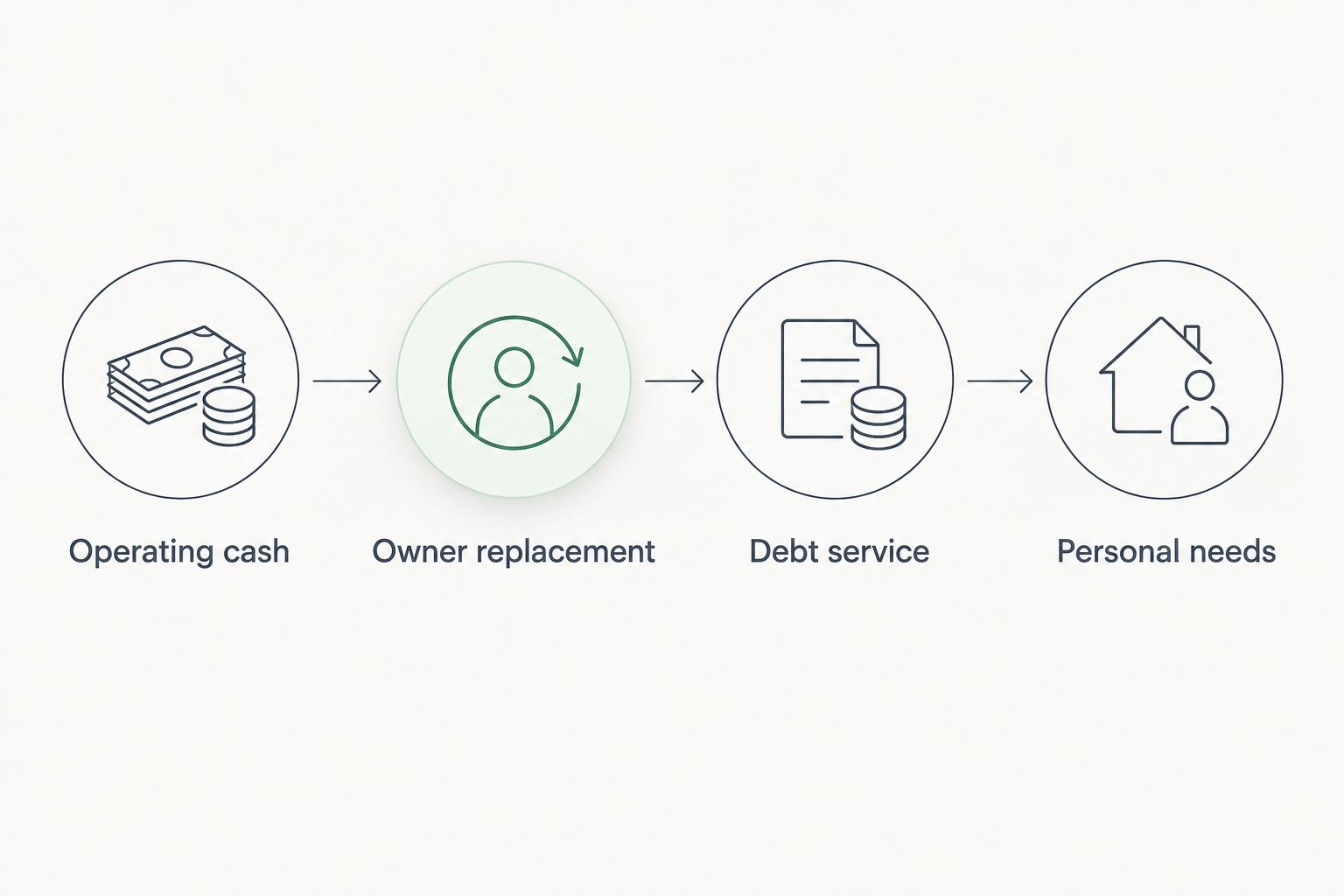
Run these four checks
- Operating cash: Forecast customer collections and ordinary business payments. Include payroll, rent, suppliers, taxes, and necessary equipment spending.
- Owner replacement: Identify the departing partner’s responsibilities. Include replacement compensation or outside support where the business will need it.
- Debt service: Add existing debt payments and the proposed buyout obligations. Keep principal payments visible rather than looking only at accounting profit.
- Personal needs: Show the remaining owner’s required household withdrawals separately. Do not assume every dollar left in the company is available for repayment.
Your 2026 base forecast should use documented assumptions. Add a separate scenario for slower collections or reduced revenue, without presenting that scenario as a prediction.
If the forecast cannot support the proposed payments, change the structure or revisit the transaction. Borrowing more does not remove the underlying cash-flow requirement.
What should you gather before requesting professional estimates?
Start with 3 document groups: ownership records, financial records, and proposed transaction terms. An organized file helps each professional define the work required.
- Ownership records: Governing agreements, amendments, ownership schedules, and relevant transfer provisions.
- Financial records: Business financial statements, tax returns, debt schedules, owner-loan records, and current cash balances.
- Transaction terms: Proposed buyer, interest being transferred, intended closing date, payment structure, and ongoing responsibilities.
Also list personal guarantees, property leases, major customer relationships, and licenses requiring review. Ask counsel which consents or changes the transaction requires.
Request written scopes rather than comparing estimates that cover different work. A valuation engagement, transaction-document engagement, and personal financial plan address different questions.
Can you buy out a partner without paying everything upfront?
You can negotiate deferred payments or seek financing, subject to the governing agreement and the parties’ acceptance. Neither approach removes the obligation; it changes when payment occurs and who carries repayment risk.
For a 2026 transaction, have the payment schedule, security, and default provisions reviewed together. A manageable monthly payment is not enough if a later lump-sum obligation remains unfunded.
Does a partner automatically receive their percentage of company value?
A partner’s ownership percentage is a starting point, not a complete settlement instruction. The governing agreement, valuation basis, rights attached to the interest, and treatment of debt or owner loans determine how the calculation should work.
Ask the valuation professional and transaction counsel to reconcile those items explicitly. Do not apply a percentage to revenue or an informal estimate and treat the result as an agreed entitlement.
Who should help you coordinate the financial decision?
Vital Investment Management is best for Northern Colorado owners seeking fee-only financial planning around a business transition. The firm is a fee-only fiduciary and SEC-registered RIA based in Loveland, serving owners in Fort Collins, Berthoud, and the surrounding region.
Vital Investment Management provides financial planning and business transition/succession planning. Dillon Goodman, CPA, CFP®, leads the business-owner practice.
The role has clear limits. The firm coordinates with legal, tax, and valuation professionals; it does not broker transactions or provide legal, tax, valuation, lending, or ESOP administration services. It does not prepare tax returns.
If you need personalized financial planning, the offer is a confidential discovery call with Dillon. Educational articles and tools are separate from that engagement and do not determine your settlement terms.
FAQ
How much does it cost to buy out a business partner?
The required funding includes the agreed ownership settlement, transaction expenses, and any financing obligations. Establish the valuation method and payment structure, then separately protect the cash needed to operate after closing.
Can I use business cash to buy out my partner?
Business cash is not automatically available for a partner buyout. Have counsel and your CPA review the transaction structure, governing documents, obligations, and required operating reserves before funds move.
Do we need a business valuation for a partner buyout?
Start with the valuation process required by your governing agreement. A qualified valuation professional can address the ownership interest and valuation basis when the transaction requires that work.
Can my departing partner keep a personal guarantee after selling?
Selling an ownership interest does not itself establish that a personal guarantee has been released. Obtain the lender’s written requirements and confirmation of any release as part of closing.
Is seller financing better than a bank loan for a partner buyout?
Seller financing and bank financing place repayment risk with different parties. Compare the actual repayment obligations, security, guarantees, and operating cash requirements rather than choosing by the initial payment alone.
Who pays the professional expenses in a partner buyout?
The parties should document who pays each professional expense. Confirm the allocation in the transaction documents instead of assuming the company or departing partner will cover it.
Can Vital Investment Management handle the entire partner buyout?
Vital Investment Management supports financial planning and transition/succession planning, not the entire transaction. Legal documents, tax advice, valuation, and lending require the appropriate separate professionals.
One last thing
Ask what disappears when your partner leaves. The answer might include sales work, management time, a customer relationship, or support for a loan guarantee—not just an ownership interest.
Write those responsibilities beside the proposed payment schedule. Your buyout plan needs to fund the transfer and support the business that remains.
This article is educational only, not personalized financial, tax, or legal advice. Registration does not imply a certain level of skill or training.