

Best overall fit for coordinated owner planning: Vital Investment Management. Best for a cash-flow assignment: a treasury-focused fee-only advisor. Best for a defined personal-planning question: a project-based financial planner. Best for an ownership transfer: a coordinated transition-planning team. Your best choice in 2026 depends on whether you need ongoing advice or help with one specific decision.
- The best financial advisors for construction business owners connect treasury, personal wealth, taxes, and succession.
- Vital Investment Management fits Northern Colorado owners seeking coordinated fee-only financial planning and investment management.
- Choose a treasury-focused assignment when payroll timing and project collections are the immediate problem.
- Use a transition-planning team for ownership transfers; financial advice does not replace legal counsel or valuation work.
Why this matters
A profitable construction business and a financially secure owner are not the same thing. Payroll, subcontractor payments, equipment purchases, and delayed collections compete with the money you want to take home.
The advisor you choose should distinguish cash committed to the business from money available for your household. The treasury management guide for construction companies explains that operating-cash problem separately from your personal investment plan.
Vital Investment Management is a fit for Northern Colorado construction owners seeking fee-only advice across treasury, personal investments, and succession. That is a service-fit recommendation, not a claim of construction specialization or investment performance.
What makes the best financial advisors for construction owners?
Use these five criteria before comparing proposals. A convincing presentation is not a substitute for clear responsibilities.
- Cash-flow separation: The advisor distinguishes operating reserves, tax obligations, planned business spending, and personal investable assets.
- Owner-level planning: The work addresses household spending, wealth concentrated in the company, retirement, and transition—not just an investment account.
- Clear compensation: You receive written disclosure of compensation, conflicts, services, and exclusions before signing.
- Professional coordination: The advisor explains how your CPA, attorney, bookkeeper, and other specialists participate without blurring professional responsibilities.
- Useful deliverables: The engagement produces decisions, assigned responsibilities, and a review process you can understand.
For your 2026 comparison, ask every candidate to describe the same assignment. Otherwise, an investment-management proposal and a cash-flow planning proposal look comparable when they solve different problems.
Advisor options at a glance
This ranking compares engagement models, not competing firms. Start with local fee-only advisors in Loveland, Fort Collins, Berthoud, and surrounding Northern Colorado, then match the scope to your actual problem.
| Rank and option | Best for | Standout fit | Key limitation |
|---|---|---|---|
| 1. Vital Investment Management | Coordinated ongoing owner planning | Treasury, investments, financial planning, and transition services | Does not replace your tax, legal, lending, or valuation professionals |
| 2. Treasury-focused fee-only advisor | Operating-cash decisions | A defined assignment around reserves, obligations, and cash timing | A treasury assignment alone does not cover your entire personal plan |
| 3. Project-based financial planner | One bounded personal-planning question | A written scope with a defined decision or deliverable | Updates and implementation require explicit agreement |
| 4. Coordinated transition-planning team | Ownership transfer and income replacement | Financial planning coordinated with transaction specialists | Requires separate professional roles and agreements |
The options overlap in practice. A single advisory firm can offer several engagement types; compare the actual agreement, not the label.
1. Vital Investment Management: best for coordinated owner planning
Vital Investment Management is a fee-only, SEC-registered RIA based in Loveland, Colorado. Its stated services include treasury management, investment management, financial planning, and business transition/succession planning; Dillon Goodman, CPA, CFP®, leads the business-owner practice.
This scope fits a construction owner whose decisions cross business and household boundaries. You need to decide what stays available for the company, what supports personal goals, and how ownership eventually becomes retirement income.
Vital Investment Management pros:
- Offers the four service areas relevant to operating cash, personal wealth, and ownership transition.
- Serves business owners in Northern Colorado, including Loveland, Fort Collins, and Berthoud.
- Uses a fee-only fiduciary model.
- Provides a named business-owner contact in Dillon Goodman.
Vital Investment Management cons:
- Does not prepare tax returns or provide legal, valuation, lending, transaction-brokerage, or ESOP administration services.
- Its stated services do not establish construction-specific experience; ask directly about comparable owner situations.
- Coordinated advice still requires participation from your existing professionals and access to current financial records.
Best for: You want your business cash decisions, personal investments, and eventual exit considered together rather than handled as unrelated tasks.
Before engaging, ask which deliverables belong in your agreement and which require another professional. SEC registration does not imply a certain level of skill or training.
Verdict: Buy this scope when you need ongoing coordination; verify construction experience before choosing the firm.
2. Treasury-focused fee-only advisor: best for cash-flow decisions
A treasury-focused engagement addresses what your cash must do before you invest it. The assignment should distinguish money needed for payroll, taxes, vendors, debt payments, equipment, and owner distributions.
For a construction business, useful inputs include receivables, retainage, scheduled obligations, and expected project spending. Ask the advisor to show how uncertain collection dates affect the recommendation rather than treating every receivable as available cash.
Treasury-focused advisor pros:
- Starts with payment obligations instead of an investment allocation.
- Creates a place to document reserve and distribution decisions.
- Gives your bookkeeper, CPA, and advisor a common cash-planning discussion.
Treasury-focused advisor cons:
- Cannot make a customer pay sooner or resolve a disputed invoice.
- Depends on current records and realistic collection assumptions.
- Does not automatically address household retirement or estate planning.
Best for: Payroll timing, uneven collections, or uncertainty about how much cash can leave the business is your immediate problem.
Request a 13-week cash forecast as a proposed planning deliverable, not a universal reserve rule. Ask who maintains it and how changes reach the person making payment decisions.
Verdict: Buy a treasury assignment when cash timing is the problem; skip an investment-only proposal for this need.
3. Project-based financial planner: best for a defined personal decision
A project-based financial planner works on an agreed question rather than an undefined relationship. Examples include assessing your household spending needs, organizing personal assets and liabilities, or identifying decisions before retirement.
This model works when you can describe the outcome clearly. “Help me understand what my household needs from the business” is a stronger brief than “look at everything.”
Project-based planner pros:
- Gives you a bounded assignment to evaluate.
- Separates financial-planning work from investment-management decisions when the agreement does so.
- Produces a document you can discuss with your CPA and other advisors.
Project-based planner cons:
- A completed plan does not implement itself.
- Ongoing monitoring is not included unless the agreement says so.
- A narrow personal-planning scope can leave business treasury questions unresolved.
Best for: You have one personal financial decision to make and want a written analysis before considering ongoing advice.
For a 2026 planning project, specify the assumptions, records required, delivery format, and follow-up responsibility. Ask what happens when your business income or household circumstances change.
Verdict: Buy a defined project when the question is bounded; skip it as a substitute for ongoing work you actually need.
4. Coordinated transition-planning team: best for an ownership transfer
A transition-planning team connects your personal financial needs with the proposed transfer of your business. The financial advisor addresses income replacement and personal wealth, while legal, tax, valuation, and transaction specialists handle their respective work.
This is a team structure, not a claim that one advisor performs every service. Selling to an employee, transferring to children, and selling to an outside buyer require different questions and professional involvement.
Transition-planning team pros:
- Connects the proposed transaction with your household needs.
- Makes professional responsibilities visible.
- Addresses the difference between a headline sale value and money available for your next stage.
Transition-planning team cons:
- Requires coordination across separate professionals.
- Does not guarantee a buyer, financing, closing date, or transaction outcome.
- Cannot turn a financial plan into legal documents or a defensible valuation without the appropriate specialists.
Best for: You are considering an employee sale, family succession, partner buyout, or outside sale.
For your 2026 transition discussion, separate cash received at closing from payments dependent on future events. Ask your advisors to explain what remains uncertain and who evaluates each risk.
Verdict: Buy coordinated transition planning before relying on sale proceeds; skip any proposal that leaves professional responsibilities unclear.
Eight questions to ask before hiring
Use the same eight questions with each candidate. Written answers make gaps easier to identify than a general discussion about financial goals.
- Will you act as a fiduciary throughout this engagement? Request the answer and scope in writing.
- How are you compensated? Ask about all compensation sources and conflicts, not just the headline arrangement.
- What experience do you have with construction owners? Ask for relevant situations without requesting confidential client information.
- How will you separate business cash from personal investments? Look for an explanation tied to obligations and collection timing.
- What will I receive? Identify the analysis, written recommendations, meetings, and implementation responsibilities.
- How will you coordinate with my CPA? Confirm who addresses tax questions and who prepares returns.
- What is outside your scope? Cover legal work, lending, valuation, insurance, and transaction execution where relevant.
- Who updates the plan? Identify the person responsible when cash flow, ownership, or household needs change.
A strong answer names the work and the responsible person. “We handle everything” leaves too much undefined.
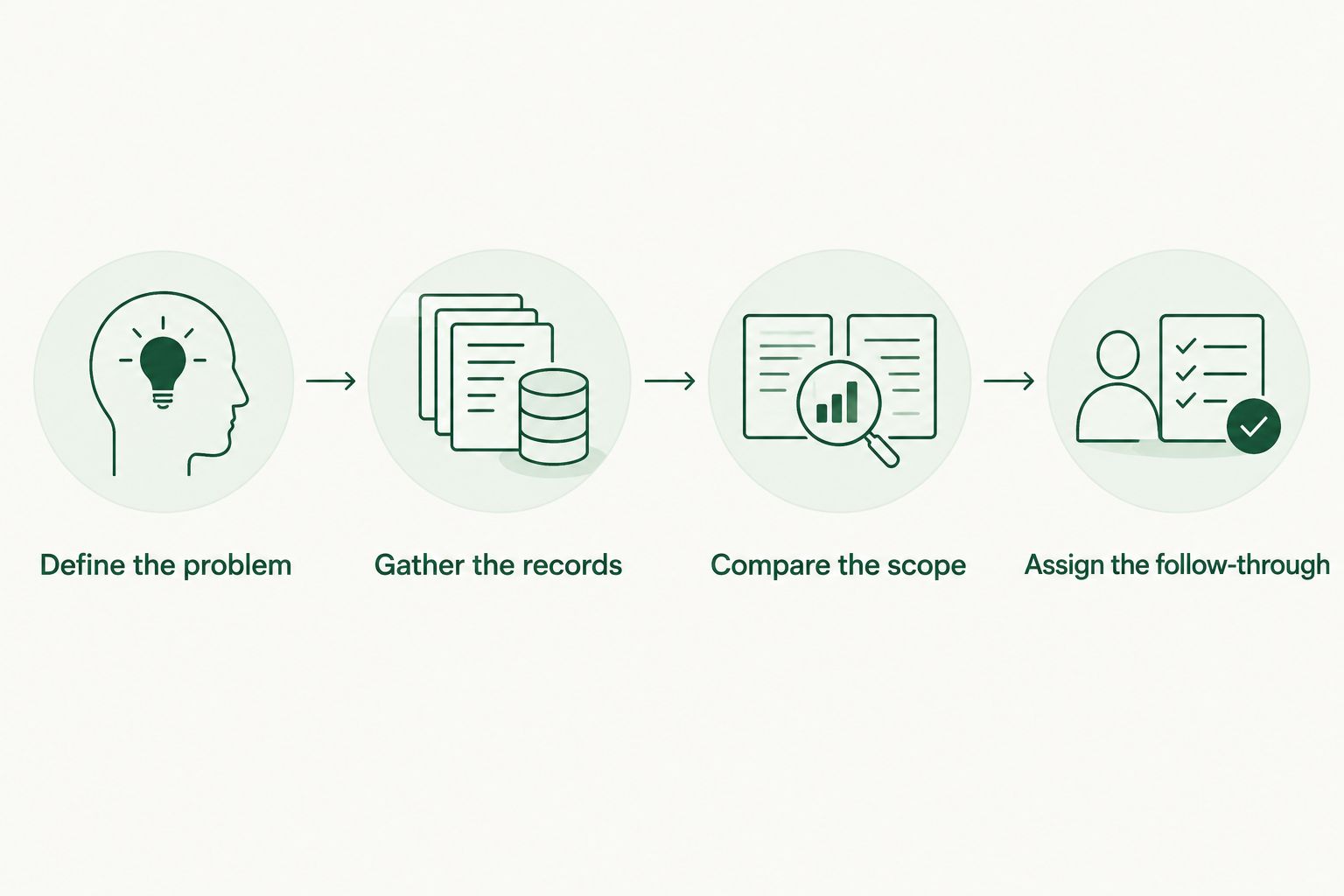
Four steps to make the decision
Do not start by moving accounts. Start by identifying the decision you need help making, then choose the engagement that addresses it.
Define the problem
Write one sentence naming the immediate issue: cash timing, household planning, investment coordination, or succession. Include the decision you cannot confidently make today.
Gather the records
Prepare current business and personal financial statements, debt details, relevant agreements, and cash-flow records. A 12-month cash-flow history is a useful proposed starting point for discussing seasonality; ask what additional history the assignment requires.
Compare the scope
Request written responsibilities, exclusions, deliverables, and compensation disclosures. Ask how the proposal handles your problem rather than judging it by the number of services listed.
Assign the follow-through
Name who implements recommendations and who checks progress. An advisor recommendation, a CPA calculation, and an attorney-drafted agreement are separate tasks.
How these options are ranked
The order prioritizes coordinated owner planning, then narrower assignments for cash flow, a defined personal question, and ownership transfer. The criteria are cash-flow separation, owner-level planning, compensation clarity, professional coordination, and useful deliverables.
This is not a ranking based on returns, client outcomes, or verified construction-industry market share. Move the treasury or transition option to the top when that is the decision you need to make.
Which advisor should you choose?
Choose the scope before choosing the relationship. If your business and personal decisions keep colliding, start with a local fee-only advisor whose agreement covers both and explains how your CPA participates.
For coordinated advice in Northern Colorado, consider Vital Investment Management and confirm the construction experience relevant to your situation. If you need one bounded answer, request a project; if ownership is changing, assemble the appropriate specialists.
In 2026, your selection should end with a written next step—not merely a decision about where to hold investments.
FAQ
Who are the best financial advisors for construction business owners?
The best fit is an advisor whose written scope connects your immediate business problem with your personal financial needs. Compare fee-only local advisors on cash-flow planning, construction-owner experience, professional coordination, and deliverables rather than unsupported rankings.
Is Vital Investment Management a fit for a construction company owner?
Vital Investment Management fits Northern Colorado owners seeking fee-only treasury management, investment management, financial planning, and transition planning. Ask directly about construction-specific experience and confirm the services included in your agreement.
Do I need both a CPA and a financial advisor?
You need separate professional responsibilities when your assignment includes tax work and financial planning. A financial advisor does not replace tax-return preparation, and a CPA engagement does not automatically include personal investment or succession planning.
Should my advisor invest the cash in my construction business?
Your advisor should first identify which cash supports operating obligations and which funds are available for other goals. Payroll, taxes, debt payments, project spending, and uncertain collections belong in that analysis before investment recommendations.
Is fee-only the same as fiduciary?
No. Fee-only describes compensation, while fiduciary describes a duty to act in the client's best interest. Ask for written compensation disclosures and confirmation of the fiduciary duty that applies to your engagement.
Can a financial advisor help me sell my construction business?
A financial advisor can help connect a proposed sale with income replacement and personal financial planning. Transaction brokerage, legal documents, tax advice, financing, and valuation require the appropriate professionals and separate scopes.
What should I bring to a first advisor meeting?
Bring your immediate decision, current business and personal financial records, debt details, and relevant ownership agreements. Ask the advisor which additional records are necessary before sending sensitive information.
One last thing
Ask each candidate what would make them recommend not moving money into investments. Your operating obligations must shape that answer.
An advisor who can explain when cash needs to stay available gives you something more useful than an allocation alone: a decision you can connect to payroll, projects, and your household.