

Selling your business is the better fit when you need liquidity, want to reduce your dependence on the company, or lack a willing and capable family successor. Passing it to family fits when the successor wants the responsibility and the transfer supports your retirement without overloading business cash flow. Choose the path that funds your life and gives the next owner a workable business—not the path that merely avoids a difficult conversation.
- Is it better to sell my business or pass it to family? Compare retirement funding, successor readiness, and control.
- An outside sale fits owners seeking separation; family succession fits willing, capable successors with a workable funding plan.
- A family sale still requires valuation, financing, and legal documents; a gift does not create retirement cash.
- VIMSmallBusiness fits Northern Colorado owners seeking fee-only financial planning for a business transition.
Is it better to sell my business or pass it to family?
Neither route wins automatically. Compare what you receive, what obligations remain, and who can operate the company after you leave. Start with the owner-focused financial planning and transition services at VIMSmallBusiness, then separate your personal funding needs from your preferred ownership outcome.
| Path | Best for | Main advantage | Main drawback |
|---|---|---|---|
| Outside sale | Owners seeking liquidity and separation | Converts ownership into negotiated sale proceeds | Finding a suitable buyer and acceptable terms takes work |
| Family sale | Owners with a willing, capable family buyer | Keeps ownership in the family while providing payment | Buyer financing and repayment depend on workable terms |
| Family gift | Owners whose retirement does not depend on payment for the transferred interest | Transfers ownership without requiring a purchase payment | Creates no sale proceeds and requires estate and tax planning |
| Staged family transfer | Owners who want a gradual handoff | Separates leadership development from the ownership transfer | Extends shared control and requires clear decision rights |
These are different transactions, not interchangeable ways to announce retirement. A family sale creates a buyer and seller relationship; a gift transfers value without purchase proceeds. A staged transfer also needs a destination, rather than an indefinite promise that the children will take over someday.
Why this matters
Your business can be your income source, your largest financial asset, and your family’s shared identity. Those roles do not always point toward the same decision. A transfer that preserves the family name but leaves your retirement dependent on uncertain distributions has not solved the financial problem.
For a 2026 transition review, separate ownership, management, and retirement funding before discussing the preferred recipient. Your child can manage without immediately owning everything, and you can transfer ownership without retaining an informal veto over every decision. Your agreements must explain which arrangement you actually intend.
An outside sale: best for liquidity and separation
An outside sale fits when you want to reduce your financial connection to the company and no family successor meets the requirements. It also deserves consideration when family members simply do not want the job. Their lack of interest is a decision input, not a failure of loyalty.
The benefit is the opportunity to turn concentrated business ownership into assets outside the company. The limitation is that a signed transaction does not necessarily mean complete separation. Seller financing, contingent payments, transition duties, or retained ownership leave you connected to future operations.
Before favoring a sale, ask:
- What payment arrives at closing, and what payment depends on later events?
- What responsibilities remain after closing?
- What restrictions apply to your future work?
- What happens if the buyer cannot meet a payment obligation?
Judge the sale by usable proceeds and remaining obligations, not the headline offer. Have transaction counsel explain the agreement and your CPA evaluate the tax treatment before treating the proceeds as retirement funding.
A family transfer: best for a prepared successor
Passing the business to family fits when a specific person wants ownership, demonstrates operating ability, and accepts the obligations. Shared history helps explain motivation. It does not establish readiness to manage employees, handle cash flow, or make unpopular decisions.
Separate the emotional question—whether you want the business to stay in the family—from the operating question: whether the proposed successor can run it. Give the successor defined authority and assess actual decisions. A title alone proves little if you still approve every customer concession and payroll decision.
The benefit is continuity with someone who understands the business and wants to carry it forward. The drawback is that employment disagreements can become family disagreements, particularly when relatives have different expectations about compensation or ownership.
Do not transfer ownership to create motivation that is not already there. For the practical handoff, read how to transition your business to your children.
Why the right succession choice varies
The answer changes with the facts of your household and company, not simply with whether you have children. Use these factors to compare both paths on the same basis:
- Retirement funding: Identify how much personal spending depends on business distributions or transfer proceeds.
- Successor readiness: Separate demonstrated management ability from family membership and time on the payroll.
- Funding capacity: Test whether the company can support operations, reinvestment, and any acquisition payments.
- Control: Decide which decisions you will surrender and which, if any, you will retain through documented rights.
- Family fairness: Distinguish compensation for work from ownership benefits and inheritance expectations.
- Transaction structure: Review taxes, payment terms, ownership restrictions, and continuing obligations with the appropriate professionals.
For your 2026 comparison, use the same financial information for each path. Comparing an optimistic outside-sale scenario with a cautious family-transfer scenario produces a preference, not a useful decision.
How do I compare the choices without getting stuck?
Use 5 decision steps to turn a broad family debate into a documented comparison. Finish each step before treating either path as the agreed outcome.
Establish retirement needs
List household spending, debt obligations, assets outside the business, and income sources that continue after you stop working. Separate your salary from distributions and business-paid expenses that you will need to replace personally. The result is a funding requirement, not a desired sale figure.
Keep the first draft grounded in current records. A 2026 household budget gives your financial advisor and CPA a clearer starting point than an assumption that retirement spending will somehow work itself out.
Test successor readiness
Ask the proposed family successor privately whether ownership is genuinely wanted. Then evaluate responsibilities already handled independently: employee management, customer relationships, purchasing, and cash decisions. Identify the duties that still depend on you.
Write down the gaps and assign responsibility for addressing them. Do not use a future ownership promise as a substitute for a management development plan.
Compare transfer terms
Describe the outside sale and family transfer in comparable terms: payment timing, retained obligations, ongoing work, and control. Obtain qualified valuation support rather than assuming a family transfer makes valuation unnecessary.
A family buyer’s affordability and the business’s value are different questions. If they do not align, address the difference explicitly with your advisors instead of burying it in an informal agreement.
Test business cash
Review how operations would fund payroll, working capital, maintenance, and any transfer-related obligations. Include the cost of replacing work you perform today. A successor who must hire additional management inherits a different cash-flow picture from the one shown in your owner-operated budget.
Then test weaker operating conditions. The purpose is to identify which obligations become difficult to meet, not to predict a specific outcome.
Document the handoff
State who owns what, who makes decisions, how payments work, and what happens if circumstances change. Coordinate the ownership documents with your estate plan and existing agreements. Management responsibility, legal ownership, and account access should not rely on conflicting understandings.
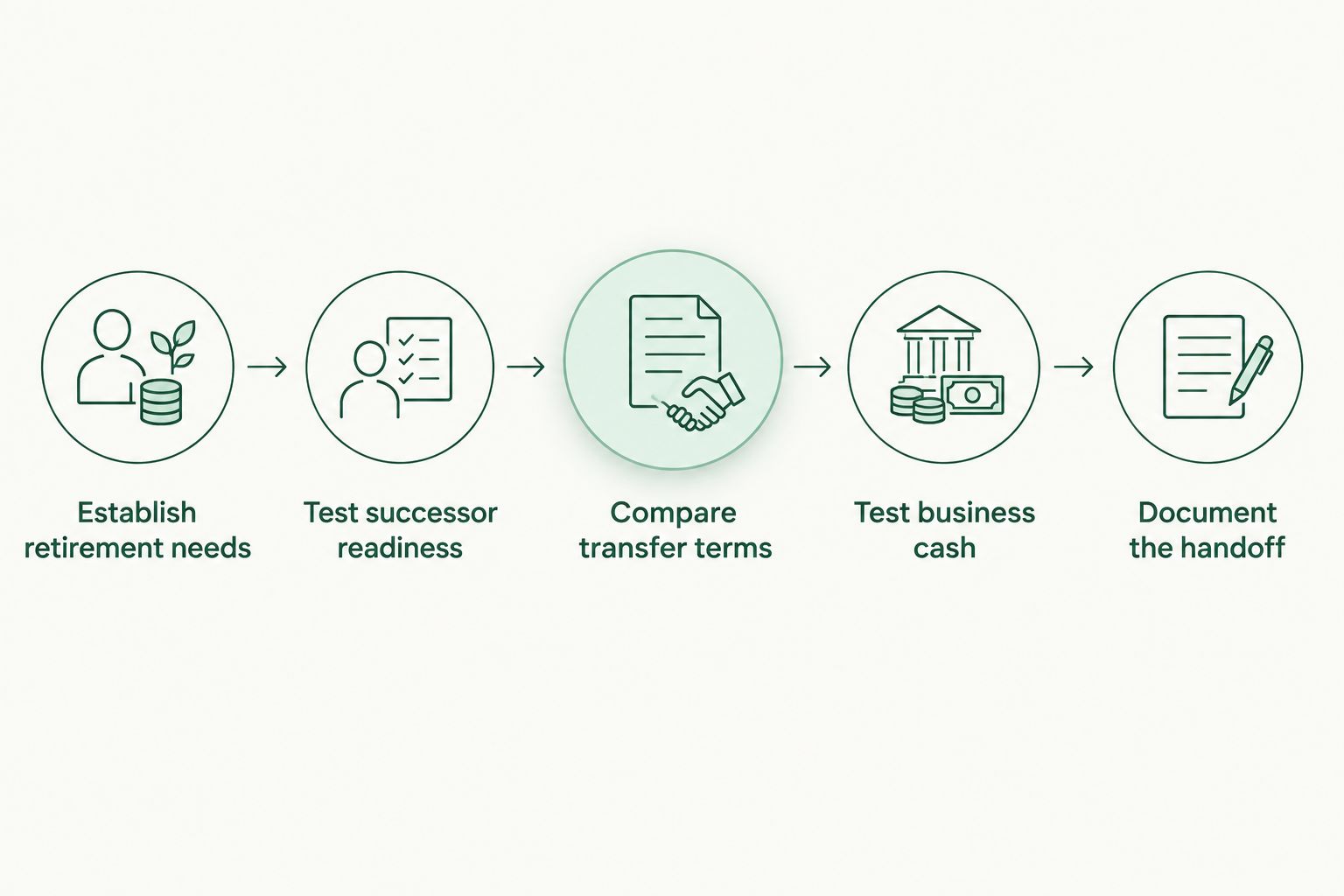
The completed comparison should show both the intended ownership outcome and the obligations that survive your departure. Keep unresolved questions visible. An unsigned assumption about your future income is not a funding plan.
How do I keep the family discussion practical?
Separate 3 decisions: who works in the company, who owns it, and how your estate treats family members. Combining them creates confusion. A child’s job performance does not automatically determine inheritance, and an ownership interest does not automatically create a management role.
Discuss operating authority before discussing titles. Who approves borrowing? Who sets compensation? Who can hire or dismiss relatives? These questions expose disagreements that a general promise of family continuity leaves untouched.
For a 2026 family meeting, use 4 questions as the agenda:
- Who genuinely wants responsibility for the business?
- What income does the departing owner need?
- Which decisions belong to the successor after the handoff?
- How will disagreements and changed circumstances be handled?
Record decisions and open issues separately. Your attorney should translate agreed terms into appropriate documents; meeting notes are not a replacement for legal advice.
Who should help me make the decision?
Use a financial advisor for the connection between the transition and your personal finances, a CPA for tax analysis, transaction counsel for legal terms, and a qualified valuation professional for valuation work. Different responsibilities require different expertise. No single conversation replaces that coordination.
VIMSmallBusiness provides fee-only financial planning and business transition/succession planning for Northern Colorado owners, including Loveland, Fort Collins, and Berthoud. Its role includes coordinating with legal, tax, and valuation professionals—not brokering transactions or providing legal, tax, valuation, or lending services. The practice does not prepare tax returns.
For a 2026 review, ask each professional to identify their scope and the information they need from the others. A coordinated decision is more useful than disconnected recommendations based on different assumptions.
FAQ
Is it better to sell my business or pass it to family if I need retirement income?
Selling is the better fit when you need proceeds that a family transfer cannot provide on workable terms. A family sale remains an option if its payment structure supports both your retirement and the company’s operating needs.
Can I sell my business to my children instead of giving it away?
Yes, a family transfer can be structured as a sale rather than a gift. Evaluate valuation, financing, payment terms, taxes, and legal documents with qualified professionals.
Should all my children get an equal share of the business?
Equal business ownership is not automatically the right arrangement. Separate management responsibility, ownership rights, and inheritance goals before deciding how to treat children who do and do not work in the company.
Can I keep control after passing the business to family?
Retained control depends on the ownership structure and governing documents. Define decision rights with counsel rather than assuming that being the founder preserves final authority.
What if my children do not want to run the business?
An outside sale deserves consideration when your children do not want operating responsibility. Do not build your retirement plan around a successor who has not freely accepted the role.
Is giving the business to family the same as funding my retirement?
No, a gift does not create sale proceeds for you. Your retirement must rely on other assets, continuing income, or a separately documented arrangement that your advisors evaluate.
Can a financial advisor help me choose between selling and family succession?
A financial advisor can compare how each path affects retirement funding, liquidity, and concentration in the business. Legal structure, tax treatment, and valuation require the appropriate professionals.
One last thing
The recipient of your business and the source of your retirement income do not have to be the same person. Start by identifying what you need outside the company, then evaluate which ownership path supports it. That reverses the familiar—and unhelpful—sequence of promising the business first and solving the funding problem later.
VIMSmallBusiness is a fee-only fiduciary and SEC-registered RIA serving Northern Colorado owners. Registration does not imply a certain level of skill or training. This article is educational, not personalized financial, tax, or legal advice.