

Review your succession plan annually and update it whenever a change affects who takes over, how the transfer is funded, or what you need from the business. Use an annual review as your planning baseline in 2026, not as permission to wait after a partner leaves, a successor withdraws, or your retirement plans change.
- How often to update a succession plan: review annually and revise after changes to ownership, successors, funding, or personal goals.
- Reviewing a plan does not automatically mean rewriting legal documents; identify what changed before commissioning revisions.
- VIMSmallBusiness offers business transition and succession planning; legal documents and tax returns require separate professional work.
- Keep emergency operating authority separate from the long-term ownership transfer, and check both during your review.
How often should a business owner update their succession plan?
Schedule an annual review, then reopen the affected parts whenever the underlying facts change. A calendar reminder catches gradual drift. An event-triggered review catches changes that cannot wait until the next anniversary.
Use the following review schedule as a working recommendation, not a legal deadline. Your agreements, financing arrangements, and professional advisers determine whether a particular change requires formal action.
| Review approach | Best for | Main benefit | Limitation |
|---|---|---|---|
| Annual review | Checking the whole plan against current facts | Creates a recurring checkpoint for ownership, cash flow, and personal goals | Misses important changes if you wait for the scheduled date |
| Event-triggered review | Responding to a changed successor, partner, financing arrangement, or family situation | Focuses attention on the affected decisions | Can leave unrelated assumptions untouched |
| Transfer-readiness review | Preparing for an actual ownership or management handoff | Checks whether people, documents, and funding agree | Does not replace legal, tax, or valuation work |
These approaches work together. If you are still deciding when the process should begin, the guide to when to start succession planning addresses the starting decision; this page addresses keeping that work current.
Why this matters
Your succession plan connects decisions that do not necessarily change together. Your intended successor can remain the same while the business takes on debt, your household spending changes, or a key employee becomes essential to daily operations.
A dated document does not tell you whether those connections still hold. For your 2026 review, test the plan against current ownership records, business finances, personal needs, and the successor's actual willingness to proceed.
The review is complete when you know what remains valid, what needs revision, and who owns the next action. Reprinting the plan with a new date accomplishes none of those things.
Annual review: check the whole plan
An annual review should test the decisions behind the documents before you ask anyone to rewrite them. Start with these eight questions:
- Successor: Does the intended successor still want the role, and have you confirmed that directly?
- Readiness: Can that person handle the responsibilities the plan assigns, or is training still unfinished?
- Ownership: Do the current owners and ownership interests match the plan's assumptions?
- Funding: Does the proposed transfer still have an identified funding path?
- Cash flow: Can the business support operations alongside the payments or distributions the plan anticipates?
- Personal finances: Does the transition still support your household needs and retirement decisions?
- Documents: Do the operating agreement, buy-sell agreement, and relevant estate documents reflect compatible intentions?
- Continuity: Does someone know how to keep the business operating if you become unavailable before the planned handoff?
An unchanged answer is still useful. Record what you checked and the information supporting it, rather than assuming silence means agreement.
Use current records for your 2026 review. Identify the date of each financial statement, ownership record, and professional assessment so that an older assumption does not pass unnoticed as a current fact.
Event-triggered review: act when the assumptions change
Do not reopen every document after every ordinary business decision. Reopen the relevant part when a change affects authority, ownership, funding, successor readiness, or your personal transition goals.
A successor withdrawing is a direct trigger. So is a partner proposing a different buyout structure, a lender changing conditions that affect transfer funding, or your decision to remain involved longer than planned.
Start by describing the change plainly: what happened, which decision it affects, and what must be confirmed. Then involve the professional responsible for that question.
A review can conclude that no amendment is needed. The point is to reach that conclusion deliberately, not to treat an old signature as evidence that today's arrangement still works.
Transfer-readiness review: verify before the handoff
When a transfer moves from an intention to an active transaction, check the plan against the proposed terms. An earlier succession discussion is not a substitute for reviewing the actual agreement, financing, responsibilities, and timing.
Separate management readiness from ownership readiness. A capable manager does not automatically have the funding to buy the business, and someone receiving ownership does not automatically know how to run it.
Ask your legal, tax, valuation, and financial professionals to identify the questions within their respective roles. Do not assume that one person's review covers another person's work.
For a transfer under discussion in 2026, keep a single action list showing the decision, responsible person, supporting document, and unresolved dependency. That list helps you distinguish an agreed intention from a completed step.
Why succession-plan review timing varies
The right review trigger depends on what changed, not simply how much time has passed. Use these six factors to decide what needs attention:
- Ownership changes: A partner entering, leaving, or changing an ownership interest calls for checking the ownership and transfer assumptions.
- Successor changes: A change in willingness, capability, availability, or family expectations calls for revisiting the intended handoff.
- Business finances: New debt, different cash flow, or a changed operating model calls for retesting the proposed funding arrangement.
- Personal circumstances: Retirement decisions, health changes, marriage, divorce, or a death call for reviewing the affected personal and business provisions with counsel.
- Transfer terms: A different buyer, payment structure, or timetable calls for checking whether the existing plan still describes the intended transaction.
- Legal and tax considerations: Ask your attorney and tax professional whether a relevant change affects your documents or proposed transfer.
Not every factor requires the same response. A contact change belongs in your operating records; a change in ownership intentions belongs in a substantive planning discussion.
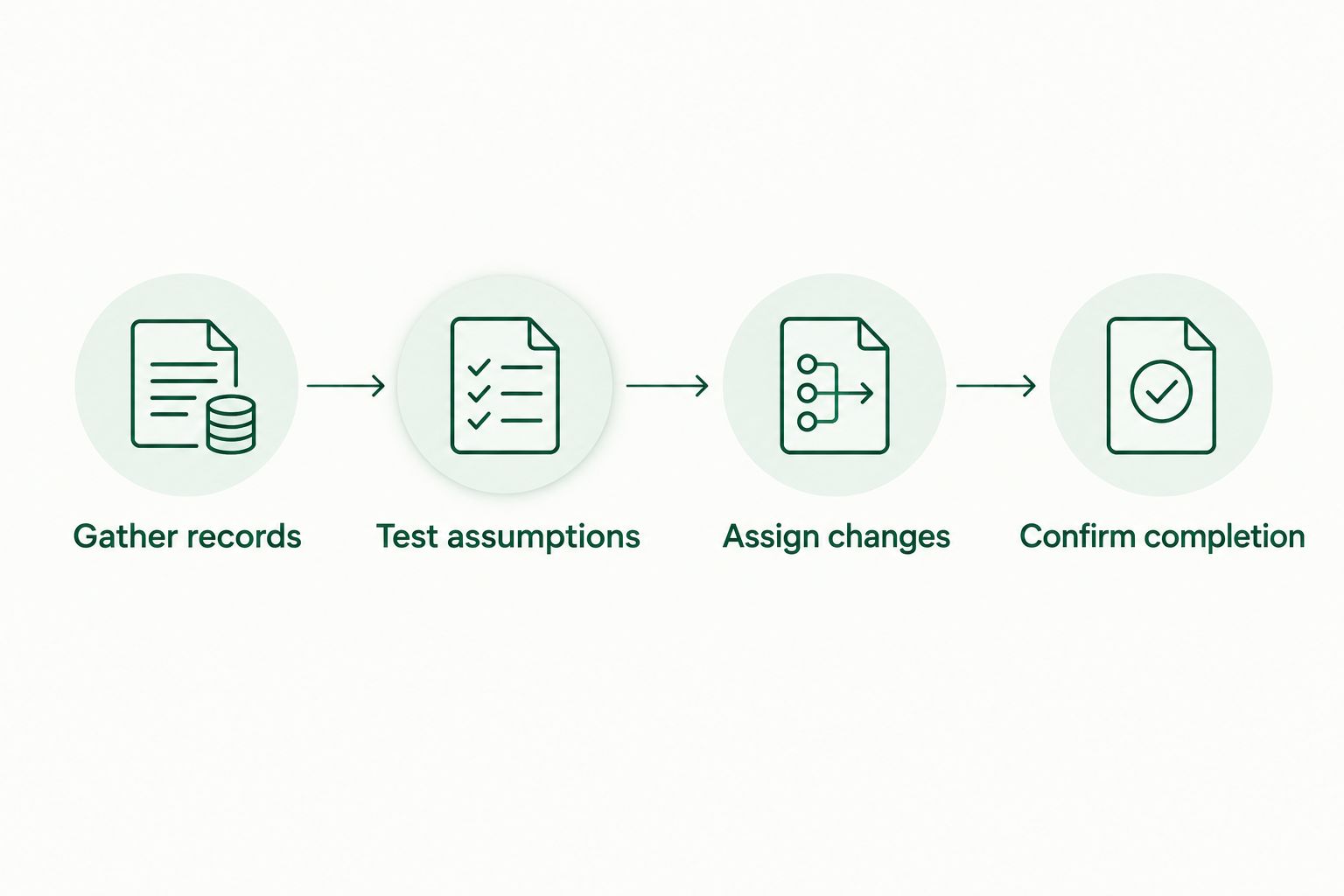
How to update your succession plan without starting over
Use these four steps to turn the review into decisions rather than another unfinished meeting. Keep the scope tied to the facts that changed.
Gather records
Bring the current plan, ownership records, relevant agreements, recent financial statements, debt information, and the personal financial assumptions behind your transition decision. Include existing professional assessments and identify their dates.
You are establishing a common starting point. Do not circulate passwords or sensitive account access details as part of an ordinary planning packet.
Test assumptions
Compare the records with what the plan assumes about the successor, ownership, funding, business operations, and your household needs. Ask the people named in the plan to confirm their roles directly.
An assumption that nobody has checked belongs on the unresolved list. It does not belong in the confirmed column simply because it appeared in the previous version.
Assign changes
Separate operational updates from legal amendments, tax questions, valuation questions, and financial planning work. Assign each action to a named person and agree on a completion date.
Ask the relevant professional to determine the form of any required revision. A meeting note records a decision, but it does not automatically amend an agreement.
Confirm completion
Check that agreed changes were actually completed and that related records do not contradict them. Confirm who holds the current documents and who needs to know about changed responsibilities.
Close the review with a dated summary. Record decisions that remain open as clearly as decisions that are complete.
Who should take part in the review?
You need the people who own the decisions, not a crowded meeting with unclear responsibilities. Include the current owners and involve the intended successor when discussing willingness, responsibilities, training, and the handoff.
Your attorney handles legal questions and document changes. Your tax professional evaluates tax questions, a valuation professional addresses valuation work, and your financial adviser connects the proposed transition with your personal finances and investment planning.
VIMSmallBusiness is a fit for Northern Colorado business owners seeking fee-only financial planning alongside succession decisions. Its financial advisory services include treasury management, investment management, financial planning, and business transition and succession planning.
VIMSmallBusiness is a fee-only fiduciary and SEC-registered RIA based in Loveland, serving owners in Fort Collins, Berthoud, and the wider Northern Colorado region. Its planning role does not replace your attorney, tax preparer, or valuation professional; the firm does not prepare tax returns.
Do I need to rewrite my succession plan every year?
An annual review does not require an annual rewrite. Keep provisions that still reflect your intentions and circumstances, and ask counsel to identify which decisions require document changes.
Keep a dated record even when the review produces no amendments. For a 2026 review, that record should distinguish confirmed facts from questions still waiting for an answer.
Should I update the plan if my successor changes their mind?
Reopen the plan when your successor withdraws or changes their commitment. Check both the long-term ownership transfer and any emergency responsibilities assigned to that person.
Do not insert another name without confirming willingness, capability, and the proposed ownership arrangement. Being available to run operations is different from agreeing to buy or inherit ownership.
Should I review the plan before retiring?
Review the plan before committing to the handoff, even if the annual review is not due. Confirm the actual transfer terms, your continuing responsibilities, and how the arrangement fits your personal finances.
Retirement is a personal decision as well as a business transaction. Check what happens if the transfer produces different cash flow or requires more of your time than you intended.
FAQ
How often should I review my business succession plan?
Review your business succession plan annually as a working baseline, and reopen it after changes affecting ownership, successors, funding, or personal goals. Your agreements and professional advisers determine whether formal amendments are required.
Does reviewing my succession plan mean changing the legal documents?
No, reviewing your succession plan means testing whether its assumptions and provisions still fit. Ask your attorney which decisions require amendments rather than treating meeting notes as legal changes.
Should I update my succession plan when a business partner leaves?
Yes, review the ownership, authority, and buyout provisions when a business partner leaves. Involve your attorney and check how the proposed arrangement affects business funding and your personal finances.
Can I keep the same plan if I postpone retirement?
Keep the existing plan only after checking whether the later retirement changes the handoff, successor expectations, or funding assumptions. Confirm the revised intentions with the people whose roles are affected.
Who should help me review my succession plan?
Involve the owners and the professionals responsible for the affected legal, tax, valuation, and financial questions. Include the intended successor when confirming commitment, readiness, and responsibilities.
Can a financial adviser help me update my succession plan?
A financial adviser can connect succession decisions with your household needs, cash flow, and investment planning. VIMSmallBusiness offers business transition and succession planning, but its role does not replace legal documents, tax preparation, or independent valuation work.
What should I do if my succession plan is out of date?
Start by identifying which facts have changed, then assign the affected questions to the appropriate people. Check emergency operating responsibilities while the longer-term ownership decisions are being resolved.
One last thing
Ownership transfer and permission to act are different questions. Naming a future owner does not, by itself, establish who can approve payroll, speak with the bank, or handle essential decisions while you are unavailable.
At your next review, ask who has authority to keep the business operating before the transfer occurs. Have counsel and the relevant institutions confirm the arrangements rather than relying on a name in the succession narrative.
This article provides general education, not personalized financial, tax, or legal advice.