

Your business deposits are generally FDIC insured up to $250,000 per depositor, per FDIC-insured bank, per ownership category in 2026. Business checking, savings, and certificates of deposit held by the same corporation, partnership, or qualifying LLC at one bank share that limit; a sole proprietor’s business deposits generally share coverage with the owner’s other single-owner deposits at that bank.
- FDIC insurance limits for business bank accounts are generally $250,000 per depositor, per insured bank, per ownership category.
- Separate business checking, savings, and CDs do not create separate coverage for the same entity at one bank.
- Sole proprietors generally share coverage with their personal single-owner deposits at the same bank.
- Deposit sweeps require checking receiving banks, existing deposits, and pass-through insurance requirements.
How much of my business bank deposits are FDIC insured?
The standard limit is $250,000, not $250,000 per account. The FDIC combines deposits held by the same depositor in the same ownership category at the same insured bank, including principal and accrued interest through the bank’s failure date.
The FDIC’s guidance on business and single accounts supplies the ownership rules below. For your 2026 review, start with the legal owner and the insured institution—not the account nickname.
| Deposit arrangement | How coverage generally works | Main limitation |
|---|---|---|
| Corporation, partnership, or qualifying LLC | Up to $250,000 for the entity at each insured bank in the business ownership category | Checking, savings, and CDs at that bank are combined |
| Sole proprietorship or DBA | Combined with the owner’s other single-owner deposits at that bank | A business name does not create a separate depositor |
| Same business at separately insured banks | Coverage calculated separately at each bank | Different branches or brands do not necessarily mean different insured banks |
| Deposits placed through a sweep program | Coverage assessed at each receiving bank, subject to applicable requirements | Existing deposits at receiving banks count toward the same limits |
Why this matters
Cash is lumpy. Customer payments, payroll, tax reserves, and equipment purchases can push your bank balance above its normal level without changing your insurance protection.
Your treasury management plan needs to address both deposit coverage and access to operating cash. An insured balance is not the same thing as a payment-continuity plan.
VIMSmallBusiness treats treasury management as part of the broader financial planning needs of business owners. The practical starting point is an account inventory, not an investment decision.
Corporations, partnerships, and qualifying LLCs: $250,000 per bank
A corporation, partnership, or unincorporated association engaged in an independent activity generally receives coverage separately from its owners’ personal accounts. Qualifying LLC deposits fall within these business-account rules.
The entity receives the coverage—not each shareholder, member, or authorized signer. Adding a business partner to the signature card does not multiply the business’s insurance limit.
Separate accounts for payroll, taxes, and operating expenses can improve bookkeeping. They still share the entity’s limit when held at the same insured bank in the same ownership category.
An LLC’s tax treatment does not, by itself, settle its deposit-insurance treatment. If your ownership structure is unusual, confirm the account classification with the bank and the FDIC rather than assuming that tax terminology answers the insurance question.
Sole proprietorships and DBAs: $250,000 combined with single accounts
A sole proprietorship is not a separate legal owner for FDIC deposit-insurance purposes. Its deposits generally combine with the owner’s other single-owner deposits at the same insured bank.
That includes an account opened under a doing-business-as name. Separate statements and a separate business label do not create another ownership category.
For your 2026 review, collect personal single-owner statements alongside business statements if you operate as a sole proprietor. Looking only at the business dashboard leaves part of the coverage calculation out.
Joint accounts and other ownership categories have their own requirements. Do not assume an account qualifies for separate coverage simply because another person can access it.
Multiple insured banks: $250,000 at each bank
The same business can receive separate coverage at separately FDIC-insured banks. The key distinction is the insured institution, not the branch location or the name displayed in an app.
Two branches of one bank share the same insurance limit for your deposits in the same ownership category. Different banking brands can also operate under the same insured institution.
Use the FDIC’s BankFind Suite to identify the institution and its FDIC certificate number. If accounts display different brands but the same insured bank, include them together when reviewing coverage.
Bank mergers require another check. Special transition rules can apply after a merger; ask how those rules affect your particular deposits rather than treating the former banks as permanently separate.
Why your covered balance varies
The standard limit stays the same, but the amount of your money that falls within it depends on these factors:
- Legal owner: A corporation’s deposits and a sole proprietor’s deposits follow different ownership rules.
- Insured institution: Accounts at different branches of the same bank are combined.
- Ownership category: Separate coverage requires meeting the applicable category’s requirements, not merely changing an account label.
- Total deposits: Checking, savings, money market deposit accounts, and CDs can share one coverage limit.
- Accrued interest: Interest counts toward the limit, so principal alone is not the full calculation.
- Intermediary arrangements: Sweep and custodial accounts require checking the receiving banks and applicable pass-through requirements.
Account purpose does not create insurance coverage. Earmarking money for payroll or taxes does not give those balances their own FDIC allowance.
How do I check my business’s coverage?
Build a coverage map before moving cash. Use your current account agreements and statements, not just the balances visible on the home screen of your banking app.
- Identify ownership. Record the legal owner of each account. Distinguish the entity’s money from your personal deposits.
- Verify banks. Identify the actual FDIC-insured institution behind each account, including any banking app or sweep arrangement.
- Combine balances. Group deposits by owner, insured bank, and ownership category. Include accrued interest and deposits held through intermediaries.
- Check coverage. Use the FDIC’s Electronic Deposit Insurance Estimator, known as EDIE, for supported account arrangements. Ask the FDIC or bank about structures that need clarification.
- Plan access. Document payroll funding, payment permissions, transfer procedures, and the account you would use if your primary banking channel became unavailable.
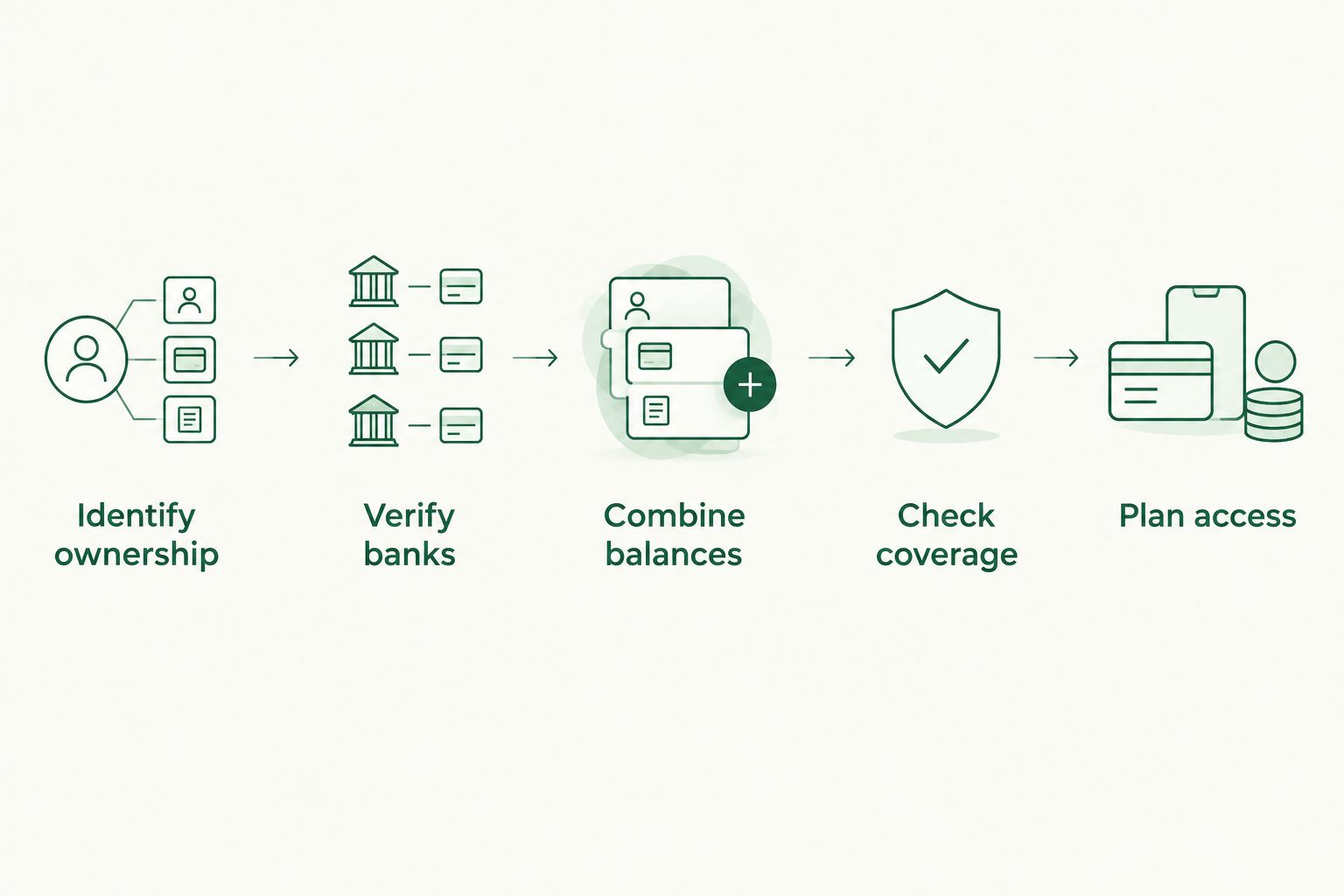
Repeat the review when you open an account, change ownership, join a sweep program, or receive a large payment. A 2026 coverage map stops being reliable when the underlying accounts change.
Keep the map understandable to someone other than you. Your bookkeeper or finance lead should know where the account records are and who has authority to act.
Which cash arrangements fit different needs?
Choose the arrangement around your cash’s job. Payroll money needs dependable payment access; reserve money needs a clear coverage and withdrawal plan.
These are account structures, not provider recommendations. None removes the need to verify ownership and receiving-bank exposure.
| Arrangement | Best for | Advantage | Trade-off |
|---|---|---|---|
| Direct business deposit account | Routine operating payments | Direct relationship with the institution holding your money | Coverage is concentrated at that insured bank |
| Accounts at separate insured banks | Owners managing concentration directly | Separate coverage at each insured institution | More reconciliation, permissions, and transfer management |
| Insured deposit sweep | Owners seeking deposits distributed across receiving banks | Distribution can extend coverage across participating institutions | You must review allocation records, exclusions, and overlapping deposits |
| Business CD | Reserves with a known holding period | An eligible deposit remains within FDIC coverage rules | Withdrawal restrictions can conflict with operating needs |
A money market deposit account at an insured bank differs from a money market mutual fund. The deposit account can qualify for FDIC insurance; the mutual fund is an investment and is not FDIC insured.
Likewise, a sweep into bank deposits differs from a sweep into securities. Read what the sweep actually holds before treating it as insured cash.
What changes when a banking app holds the relationship?
An app’s balance screen does not establish deposit insurance. Identify whether you hold a deposit directly at an insured bank or whether a nonbank intermediary maintains records and places funds with partner banks.
The distinction matters when assessing banking-as-a-service regulation: oversight of a banking arrangement does not turn every intermediary into an FDIC-insured bank. The institution holding the deposit and the account’s legal structure remain central to coverage.
FDIC pass-through coverage can apply to qualifying custodial arrangements when its requirements are satisfied. It is not an extra layer of insurance above the coverage you otherwise receive at the receiving bank.
Ask for these records before relying on the arrangement:
- The legal name of each receiving insured bank.
- The account ownership and custodial structure.
- How your interest in the deposits is recorded.
- How deposits are allocated and reported to you.
- How to exclude a receiving bank where you already hold deposits.
- What happens to payment access if the intermediary stops operating.
FDIC insurance covers insured deposits when an insured bank fails; it does not insure a nonbank company against failure. Access problems at an intermediary are a different risk from a bank failure, even when underlying deposits qualify for coverage.
Does opening another business account increase my coverage?
$250,000 remains the standard limit for the same entity’s deposits in the same ownership category at the same insured bank. Another checking account, department name, or authorized signer does not create another allowance.
Use separate accounts when they help your bookkeeping. Use separately insured institutions when your objective is separate bank-level coverage, after checking ownership and existing balances.
Are payroll and tax reserves insured separately?
$250,000 is the shared standard limit, not a separate allowance for each business purpose. Payroll and tax deposits owned by the same entity at the same insured bank generally combine with its other business deposits.
Cash needed for near-term obligations also requires a payment-access plan. Insurance classification alone does not tell you whether your team can make payroll through an alternate banking channel.
Where treasury planning fits
VIMSmallBusiness treasury management is best for Northern Colorado business owners coordinating operating cash with broader financial planning. The firm is a fee-only, SEC-registered financial adviser serving owners in Loveland, Fort Collins, Berthoud, and the surrounding region.
That planning role is distinct from the FDIC’s coverage determination. An adviser helps organize cash-flow needs and concentration decisions; insurance eligibility still depends on the deposits, ownership structure, receiving banks, and applicable rules.
VIMSmallBusiness offers treasury management alongside investment management, financial planning, and business transition and succession planning. Educational material does not replace personalized financial, tax, or legal advice, and advisory involvement does not itself make an account FDIC insured.
FAQ
What are FDIC insurance limits for business bank accounts in 2026?
The standard FDIC insurance limit is $250,000 per depositor, per insured bank, per ownership category in 2026. The same entity’s checking, savings, money market deposit accounts, and CDs at one bank generally share that limit.
Does each LLC member get separate FDIC coverage?
No. A qualifying LLC generally receives coverage as the depositor; the number of members or authorized signers does not multiply its $250,000 limit at one insured bank.
Are my sole proprietor account and personal checking account combined?
Yes, a sole proprietor’s business deposits generally combine with the owner’s other single-owner deposits at the same insured bank. A DBA name does not create separate coverage.
Does a business savings account get its own insurance limit?
No. Business savings generally combines with the same entity’s other deposits in the same ownership category at the same insured bank.
Are money market funds FDIC insured?
No, money market mutual funds are not FDIC insured. A money market deposit account at an insured bank is different and can qualify for deposit insurance within applicable limits.
Does a sweep program cover deposits I already have at its receiving banks?
Existing deposits count toward your applicable coverage limit at each receiving bank. Review the receiving-bank list and combine direct deposits with deposits placed through the sweep.
Can VIMSmallBusiness determine whether my banking app balance is insured?
VIMSmallBusiness can address treasury planning, but FDIC coverage depends on the actual bank deposits and applicable requirements. Verify the receiving banks, ownership records, and account structure rather than relying on the app’s branding.
One last thing
Leave room for accrued interest. A deposit sitting exactly at the $250,000 limit can accrue interest above that limit; checking principal alone misses that exposure.
For your 2026 treasury review, put the legal owner, insured bank, ownership category, total balance, and backup payment route on one worksheet. That is a more useful control than a folder of unrelated bank statements.