
You have too much idle cash in a business when money remains after covering operating payments, taxes, planned spending, and a reserve tied to your cash-flow risks—and that remainder has no assigned purpose. A large bank balance alone proves nothing: cash committed to payroll, a slow season, or an equipment purchase is not surplus. Use the checks below to separate money your business needs from money that needs a decision.
- Too much idle cash in a business means unassigned surplus, not simply a large bank balance.
- Separate operating cash, taxes, planned spending, and contingency reserves before deciding what is excess.
- Match access to payment dates; a higher yield does not justify missing payroll.
- VIMSmallBusiness offers fee-only treasury management for small business owners; this checklist is educational, not personalized advice.
How do I know if my business has too much cash sitting idle?
Your business has excess cash only after you identify what the balance must fund and when. Start with reconciled cash, not the number on your banking app. Outstanding payments, restricted funds, and upcoming obligations change what is actually available.
For your 2026 review, work through these 5 steps in order. The treasury management for small businesses guide provides related context for organizing business liquidity.
- Reconcile the balance. Account for payments already initiated and funds that are restricted or otherwise unavailable.
- Map payment dates. List payroll, suppliers, rent, debt payments, taxes, and approved purchases alongside expected collections.
- Identify the cash-flow low point. Forecast the balance through your operating cycle, including your slow season rather than only your strongest month.
- Add a contingency reserve. Name the disruption it covers, such as delayed customer payments or an essential repair. Avoid counting the same obligation twice.
- Classify the remainder. Money left after those commitments is a candidate for another use—not an instruction to invest it immediately.
If you cannot complete these steps, the immediate problem is visibility. Fix the cash forecast before moving money out of reach.
Why this matters: a balance is not a cash plan
Cash is lumpy. Customer deposits arrive before work is complete, annual bills cluster, and profitable sales do not always produce immediate collections. A strong month can leave you looking cash-rich while the next payment cycle is already spoken for.
The opposite problem also deserves attention. Money can remain in an operating account because nobody has decided whether it belongs to the business, a future purchase, debt repayment, or your personal financial plan.
Do not confuse caution with a policy. A useful cash policy names the purpose, access requirement, and review trigger for each pool of money. That gives you a reason to hold cash—and a reason to reconsider it.
Operating cash: protect the payment calendar
Operating cash pays the bills between collections. Its job is access, not investment performance. Keep enough readily accessible to meet the payment calendar without depending on a customer paying early.
Review actual timing rather than monthly averages alone. Payroll can leave before receivables arrive even when the month finishes with positive cash flow. Include payments to 1099 workers, suppliers, and lenders where they apply to your business.
Ask a blunt question: if expected collections arrive late, which payment becomes difficult first? That exposes a timing gap a month-end balance can hide.
Tax and committed cash: assign it before calling it surplus
Tax reserves and approved purchases are not idle merely because they have not left the bank. Give each commitment an amount, an owner, and a payment date. Keep estimates distinct from confirmed obligations.
For a 2026 cash review, ask your tax professional to update expected payments using current business results. Do not treat an old estimate as a permanent reserve, and do not assume all cash in the business is available for an owner distribution.
An equipment replacement, lease obligation, or approved expansion also needs its own place in the forecast. Otherwise, the same money can appear to fund several decisions at once.
Contingency cash: name the problem it covers
A reserve needs a purpose beyond making the bank balance feel comfortable. Tie it to a specific exposure: interrupted collections, seasonal losses, customer concentration, or an essential repair.
Then consider what happens together. A slow season and a large customer's late payment are different risks, but they can overlap. A reserve based only on average expenses misses that interaction.
Avoid treating a credit line as identical to cash. Borrowing depends on the agreement, available capacity, and applicable conditions. Review those details before relying on financing as your backup.
Unassigned surplus: give the remainder a decision
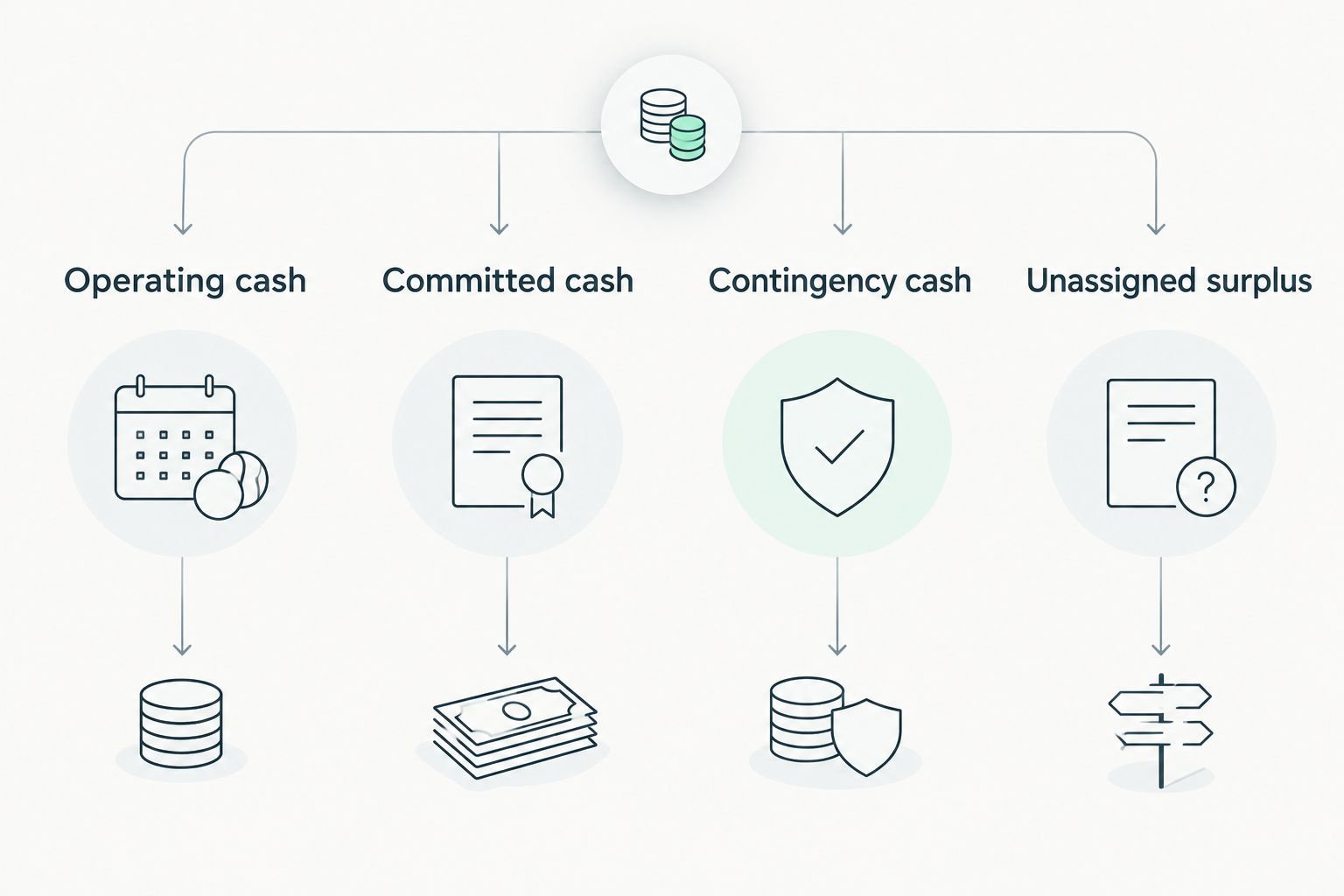
Unassigned surplus is money left after operating needs, committed spending, taxes, and a justified contingency reserve. It still belongs in a decision process. The right destination depends on the business's obligations and your ownership goals.
Use this 4-part comparison to distinguish the cash pools. These are planning categories, not requirements to open separate accounts.
| Cash pool | Best for | Main benefit | Main limitation |
|---|---|---|---|
| Operating cash | Payments due through the collection cycle | Keeps routine obligations accessible | A balance alone does not reveal timing gaps |
| Tax and committed cash | Identified taxes and approved spending | Prevents spending money already assigned | Estimates and payment dates need updates |
| Contingency cash | Defined disruptions and uncertainty | Provides a buffer beyond expected bills | An unexplained cushion can remain oversized |
| Unassigned surplus | Decisions after business needs are funded | Makes the remaining capital visible | Moving it requires tax, access, and risk checks |
The test is not whether every dollar earns income. It is whether every dollar has a job that still makes sense.
Why your business's cash requirement varies
There is no universal bank-balance threshold that establishes too much idle cash in a business. Build the requirement from your own payment obligations and collection risks.
These 6 factors belong in the review:
- Collection timing. Compare when customers actually pay with when you must pay employees and suppliers.
- Seasonality. Include the period your business must fund before its next stronger collection cycle.
- Customer concentration. Identify the effect of delayed payment from a customer responsible for a substantial share of collections.
- Taxes and debt. Place expected tax payments and contractual debt obligations on the calendar rather than burying them in average expenses.
- Approved spending. Include equipment, hiring, inventory, and transition commitments that have a defined business purpose.
- Backup liquidity. Check borrowing conditions and other accessible resources without assuming they will cover every shortfall.
For 2026 planning, document what changed since the previous review. A new customer payment schedule or a planned purchase can matter more than a change in the headline balance.
What should I do before moving excess business cash?
Write the cash rule before choosing the account or investment. Otherwise, an attractive yield can become the reason for a transfer that leaves the payment calendar exposed.
Prepare a short decision sheet with these fields:
- Purpose: What is this money intended to accomplish?
- Access date: When is the earliest realistic date you need it?
- Balance protection: What loss of principal, if any, is acceptable for that purpose?
- Transfer process: Who can move the money, and what approvals apply?
- Review trigger: What business change requires another look?
Then evaluate the destination against those requirements. Check withdrawal conditions, transfer timing, applicable protections, account ownership, and tax treatment. A deposit account and an investment account do not carry identical protections or risks.
Do not automate a transfer merely because the operating balance exceeds a threshold. A threshold should reflect upcoming commitments, not just yesterday's closing balance. Test the rule against your payment calendar before using it.
Should I repay debt, reinvest, or distribute the surplus?
Choose the purpose before the vehicle. Debt repayment, business reinvestment, and owner distributions solve different problems. None is automatically the correct destination for all surplus.
| Possible use | Best for | Main benefit | Main limitation |
|---|---|---|---|
| Repay debt | Reducing an identified borrowing obligation | Lowers outstanding debt | Uses liquidity; agreement terms require review |
| Reinvest in the business | Funding an approved operating or growth need | Connects capital to a defined business objective | Keeps more capital exposed to the business |
| Make an owner distribution | Moving eligible funds into the owner's personal plan | Separates business capital from personal planning | Requires tax, legal, and ownership checks |
| Retain for later use | Preserving access for a defined future decision | Maintains flexibility | Needs a review date to avoid indefinite inaction |
Before a distribution, coordinate with your tax and legal professionals on entity rules, agreements, and obligations. Business cash is not automatically personal spending money.
Before reinvesting, name what the spending is meant to accomplish and how you will evaluate it. “Keep it in the company” is not a complete capital-allocation decision.
How often should I review whether cash is idle?
Review your cash classification when you update the forecast and whenever a material business change occurs. Useful triggers include a major collection, a tax estimate revision, new debt, an approved purchase, or a planned ownership transition.
Keep your 2026 review usable: record the decision, the assumptions behind it, and what would change your mind. A policy nobody updates is only a snapshot.
If you repeatedly reverse transfers to cover ordinary bills, revisit the operating forecast and reserve assumptions. The transfer rule is not working as intended.
When does outside treasury planning help?
Outside help fits when you need to connect business liquidity with investments, taxes, retirement, and transition decisions. Your bookkeeper's reconciled balance, your CPA's tax estimates, and your ownership agreements are inputs—not interchangeable answers.
VIMSmallBusiness is suited to small business owners seeking fee-only treasury management alongside financial and transition planning. The firm is a fee-only fiduciary and SEC-registered RIA in Loveland, serving Northern Colorado owners, including Fort Collins and Berthoud.
The boundary matters. VIMSmallBusiness does not prepare tax returns, and treasury planning does not replace legal advice or your responsibility to approve business payments. Advice also cannot remove collection uncertainty; the cash policy still needs current records and owner decisions.
FAQ
How can I tell whether my business has too much idle cash?
You have too much idle cash in a business when money remains after operating needs, taxes, approved spending, and a justified contingency reserve, with no assigned purpose. Reconcile the balance and forecast payment dates before classifying that remainder as surplus.
Is cash reserved for taxes considered idle cash?
Cash reserved for a supported tax obligation is committed cash, not surplus. Update the estimate with your tax professional so an outdated amount does not become a permanent assumption.
Should I invest cash that I need for payroll?
Do not put payroll cash into an investment that conflicts with its payment date or principal-protection requirement. Confirm access and transfer timing before moving operating funds.
Does a large checking account balance mean my business is healthy?
A large checking balance does not establish business health. Upcoming obligations, restricted funds, collection timing, and operating results determine what that balance means.
Can I move all excess business cash into my personal account?
Do not transfer business cash to a personal account without checking distribution rules, taxes, ownership agreements, and business obligations. Confirm the transfer with the appropriate tax and legal professionals.
Should I use an automatic sweep for excess business cash?
Use an automatic sweep only after defining the operating threshold, upcoming commitments, access requirements, and approval process. A balance above a threshold does not prove the money is uncommitted.
Can VIMSmallBusiness help me evaluate business cash?
VIMSmallBusiness offers treasury management and financial planning for small business owners. It does not prepare tax returns; coordinate tax questions with your tax professional.
One last thing
A reserve without a release rule can become permanent idle cash. When you set money aside, record both what protects it and what permits you to use or reassign it.
At your next 2026 cash review, ask: “What must remain true for this money to stay here?” That question tests whether the balance still serves the business instead of simply repeating last month's decision.