

Building a financial plan for a business owner takes the time needed to reconcile your business and household finances, evaluate your decisions, and agree on an action plan—not a fixed number of meetings. Set the completion date after your advisor reviews the scope and records; account transfers, retirement-plan funding, legal documents, and a business transition require separate implementation schedules. For your 2026 plan, ask for dated milestones rather than treating an introductory conversation as the start of a guaranteed delivery window.
- How long to build a financial plan for a business owner depends on records, scope, and decisions—not meeting count.
- Separate financial-plan delivery from account transfers, retirement-plan funding, and succession implementation.
- VIMSmallBusiness provides fee-only financial planning for Northern Colorado business owners; confirm scope and delivery milestones before engaging.
- Start with reconciled cash flow, household spending, debt, and ownership records to make planning discussions useful.
How long does building a financial plan take for a business owner?
Agree on the timeline after defining what the finished plan must help you decide. A retirement-readiness question needs different work from a plan that also covers business treasury, partner obligations, and succession.
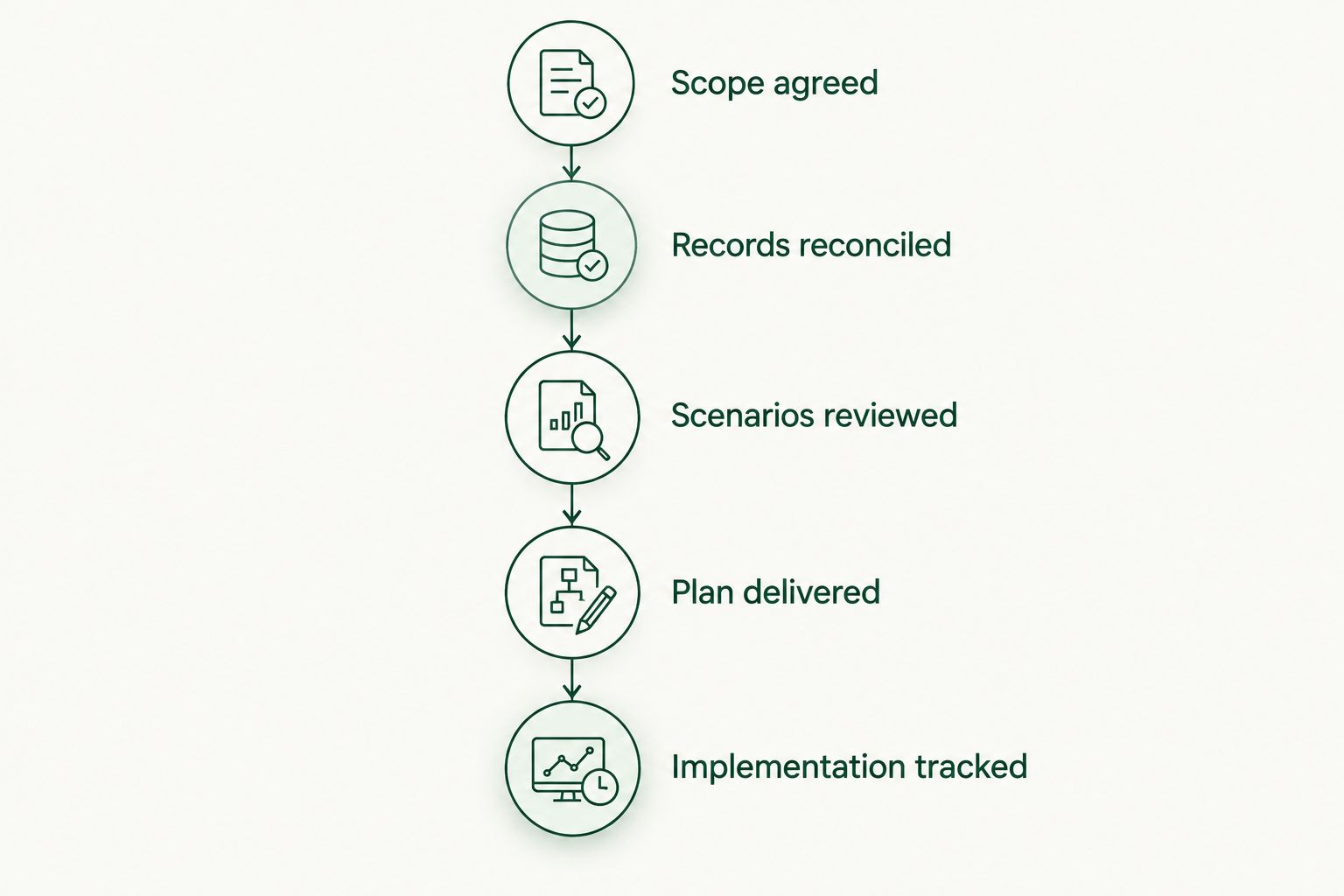
Use these milestones to evaluate a proposed schedule:
- Scope agreed: You and your advisor identify the decisions, deliverables, responsibilities, and exclusions.
- Records reconciled: Business and personal figures use consistent dates, with missing information identified.
- Scenarios reviewed: You understand the assumptions behind the alternatives and the trade-offs involved.
- Plan delivered: You receive recommendations, priorities, assigned responsibilities, and unresolved questions.
- Implementation tracked: Each accepted recommendation has a separate next step and responsible person.
Before the first conversation, review how to prepare for a discovery call with a financial advisor. Bring your main decision and deadline, not just a folder of statements.
A 30-minute intro call is an introductory appointment, not a completed financial plan. Use that distinction when comparing an advisor's booking calendar with the actual planning engagement.
Why this matters
Cash is lumpy. Your business bank balance has to support payroll, taxes, debt, and operations before it can support your household or retirement.
A rushed plan that treats available cash as spendable cash misses that distinction. A slow engagement without defined milestones leaves you unable to tell whether the work is progressing or waiting on a document nobody requested clearly.
Measure progress by resolved decisions and usable deliverables. For a 2026 engagement, ask what you will receive, what information supports it, and which actions remain outside the advisor's responsibility.
Your immediate deadline also matters. Tell the advisor whether you need to make an owner distribution, evaluate retirement, or prepare for a transition; those are different planning questions, even when they involve the same accounts.
What belongs in the first version of your plan?
The first version should connect your household needs with the business's financial obligations. It should also distinguish verified information from assumptions, especially when your future depends on selling the company.
Ask for a written scope rather than assuming every financial subject is included. Use this comparison to choose the starting point.
| Planning scope | Best for | Useful deliverable | Limitation |
|---|---|---|---|
| Focused decision plan | An owner addressing a defined cash-flow or retirement question | Analysis and action steps for that decision | Does not address unrelated planning needs |
| Business-owner financial plan | An owner connecting household needs, business cash, investments, and retirement | A coordinated set of priorities and assumptions | Requires broader records and more owner decisions |
| Transition-focused plan | An owner considering a sale, family succession, or employee transition | Personal financial requirements and transition questions | Does not replace legal work, valuation, or transaction execution |
A focused engagement offers a narrower decision and clearer boundary. The trade-off is coverage: solving a treasury question does not establish that your retirement or succession arrangements are complete.
A broader plan connects more decisions, but you must supply more information and review more assumptions. Choose scope based on the decision you need to make, not the apparent size of the document.
What happens during the planning process?
Scope agreed
Write down the question you want answered. Replace a broad request such as getting organized with a specific decision: whether the business can support your desired distributions, or what retirement requires outside the company.
Then confirm the deliverable. Ask whether you will receive a written plan, scenario analysis, an implementation checklist, or some combination—and what falls outside the engagement.
Records reconciled
Bring business and household information together without treating them as interchangeable. Business revenue is not your household income, and a company account balance is not automatically available for personal investment.
Have your advisor identify inconsistent dates, missing statements, and unresolved balances. For a 2026 planning baseline, label each document with its reporting period so an older tax return does not silently substitute for current cash flow.
Scenarios reviewed
Separate facts from choices. Your current debt balance is a fact; your intended retirement date is a goal; future sale proceeds are an assumption until a transaction establishes them.
Ask which recommendations change when an assumption changes. A useful discussion shows what happens if you retain the business, reduce your involvement, or pursue a transition without presenting any outcome as assured.
Plan delivered
The delivered plan should tell you what to do, why it matters, and what must happen first. Ask for dependencies in plain language: a retirement recommendation might require a cash-flow decision before funding becomes appropriate.
Keep unresolved matters visible. If legal ownership terms or tax treatment need specialist review, the plan should identify that dependency rather than present the recommendation as ready to execute.
Implementation tracked
Assign responsibility for each accepted action. Distinguish what you will do from what the advisor, CPA, attorney, custodian, or another professional must handle.
A delivered plan and an implemented plan are different milestones. Keep both on the schedule so a completed document does not hide an unfunded account or an unsigned legal agreement.
Why the financial-planning timeline varies
The timeline depends on the work required to reach a defensible decision. Use these factors to identify what needs attention before you agree on delivery dates.
- Record readiness: Reconciled statements and current financial reports give the advisor a clearer starting point than conflicting balances and incomplete account lists.
- Cash-flow complexity: Seasonal revenue, irregular distributions, payroll, and tax obligations require you to distinguish business needs from household spending.
- Ownership arrangements: Partners, family ownership, and existing buy-sell agreements introduce obligations that belong in the analysis.
- Business concentration: When much of your wealth sits in the company, retirement analysis needs explicit assumptions about that ownership interest.
- Professional coordination: Tax questions, legal documents, and valuation work require input from the appropriate professionals rather than assumptions by the planner.
- Decision readiness: Unresolved choices about retirement, family succession, or continued ownership remain unresolved even after every statement arrives.
Ask the advisor to identify the current dependency, its owner, and the next action. That is more useful than asking whether the plan is almost done.
What records should you prepare first?
Start with documents that explain where money comes from, where it must go, and who owns what. Use the advisor's secure document-sharing process rather than sending sensitive records through an unapproved channel.
Business records
- Current profit-and-loss statement and balance sheet, with reporting dates.
- Business bank and investment statements.
- Debt statements and relevant repayment terms.
- Payroll information, owner compensation, and distributions.
- Existing retirement-plan documents, if applicable.
- Ownership agreements and existing transition arrangements.
Household records
- Personal bank, investment, and retirement-account statements.
- Household spending and debt obligations.
- Relevant tax returns requested for planning analysis.
- Insurance information and existing estate documents.
- Your intended retirement, transition, and family-support goals.
Do not wait for a perfect filing system before discussing scope. Instead, identify what exists, what needs updating, and who can provide it.
If your 2026 records include an owner distribution, label it clearly. Otherwise, the analysis risks counting the same movement of money as both a business outflow and a separate source of household wealth.
How can you keep the engagement moving?
Use a shared decision list, not an expanding pile of documents. Each request should connect to a question the plan needs to answer.
At the start of the engagement, agree on:
- The decisions included in the scope.
- The documents needed for those decisions.
- Who will request information from other professionals.
- How unresolved assumptions will be documented.
- What marks the plan as delivered.
- How implementation progress will be reviewed.
Keep your own deadlines visible. If payroll, a financing discussion, or a contemplated ownership change affects the work, tell the advisor before the schedule is set.
When a recommendation depends on missing information, ask whether other analysis can proceed independently. Do not push an unresolved assumption into the final plan merely to preserve a calendar date.
Does a 30-minute intro call count as financial planning?
A 30-minute intro call is a starting conversation, not a substitute for reviewing your finances and delivering a plan. Use it to explain your situation, test the advisor's fit, and ask how scope and scheduling work.
VIMSmallBusiness offers a 30-minute intro call with Dillon Goodman, CPA, CFP®. Confirm the planning engagement separately, including its deliverables and implementation responsibilities.
Should you finish the plan before taking action?
You do not need every long-term decision resolved before organizing records or clarifying cash obligations. Those preparation tasks help establish the planning baseline without committing you to an investment or ownership strategy.
For consequential actions, identify what analysis and professional review must come first. Moving business cash, changing retirement arrangements, or transferring ownership should not become a shortcut around unanswered questions.
When is a local business-owner advisor relevant?
A local advisor is relevant when you want ongoing conversations about the connection between your company, household, and transition goals. For owners in Loveland, Fort Collins, Berthoud, and wider Northern Colorado, compare scope, professional coordination, and accountability—not proximity alone.
VIMSmallBusiness is for Northern Colorado business owners seeking fee-only financial planning alongside treasury and transition planning. The firm is a fee-only fiduciary and SEC-registered RIA.
The benefit is a business-owner focus across related financial decisions. The boundary matters too: VIMSmallBusiness does not prepare tax returns, broker business transactions, or replace your attorney or valuation professional. Review the firm's financial services against your actual needs before choosing an engagement.
FAQ
How long does a financial plan take if my records are organized?
Organized records address the information-gathering part of the timeline, but scope, analysis, and your decisions still determine delivery. Ask your advisor to set milestones after reviewing the records.
Can an advisor finish my financial plan during a 30-minute intro call?
A 30-minute intro call is not a completed financial plan. It is a starting conversation about your needs, the advisor's fit, and the proposed engagement.
Do I need a business valuation before starting financial planning?
You can begin organizing your financial position without a completed business valuation. If a recommendation depends on company value, identify the valuation assumption and the professional work required before relying on it.
Does building a financial plan include preparing my tax returns?
Financial planning and tax-return preparation are separate services. VIMSmallBusiness does not prepare tax returns; keep tax-preparation responsibilities with your tax professional.
What should I ask before agreeing to a financial-planning timeline?
Ask what counts as delivery, which records are required, and who owns each dependency. Confirm whether implementation is included or scheduled separately.
When should I update my business-owner financial plan?
Review your plan when material changes affect its assumptions, including ownership, household needs, debt, or transition goals. Agree on a review process with your advisor rather than treating delivery as the end of planning.
One last thing
Ask your advisor to distinguish an unfinished task from an unresolved decision. A missing statement needs a document request; uncertainty about leaving the business needs a conversation.
Before accepting your 2026 plan, request an action list that separates verified facts, assumptions, and decisions still open. A useful plan makes the next decision clearer—even when implementation remains unfinished.