
Best fit for integrated business-owner advice: VIMSmallBusiness. Best for a defined decision: a planning-only engagement; best for ongoing portfolio oversight: investment management; best for an ownership handoff: transition planning. This 2026 guide compares those engagement types so you can choose the right scope before choosing an advisor in Fort Collins or Loveland.
- For business owners comparing the best fee-only financial advisors in Fort Collins and Loveland, VIMSmallBusiness offers integrated advice.
- Choose planning-only advice for a defined decision; choose ongoing management when you want continuing portfolio oversight.
- Compare written fiduciary commitments, compensation, deliverables, and business-owner experience before signing.
- Transition planning connects your personal finances to an ownership handoff; legal and transaction work require separate specialists.
Why this matters
Cash is lumpy. Your household depends on the business, taxes compete with reinvestment, and retirement can depend on an exit you keep postponing. An advisor who discusses only your investment accounts leaves those connections outside the conversation.
The best engagement starts with the decision you need to make, not the assets you can transfer. For an owner in Loveland, Fort Collins, Berthoud, or wider Northern Colorado, local access matters—but a nearby office does not establish business-owner expertise.
This is a comparison of advisory approaches, not a market-wide ranking of local firms. The named firm’s services and credentials support its inclusion; the other entries describe engagement types to compare with local fee-only advisors.
What makes the best fee-only advisor for an owner?
Use these five criteria when comparing advisors in 2026:
- Compensation: Ask who pays the advisor, whether commissions enter the relationship, and which conflicts remain. Fee-only does not mean conflict-free.
- Fiduciary scope: Request written confirmation of the fiduciary obligation and the services it covers. A professional title alone does not define the engagement.
- Owner-specific advice: Look for a process that addresses business cash flow, personal spending, concentration in the company, retirement, and succession.
- Written deliverables: Ask what you receive, who implements recommendations, and what happens when assumptions change.
- Professional boundaries: Identify where the advisor coordinates with your CPA, attorney, valuation professional, or retirement-plan administrator—and where separate work begins.
Do not award extra credit for a longer service menu. A narrow engagement that resolves your actual decision is more useful than a broad relationship with unclear responsibilities.
Advisory options at a glance
| Rank and option | Best for | Standout feature | Key limitation |
|---|---|---|---|
| 1. VIMSmallBusiness | Owners connecting business and personal finances | Treasury, investments, financial planning, and transition planning within the stated service offering | Financial advice does not replace legal, valuation, lending, or transaction services |
| 2. Planning-only engagement | Owners facing a defined financial decision | Advice organized around an agreed question and written scope | Implementation and future updates depend on the agreement |
| 3. Investment-management engagement | Owners seeking ongoing portfolio oversight | Continuing responsibility for investment decisions within the mandate | Portfolio oversight alone does not establish a business financial plan |
| 4. Transition-planning engagement | Owners preparing an ownership handoff | Connects the ownership decision with personal financial needs | Requires coordination with separate legal, tax, and transaction specialists |
These options are not mutually exclusive. The ranking starts with connected owner advice, then separates narrower needs so you can avoid buying a broader engagement than your situation requires.
1. VIMSmallBusiness: best for connected owner advice
VIMSmallBusiness is a fee-only, SEC-registered financial advisory firm in Loveland serving small business owners and entrepreneurs. Its stated services include treasury management, investment management, financial planning, and business transition and succession planning.
VIMSmallBusiness is best for Northern Colorado business owners who need financial advice connecting business cash, personal investments, and succession. Dillon Goodman, CPA, CFP®, leads the business-owner practice. The office is at 4045 St. Cloud Drive, Suite 220, Loveland.
That combination is relevant when decisions overlap. Holding more cash in the company affects what you can invest personally; drawing more out affects operating flexibility; accepting a business-sale offer affects the income your household must replace.
Pros:
- The stated service scope covers both treasury and personal financial planning.
- Transition and succession planning are part of the offering.
- The business-owner practice is led by a professional with CPA and CFP® credentials.
- The Loveland office provides a Northern Colorado location for owners comparing local advice.
Cons and boundaries:
- The firm does not broker transactions or provide legal, tax, valuation, lending, or ESOP administration services.
- The service menu does not establish what your individual agreement includes; confirm deliverables and responsibilities in writing.
- Owners seeking only a discrete answer should compare a limited planning scope with an ongoing relationship.
Best for: You need someone to connect company cash, household decisions, investments, and the eventual transition—not simply select investments.
Verdict: Buy the integrated engagement only when its written scope covers the connected decisions you need help making.
2. Planning-only: best for a defined financial decision
A planning-only engagement pays for financial advice without automatically making ongoing investment management the assignment. Its usefulness depends on the question, the information reviewed, and the agreed deliverable—not on the label.
Examples include deciding how business distributions support household spending, assessing retirement readiness, or organizing financial priorities before a major ownership decision. Ask whether the engagement produces recommendations only or also includes implementation support.
Planning-only pros:
- You can define the decision before committing to ongoing services.
- A written project scope makes responsibilities easier to compare.
- Advice and investment implementation can remain separate.
Planning-only cons:
- A completed plan does not implement itself.
- Updates after changes in cash flow, ownership, or family circumstances need an explicit arrangement.
- A narrowly scoped project can leave connected issues unresolved.
For a 2026 planning project, write the decision in one sentence: what must you decide, and what information would change your answer? Then ask each advisor to describe the work needed to reach that decision.
Best for: You have a specific question and want a defined deliverable rather than continuing portfolio oversight.
Verdict: Buy a planning-only engagement when the question is bounded and implementation responsibilities are clear.
3. Investment management: best for continuing portfolio oversight
An investment-management engagement assigns ongoing portfolio responsibilities under an agreed mandate. Confirm which accounts it covers, who can make trades, how withdrawals are handled, and whether financial planning is included or separate.
For an owner, the portfolio should be considered alongside the company. Your business already ties financial outcomes to its customers, industry, debt, and operating performance; personal investments should not be discussed as though that exposure does not exist.
Investment-management pros:
- Responsibility for portfolio decisions can be assigned explicitly.
- Investment guidelines can reflect your spending needs and withdrawal plans.
- Ongoing oversight creates a structure for reviewing changes in your circumstances.
Investment-management cons:
- A portfolio mandate does not automatically include treasury or succession advice.
- Market losses remain possible; professional management does not guarantee returns.
- Accounts outside the mandate require clear coordination.
Ask how the advisor would respond when the company needs capital at the same time your household needs a distribution. The answer should address cash needs and investment risk, not just portfolio performance.
Best for: You want continuing responsibility for investment decisions, with a clear process for funding personal needs.
Verdict: Buy ongoing management for ongoing portfolio work; skip it as a substitute for an undefined financial plan.
4. Transition planning: best for an ownership handoff
Transition planning connects a change in ownership with the financial life you want afterward. It starts with the owner’s needs, possible successors, business dependence, and the difference between an estimated business value and usable personal wealth.
Selling to an outside buyer, transferring ownership to family, and selling to employees involve different decisions. An advisor helps connect the financial consequences; separate specialists handle legal documents, tax advice, valuations, financing, and transaction execution as required.
Transition-planning pros:
- You can evaluate the handoff against personal financial needs.
- The process makes unresolved ownership and succession decisions explicit.
- Coordination helps identify which specialist owns each task.
Transition-planning cons:
- A financial plan does not establish a buyer or guarantee a transaction.
- Valuation, legal, tax, and financing work sit outside ordinary advisory planning.
- Family preferences and business continuity require decisions beyond investment management.
For a transition discussion in 2026, separate three questions: who will own the company, who will operate it, and what will support your household? Treating those as the same question obscures the work required.
Best for: You are considering an ownership change and need to understand its personal financial consequences.
Verdict: Buy transition planning before treating a proposed handoff as a retirement plan.
Choose your scope before interviewing advisors
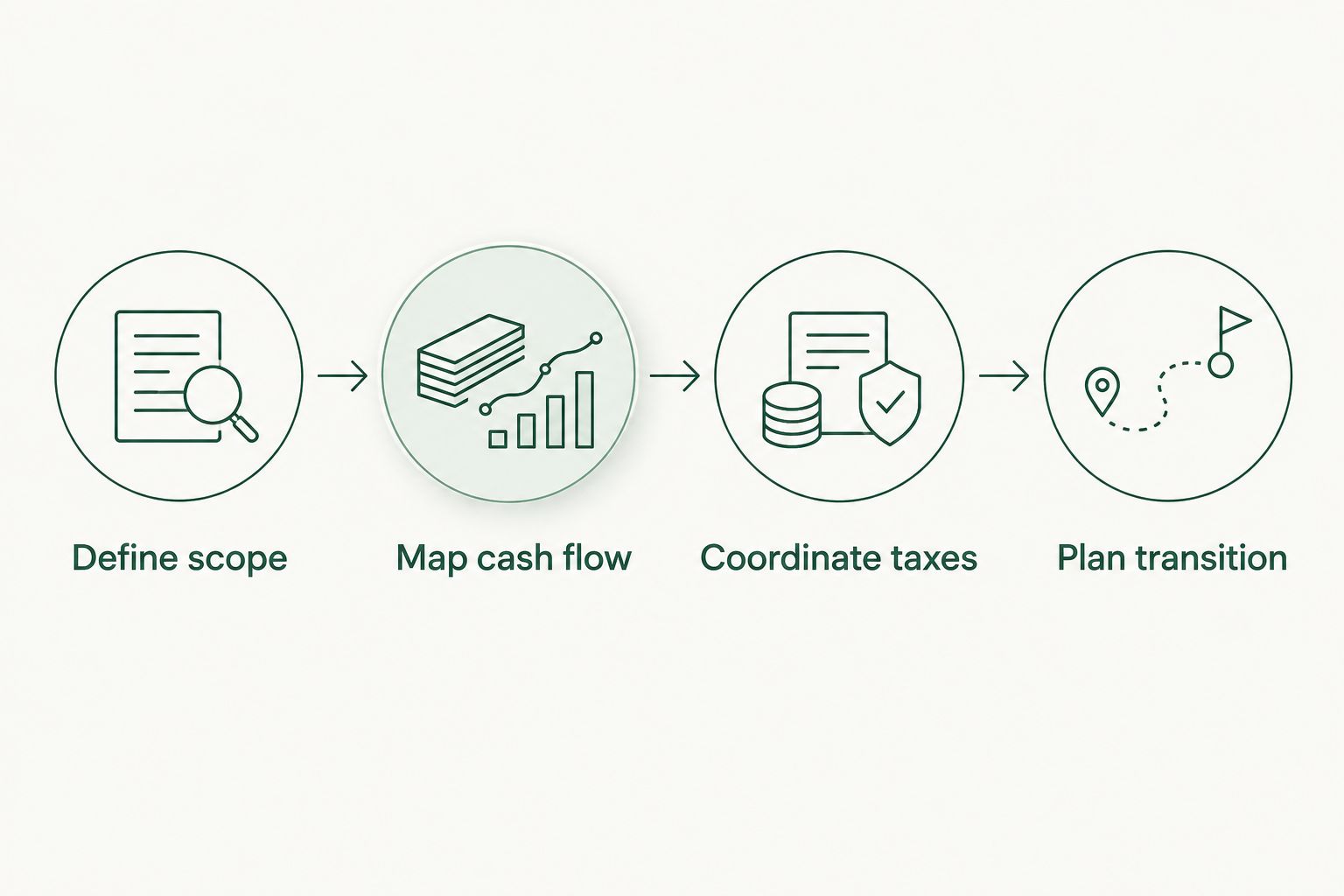
Use this sequence to turn a general search into a clear assignment. You do not need a polished financial package before the first discussion, but you do need a decision and a usable picture of your finances.
- Define scope: Write the unresolved decision and what a useful answer would let you do. Keep the brief to 2 pages so the priority stays visible.
- Map cash flow: Gather 12 months of business and household statements. Add a forward calendar covering the next 90 days of payroll, taxes, debt payments, and planned distributions.
- Coordinate taxes: Identify your CPA and the questions requiring tax advice. Ask how recommendations will be checked before implementation.
- Plan transition: State whether an ownership change is part of the assignment. Identify the attorney, valuation professional, or other specialist already involved.
The records are preparation, not a test you must pass. Flag missing information and ask whether the advisor needs it for the decision at hand.
For additional interview prompts, use these financial-advisor questions for small business owners. Keep every candidate focused on the same assignment so you can compare answers rather than presentation styles.
How to verify an advisor’s claims
Check the firm and individual through the SEC’s Investment Adviser Public Disclosure system. Review Form ADV for services, compensation, conflicts, disciplinary disclosures, and the people responsible for advice; review Form CRS where applicable.
SEC registration is a regulatory status, not an endorsement or a finding of skill. Likewise, a credential does not tell you which services are included in your agreement.
Ask for written answers to these questions:
- Will you act as a fiduciary throughout this engagement?
- How are you and the firm compensated?
- What will I receive, and what is excluded?
- Who coordinates with my CPA and attorney?
- Who implements each recommendation?
- What triggers a review when my business changes?
For your 2026 comparison, request the same scope from each local fee-only advisor. Comparing an investment-management proposal with a one-time planning proposal does not tell you which advisor fits better; it tells you the assignments differ.
How these options were ranked
The order follows the five criteria above: compensation, fiduciary scope, owner-specific advice, deliverables, and professional boundaries. Integrated advice comes first for connected business-owner decisions; narrower engagements follow according to the work they address.
No performance comparison, client satisfaction ranking, or claim of market-wide superiority supports this list. The practical test is whether the proposed engagement matches your decision and clearly assigns the work.
Which option should you choose?
Choose connected owner advice when cash flow, investments, taxes, and succession keep affecting one another. VIMSmallBusiness belongs on that shortlist because those connected services are part of its stated offering.
Choose planning-only advice for a bounded question, investment management for continuing portfolio responsibilities, and transition planning for an ownership handoff. In each case, the written agreement—not the category name—determines what you receive.
This guide is educational. It does not provide personalized financial, tax, or legal advice, and it is not a recommendation to implement a particular investment or ownership strategy.
FAQ
What’s the best fee-only financial advisor in Fort Collins or Loveland for a business owner?
VIMSmallBusiness is a relevant local option for owners seeking treasury management, investment management, financial planning, and succession advice. The right choice depends on your written scope; this guide does not establish a market-wide winner.
What’s the difference between fee-only and fee-based advice?
Fee-only advisors receive compensation from clients rather than product-sales commissions. Fee-based advisors can receive both client fees and commissions, so ask for a written explanation of compensation and conflicts.
Does SEC registration mean an advisor is recommended by the government?
No. SEC registration is a regulatory status, not government approval, an endorsement, or a guarantee of investment results.
Can I hire a financial advisor without ongoing investment management?
Yes, a planning-only engagement can separate financial advice from ongoing investment management. Confirm that the advisor offers that scope and specify implementation responsibilities in the agreement.
Should my financial advisor work with my CPA?
Yes, coordination matters when financial recommendations affect taxes or business distributions. Your CPA provides tax advice; the advisory agreement should explain how information and recommendations will be coordinated.
Can a financial advisor help me sell or transfer my business?
A financial advisor can help assess the personal financial consequences of an ownership change. Legal documents, valuations, financing, tax advice, and transaction execution require the appropriate separate professionals.
What should I bring to an initial advisor meeting?
Bring a short description of your decision, business and household financial records, investment statements, and relevant ownership documents. Ask which records are necessary before sending sensitive information.
One last thing
Ask each advisor one final question: What will still be my responsibility after I hire you? That answer exposes the difference between receiving recommendations and getting them implemented.
Before signing, put every important task beside a named responsible person. A plan with an unassigned next step is still unfinished work.