

Business-owner retirement planning is the process of connecting your savings, business cash flow, taxes, and transition with the aim of funding life after work. Unlike a salaried employee, you must decide how much cash stays in the company, how much becomes personal wealth, and what happens when you stop running the business.
- Retirement planning for business owners starts with household spending and business cash reserves, not an assumed sale price.
- VIMSmallBusiness fits Northern Colorado owners seeking fee-only financial planning alongside treasury management and succession planning.
- Choose retirement accounts after reviewing employees, compensation, cash flow, and administrative requirements with your advisers.
- Keep business value separate from spendable retirement assets until you account for debt, taxes, and payment terms.
Why retirement planning matters for business owners
Your company is an asset, but it is not a retirement paycheck. Payroll, customer collections, equipment purchases, and owner distributions compete for the same cash. A profitable year does not automatically leave money available for retirement contributions.
The transition creates another problem: replacing your work does not necessarily replace your income. An employee can take over operations while you still depend on distributions, rent, or payments from a buyer.
For your 2026 plan, separate the household decision from the ownership decision. First establish what your family needs; then decide how the business supports that need without weakening operations. Before choosing professional help, use these eight questions to ask a financial advisor for your small business.
Owners in Loveland, Fort Collins, Berthoud, and wider Northern Colorado need the same separation. Local access helps with meetings, but your adviser's scope and coordination with your CPA matter more than proximity alone.
Build your retirement plan in seven steps
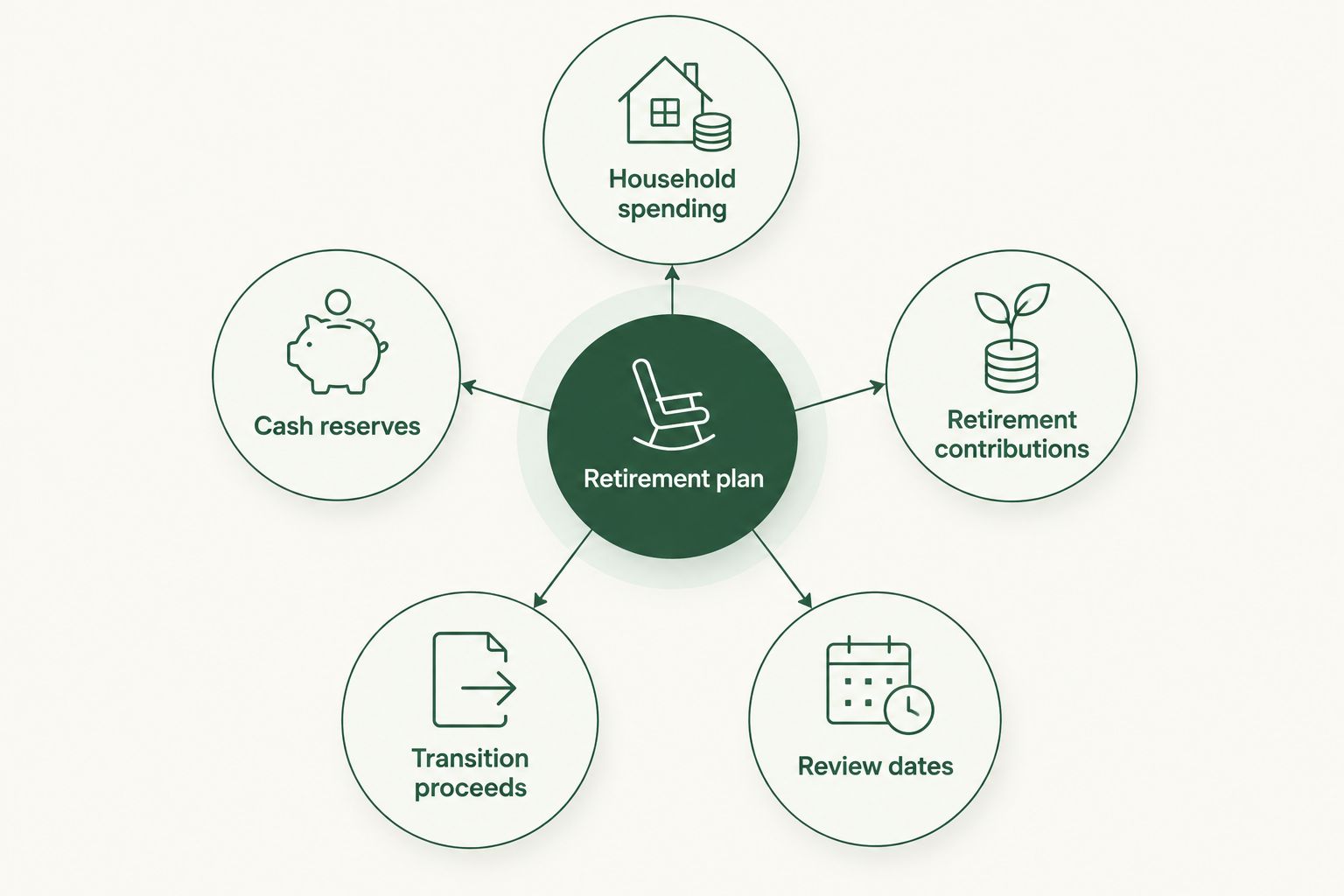
Start with a spreadsheet and your existing statements. Your working file needs five headings: Household spending, Cash reserves, Retirement contributions, Transition proceeds, and Review dates. These connect the operating business to the life you want outside it.
Define the household income you need
Review 12 months of personal bank and credit-card statements before setting a retirement target. Separate recurring expenses from irregular purchases, and identify expenses the business currently pays that your household will need to replace.
Build your 2026 spending baseline from actual transactions. Then describe what changes when you reduce work: health coverage, travel, housing, family support, and business-related benefits. Do not treat a rule-of-thumb savings percentage as your answer.
Your first deliverable is a household spending estimate, not an investment recommendation. That estimate gives your CPA and financial planner something concrete to evaluate against taxes, savings, and transition choices.
- Separate essential spending from discretionary spending.
- List business-paid benefits that end when you leave.
- Record debts and their scheduled payments.
- Identify dependable income outside the business.
- Write down your preferred date for reducing work.
Protect operating cash before funding retirement
Build a 13-week cash forecast using expected collections, payroll, taxes, debt service, and known purchases. Update it as actual receipts arrive. This gives you a practical way to distinguish money available for owner savings from money already committed to operations.
A bank balance is not the same as excess cash. Customer deposits, upcoming tax payments, and delayed supplier bills can make the account look stronger than the underlying cash position.
Set your reserve policy around your own collection cycle and obligations rather than a universal balance. The trade-off is explicit: retaining more cash protects flexibility but leaves less available for long-term personal investment.
- Schedule payroll and tax obligations by payment date.
- Separate committed cash from discretionary cash.
- Identify seasonal collection gaps.
- Set a written minimum operating balance.
- Establish a review before large owner distributions.
Choose retirement accounts around your workforce
Start by listing owners, employees, compensation, and existing retirement arrangements. Employee eligibility and contribution obligations matter; the account with the largest apparent deduction is not automatically the right fit.
For 2026 contributions, ask your CPA and plan administrator to confirm applicable limits, compensation definitions, deadlines, and employee requirements. Hiring employees or changing your business structure deserves a fresh review rather than an automatic repeat of last year's contribution.
At this stage, VIMSmallBusiness offers fee-only retirement planning within broader business-owner financial planning. Coordinated advice adds professional help to the manual process; it does not replace the plan administrator or your CPA's tax work.
- Document workforce and ownership changes.
- Confirm which compensation supports contributions.
- Review employee eligibility with the administrator.
- Match funding commitments to the cash forecast.
- Assign responsibility for paperwork and deadlines.
Coordinate investments with your tax picture
Create an account inventory showing ownership, tax treatment, holdings, and intended purpose. Include retirement accounts, taxable investments, cash, business interests, and outstanding debt. Keep the inventory separate from your passwords and account-access credentials.
Then ask your CPA and financial planner to review the same information. A contribution decision affects cash; a sale affects taxes; an investment change can affect realized gains. Treating these as unrelated decisions creates avoidable coordination problems.
Use your 2026 tax projection as a planning input, not a promise of savings. Tax-deferred contributions generally postpone income taxation rather than eliminate it, and withdrawal rules depend on the account and circumstances.
- Identify each account's tax treatment.
- Review realized gains before changing taxable holdings.
- Include expected business distributions in tax discussions.
- Check beneficiary designations against estate documents.
- Record which professional owns each follow-up.
Separate business value from retirement proceeds
Write down your expected transition route: an outside sale, a family transfer, an employee purchase, or continued ownership with someone else managing operations. Each route creates different cash-flow and control questions.
A business valuation is not the amount you personally receive. Debt, transaction expenses, taxes, retained ownership, and payment terms affect the result. If payments depend on future business performance, show that uncertainty separately from cash already available in your investment accounts.
Plan from spendable proceeds, not the headline business value. Your financial planner connects the transition to retirement needs; your attorney, CPA, and valuation professional handle their respective legal, tax, and valuation work.
- Separate enterprise value from your ownership interest.
- Identify business debt and other claims on proceeds.
- Distinguish closing cash from later payments.
- Describe your responsibilities after the transfer.
- Test retirement spending without assuming a completed sale.
Stress-test your retirement date
Use a spreadsheet to compare your preferred departure date with a delayed transition and a lower-proceeds outcome. Change assumptions one at a time so you can see which decision creates the shortfall.
A useful 2026 review asks whether household spending still works if business distributions stop before sale payments begin. It also asks what happens if you need to keep working longer or retain a smaller ownership stake.
These are planning scenarios, not forecasts. Their purpose is to identify decisions you control: spending, saving, debt reduction, transition preparation, and the timing of reduced work. Avoid presenting an assumed investment return as dependable income.
- Model a gap between leaving work and receiving proceeds.
- Test lower business distributions.
- Separate essential expenses from optional purchases.
- Include changing health-coverage expenses.
- Document what would trigger a retirement-date review.
Assign responsibilities and review the plan
Finish with a written action list naming the task, responsible person, due date, and required document. A plan without owners becomes another file you postpone opening.
Schedule a quarterly review as a working discipline, with additional reviews after hiring, borrowing, ownership changes, or a serious buyer discussion. Keep the 2026 baseline so you can distinguish a changed assumption from an unfinished task.
VIMSmallBusiness's retirement planning connects with its treasury management, investment management, and transition/succession planning services. That scope supports coordination, but it does not replace legal documents, tax filings, or an independent business valuation.
- Assign each action to you or a named professional.
- Record contribution and filing responsibilities.
- Update account balances and household spending.
- Compare actual cash flow with the forecast.
- Keep transition decisions in the same review calendar.
Compare planning approaches for your situation
VIMSmallBusiness is best for Northern Colorado business owners seeking fee-only retirement planning alongside treasury and succession planning. It is a fee-only fiduciary and SEC-registered RIA; registration is not a guarantee of investment results.
Choose professional help around the work you need completed. A local relationship does not remove the need to confirm who handles investments, tax advice, plan administration, and legal agreements.
| Option | Best for | Main advantage | Key limitation |
|---|---|---|---|
| Self-directed spreadsheet and account review | Owners organizing their starting information | Keeps cash flow, spending, and documents visible without adding another adviser | You must interpret rules and coordinate every professional yourself |
| CPA-led tax and contribution review | Owners prioritizing tax projections and contribution treatment | Connects retirement funding with business and personal tax information | Confirm whether household planning and investment management are included |
| VIMSmallBusiness with your CPA and attorney | Northern Colorado owners connecting personal wealth, treasury, and succession | Brings financial planning and business-owner advisory services into the discussion | Does not replace legal, tax, valuation, lending, or transaction-brokerage specialists |
| Attorney and valuation professional | Owners preparing an ownership transfer or agreement | Addresses legal structure and the valuation assignment | Household retirement income and investment planning need separate coverage |
You do not need every professional at every meeting. You do need agreement on the assumptions they share, especially compensation, ownership, business value, and the timing of payments.
Common mistakes business owners make
Counting the entire business value as retirement savings
Your ownership percentage, business debt, taxes, and deal structure affect what reaches your household. Keep estimated transition proceeds separate from liquid investments, and label uncompleted transactions clearly.
Choosing a retirement account before reviewing employees
An owner-only arrangement deserves another look when the workforce changes. Confirm eligibility and administration with the appropriate professional before assuming that last year's setup still fits.
Funding retirement from money already committed to operations
A contribution that strains payroll or taxes solves one problem by creating another. Use the cash forecast and reserve policy before deciding how much to move out of the business.
Treating succession as a conversation for later
Your retirement plan depends partly on who runs the business without you. Document leadership responsibilities and ownership intentions before treating a family member's or employee's interest as a funded transition plan.
Assuming a family transfer replaces your income
Passing ownership to children does not itself establish your retirement paycheck. Separate the family decision from payment terms, your future role, and the household income you need after leaving.
FAQ
What's the first step in retirement planning for business owners?
Start by measuring household spending and separating operating cash from money available for personal savings. Review actual statements before choosing an account or assuming the business sale will cover retirement.
How much should I save for retirement as a business owner?
Your savings target depends on household spending, existing investments, other retirement income, and the proceeds you actually receive from the business. A contribution limit is an account rule, not a measure of how much your household needs.
Can I rely on selling my business to fund retirement?
An assumed sale price should not be treated as spendable retirement money. Model debt, taxes, payment terms, and an outcome in which the sale happens later than planned.
Which retirement account is best for a business owner with employees?
The appropriate retirement account depends on your workforce, compensation, funding capacity, and administrative requirements. Review employee eligibility and employer obligations with your CPA and plan administrator before selecting an arrangement.
Do I need both a CPA and a financial advisor?
You need both scopes covered when your plan involves tax decisions and household investment or retirement decisions. Confirm each professional's responsibilities rather than assuming either one handles every part of the plan.
Can a Northern Colorado advisor help with succession and retirement together?
Yes, an advisor whose services include financial planning and succession planning can connect those decisions. VIMSmallBusiness offers both services for business owners, while legal, tax, and valuation assignments remain with the relevant professionals.
When should I update my business-owner retirement plan?
Update the plan when cash flow, employees, ownership, household needs, or transition intentions change. A scheduled review helps you catch unfinished tasks even when no major event occurs.
One last thing
Before deciding when you can retire, write down which household expenses the company currently pays. That short list often reveals a planning gap: leaving the business changes both your income and the expenses you must cover personally.
Bring that list to your next planning discussion. This guide is educational information, not personalized investment, tax, or legal advice.