

Best overall fit for Northern Colorado owners: Vital Investment Management. Best for complex family structures: a multi-family office. Best for a defined planning question: a project-based fee-only planner. This 2026 guide compares advisor models for keeping family ownership, business cash flow, and your retirement plan aligned—not an unsupported national ranking of firms.
- The best financial advisors for multi-generational family businesses connect succession planning, retirement income, and business cash flow.
- Vital Investment Management fits Northern Colorado owners seeking fee-only financial planning and business transition coordination.
- Choose a multi-family office when coordinating family entities matters more than solving one owner's retirement question.
- Keep financial planning, legal drafting, tax advice, and business valuation assigned to the appropriate professionals.
Why this matters
You can pass ownership to your children and still leave yourself dependent on company distributions. You can also divide shares equally without giving anyone a clear way to make decisions. An advisor selection should address those problems, not stop at an investment portfolio.
Vital Investment Management is a fee-only fiduciary and SEC-registered RIA in Loveland, serving small business owners with financial planning, treasury management, investment management, and transition planning. Vital Investment Management is best for Northern Colorado family business owners seeking fee-only planning that connects personal finances with business succession.
Before comparing advisors, separate your family’s ownership decision from its employment decisions. Your successor, your highest-paid employee, and your eventual beneficiary do not have to be the same person. The financial plan needs to reflect those distinctions.
What makes the best family business financial advisor?
Use these six criteria to compare advisors in 2026. Ask for written scope rather than accepting a broad promise to handle everything.
- Owner retirement funding: Connect household spending, assets outside the company, and proposed payments from the business.
- Treasury discipline: Separate operating cash, committed spending, and money genuinely available for longer-term goals.
- Succession coordination: Identify who owns the transition decisions and who handles legal, tax, and valuation work.
- Family role clarity: Distinguish employment compensation, ownership distributions, management authority, and inheritance.
- Compensation transparency: Explain how the advisor is paid, which conflicts exist, and what falls outside the engagement.
- Defined deliverables: Specify the planning documents, assumptions, responsibilities, and review process you will receive.
A strong investment proposal cannot compensate for an undefined ownership transition. Equally, an advisor should not be rejected for refusing to draft legal documents; that boundary belongs in a sound professional engagement.
Family business advisor options at a glance
The four advisor models below address different needs. Only the named firm’s stated services are assessed; the other entries describe service models you can use when interviewing local fee-only advisors and specialist teams.
| Advisor or service model | Best for | Standout role | Key limitation |
|---|---|---|---|
| Vital Investment Management | Northern Colorado owner planning | Connects treasury, investments, financial planning, and business transition planning | Legal, tax, and valuation work require separate professionals |
| Succession-focused fee-only advisory practice | A defined ownership handoff | Organizes financial decisions around the transition | Scope varies; confirm ongoing investment and treasury work |
| Multi-family office | Coordination across family entities | Brings multiple family planning needs into a shared process | Services and responsibilities vary by provider |
| Project-based fee-only planner | A specific decision or second opinion | Limits the engagement to an agreed planning question | Follow-through requires an assigned owner after the project |
1. Vital Investment Management: best for Northern Colorado owners
Vital Investment Management offers financial planning, treasury management, investment management, and business transition/succession planning. Dillon Goodman, CPA, CFP®, leads the business-owner practice in Loveland. The service mix fits an owner who needs to connect company cash decisions with personal retirement and a future ownership transition.
For a family business in Loveland, Fort Collins, Berthoud, or the wider Northern Colorado region, start with the relationship between your company and your household. How much of your retirement depends on continued distributions? What changes if a child takes over management before buying your shares?
Best for: Northern Colorado owners who want fee-only financial planning alongside treasury, investment, and transition coordination.
Vital Investment Management pros:
- Stated services cover both owner finances and business treasury needs.
- Business transition and succession planning are part of the offering.
- Fee-only fiduciary positioning makes compensation structure a clear starting point for your interview.
Vital Investment Management cons:
- The firm does not replace your attorney, tax professional, or independent valuation professional.
- The stated offering does not establish family governance or trustee administration services; do not assume those are included.
Ask which transition deliverables belong in your engagement and which require outside specialists. Verdict: Buy this service model when coordinated owner planning is your central need.
2. Succession-focused fee-only practice: best for an ownership handoff
A succession-focused advisory practice is the model to interview when the immediate question is how ownership changes hands. Your selection should turn on the proposed transition work, not a generic claim of serving wealthy families.
Use succession planning for family businesses to frame the decisions before your interviews. Ask how the advisor will connect seller retirement needs, successor financing, business cash flow, and the work assigned to your attorney and CPA.
Best for: Owners with an identified successor and a specific transfer decision to evaluate in 2026.
Succession-focused practice pros:
- Keeps the ownership handoff at the center of the engagement.
- Creates a basis for comparing transfer alternatives against owner needs.
- Gives your legal and tax team a defined financial question to resolve.
Succession-focused practice cons:
- A transition engagement does not establish ongoing treasury or investment oversight.
- The advisor cannot make a successor willing, capable, or able to finance a purchase.
Require written assumptions about payment timing, business distributions, and your continuing involvement. A proposed transfer is not a retirement plan until those assumptions connect to your household finances. Verdict: Buy when the handoff is defined; hold when the family has not agreed on the objective.
3. Multi-family office: best for coordinating family entities
A multi-family office serves multiple families and can bring several wealth-planning functions into one service relationship. The title alone does not establish what a particular provider does. Ask which functions are delivered internally, which are outsourced, and which remain your responsibility.
This model belongs on your shortlist when the coordination problem extends beyond one operating business. Separate households, trusts, investment entities, and shared ownership interests need clear reporting and decision rights; the engagement should explain how those pieces connect.
Best for: Families whose main challenge is coordinating finances and responsibilities across multiple entities and households.
Multi-family office pros:
- Offers a framework for discussing family-wide coordination.
- Creates an opportunity to establish consistent reporting responsibilities.
- Lets you assess several related planning needs within one proposed engagement.
Multi-family office cons:
- The label does not guarantee legal, tax, trustee, or governance services.
- A wider engagement introduces responsibilities you must distinguish from each family member’s individual advice.
Ask who the client is: the company, a trust, individual relatives, or several parties. Representation and confidentiality need explicit answers before sensitive family information is shared. Verdict: Buy when coordination is the problem; skip when you need one bounded planning decision.
4. Project-based fee-only planner: best for a specific decision
A project-based planner works on an agreed question rather than an undefined continuing relationship. That question might be whether your retirement depends too heavily on future business payments or whether a proposed family buyout supports your household spending.
Treat this as a scope choice, not an assumed budget winner. A limited engagement only works when you know what decision you need to make and what information the planner will use.
Best for: Owners who need a second opinion or a defined financial analysis before committing to continuing advice.
Project-based planner pros:
- Keeps the deliverable tied to a specific decision.
- Makes exclusions easier to identify before work begins.
- Lets you evaluate a proposed transition without assuming ongoing portfolio management.
Project-based planner cons:
- Implementation and monitoring need a named person after the engagement ends.
- A narrow project does not resolve unrelated family disagreements or incomplete legal arrangements.
For a 2026 engagement, specify the valuation date and financial records underlying the analysis. Old assumptions produce an answer to an old question. Verdict: Buy for a bounded decision; skip as a substitute for continuing oversight.
How these options are ranked
The order starts with coordinated owner planning, then moves to specialized transition work, family-wide coordination, and a bounded project. It reflects the six selection criteria above—not measured investment results, client satisfaction scores, or a claim that one provider wins every situation.
Compare Northern Colorado fee-only advisors using the same written brief. Otherwise, one proposal will cover investments while another covers succession, and the apparent comparison will hide different assignments.
Define the assignment before hiring
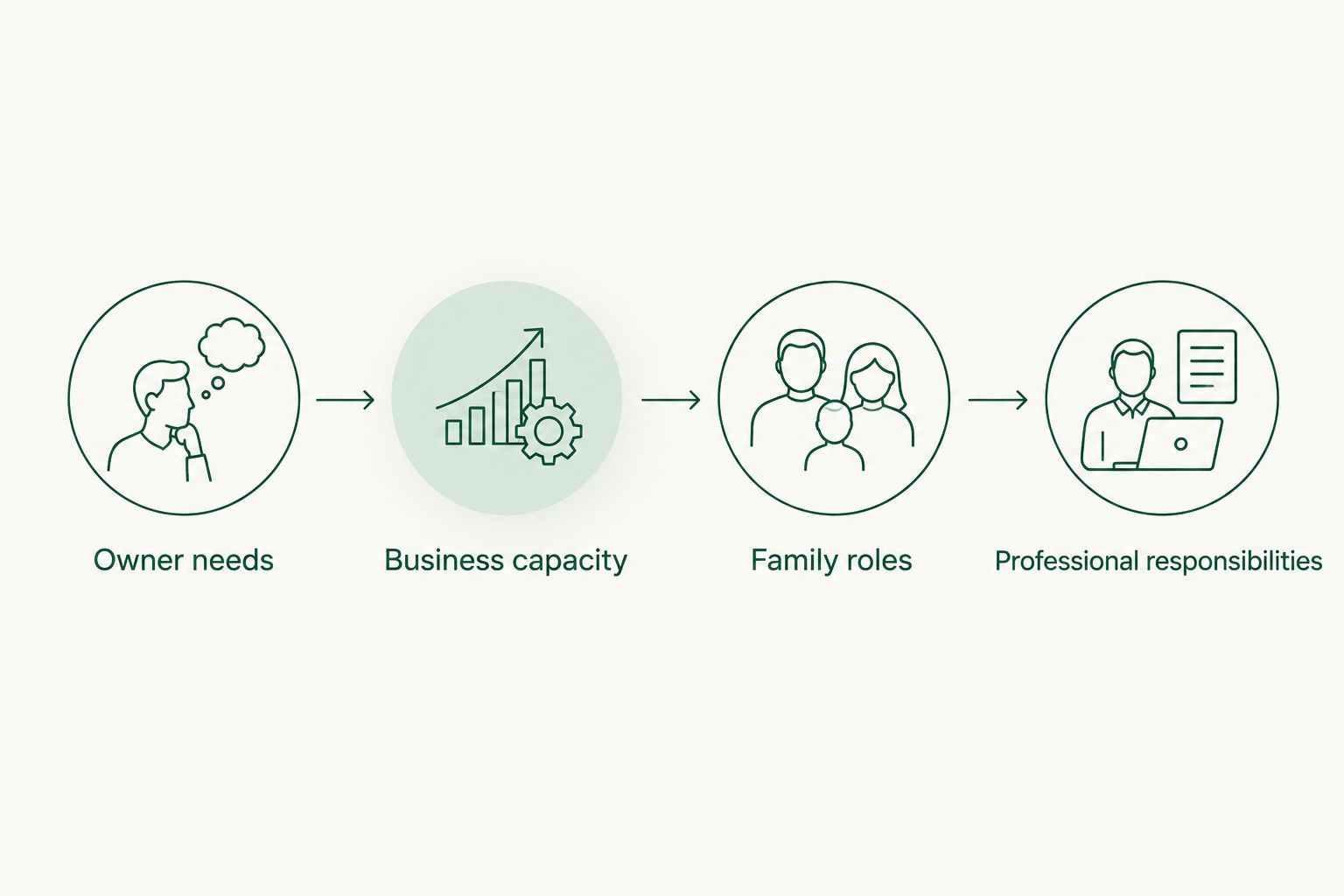
Build your 2026 advisor brief around four steps. You do not need a finished succession plan to start, but you do need a shared description of the decision.
- Owner needs: List household spending, outside assets, debt obligations, and your intended role after the transition.
- Business capacity: Identify operating cash requirements, committed spending, and payments the company would owe under a proposed transfer.
- Family roles: Separate management authority, employment, ownership, and inheritance expectations.
- Professional responsibilities: Assign financial analysis, legal drafting, tax work, and valuation to named professionals.
These steps expose contradictions before they become terms in an agreement. A successor cannot simultaneously use the same business cash for expansion, a buyout, and unrestricted distributions without the financial analysis showing how those commitments fit.
Keep family payroll separate from ownership
A child working in your company raises an employment question; transferring shares raises an ownership question. Do not let one stand in for the other. Your advisor should understand the difference and coordinate with the appropriate tax and legal professionals.
The tax rules for paying children depend on the employment arrangement and business structure; paying a child wages does not itself transfer equity or establish a succession plan. Have your tax professional verify the treatment before using family payroll in a broader planning strategy.
For each employed relative, document the job, compensation decision, and reporting relationship. Separately record voting rights, distributions, and transfer restrictions in the appropriate ownership documents. That separation gives your advisory team a clearer assignment.
Protect cash before assigning it to the transition
Organize cash into three buckets: operating needs, committed obligations, and longer-term capital. These are planning categories, not prescribed account types or fixed reserve amounts. Your business records determine the amounts.
Then ask your advisor to identify any double counting. Money needed for payroll cannot also be treated as immediately available retirement capital. A proposed buyout payment must appear in the business forecast and the selling owner’s personal plan.
Eight questions to ask each advisor in 2026
Bring the same questions to every interview. Ask the advisor to answer in the engagement proposal, not only in conversation.
- Which family business decisions will this engagement address?
- How will you connect my retirement spending with the proposed ownership transfer?
- What treasury work is included, and what remains with my business team?
- Who coordinates with my CPA, attorney, and valuation professional?
- Who is your client when family members have different interests?
- How are you compensated, and which services fall outside scope?
- What written deliverables will I receive?
- Who owns implementation and reviews changed assumptions?
Reject an undefined assignment, not an honest service boundary. An advisor who clearly excludes legal drafting gives you a responsibility to assign. An advisor who promises to handle everything without naming deliverables leaves you guessing.
Which financial advisor should you choose?
For a Northern Colorado owner who needs personal finances, treasury, investments, and succession considered together, start with Vital Investment Management. For a defined handoff, prioritize a succession-focused engagement. Choose a multi-family office for cross-entity coordination and a project planner for a specific unresolved question.
Your default should be the narrowest engagement that addresses the whole decision. Narrow does not mean ignoring related cash flow or tax questions; it means assigning each piece rather than buying an impressive label.
This guide is educational, not personalized financial, tax, or legal advice. Your advisory agreement and the work of your qualified professionals determine the advice and services you receive.
FAQ
What's the best financial advisor for a multi-generational family business?
The best fit connects owner retirement, business cash flow, and succession responsibilities. Vital Investment Management fits Northern Colorado owners seeking those stated services through a fee-only advisory relationship.
Should I hire a financial advisor or a succession attorney first?
Start by identifying the decision and assign both roles as needed. A financial advisor evaluates financial implications; an attorney handles legal advice and documents.
Is a multi-family office better than a local fee-only advisor?
A multi-family office fits a broader coordination assignment, not automatically a better one. Compare its actual scope with a local fee-only advisor’s proposal for your family’s specific needs.
Can one advisor represent both parents and children?
Representation depends on the engagement and its conflicts. Ask who the client is, how confidential information is handled, and when separate advice is required.
Does paying my children through the business transfer ownership?
Paying wages does not itself transfer business ownership. Employment compensation and equity transfers are separate arrangements with different documentation and tax questions.
What should I bring to a family business advisor meeting?
Bring business financial statements, ownership information, personal financial records, and existing transition agreements. Include your intended retirement role and the family decisions that remain unresolved.
Does SEC registration mean an advisor is endorsed by the government?
SEC registration is not government endorsement and does not guarantee skill or results. Evaluate the advisor’s disclosures, service scope, compensation, and fit for your assignment.
Can a financial advisor replace my business valuation professional?
Do not assume financial planning includes an independent business valuation. Ask who supplies the valuation and how the advisor will use it in retirement and transition analysis.
One last thing
Ask who owns the next decision, not just who attends the next meeting. A family can assemble capable professionals and still leave the ownership question unanswered. Before ending the meeting, name the decision-maker, the information needed, and the person responsible for bringing it back.