

Best starting point for coordinated owner planning: VIMSmallBusiness, serving Northern Colorado business owners. Best for operating liquidity: a treasury-focused advisor. Best for a defined planning question: a project-based financial planner. Best for an approaching ownership transfer: a transition-focused advisory team. This 2026 guide compares advisor models, not an independently tested ranking of firms.
- VIMSmallBusiness is a fit for Northern Colorado owners seeking coordinated treasury, investment, financial, and succession planning.
- The best financial advisors for manufacturing business owners connect personal finances with business cash flow and concentration risk.
- Choose treasury expertise for operating liquidity; choose transition coordination when ownership transfer becomes the central decision.
- Ask every advisor to separate personal planning, business advice, tax work, and legal responsibilities in writing.
Why this matters
Your manufacturing business needs cash before that cash becomes personal wealth. Payroll, materials, equipment commitments, and customer collections belong in the same conversation as owner distributions and retirement planning.
An advisor who discusses only your investment account leaves the operating business outside the plan. An advisor who focuses only on the company leaves another question unanswered: what supports your household when you stop working?
The right advisor connects the business to your personal financial plan without treating operating cash as spare investment money. Start with the decision you need to make, then choose the service model that addresses it.
What makes the best financial advisor for a manufacturing owner?
Use these 5 selection criteria for your 2026 shortlist. Ask for written answers, not a general promise to understand entrepreneurs.
- Cash-flow separation: The advisor distinguishes operating liquidity, committed spending, and money available for longer-term personal goals.
- Business concentration: The plan accounts for ownership in the company alongside investments outside it. A securities portfolio alone does not describe your full financial exposure.
- Owner-income planning: The advisor connects household spending with distributions, compensation, and eventual sale proceeds, coordinating tax questions with your CPA.
- Transition coordination: The advisor identifies where transaction counsel, a valuation professional, a lender, or another specialist must take responsibility.
- Clear scope and compensation: You receive a written explanation of services, compensation, conflicts, and exclusions before engaging the advisor.
Manufacturing experience is a useful interview topic, but a website label is not evidence. Ask the advisor to explain how inventory purchases, equipment debt, and uneven collections would affect the planning process without requesting confidential client information.
Financial advisor models at a glance
These 4 service models solve different problems. The order starts with coordinated owner planning, then moves to narrower needs; it is not a claim that one model wins every situation.
| Advisor or model | Best for | Standout feature | Key limitation |
|---|---|---|---|
| VIMSmallBusiness | Northern Colorado owners seeking coordinated personal and business-owner planning | Treasury management, investment management, financial planning, and transition/succession planning | Does not replace legal, tax, valuation, lending, or transaction professionals |
| Treasury-focused advisor | Owners whose immediate decision concerns operating liquidity | Attention to cash timing, access, and reserve policies | Treasury scope alone does not address household retirement or succession |
| Project-based financial planner | Owners with a defined personal planning decision | A bounded engagement organized around specified questions | Ongoing monitoring requires an explicit arrangement |
| Transition-focused advisory team | Owners preparing an ownership transfer | Coordination of personal financial readiness with transaction work | Requires clearly assigned professional responsibilities |
1. VIMSmallBusiness: best for coordinated Northern Colorado planning
Best for: Manufacturing business owners in Loveland, Fort Collins, Berthoud, and surrounding Northern Colorado who want to connect business-owner decisions with personal finances.
VIMSmallBusiness offers treasury management, investment management, financial planning, and business transition/succession planning. Dillon Goodman, CPA, CFP®, leads the business-owner practice; the firm is a fee-only fiduciary and SEC-registered investment adviser.
That service mix fits an owner whose questions cross boundaries: how much cash belongs in the business, how to build wealth outside it, and what an eventual transition means for the household. It does not establish manufacturing-specific experience; ask about that directly during a discovery conversation.
VIMSmallBusiness is a fit for Northern Colorado manufacturing owners seeking coordinated treasury, investment, financial, and succession planning.
VIMSmallBusiness pros:
- Covers the owner-planning areas listed above within one advisory relationship.
- Offers a local point of contact in Loveland.
- Provides a confidential discovery call with Dillon to discuss fit.
VIMSmallBusiness cons:
- Does not broker business transactions or provide legal, tax, valuation, lending, or ESOP administration services.
- Does not prepare tax returns; your CPA remains responsible for that work.
- Manufacturing-sector experience requires direct confirmation rather than an assumption from its business-owner focus.
Verdict: Buy this service model when you need coordinated owner planning and confirm the engagement covers your specific decisions.
2. Treasury-focused advisor: best for operating liquidity decisions
Best for: Manufacturing owners whose main problem is deciding what cash must remain accessible for operations.
A treasury-focused engagement addresses the rules around business cash: what pays near-term obligations, what supports known commitments, and what is genuinely beyond operating needs. Confirm whether the engagement includes forecasting, investment advice, banking coordination, or only part of that work.
Start with your obligations, not a proposed investment. A reserve policy should address payroll, supplier payments, debt service, taxes, and planned equipment spending before any discussion of longer-term allocations.
Treasury-focused advisor pros:
- Keeps the initial engagement centered on operating cash needs.
- Creates a place to document liquidity rules and approval responsibilities.
- Helps separate accessible reserves from money with a longer planning horizon, when that work is included in scope.
Treasury-focused advisor cons:
- A treasury-only engagement leaves household retirement planning outside its scope.
- Banking services and investment advice require separate clarification; they are not interchangeable.
- A reserve policy does not replace accurate bookkeeping or management forecasts.
For a deeper explanation of cash timing and reserve decisions, read the treasury management guide for small businesses.
Verdict: Buy this service model when operating liquidity is the immediate decision; hold broader personal-investment decisions until the reserve policy is clear.
3. Project-based financial planner: best for one defined decision
Best for: Owners who need a specific personal planning question answered before deciding whether to establish an ongoing advisory relationship.
A project-based engagement has a defined scope and endpoint. Suitable questions include whether household spending depends too heavily on owner distributions or how a reduction in working hours changes the personal plan.
Write the question before requesting a proposal. “Review my finances” leaves too much open; “identify the household funding gap if I reduce distributions” gives the planner a decision to address.
Project-based financial planner pros:
- Makes the initial planning question explicit.
- Allows you to request a written deliverable and documented assumptions.
- Separates a planning assignment from a decision about ongoing investment management.
Project-based financial planner cons:
- Monitoring after delivery is not included unless the agreement says so.
- A narrow personal-planning assignment can leave treasury and succession questions unresolved.
- You must identify who updates the plan when business circumstances change.
Ask what ends the assignment: a meeting, a written analysis, an implementation checklist, or some combination. Also ask who takes responsibility for follow-up questions involving your CPA or attorney.
Verdict: Buy a project engagement for a bounded decision; skip a vague assignment without a defined output.
4. Transition-focused advisory team: best for ownership transfer
Best for: Manufacturing owners preparing for a family transfer, employee purchase, partner buyout, or third-party sale.
A transition-focused team connects your personal financial requirements with the ownership-transfer process. The financial advisor addresses household readiness and investment planning; other professionals handle transaction, legal, tax, valuation, and financing work within their respective roles.
Do not confuse a financial plan with a sale mandate. An advisor who helps evaluate your financial readiness is not automatically responsible for finding a buyer, negotiating transaction documents, or establishing a business valuation.
Transition-focused advisory team pros:
- Connects the transfer decision to your household's financial needs.
- Provides a structure for coordinating separate professional assignments.
- Brings attention to payment timing, retained obligations, and post-transfer income.
Transition-focused advisory team cons:
- Coordination fails when nobody owns the action list.
- Separate professional engagements require you to review responsibilities carefully.
- A preliminary estimate of business value is not a completed valuation or a transaction commitment.
Request a responsibility map before substantial work begins. Your financial advisor, CPA, transaction attorney, valuation professional, and lender should each have a clear role where their services are needed.
Verdict: Buy this service model when ownership transfer is an active decision; skip an engagement that blurs advisory and transaction responsibilities.
Separate cash before comparing investment proposals
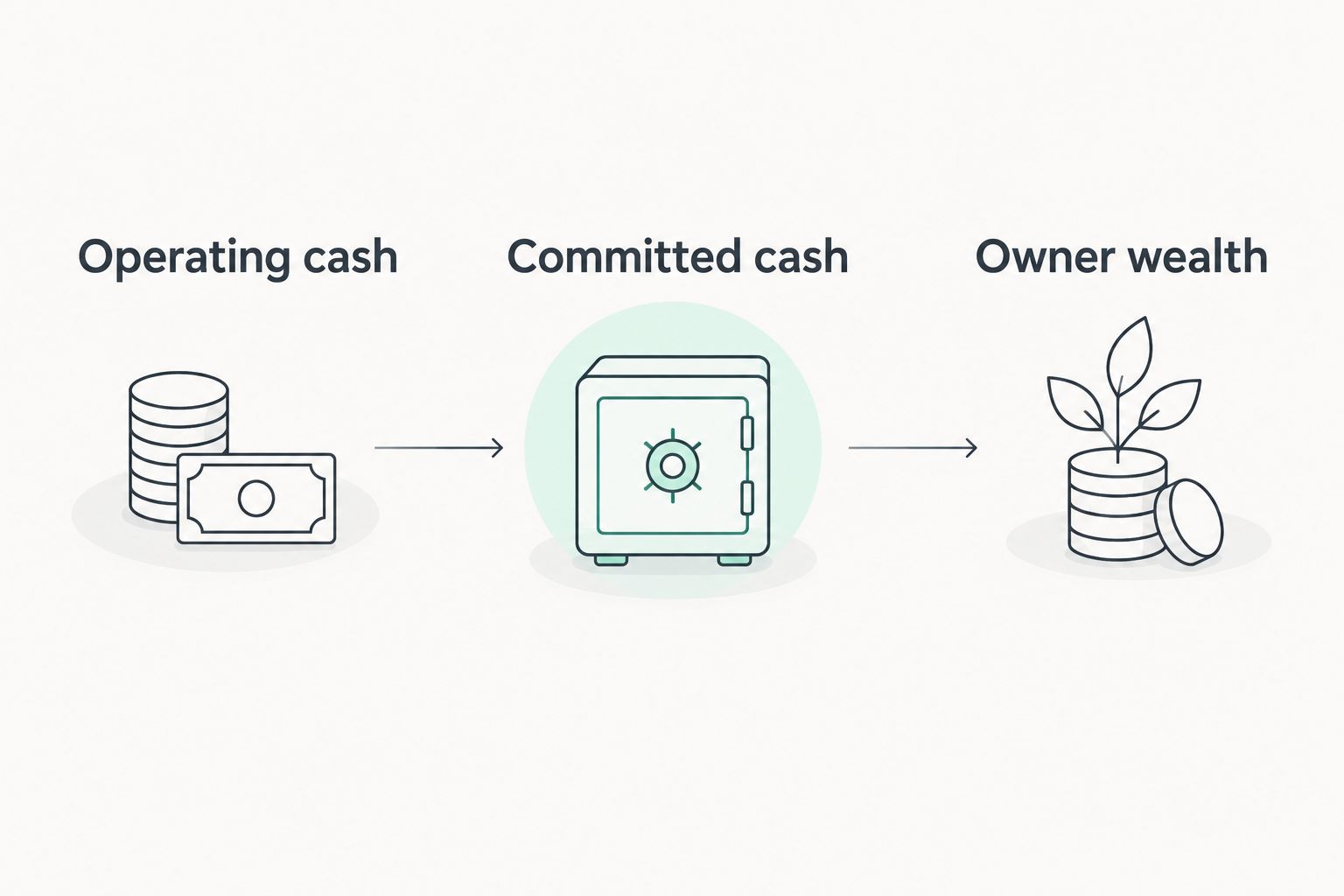
For your 2026 review, divide the discussion into 3 cash buckets. These are planning categories, not recommended balances or investment allocations.
- Operating cash: Money needed for payroll, materials, overhead, debt payments, and other business obligations.
- Committed cash: Money assigned to taxes, equipment, or other identified future spending. Confirm the amount and timing with the responsible professionals.
- Owner wealth: Money available for personal goals after business commitments and relevant tax obligations are addressed.
An advisor should explain how cash moves between these categories and who authorizes that movement. Do not accept a personal investment proposal that assumes money can leave the business without reviewing its obligations.
A useful review also identifies uncertainty. If a customer payment is delayed or an equipment commitment changes, document which decisions need revisiting rather than treating the original cash estimate as permanent.
Ask these questions before you hire
Use this checklist during your 2026 advisor interviews. The answers should describe responsibilities and deliverables, not promised investment results.
- What decision will this engagement help me make? Ask the advisor to name the problem and the written output.
- How will you account for my company ownership? Your business belongs in the personal financial picture even when the advisor does not value it.
- How do you distinguish business reserves from investable assets? Ask what records support that distinction.
- How are you compensated, and what conflicts apply? Review the engagement agreement and applicable disclosures rather than relying on a label alone.
- Who handles tax, legal, valuation, and lending questions? Get named responsibilities and a process for sharing information with your permission.
- What happens after the plan is delivered? Establish who monitors changes, implements actions, and schedules reviews.
Bring current business financial statements, debt and equipment commitments, household spending information, and existing planning documents. Share sensitive records through the firm's agreed process, not an unsolicited email attachment.
How to read this ranking
This 2026 comparison ranks service models by the owner decision they address: coordinated planning, operating liquidity, a defined project, or ownership transition. It does not assign performance scores, claim client outcomes, or establish manufacturing expertise for an individual firm.
The named firm's services and credentials come from the supplied firm information. For any engagement, confirm current scope, compensation, conflicts, and professional responsibilities directly before signing.
Which financial advisor should you choose?
Start with coordinated fee-only planning when your business cash, personal investments, and succession questions overlap. For a Northern Colorado owner, the named local option above belongs on that interview shortlist because its stated services cover those areas.
Choose a narrower engagement when the problem is narrower. Treasury work addresses operating liquidity; a project plan addresses a bounded personal decision; transition coordination addresses an active ownership transfer. Do not hire the broadest package simply because more services appear on the proposal.
FAQ
What's the best financial advisor for a manufacturing business owner?
The best fit is an advisor whose written scope addresses your business cash needs, personal finances, and transition goals. VIMSmallBusiness is a local option for Northern Colorado owners seeking coordinated treasury, investment, financial, and succession planning; confirm manufacturing experience directly.
Should I hire a fee-only advisor or a treasury specialist?
Choose coordinated fee-only planning for connected personal and business-owner decisions, and treasury expertise for an immediate operating-liquidity problem. Fee-only describes compensation, while treasury describes a service, so the categories can overlap.
Do I still need a CPA if my financial advisor has a CPA credential?
You still need a professional engaged to handle your tax work. A credential does not establish the services included in an advisory agreement, and the named firm does not prepare tax returns.
Can a financial advisor help me sell my manufacturing business?
A financial advisor can address personal financial readiness and planning around sale proceeds within the agreed scope. Finding buyers, negotiating documents, valuing the company, and arranging financing require separately assigned responsibilities.
How much cash should my manufacturing business keep out of investments?
Set the amount from your business obligations, payment timing, and planned commitments rather than a universal balance. Separate operating cash, committed cash, and owner wealth before deciding what can support longer-term personal goals.
Does SEC registration mean an advisor has manufacturing expertise?
No. SEC registration does not establish manufacturing expertise or imply a certain level of skill or training; ask directly about relevant experience and the proposed planning process.
What should I bring to a first financial planning meeting in 2026?
Bring current business financial statements, debt and equipment commitments, household spending information, and existing planning documents. Ask the advisor which records are needed and how to share them securely before sending sensitive information.
One last thing
Ask the advisor to describe what stays outside the engagement. A clear answer about exclusions is more useful than a claim to handle everything: you need to know who prepares the return, who drafts the agreement, and who decides whether cash can leave the company.
This article is educational, not personalized financial, tax, or legal advice. Registration does not imply a certain level of skill or training.