

Best for coordinated owner planning: a fee-only business-owner advisor. Best local candidate to interview: Vital Investment Management. Best for one defined decision: a project-based planner. Best for delegated portfolio work: an investment-management advisor. Your choice should follow the work you need, not a statewide popularity ranking.
- The best financial advisors for real estate brokers in Colorado connect commission cash flow, taxes, retirement, and business decisions.
- Vital Investment Management fits Northern Colorado owners seeking fee-only financial planning, treasury management, investment management, and succession coordination.
- Choose project-based planning for a defined question; choose ongoing advice when decisions need regular coordination.
- Ask every candidate for written scope, compensation disclosures, fiduciary responsibilities, and a clear division of work with your CPA.
Why this matters
A closing is business revenue, not automatically money you can invest. You still need to account for operating expenses, taxes, household spending, and commitments that continue when commissions slow.
For your 2026 advisor search, separate the business problem from the investment problem. A portfolio recommendation does not establish how much cash your brokerage needs or how much income your household can safely draw.
Start with the broader financial planning guide for real estate brokers, then use the comparison below to choose the advisory relationship that matches your responsibilities.
What makes the best advisor for a Colorado broker?
Use these criteria before reviewing credentials or scheduling interviews:
- Cash-flow planning: The advisor distinguishes expected closings from collected commissions and separates operating cash from investable money.
- Business-owner scope: The work connects your brokerage, personal finances, retirement, and any ownership transition.
- Tax coordination: The advisor identifies decisions for your CPA without presenting financial planning as tax-return preparation.
- Compensation clarity: You receive written explanations of how the advisor is paid and where conflicts exist.
- Defined implementation: You know who supplies information, makes decisions, and follows up.
- Local practicality: Meetings and coordination work for you in Loveland, Fort Collins, Berthoud, or elsewhere in Northern Colorado.
Fee-only compensation is a screening criterion, not proof that every service you need is included. Read the engagement scope. An advisor can meet your compensation preference while offering a narrower service than your business requires.
Advisory options at a glance
These options rank by the problem they solve, not by investment performance. The named firm is a local candidate; the other entries describe advisory models you can use to evaluate local fee-only advisors.
| Option | Best for | Standout scope | Key limitation |
|---|---|---|---|
| Vital Investment Management | Coordinated Northern Colorado owner planning | Treasury, investments, financial planning, and transition planning | Does not prepare tax returns or provide legal or valuation services |
| Project-based fee-only planner | One defined financial decision | A bounded planning engagement | Updates and implementation depend on the agreement |
| Ongoing fee-only investment advisor | Delegating portfolio management | Continuing investment oversight | Business cash-flow and succession work require explicit scope |
| Succession-focused fee-only advisor | Preparing to leave brokerage ownership | Connecting transition decisions with personal financial needs | Legal documents and transaction valuation require separate professionals |
1. Vital Investment Management: best for coordinated owner planning
Vital Investment Management is a fee-only, SEC-registered RIA in Loveland serving small business owners and entrepreneurs. Its stated services include treasury management, investment management, financial planning, and business transition/succession planning.
That combination fits an owner whose questions cross business and household boundaries. You need to decide what stays available for operations, what supports personal goals, and how the business fits into a future transition.
Best for: Northern Colorado brokerage owners seeking coordinated financial planning rather than portfolio management alone.
Vital Investment Management is a fit for Northern Colorado brokerage owners who want fee-only advice across business cash, personal investments, and succession.
Pros:
- The stated service scope covers both business-owner planning and investments.
- Dillon Goodman, CPA, CFP®, leads the business-owner practice.
- The Loveland location provides a local interview option for owners across Northern Colorado.
Cons:
- The firm does not prepare tax returns; your CPA remains responsible for that work.
- Legal, valuation, and transaction execution require other professionals; financial planning does not replace them.
For a 2026 discovery conversation, bring your business structure, cash-flow questions, existing accounts, and transition concerns. Ask which services belong in your proposed engagement and which decisions require your CPA or attorney.
SEC registration does not imply a certain level of skill or training.
Verdict: Buy the coordinated engagement only when the written scope matches your business and household needs.
2. Project-based fee-only planner: best for a defined decision
A project-based planning engagement starts with a bounded question. For a real estate broker, that question might concern the relationship between household spending and uneven commissions, or whether current savings support a planned reduction in work.
Do not assume every project includes execution. The agreement should name the deliverable, the information required, and what happens after you receive the recommendations.
Best for: Brokers who can name the decision and handle subsequent implementation themselves.
Project-based planner pros:
- A defined scope keeps the work centered on your immediate question.
- You can distinguish the planning assignment from ongoing asset management.
- A written deliverable gives you something concrete to discuss with your CPA.
Project-based planner cons:
- A completed plan does not automatically update when commissions or household needs change.
- You must arrange follow-through unless the engagement includes it.
Ask the planner to write the question at the top of the proposal. If the proposed work cannot explain how it answers that question, narrow the assignment before committing.
Verdict: Buy for a bounded decision; skip a one-time engagement when you need continuing coordination.
3. Ongoing fee-only investment advisor: best for portfolio delegation
An investment-management relationship focuses on decisions about the assets covered by its agreement. Those decisions include portfolio allocation, investment selection, and ongoing oversight within the agreed mandate.
For a broker, the critical boundary is between business liquidity and long-term investments. Money needed for operating commitments should not enter a portfolio merely because a strong closing month increased the account balance.
Best for: Brokers who have defined their cash needs and want to delegate management of long-term investments.
Investment advisor pros:
- Delegates investment decisions within an agreed scope.
- Establishes responsibility for portfolio oversight.
- Provides a place to discuss how investment risk relates to your goals.
Investment advisor cons:
- Portfolio management alone does not establish brokerage operating reserves.
- Tax coordination, household planning, and succession require confirmation in the agreement.
Before selecting this model in 2026, ask how the advisor handles withdrawal requests during a weak commission period. The answer should address liquidity and planning responsibilities, not promise that investment returns will cover a revenue shortfall.
Verdict: Buy for portfolio delegation after defining cash needs; hold if you still cannot separate operating money from long-term capital.
4. Succession-focused fee-only advisor: best for an ownership transition
A succession-focused financial advisor connects an ownership transition with your personal financial needs. That means examining what income must replace owner distributions, which assets remain outside the business, and how the proposed transition affects retirement decisions.
The financial advisor is one participant, not the entire transaction team. Your attorney handles legal work, your CPA addresses tax matters, and a qualified valuation professional handles a valuation assignment.
Best for: Brokerage owners preparing to transfer ownership, reduce involvement, or evaluate life after the business.
Succession advisor pros:
- Connects a business decision with household income needs.
- Separates personal readiness from transaction readiness.
- Creates a framework for coordination among professional advisers.
Succession advisor cons:
- Financial planning does not produce a buyer or establish transaction value.
- Legal agreements, tax analysis, and financing require separate responsibilities.
Ask for a planning process that works before a transaction is certain. You need to understand your options without assuming a particular sale date or proceeds amount.
Verdict: Buy when ownership transition is the central decision; skip any proposal that treats an unconfirmed sale as spendable cash.
Separate commission cash before discussing investments
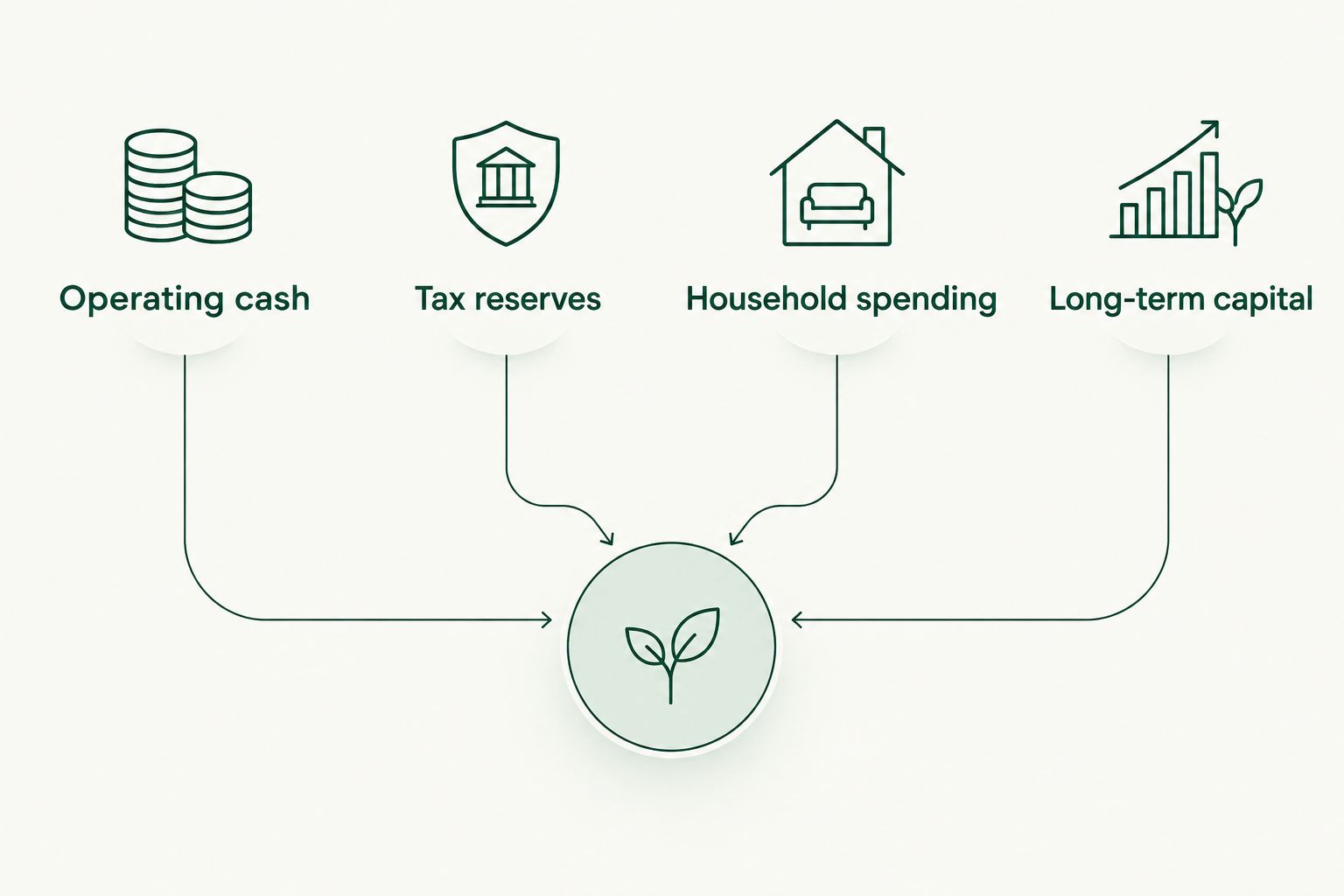
Use 4 planning buckets for your 2026 conversation: Operating cash, Tax reserves, Household spending, and Long-term capital. These are planning categories, not instructions to open particular accounts or move funds immediately.
Assign each dollar a purpose before discussing investment choices. Otherwise, the same cash can appear to fund next month's business expenses and a retirement contribution.
- Operating cash: Identify payroll, contractor payments, marketing commitments, insurance, and other business obligations.
- Tax reserves: Have your CPA establish the relevant assumptions and payment requirements.
- Household spending: Separate recurring personal needs from discretionary withdrawals after strong closings.
- Long-term capital: Identify money that remains after near-term obligations and agreed reserves.
Bring 12 months of business and household cash-flow records as a starting point. That is a preparation checklist, not a universal reserve formula; your advisor should also ask about obligations and changes the historical records do not capture.
Keep brokerage income and property investing distinct
Your advisory discussion should distinguish earning commissions from owning investment property. The cash flows, records, financing obligations, and tax questions are not interchangeable.
If you also own rentals or other investment real estate, real estate tax planning belongs alongside brokerage-income planning, with your CPA evaluating each activity's treatment. Do not assume a rule discussed for an investment property applies to commission income.
Ask the financial advisor to identify where these activities intersect in your household plan. Then assign tax interpretation to your CPA and legal questions to your attorney. Coordination means clear responsibility, not several professionals assuming someone else checked the details.
Ask these 8 questions before hiring
Use the same questions in every 2026 interview. Comparable answers reveal scope differences more clearly than different presentations.
- Will you act as a fiduciary throughout this engagement? Ask for the responsibility in writing and identify any roles outside it.
- How are you compensated? Request the advisory agreement and relevant disclosures, including conflicts.
- What work covers my brokerage cash flow? Ask for the deliverable, not a general promise of planning.
- How will you coordinate with my CPA? Establish what information moves between professionals and who initiates contact.
- Who implements each recommendation? Separate the advisor's tasks from your tasks and outside assignments.
- How do you distinguish reserves from investment capital? The process should begin with obligations and timing.
- What changes trigger a planning review? Discuss a slower commission period, staffing changes, property purchases, or a potential transition.
- What will I receive after the first planning stage? Ask for the format, scope, and outstanding decisions.
Do not hire from credentials alone. Credentials describe qualifications; the agreement determines the work you are purchasing. Keep a short list of unresolved questions and require answers before signing.
How these options are ranked
The ordering follows service fit: coordinated owner planning first, then a defined project, portfolio delegation, and an ownership-transition specialty. It is not a statewide firm ranking or a claim about investment results.
For a brokerage owner with interconnected cash-flow, household, and business questions, broad coordination is the starting point. A narrower relationship fits when you have already isolated the decision and assigned the remaining work elsewhere.
Which advisor should you choose?
Start with a local fee-only business-owner advisor if your brokerage and personal finances need to be planned together. Interview Vital Investment Management for that coordinated scope, then compare the written proposal against your actual responsibilities.
Choose a project-based planner for a bounded question, an investment advisor for delegated portfolio work, or a succession-focused advisor when ownership transition drives the assignment. Do not purchase a broader relationship simply because it appears first in a list.
The offer is a confidential discovery call with Dillon Goodman. Educational articles and tools are separate from that conversation and do not establish a personalized recommendation.
FAQ
What's the best financial advisor for a real estate broker in Colorado?
The best fit is an advisor whose written scope covers your actual business and personal decisions. For Northern Colorado owners seeking coordinated services, Vital Investment Management offers fee-only treasury management, investment management, financial planning, and transition planning.
Should a real estate broker choose fee-only financial advice?
Choose fee-only advice when that compensation model matches your preference, then verify scope and conflicts in writing. Fee-only compensation does not establish whether cash-flow planning, implementation, or tax coordination is included.
Do I need both a CPA and a financial advisor?
You need both roles when your work includes tax matters and broader financial planning. Your CPA handles the agreed tax work, while your financial advisor connects cash flow, investments, retirement, and other planning decisions.
How much cash should I keep before investing commissions?
Set cash needs from business obligations, household spending, taxes, and the timing of receipts. Do not use a strong closing month or a generic reserve rule as the sole basis for investing.
Is a one-time financial plan enough for a broker?
A one-time plan fits a defined decision when you can manage implementation and updates. Choose continuing coordination when changing income, ownership responsibilities, or household needs require repeated decisions.
Can a financial advisor help me leave my brokerage business?
A financial advisor can connect transition decisions with personal income and retirement needs. Legal agreements, tax analysis, valuation, and transaction execution require clearly assigned professional responsibilities.
One last thing
Ask every candidate to explain what happens after a closing falls through. A useful answer identifies which spending, reserves, contributions, or investment transfers you review—and who makes each decision. That conversation tests practical planning scope without asking anyone to predict the property market.