

Yes, your small business can afford a fee-only financial advisor when the engagement fits your cash flow and addresses decisions you need help making. The advisor’s compensation is not the whole commitment: account expenses, outside professional work, and your own preparation time also belong in the decision.
- Can a small business afford a fee-only financial advisor? Yes, when the scope fits cash flow and planning needs.
- Fee-only describes compensation, not affordability; compare written scope, payment terms, and separate account expenses.
- Vital Investment Management serves Northern Colorado owners seeking treasury management, financial planning, investment management, and succession planning.
- Protect operating cash before committing to ongoing advice; do not fund the engagement with money reserved for obligations.
Can a small business afford a fee-only financial advisor?
Affordability depends on the written engagement and the cash available to support it—not on revenue alone. A business with strong sales can still have little room for another recurring commitment when collections are slow, payroll is due, or taxes remain unfunded.
Start by separating compensation from service. A fee-only versus fee-based advisor comparison explains the compensation distinction; it does not tell you whether a particular engagement fits your business.
Fee-only advisors receive compensation from clients rather than commissions on financial products. That arrangement does not eliminate every conflict or make every service suitable. You still need to understand what the advisor does, how compensation changes, and what remains your responsibility.
Use these steps to make the affordability decision:
- Protect operating cash. Identify money committed to payroll, taxes, debt payments, and other obligations.
- Name the decision. Specify the cash-flow, investment, retirement, or transition question you need answered.
- Match the scope. Ask which services address that decision and which do not.
- Review the agreement. Check compensation terms, billing timing, separate expenses, and cancellation provisions.
- Assign follow-through. Decide who supplies records, implements recommendations, and coordinates with other professionals.
For a 2026 engagement, use your current cash position and current agreement—not an old proposal or a generic online estimate.
Why this matters
Cash is lumpy. Customer receipts, owner distributions, equipment purchases, and tax payments do not arrive on a convenient schedule. A commitment that looks manageable against annual revenue can still strain the business during a cash-flow trough.
The opposite problem is paying for help that does not address your actual decision. You might need a treasury policy while comparing an investment-only service, or succession planning while asking only about portfolio management.
Buy a defined scope of work, not the label “financial advice.” Affordability includes whether the engagement gives you something you can use and whether you have the time to act on it.
Which type of engagement fits your decision?
Fee-only describes how an advisor receives compensation. Hourly work, project work, ongoing planning, and asset-based investment management describe different engagement arrangements. A firm does not necessarily offer all of them.
Ask local fee-only advisors which arrangements they actually provide. Compare the written services before comparing compensation terms.
| Engagement arrangement | Best for | Main advantage | Main limitation |
|---|---|---|---|
| Hourly advice | Owners with a defined question and organized records | Focuses professional time on a bounded issue | Follow-up and implementation depend on the agreement |
| Project-based planning | Owners facing a specific planning decision | Establishes a defined assignment and deliverable | Changes after completion require a separate discussion |
| Ongoing planning | Owners needing recurring coordination | Provides a structure for revisiting connected decisions | Requires a continuing commitment and participation |
| Asset-based investment management | Owners seeking management of an investment portfolio | Connects compensation to assets under management | Business planning is not automatically included |
These are comparison categories, not a statement of Vital Investment Management’s available billing arrangements. Verify any proposed arrangement directly with the firm.
Hourly advice: best for a bounded question
Hourly advice fits a question you can state clearly, such as how to organize owner distributions alongside household cash needs. Preparation matters: scattered records make it harder to keep the assignment focused.
Ask what the advisor needs before the meeting and what you receive afterward. Do not assume a conversation includes a written plan, implementation, or later revisions.
Project-based planning: best for a defined deliverable
A project arrangement fits a decision with a clear endpoint. That endpoint might be a documented cash-management framework or an assessment of how business ownership affects your personal financial plan.
Specify what completion means. A recommendation, an implementation checklist, and completed implementation are different deliverables.
Ongoing planning: best for connected decisions
Ongoing planning fits owners whose business and household decisions keep changing together. Hiring, distributions, retirement saving, borrowing, and transition planning can require repeated coordination.
The limitation is commitment. You need enough cash-flow room and enough attention to maintain the relationship; an ongoing engagement is not a substitute for keeping your records current.
Investment management: best for a portfolio-management need
Investment management fits a need to manage assets outside the company. It does not automatically solve operating cash flow, business valuation, or succession planning.
Ask which planning services accompany portfolio management. If your main concern is the business, an investment-only scope leaves that concern unresolved.
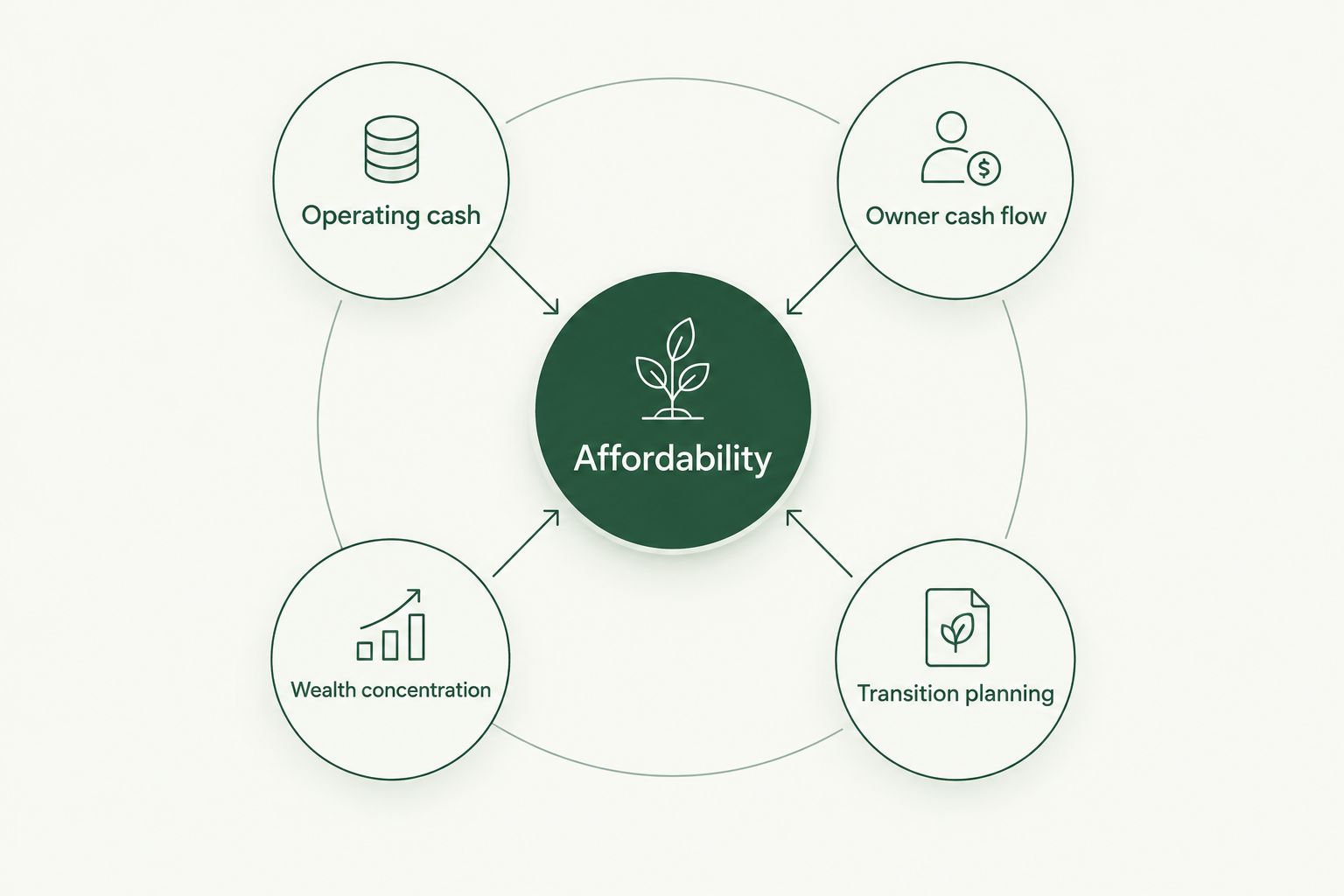
Check affordability across four planning areas
Review 4 planning areas before deciding what help to buy: operating cash, owner cash flow, wealth concentration, and transition planning. These areas connect, but each needs a clear boundary.
Use your 2026 planning review to identify the decision with the strongest need for outside help. You do not need to purchase every possible service simply because the issues overlap.
Operating cash
Separate cash committed to obligations from cash available for longer-term decisions. Payroll, taxes, inventory, debt service, and planned purchases need to remain visible.
Do not treat the bank balance as a single pool of available money. An advisor’s engagement must fit alongside those commitments, not displace them.
Owner cash flow
Your business and household need separate views. Owner distributions support personal spending, but the timing and amount also affect the company.
Identify how you pay yourself and how dependent your household is on those payments. Advice is more useful when the advisor can see both sides without confusing them.
Wealth concentration
Your business interest and your investable assets are different resources. A valuable company does not necessarily provide cash you can use for household expenses or an advisory engagement.
An advisor can help assess how your ownership interest fits with assets outside the company. That assessment does not promise investment returns or establish a transaction value.
Transition planning
An exit changes more than ownership. You need to understand how personal spending, remaining investments, transaction timing, and income replacement fit together.
Financial planning does not replace transaction counsel, tax advice, or independent valuation work. Assign those responsibilities explicitly rather than assuming one engagement covers everything.
Why the commitment varies
The work changes with the decisions involved. Compare these factors when reviewing proposals rather than assuming every fee-only engagement covers the same ground:
- Service scope. Treasury management, investment management, financial planning, and succession planning are distinct assignments.
- Engagement structure. A defined project and a continuing relationship create different commitments.
- Record quality. Organized cash-flow, account, and ownership information helps define the work; incomplete records leave questions unresolved.
- Implementation responsibility. Advice alone differs from coordinating follow-through, account changes, or recurring reviews.
- Professional coordination. A transition can require separate work from your CPA, transaction attorney, and valuation professional.
- Account arrangements. Review investment expenses and other account charges separately from the advisory agreement.
For proposals reviewed in 2026, compare matching scopes. A narrow assignment and an ongoing relationship are not interchangeable simply because both come from fee-only advisors.
What should you bring to an affordability discussion?
Bring 3 record groups: business cash flow, household commitments, and financial accounts. This is a preparation checklist, not a request to send sensitive information through an unsecured channel.
Business cash flow
Gather your current cash position, receivables, scheduled obligations, and forecast. Include upcoming tax payments and planned owner distributions so the discussion reflects cash already spoken for.
Explain the pressure points plainly. “Collections arrive after payroll” is more useful than “cash flow needs improvement.”
Household commitments
List recurring household spending, debt obligations, and the business payments that support them. Identify any planned change that affects your need for cash.
The purpose is to test the engagement against your actual commitments. It is not to treat every household dollar as available for investing.
Financial accounts
Prepare a list of business and personal accounts, their purpose, and relevant statements. Distinguish operating reserves from assets intended for longer-term goals.
Use current 2026 records for this discussion. Ask the advisor how to share them securely before sending account information.
Which eight questions should you ask before hiring?
Ask 8 questions and request answers that match the agreement. Clear answers let you compare services without relying on a sales presentation.
- Are you fee-only throughout the engagement? Ask who pays the firm and whether anyone receives product-related compensation.
- What exact decision will this engagement address? State your priority and ask the advisor to define the assignment.
- What will I receive? Identify written deliverables, meetings, reviews, and implementation responsibilities.
- How does your compensation work? Request the calculation method, billing timing, and conditions that change the commitment.
- What expenses sit outside the agreement? Ask about account expenses and separate professional work.
- What must I prepare or implement? Clarify records, approvals, and follow-through you own.
- How will you coordinate with my CPA and attorney? Confirm boundaries and obtain any necessary permissions.
- How can I change or end the engagement? Read the agreement rather than assuming flexibility.
If the scope remains unclear, pause the hiring decision. You cannot assess affordability until you know what you are committing to and what the engagement excludes.
Is a fee-only advisor the same as a fiduciary?
Fee-only describes compensation; fiduciary describes a duty. Ask both questions because one label does not answer the other.
For an investment advisory relationship, review the firm’s disclosures, services, and conflicts. SEC registration is a regulatory status, not an endorsement or a promise of results.
Do you need both a CPA and a financial advisor?
You need distinct roles when your decision involves both tax work and financial planning. A CPA’s assignment and an advisor’s assignment can complement each other without duplicating responsibility.
For example, a transition discussion needs coordination between personal income planning and the tax consequences of a transaction. Confirm who supplies each analysis and who implements it; do not assume the advisor prepares your return or provides legal advice.
When should you postpone hiring an advisor?
Postpone an engagement when it would displace cash reserved for obligations or when you cannot identify the work you need. That is a scope-and-cash decision, not a judgment about the value of professional advice.
First organize your records and name the unresolved decision. Then compare a defined assignment with an ongoing relationship, where those arrangements are offered.
Where Vital Investment Management fits
Vital Investment Management is best for Northern Colorado business owners seeking fee-only financial planning alongside treasury, investment, and transition decisions. The firm is a fee-only fiduciary and SEC-registered RIA in Loveland, serving owners in Fort Collins, Berthoud, and surrounding communities.
Vital Investment Management offers treasury management, investment management, financial planning, and business transition/succession planning. Dillon Goodman, CPA, CFP®, leads the business-owner practice.
The fit is coordination across owner and business decisions. The boundary is equally important: Vital Investment Management does not broker transactions or provide legal, tax, valuation, lending, or ESOP administration services.
The offer is a confidential discovery call with Dillon. Educational articles and tools are separate from personalized advice; use the conversation to clarify scope and fit, not to assume an engagement is affordable before reviewing its terms.
FAQ
Can a small business afford a fee-only financial advisor?
Yes, when the engagement fits available cash flow and addresses a defined planning need. Protect money committed to payroll, taxes, debt, and other obligations before accepting the engagement.
Does fee-only mean the advisor is inexpensive?
No, fee-only describes compensation rather than affordability. Compare the written scope, billing terms, and separate expenses before deciding.
Can I hire an advisor for just one business decision?
Yes, some fee-only advisors offer bounded hourly or project engagements. Ask which arrangements the firm provides and what follow-up is included.
Will investment management include business succession planning?
Investment management does not automatically include business succession planning. Confirm that transition work appears in the written scope if it is your priority.
Should I use operating reserves to pay for financial advice?
Keep cash committed to business obligations protected when assessing an advisory engagement. Evaluate the commitment against available cash, not the total bank balance.
What should I compare when choosing a Northern Colorado advisor?
Compare service scope, fee-only compensation, fiduciary responsibilities, implementation duties, and professional coordination. Ask for terms that let you compare equivalent assignments.
Does SEC registration guarantee good results?
No, SEC registration does not guarantee results or constitute an endorsement. Review the advisor’s services, disclosures, conflicts, and fit for your decision.
One last thing
Before signing a 2026 agreement, write this sentence: I am hiring this advisor to help me decide ______, and the deliverable is ______. If you cannot fill both blanks, refine the scope before committing.
Revenue answers how much business you generate. It does not answer how much uncommitted cash you have—or whether the proposed service solves your problem.