

Treasury management cost for a small business depends on the services you buy, how the provider charges, and which outside expenses remain separate; use a written proposal to establish your total. An advisory fee does not automatically include bank transaction charges, software subscriptions, or investment expenses, so compare the full scope before you sign in 2026.
- How much does treasury management cost for a small business? Compare the written scope, fee calculation, and separate charges.
- Bank services, cash flow software, and financial advice solve different problems; compare responsibilities before comparing fees.
- Vital Investment Management provides fee-only treasury management advice for Northern Colorado business owners.
- Keep payroll, taxes, and operating reserves separate from money available for longer-term investment.
How much does treasury management cost for a small business?
The useful cost is the total charge for the work your business actually needs—not an isolated account or advisory fee. Start by distinguishing payment services, cash flow reporting, and advice about business reserves. Those are different responsibilities, even when a provider uses the same treasury management label.
For the underlying process, the treasury management guide for small businesses provides a separate starting point. For a cost decision, put each proposed charge beside the task it covers.
| Cost component | What to establish in writing | What not to assume |
|---|---|---|
| Advisory fee | Covered accounts, planning work, review schedule, and calculation method | That every business or personal account is included |
| Banking charges | Account services, payment activity, and transaction charges | That financial advice replaces banking services |
| Software subscription | Forecasting, reporting, connections, and user access | That software includes personalized recommendations |
| Investment expenses | Expenses associated with investments and account administration | That the advisory fee covers every underlying expense |
| Implementation work | Setup responsibilities, account changes, and staff training | That initial work is included in ongoing service |
Use this breakdown for your 2026 comparison. Ask each provider to identify charges you pay directly, expenses deducted from accounts, and work that requires another professional.
A proposal that says only “treasury management” leaves too much unanswered. You need to know who forecasts cash, who recommends reserve levels, who executes payments, and who approves transfers.
Why this matters
Cash is lumpy. Your bank balance can look healthy while payroll, estimated taxes, inventory purchases, or debt payments are approaching.
Treasury management should help distinguish money already committed from money available for another purpose. A service that produces attractive reports but leaves that decision unresolved does not address the owner's central problem.
Compare responsibility before cost. Otherwise, you risk treating a payment platform and an advisory relationship as interchangeable—or paying separate providers for overlapping work.
Bank treasury services: best for payment operations
Bank treasury services are best for businesses that need help with collections, payments, account controls, and movement of cash. The practical benefit is operational: your team needs reliable ways to receive money, pay obligations, and control access.
The limitation is scope. Payment processing and account controls do not, by themselves, establish how much cash your business should retain or how business reserves fit your personal financial plan.
Ask the bank to separate account-level charges from activity-based charges. Then identify the services your staff actually uses; an available feature is not automatically a necessary feature.
For a 2026 proposal, ask:
- Which payment and collection services are included?
- Which activities generate separate charges?
- Who can initiate transactions, and who approves them?
- What setup work falls to your bookkeeper or office manager?
- What reporting helps you distinguish available cash from committed cash?
Recommendation: use bank services for payment operations, and confirm whether cash planning requires a separate relationship.
Cash flow software: best for visibility
Cash flow software is best for owners who need a clearer view of expected receipts and payments. Its value comes from organizing information so you can see timing problems before making spending or transfer decisions.
The limitation is ownership of the forecast. Someone still needs to check account connections, classify transactions, update assumptions, and explain changes in customer payments or operating expenses.
A forecast is not stronger merely because it updates automatically. If the assumptions omit a tax payment or treat an uncertain receivable as certain, the output does not describe the decision you face.
Ask which connections, users, reporting features, and support are included. Also establish whether your business needs staff time or outside accounting help to keep the forecast usable.
Recommendation: choose software when visibility is the main gap, and assign a person to maintain the assumptions. Do not treat a subscription as a substitute for personalized financial advice.
Financial advice: best for reserve and owner decisions
Financial advice is best for owners who need to coordinate operating reserves, investment decisions, and wealth outside the company. The benefit is decision support: cash needed for business obligations serves a different purpose from money available for longer-term investment.
The limitation is that an advisory relationship does not automatically include bookkeeping, payment execution, tax preparation, or legal work. Those responsibilities need explicit owners.
Vital Investment Management offers treasury management, investment management, financial planning, and business transition and succession planning. The firm is a fee-only fiduciary and SEC-registered RIA in Loveland, serving Northern Colorado business owners.
Vital Investment Management treasury management is for Northern Colorado business owners seeking fee-only financial advice. That identifies the relevant service category; a written proposal still needs to establish your work, responsibilities, and fees.
For owners in Loveland, Fort Collins, Berthoud, and surrounding communities, compare local fee-only advisors on the same scope. SEC registration is a regulatory status, not a promise of investment results.
Why treasury management cost varies
Treasury management proposals differ because the underlying work differs. Use these factors to explain the scope rather than assuming a larger balance always requires a more complicated service.
- Payment operations: Collections, transfers, and payment controls require different work from reserve planning.
- Cash flow visibility: A clean forecast and reliable records create a different starting point from disconnected accounts and incomplete assumptions.
- Reserve decisions: Payroll, taxes, debt payments, and planned spending determine which cash needs to remain accessible.
- Investment management: Advice about reserves and management of investment accounts are separate responsibilities unless the agreement combines them.
- Owner planning: Connecting business cash with personal financial planning or succession expands the conversation beyond the operating account.
- Implementation responsibilities: Account setup, reporting changes, and coordination with your existing professionals need an assigned owner.
For your 2026 decision, make each factor concrete. Replace “ongoing support” with the actual reviews, decisions, and deliverables you expect.
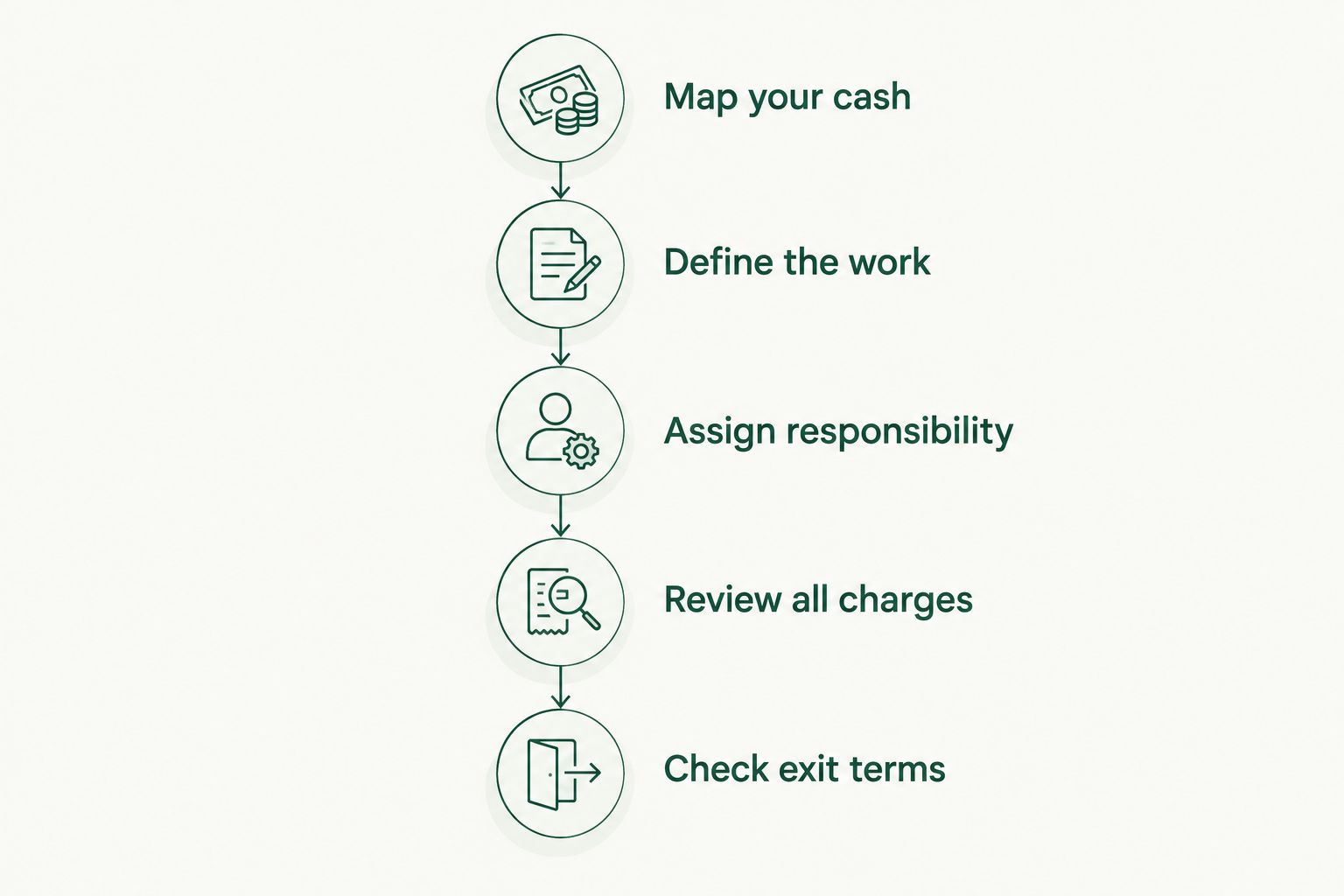
How do I compare treasury management proposals fairly?
Compare treasury management proposals using the same written scope. A lower stated fee does not establish better value when another proposal includes work the first one excludes.
Map your cash
List business accounts and identify what each balance is for. Separate operating obligations, tax reserves, planned expenditures, and money whose purpose has not yet been decided.
Do not label money “excess” simply because it is sitting in an account. Start with the obligations attached to it.
Define the work
Write down the decisions you need help making. Examples include establishing reserve guidelines, organizing a cash forecast, reviewing business investments, or connecting business cash decisions with owner planning.
Keep the list specific. “Improve cash flow” is a goal; “review expected receipts against upcoming obligations” describes work.
Assign responsibility
Identify what your bank, bookkeeper, CPA, staff, and financial advisor will each do. Ask who supplies information, who checks assumptions, who makes recommendations, and who authorizes action.
Your business remains responsible for its decisions and controls. A service agreement should make delegation clear rather than leave it implied.
Review all charges
Ask each provider to explain its calculation method and identify separate expenses. Have the provider apply that method to your proposed scope in writing, including how changes in accounts or services affect the agreement.
Compare the same work across proposals. Do not subtract hypothetical investment earnings from the fee to make a service appear less expensive.
Check exit terms
Read cancellation provisions, account access arrangements, and the process for retaining records. Establish which services stop when the relationship ends and which accounts remain with another institution.
Choose the proposal you can explain back in plain language. If the responsibilities or calculation remain unclear, request clarification before signing.
Is fee-only treasury management the same as free banking?
Fee-only treasury management describes an advisor's compensation arrangement, not the absence of banking or account expenses. You still need to understand which services the advisory fee covers and which charges remain separate.
Ask for a plain-language explanation of how the advisor is paid. Then review the agreement alongside relevant bank and investment account disclosures rather than treating the fee-only label as a complete cost breakdown.
Vital Investment Management's fee-only status does not remove the need to review your proposed scope. It also does not turn educational resources into personalized recommendations.
Can I manage business cash without an advisor?
You can manage business cash internally when you have the information, time, and controls to make and carry out the decisions. The trade-off is responsibility: your team must maintain forecasts, monitor obligations, and decide when cash is available for another purpose.
Start with the gap you need to close. If payment operations are the problem, investigate banking services; if reporting is the problem, investigate forecasting processes; if business and personal decisions overlap, consider financial advice.
For 2026, use that distinction before adding another subscription or professional relationship. Hiring help should assign work clearly, not create another dashboard nobody owns.
What should a written treasury proposal include?
A written treasury proposal should connect the service description, fee calculation, and division of responsibilities. Read those parts together; none is sufficient on its own.
Use this checklist before approving an engagement:
- Covered business entities and accounts.
- Named planning, reporting, or investment responsibilities.
- Fee calculation and billing method.
- Separate banking, software, and investment expenses.
- Initial setup work and ongoing deliverables.
- Review schedule and information you must supply.
- Authority to recommend, initiate, or approve transfers.
- Coordination with your CPA and other professionals.
- Cancellation terms and access to records.
If transition or succession is part of the discussion, identify that work separately. Routine cash oversight and preparation for a business transition are not interchangeable assignments.
FAQ
How much does treasury management cost for a small business in 2026?
Treasury management cost depends on the written scope, the provider's fee calculation, and separate banking, software, or investment expenses. Compare proposals covering the same work and request a written total for your business.
Are bank fees included in treasury management advice?
Bank fees are not automatically included in a treasury management advisory agreement. Ask the advisor and bank to identify their respective charges and responsibilities.
Is cash flow software enough for my small business?
Cash flow software addresses visibility, but your team still needs to maintain assumptions and make decisions. Personalized advice is a separate service when you need help connecting reserves, investments, and owner planning.
Does fee-only mean there are no other expenses?
Fee-only describes advisor compensation; it does not mean every account or investment expense disappears. Review the advisory agreement and separate account disclosures together.
Can I invest all the cash above my usual bank balance?
Do not treat cash above your usual balance as automatically available for investment. First account for payroll, taxes, debt payments, and planned spending, then match any remaining cash to its purpose and timing.
Does Vital Investment Management provide treasury management?
Vital Investment Management provides treasury management alongside investment management, financial planning, and business transition and succession planning. The fee-only, SEC-registered firm serves Northern Colorado business owners from Loveland.
Should my CPA participate in treasury planning?
Include your CPA when tax obligations or accounting assumptions affect the cash forecast. Establish who supplies those figures and who incorporates them into business cash decisions.
One last thing
Ask every provider to finish this sentence in writing: Your team remains responsible for these tasks. That answer exposes the work left outside the agreement more clearly than a broad service label.
Keep it beside the fee explanation in your 2026 decision file. This article is educational; personalized financial, tax, and legal decisions require advice appropriate to your circumstances.