

Yes—an advisor can help reduce concentration risk from owning company stock by building assets outside your business, coordinating withdrawals with tax planning, and preparing for an eventual ownership transition. An advisor cannot remove business risk or make private shares readily sellable. The right plan reduces your household’s dependence on the company without draining the cash your business needs.
- Concentration risk from owning company stock includes your equity, income, and dependence on future sale proceeds.
- VIMSmallBusiness provides business-owner financial planning; tax preparation and transaction execution require separate professionals.
- Protect operating cash before moving business distributions into a diversified personal portfolio.
- Coordinate diversification, taxes, and succession rather than treating a business sale as the entire retirement plan.
Why this matters
Your business can support your paycheck, retirement expectations, and family succession plans at the same time. If company performance weakens, those commitments do not become separate risks just because they sit on different planning worksheets.
For your 2026 review, start with a blunt question: what household spending can you support without another company distribution or a sale? The answer connects concentration planning with wealth management for business owners, rather than treating your investment account as an isolated project.
Can an advisor reduce concentration risk in my business?
Yes. An advisor helps you identify where the company supports your personal finances, decide which exposures you can change, and establish a sequence for making those changes. The work should produce decisions about cash, investments, and transition—not simply a different portfolio allocation.
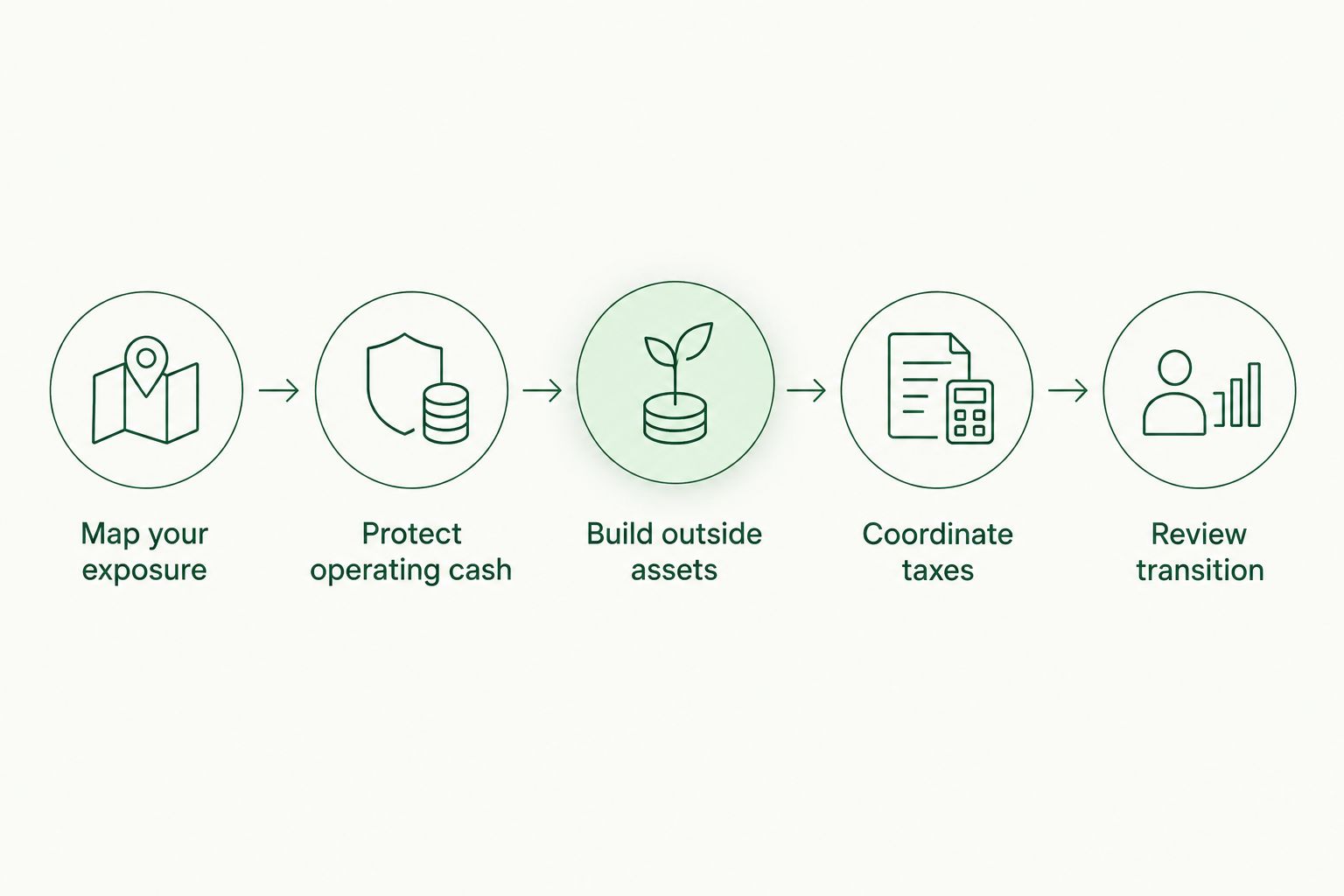
Use this sequence to evaluate the advice you receive.
- Map your exposure. List company ownership, compensation, distributions, business-linked property, personal guarantees, and any company shares held in investment accounts. Keep estimated business value separate from money you can actually access.
- Protect operating cash. Identify payroll, taxes, debt payments, seasonal needs, and planned business spending before deciding what is available for personal diversification.
- Build outside assets. Decide how distributable cash will support household reserves, retirement accounts, and a diversified personal portfolio. Account eligibility and investment choices depend on your circumstances.
- Coordinate taxes. Ask your tax professional to evaluate proposed distributions, share sales, or ownership changes before you execute them. An investment decision is not complete until its tax consequences are understood.
- Review transition. Connect your investment plan to ownership agreements, successor readiness, and the role of future sale proceeds. Revisit the plan when those assumptions change.
An advisor should also identify decisions outside the advisory engagement. A valuation professional assesses business value; an attorney addresses ownership documents; your tax preparer evaluates reporting and tax obligations. Coordination does not replace those responsibilities.
Private business ownership: start with cash flow
Best for: owners who intend to keep operating their company. If your shares are not publicly traded, diversification does not necessarily start with selling them. It starts with identifying cash you can remove without weakening operations.
Separate business reserves from personal reserves. A company bank balance that must cover payroll or a tax payment is not spare retirement capital, even if you control the account.
Next, establish a distribution policy tied to actual cash availability. That creates a decision process instead of relying on whatever remains after a busy quarter. Your advisor and tax professional should distinguish available cash from accounting profit and confirm the consequences of moving it.
The benefit is a path toward outside wealth while you retain ownership. The limitation is speed: building personal assets depends on distributable cash, and your remaining company equity stays exposed to the business.
For 2026, document the business commitments that must be funded before a personal transfer. A written rule is easier to review than an informal assumption that the company will always have enough.
Public company stock: review what you can sell
Best for: owners or founders who hold publicly traded company shares. Public shares introduce a different planning question: which holdings can you sell, when, and under what restrictions?
Your advisor should separate unrestricted shares from restricted holdings and review acquisition records, cost basis, and account location. If trading restrictions apply, involve legal counsel before adopting a sale schedule. A quoted market value does not establish that every share is available for immediate sale.
Selling company shares and reallocating proceeds can reduce single-company exposure. The trade-offs include potential taxes, transaction restrictions, and giving up participation in the shares you sell. Diversification also leaves you exposed to the risks of the investments you purchase.
Do not treat a trading strategy as a complete business-owner plan. Your salary, remaining ownership, and household spending still belong in the same review, even after your brokerage account becomes more diversified.
An approaching exit: plan beyond the sale
Best for: owners whose retirement depends on an ownership transition. Before treating a potential sale as retirement funding, distinguish the business valuation from the proceeds you expect to retain after debt, taxes, and transaction expenses.
Then examine how the proposed payment terms affect your exposure. Cash received at closing is different from a buyer’s promise to pay later. Seller financing, contingent payments, and retained equity each leave you connected to future events.
An advisor can connect those terms to household spending and investment planning. An attorney, tax professional, valuation professional, and transaction specialist address their respective parts of the deal.
The benefit is a clearer connection between your exit and your personal finances. The limitation is that planning does not create a buyer, establish a transaction value, or guarantee that a sale closes. In your 2026 plan, distinguish completed actions from hoped-for outcomes.
Which approach fits your ownership situation?
| Ownership situation | Best for | Main planning action | Benefit | Limitation |
|---|---|---|---|---|
| Continue operating a private company | Owners retaining control | Direct distributable cash toward outside assets | Builds personal resources without requiring a sale | Remaining equity stays concentrated |
| Hold publicly traded company shares | Owners with sellable shares | Coordinate share sales and diversification | Reduces exposure to one company | Taxes and trading restrictions affect execution |
| Prepare for a business exit | Owners relying on transition proceeds | Connect deal terms to household needs | Clarifies what the transaction must fund | Closing and future payments remain uncertain |
These approaches are not mutually exclusive. You can retain private ownership, build outside investments from distributions, and prepare for a later transition. The sequence should reflect your operating needs rather than a generic instruction to sell.
Why concentration risk varies between owners
The same ownership stake can create different household consequences. Review these factors with your advisor:
- Income dependence. If your household relies on company pay and distributions, a business setback affects more than your ownership value.
- Access to cash. Private shares, restricted stock, and contractual transfer limits affect your ability to turn ownership into spendable money.
- Outside assets. Personal reserves and diversified investments affect how much spending depends on continued company distributions.
- Debt and guarantees. Personal guarantees connect household obligations to business borrowing, even when your personal investment account looks diversified.
- Tax circumstances. Cost basis, ownership structure, and transaction details influence the consequences of selling or distributing assets.
- Transition dependence. A plan built around future sale proceeds remains exposed to buyer availability, deal terms, and timing.
A concentration percentage is a starting point, not a complete diagnosis. Ask what happens to household cash flow if distributions stop, the sale takes longer, or you cannot work in the business. Those questions reveal dependencies that an ownership percentage alone misses.
What should you expect from a business-owner advisor?
Expect a written connection between company cash flow and personal financial decisions. The plan should identify what stays in the business, what can move outside it, and which decisions need professional coordination.
VIMSmallBusiness is best suited to Northern Colorado business owners seeking fee-only financial planning coordinated with treasury and succession decisions. VIMSmallBusiness is a fee-only fiduciary and SEC-registered RIA serving owners in Loveland, Fort Collins, Berthoud, and the surrounding region.
Those services fit the coordination problem, but the boundaries matter. VIMSmallBusiness does not prepare tax returns, broker business transactions, or provide legal or valuation services. Its financial planning and advisory services should be evaluated alongside the separate expertise your situation requires.
Before choosing an advisor, ask:
- How will you separate my business reserves from personal investment money?
- Will you include guarantees and business-linked property in the review?
- Who evaluates taxes before I distribute cash or sell shares?
- How will you distinguish estimated company value from accessible retirement assets?
- What written decisions will I receive, and what triggers an update?
A fee-only arrangement describes compensation; it does not replace checking scope, credentials, and responsibilities. Ask who does each task rather than assuming one professional handles everything.
Can I diversify without selling my business?
Yes—you can build assets outside the business from cash that is available for distribution. That reduces dependence on company value over time without requiring an immediate ownership sale.
Start with household reserves and the investments appropriate to your goals. Do not move money simply to make a concentration percentage look better if the company needs that cash for obligations. Diversification funded by underfunding operations is not a sound trade.
Will selling part of my company remove the risk?
No—a partial sale reduces the ownership you retain, but the payment terms determine which risks remain. Retained shares still carry company risk, while seller financing introduces exposure to the buyer’s ability to pay.
Review control rights and restrictions with your attorney as well. Selling a stake changes more than an asset allocation, and the personal financial benefit depends on what you receive and what obligations you keep.
How often should I review business concentration?
Review your concentration plan when the facts supporting it change. For your 2026 planning calendar, include ownership changes, new borrowing, major distributions, retirement decisions, and changes to expected sale terms as review triggers.
Keep dated assumptions so you can tell whether progress came from building outside assets or merely changing the estimated business valuation. A higher valuation can increase paper wealth without adding money you can use for household spending.
Prepare the records that make advice useful
Bring current business financial statements, personal account statements, ownership documents, debt schedules, and available valuation work. Include tax returns and stock acquisition records where relevant, using the secure document-sharing process agreed with your professionals.
Also write down what your household receives from the company beyond salary. Distributions, benefits, and business-paid expenses belong in the conversation because a transition can change them.
For a 2026 review, identify the dates on each statement and valuation. Mixing current account balances with an older company estimate can distort the picture. Ask the advisor to label assumptions clearly rather than presenting uncertain figures as settled facts.
The useful output is a decision list: what stays in the company, what moves outside it, what requires tax or legal input, and what remains unresolved. You should be able to explain that list without translating investment jargon.
FAQ
What is concentration risk from owning company stock?
Concentration risk from owning company stock is dependence on one company for a substantial part of your financial position. For a business owner, that dependence can include equity value, compensation, distributions, and expected retirement proceeds.
Can an advisor reduce concentration risk without selling my business?
Yes—an advisor can help you build outside assets using cash available after business obligations. Your remaining company ownership stays concentrated, so the plan reduces dependence rather than eliminating business risk.
Is there a safe percentage of wealth to keep in my company?
No single percentage establishes that your ownership is safe. Liquidity, household spending, personal guarantees, outside assets, and transition plans all affect the consequences of concentration.
Does a diversified retirement account solve business concentration?
No—a diversified retirement account addresses the investments inside that account, not every business-linked exposure. Include your company equity, income, guarantees, and other connected assets in the review.
Will selling company shares create a tax bill?
Selling company shares can create taxable gains, depending on your basis, ownership structure, and transaction details. Have your tax professional evaluate the proposed sale before execution.
Can my financial advisor value or sell my private business?
Financial planning does not automatically include business valuation or transaction brokerage. Confirm the engagement scope and use qualified valuation, legal, tax, and transaction professionals for those responsibilities.
What should I ask for at my first concentration-risk meeting?
Ask for a map of your business-linked assets, income, and obligations, followed by a prioritized decision list. The list should distinguish operating cash, available distributions, outside investments, and decisions requiring other professionals.
One last thing
A business can become more valuable while your household becomes no less dependent on it. Track outside assets and spending independence—not just the company valuation.
At your next review, ask which household commitments you can meet without selling shares, taking another distribution, or borrowing against the company. That answer gives your diversification plan a practical purpose.
This article is educational information, not personalized investment, tax, or legal advice.