

You need disability insurance for a business owner when losing your ability to work would leave a household income gap, unpaid business overhead, or an unfunded ownership transition. The business does not automatically need to own every policy: personal income protection and business protection serve different purposes. Start with the cash flow that stops when you stop working, then match each uncovered obligation to the appropriate coverage.
- Disability insurance for a business owner should address household income, business overhead, and succession separately.
- Individual disability income insurance protects personal income; business overhead coverage addresses eligible operating expenses.
- VIMSmallBusiness provides fee-only financial planning for Northern Colorado business owners, not a substitute for an insurance contract review.
- Match disability definitions, waiting periods, and benefit terms before choosing coverage.
Does my business need disability insurance for the owner?
Yes, if your inability to work would create obligations that continuing revenue and accessible reserves cannot cover. If the company operates without you and your household has sufficient independent income, the uncovered need is smaller. Ownership alone does not settle the question.
Separate the risks before comparing policies. This is part of protecting your business from key-person risk, but your household and company need different cash flow calculations.
| Protection approach | Best for | Main advantage | Main limitation |
|---|---|---|---|
| Individual disability income insurance | Owners whose households depend on earned income | Provides personal income benefits for a covered disability | Does not automatically cover business operating expenses |
| Business overhead expense insurance | Owners with continuing eligible business bills | Reimburses covered overhead under the policy | Is not a replacement for personal income protection |
| Key-person disability insurance | Businesses dependent on an owner's essential work | Provides benefits to the business under its terms | Does not automatically fund household spending or an ownership purchase |
| Disability buyout insurance | Co-owners with a disability buy-sell arrangement | Helps fund an ownership purchase after a qualifying disability | Must match the agreement's trigger and funding obligations |
| Accessible reserves | Owners retaining some interruption risk | Can fund expenses without an insurance claim | Spending reserves reduces the remaining cash buffer |
These approaches are not interchangeable. Buying personal coverage does not establish that payroll is protected, and business coverage does not establish that your mortgage is covered.
Why this matters
Your company can own valuable assets and still struggle to pay bills during an interruption. Equipment, receivables, and ownership equity are not the same as accessible cash. Your household also cannot spend a business valuation.
For your 2026 review, separate 3 cash flow buckets: household spending, business operating expenses, and ownership-transition obligations. Record which resources support each bucket. Do not count the same cash balance as full protection for all of them.
Cash is lumpy. If you collect revenue after completing work, cash arriving immediately after an interruption can hide a later shortfall. Look beyond the current bank balance to the work that produces the next deposits.
Individual disability income insurance: protect household income
Best for: owners whose personal spending depends on their ability to work. Individual disability income insurance pays benefits when a disability satisfies the contract's definition and other claim requirements. The policy, not your job title alone, determines eligibility.
Its advantage is a direct focus on personal income. Its limitation is that coverage depends on the disability definition, benefit provisions, exclusions, and financial underwriting. An owner's distributions do not automatically translate into an equivalent insurable benefit.
Before applying, identify how you actually earn money. Salary, self-employment earnings, and distributions need explanation rather than a single total labeled income. Ask the insurer which earnings qualify and what financial records establish them.
Compare what happens if you cannot perform your regular duties but can do other work. Also ask how partial work, reduced earnings, or a gradual return affects benefits. A policy that addresses total disability alone answers a different question from one that also addresses a qualifying partial loss.
Business overhead expense insurance: protect eligible operating bills
Best for: owner-dependent businesses with expenses that continue during an absence. Business overhead expense insurance addresses eligible expenses under the contract, rather than replacing your household income.
Its advantage is keeping covered operating obligations separate from personal spending. Its limitation is that reimbursement follows the policy's eligible-expense rules, benefit limits, and duration. Do not assume every line in your accounting system qualifies.
Prepare an expense list that distinguishes rent, utilities, employee compensation, debt obligations, and owner compensation. Ask the insurer to mark each item as covered, excluded, or subject to a condition. That written mapping is more useful than a general statement that the policy covers overhead.
For a 2026 application, use current expenses rather than an older budget. A lease renewal, added employee, or changed ownership structure can alter the amount of overhead exposed to your absence.
Key-person disability insurance: protect the company's capacity
Best for: companies where an owner's absence interrupts essential work or revenue. Key-person disability insurance protects the business against a covered disability affecting an essential person, subject to the contract.
Its advantage is business-level protection rather than household income replacement. Its limitation is that a benefit cannot perform your work, retain a client, or authorize a bank transaction. Operational preparation still matters.
Identify the work only you perform: signing contracts, supervising technical work, maintaining customer relationships, or approving payments. Then name a backup and determine what authority that person needs. Insurance supports a continuity plan; it does not create one.
Ask who owns the policy, who receives benefits, and what conditions trigger payment. Do not infer those answers from the phrase key-person protection.
Disability buyout insurance: support an ownership transition
Best for: co-owners who have agreed how a qualifying disability changes ownership. Disability buyout insurance helps fund a purchase required by an ownership agreement when the policy's conditions are met.
Its advantage is funding tied to a defined transition. Its limitation is the possibility of a mismatch between the legal agreement and the insurance contract. A purchase obligation and an insurance benefit do not necessarily start together.
Have your attorney and insurance professional compare the definition of disability, required waiting period, buyer, seller, valuation provisions, and payment structure. Confirm who owes the purchase obligation if insurance does not pay.
For your 2026 succession review, distinguish a temporary absence from a permanent ownership change. You need a plan for running the company during recovery as well as a plan for a qualifying buyout.
Why disability protection needs vary
The right coverage depends on the obligations exposed to your absence, not simply whether you call yourself self-employed. These 5 factors explain the main differences:
- Owner dependence: Revenue tied to your personal labor creates a different exposure from revenue supported by an independent management team.
- Continuing expenses: Rent, staffing, and other obligations determine which bills remain after work slows or stops.
- Independent household resources: Income unrelated to your work and accessible personal reserves reduce the household shortfall.
- Existing coverage: Employer, association, individual, and business policies need review for eligibility, limitations, and overlapping benefits.
- Ownership agreements: Co-owner obligations create a separate funding question that personal income protection does not resolve.
Location belongs in the contract review too. An owner in Loveland, Fort Collins, or Berthoud should confirm the policy form and terms applicable to the purchase rather than rely on a generic online summary.
How do I decide what coverage to investigate first?
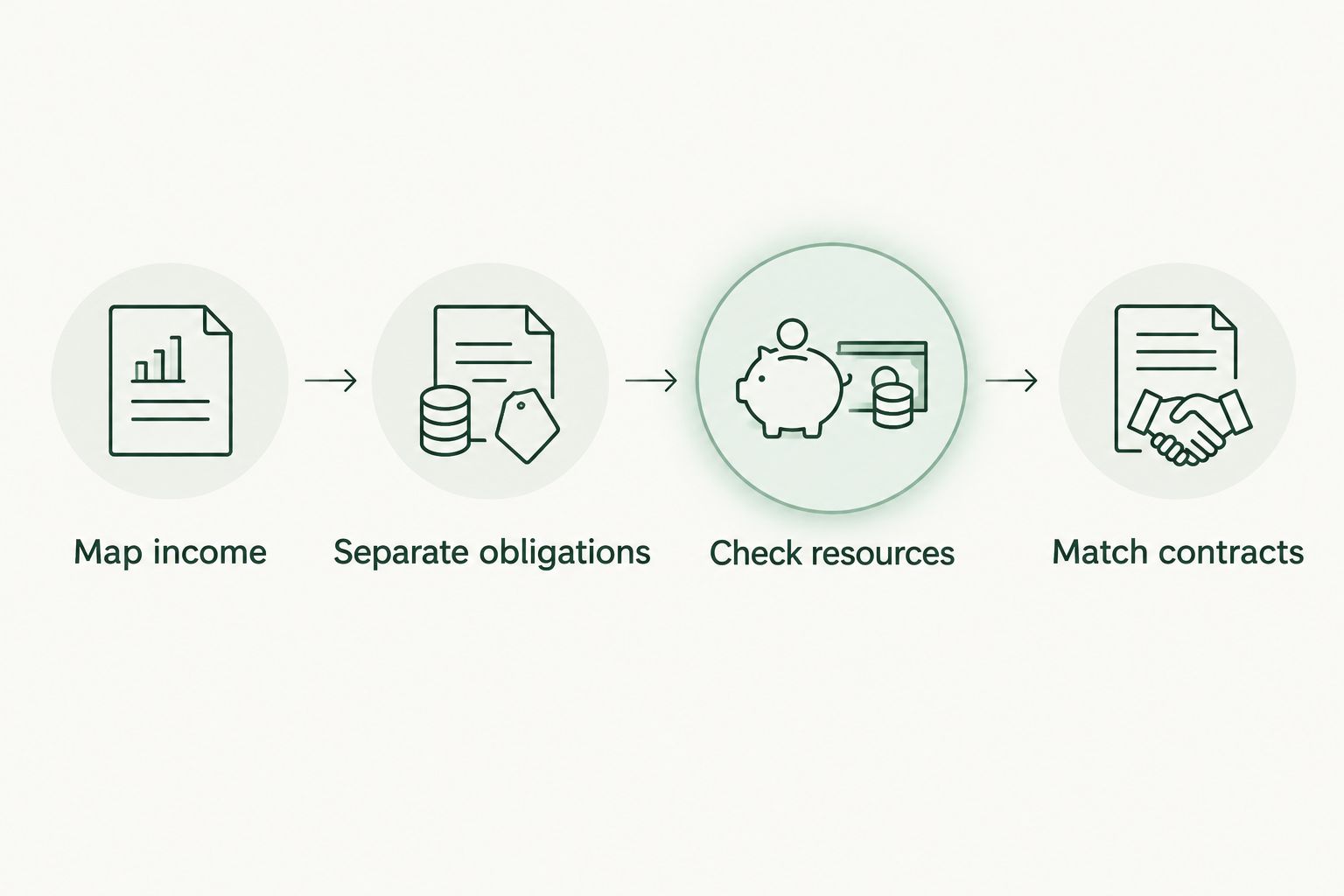
Use these 4 steps to turn a general concern into a specific insurance discussion. The deliverable is a list of uncovered obligations, not an assumed benefit amount.
1. Map income
List household income sources and business revenue streams. Mark which depend on your active work and which continue without it. Separate recurring receipts from collections for work already completed.
Document your actual duties alongside the financial records. An insurer's assessment of your occupation needs to reflect what you do, not just the title owner.
2. Separate obligations
Build separate lists for household spending, operating bills, and ownership obligations. Identify expenses you can stop, expenses you can reduce, and obligations that continue.
Do not assume shutting the business removes its bills. Review leases, contracts, guarantees, and other commitments with the appropriate professional.
3. Check resources
Assign available cash, continuing income, and existing benefits to the obligations they can actually support. Keep personal and business funds distinct, and identify any restrictions on access.
Avoid double-counting. Cash reserved for payroll cannot simultaneously provide its full value as your household emergency fund.
4. Match contracts
Take the uncovered obligations to a licensed insurance professional. Request a comparison of disability definitions, waiting periods, benefit duration, exclusions, partial-disability provisions, and documentation requirements.
Ask for the relevant contract language, not just a summary. Keep the comparison with your 2026 financial plan so future changes have a clear starting point.
What should I check before accepting a policy?
Compare claim conditions before comparing benefit amounts. A stated benefit is useful only when the contract covers the circumstances that prevent you from working.
Use this checklist during the insurance discussion:
- What does the policy mean by disability for your occupation?
- What happens if you can work fewer hours or perform only some duties?
- When does the waiting period begin, and when can benefits become payable?
- How long can benefits continue for a covered claim?
- Which exclusions or limitations apply to the issued policy?
- Which income records or expense records will a claim require?
- How do other benefits or continued earnings affect payment?
- What renewal, cancellation, and premium-change provisions apply?
For business coverage, add ownership and beneficiary questions. For buyout coverage, add an attorney's review of the agreement. Keep the issued policy and amendments together; an application illustration is not the final contract.
Can I use cash reserves instead of disability insurance?
Cash reserves can fund an interruption, but spending them transfers the loss to your balance sheet. Compare the obligations you would fund against the cash you can access without disrupting payroll, household needs, or other commitments.
Reserves provide flexibility and do not require a covered disability claim. Their limitation is depletion: a longer interruption consumes more of the buffer. Use reserves deliberately rather than treating the entire bank balance as unassigned protection.
Does my partner's ability to run the business remove the need?
A partner's ability to run the company reduces operational dependence, but it does not automatically protect your household income. Confirm whether your compensation continues, who authorizes it, and what the ownership agreement requires.
Also examine your partner's capacity. Taking over your duties is different from preserving revenue while continuing their own work. Document responsibilities before assuming the arrangement closes the gap.
Where does a fee-only financial planner fit?
A financial planner can help separate household needs, business reserves, and succession obligations before you evaluate insurance contracts. A licensed insurance professional addresses the coverage terms, while your attorney and tax professional address legal and tax questions within their roles.
VIMSmallBusiness is a fit for Northern Colorado owners who want fee-only financial planning connected to business succession planning. VIMSmallBusiness is a fee-only fiduciary and SEC-registered financial advisory firm in Loveland. Its planning role does not replace an insurer's underwriting decision or your attorney's agreement review.
The practical next move is coordination, not another disconnected document. Bring your coverage summaries, current financial records, and ownership agreement into the same review. This article is educational, not personalized financial, insurance, tax, or legal advice.
FAQ
Do I need disability insurance if I am self-employed with no employees?
You need to assess disability coverage if your household depends on your ability to work. Having no employees removes some business obligations, but it does not remove your personal income exposure.
Does business overhead insurance pay my personal bills?
Business overhead expense insurance addresses eligible business expenses, not your personal household bills. Individual disability income insurance serves the separate purpose of protecting personal income under its terms.
Is key-person disability insurance the same as disability buyout insurance?
Key-person disability insurance and disability buyout insurance serve different purposes. Key-person coverage protects the business under its terms; buyout coverage helps fund an ownership purchase after a qualifying disability.
Can I get disability benefits if I can still work part time?
Part-time work does not by itself determine eligibility for disability benefits. Review the policy's partial or residual disability provisions, income-loss requirements, and other claim conditions.
Does life insurance cover an owner's disability?
Life insurance should not be treated as a substitute for disability income or business disability protection. Review any disability-related rider separately to establish exactly what it provides.
Can I deduct disability insurance premiums through my business?
The tax treatment of disability insurance premiums depends on the policy's purpose, ownership, and payment arrangement. Have your tax professional review premium deductions and benefit taxation before choosing the structure.
What should I bring to a disability insurance planning discussion?
Bring current income records, household expenses, business operating expenses, existing policy summaries, and any buy-sell agreement. VIMSmallBusiness provides business-owner financial planning; coverage and contract questions also require a licensed insurance professional.
One last thing
The same disability can trigger a buyout obligation without triggering the insurance benefit you expected. Different definitions and waiting periods create that risk. During your 2026 review, place the ownership agreement beside the issued policy and compare the triggers directly.
Do the same with operating authority. Name who can approve payroll, communicate with clients, and access essential records if you cannot work. Money and authority solve different problems; your continuity plan needs both.