
Best overall: a rolling cash-flow forecast. Best for protecting payroll: purpose-based cash buckets. Best simple starting point: tighter collections. These cash management for small business strategies put payment timing before investment decisions; the treasury management guide explains the wider framework.
- Start cash management for small business with a rolling forecast, then separate operating cash, taxes, and reserves.
- VIMSmallBusiness suits Northern Colorado owners seeking fee-only treasury management alongside financial planning.
- Improve collections before treating borrowed money or delayed supplier payments as a cash-flow solution.
- Invest only cash that remains surplus after operating needs, taxes, reserves, and planned spending.
Why this matters
Cash is lumpy. Payroll has a date; customer payments do not always arrive when you expect them. A profitable business can still face a payment shortfall because accounting profit and available cash measure different things.
For your 2026 cash plan, start with obligations rather than the balance shown in your banking app. That balance can include money already committed to taxes, suppliers, debt payments, or equipment.
VIMSmallBusiness is best for Northern Colorado owners seeking fee-only treasury management alongside personal financial planning. Its advisory services include treasury management, investment management, financial planning, and business transition/succession planning. Advisory planning does not replace your bank's payment services or your accountant's tax work.
What makes the best cash management strategy?
Judge each strategy against these criteria before adding accounts, software, or investments:
- Payment readiness: Can you meet payroll, taxes, and essential bills when due?
- Timing visibility: Does the strategy show when cash arrives and leaves, rather than only reporting past activity?
- Access: Can you reach the money when the business needs it?
- Principal protection: Do you understand deposit coverage, investment risk, and account ownership?
- Owner effort: Can someone maintain the process during busy periods or your absence?
- Personal coordination: Does the business cash plan account for owner distributions without confusing business and household needs?
Cash management strategies at a glance
The ranking reflects implementation order, not measured investment performance. These practices work together; none replaces the others.
| Rank and strategy | Best for | Standout feature | Key limitation |
|---|---|---|---|
| 1. Rolling cash-flow forecast | Uneven receipts and payment timing | Shows upcoming cash shortfalls | Requires current assumptions |
| 2. Purpose-based cash buckets | Protecting payroll and tax money | Separates commitments from spendable cash | Transfers alone do not create liquidity |
| 3. Written reserve policy | Seasonal demand and uncertain receipts | Defines a minimum operating cushion | An arbitrary target can misstate needs |
| 4. Collections and payment discipline | Cash tied up in unpaid invoices | Addresses the timing of existing cash flows | Depends partly on customer behavior |
| 5. Deposit protection and payment controls | Concentrated balances and payment access | Reviews coverage and authority together | Requires attention to account structure |
| 6. Surplus-cash investment policy | Money beyond business commitments | Matches investments to expected use | Investments introduce risks and access constraints |
1. Rolling cash-flow forecast: best for uneven receipts
A rolling forecast lists expected receipts and payments by date. Unlike a profit-and-loss statement, it helps you see whether cash will be available when a bill comes due.
Use a 13-week forecast as a starting planning format, not a rule every business must follow. In your 2026 version, distinguish confirmed receipts from uncertain collections and update the schedule as actual payments arrive.
Rolling forecast pros:
- Makes payroll and tax-payment dates visible together.
- Reveals dependence on a particular customer's payment.
- Gives you a basis for timing distributions and purchases.
Rolling forecast cons:
- Incorrect collection assumptions produce misleading balances.
- A short forecast does not capture every long-term commitment.
Best for: Owners whose sales, collections, and expenses follow different schedules.
Assign responsibility for updating the forecast. Reconcile its opening balance to available bank cash, not an unreconciled bookkeeping figure, and show restricted or committed money separately.
Verdict: Start here before moving cash into investments.
2. Purpose-based cash buckets: best for protecting payroll
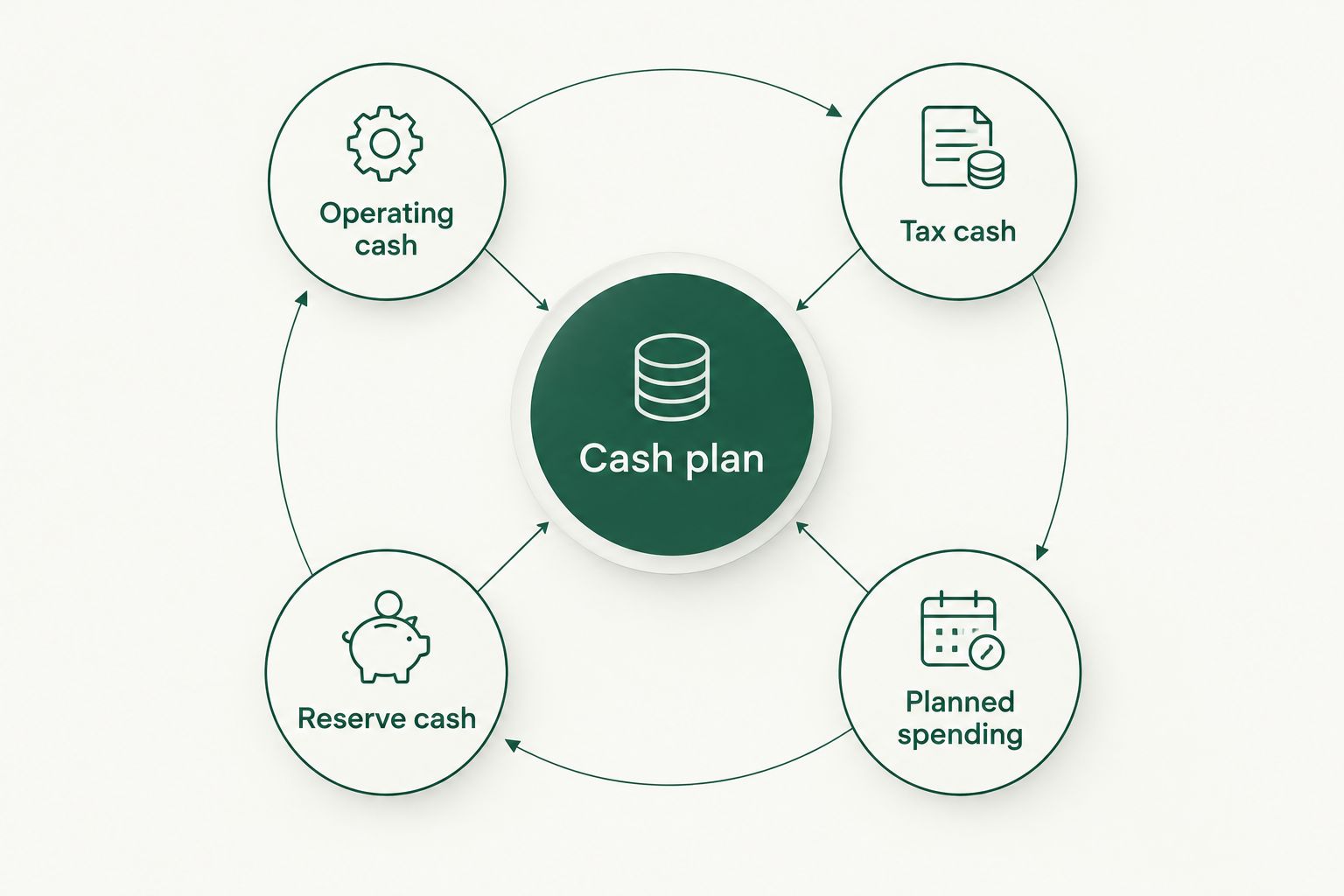
Purpose-based buckets assign cash to operating expenses, taxes, reserves, and planned spending. You can track those purposes through separate accounts or clear bookkeeping categories; the method matters less than reliable records.
The objective is straightforward: stop treating every dollar in checking as available for an owner draw. Make the allocation visible before approving spending.
Cash bucket pros:
- Distinguishes business commitments from discretionary cash.
- Makes tax set-asides easier to identify.
- Gives staff clearer instructions about permitted uses.
Cash bucket cons:
- Additional accounts create reconciliation work.
- A labeled bucket does not prove the allocation is sufficient.
Best for: Owners who repeatedly discover that their apparent surplus belongs to payroll or taxes.
Use these four labels in your 2026 cash worksheet: Operating cash, Tax cash, Reserve cash, and Planned spending. Ask your tax professional to inform tax allocations rather than applying an unsupported percentage to every deposit.
Separate account names do not necessarily create separate deposit-insurance coverage. Review coverage by institution, depositor, and ownership category.
Verdict: Separate commitments before deciding what you can spend.
3. Written reserve policy: best for seasonal uncertainty
A reserve policy defines the cash cushion your business intends to maintain and the events that justify using it. It also states how you will rebuild the reserve after a withdrawal.
Do not select a reserve target because another owner uses it. Your essential expenses, collection delays, seasonality, debt obligations, and customer concentration determine the planning problem.
Reserve policy pros:
- Creates a clear boundary for discretionary spending.
- Connects the cushion to actual business obligations.
- Makes reserve withdrawals deliberate rather than invisible.
Reserve policy cons:
- A stale target can overlook changed expenses.
- Keeping every long-term dollar immediately accessible limits your investment choices.
Best for: Businesses with slow seasons, delayed collections, or dependence on a few customers.
For your 2026 review, test a late major payment and a lower-revenue period in the forecast. Identify which expenses remain unavoidable, when a shortfall appears, and which purchases you would defer. Treat available borrowing separately from cash already held; access depends on the credit agreement.
Verdict: Set the reserve from your obligations, not a generic rule.
4. Collections discipline: best for cash tied up in invoices
Collections discipline starts before an invoice becomes overdue. Agree on payment terms, confirm billing requirements, issue accurate invoices promptly, and give someone responsibility for following up.
Review supplier payments alongside collections. Use the agreed terms rather than paying early automatically or assuming a supplier will accept a delay.
Collections discipline pros:
- Addresses cash timing without assuming new sales.
- Exposes disputed or incomplete invoices.
- Connects customer payment behavior to the forecast.
Collections discipline cons:
- Customer approval processes remain outside your control.
- Stricter terms require careful handling of commercial relationships.
Best for: Businesses with meaningful receivables and inconsistent payment timing.
Use a 7-day review cycle as an operating choice, adjusting it to your billing volume. For each overdue invoice, record the obstacle, the responsible person, and the next action. A list of overdue balances without follow-up ownership is a report, not a collections process.
If you accept deposits or progress payments, have appropriate legal and accounting professionals review the terms and treatment.
Verdict: Fix billing friction before assuming you need more financing.
5. Deposit protection: best for concentrated balances
Deposit protection means understanding where cash is legally held and what insurance applies. Payment controls address a different question: who can move that money and how instructions are verified.
For FDIC-insured banks, the standard deposit-insurance amount is $250,000 per depositor, per insured bank, per ownership category. FDIC guidance defines that scope; it is not a separate allowance for every account you open.
Deposit protection pros:
- Makes uninsured balances visible.
- Prompts review of account ownership and sweep arrangements.
- Pairs cash location with payment-access controls.
Deposit protection cons:
- Coverage depends on the actual account structure.
- Deposit insurance does not cover investment losses or every fraud event.
Best for: Owners with concentrated deposits or multiple people authorized to initiate payments.
For your 2026 review, request documentation explaining any sweep arrangement and participating institutions. Separately, confirm who can add a payee, change payment instructions, approve a transfer, and reconcile the transaction. Verify changed instructions through a known contact method rather than relying only on the message requesting the change.
Verdict: Confirm coverage and payment authority before increasing balances.
6. Surplus-cash policy: best for money beyond commitments
A surplus-cash investment policy identifies money the business does not expect to need for operations, taxes, reserves, or planned spending. It then sets permitted investments, access requirements, and decision authority.
Surplus is a conclusion from your cash plan, not a large checking balance. Review the expected use date before comparing investment choices.
Surplus-cash policy pros:
- Separates operating liquidity from investment decisions.
- Connects investment maturity and risk to future spending.
- Creates written rules for withdrawals and replenishment.
Surplus-cash policy cons:
- Selling an investment before its intended holding period can create losses.
- Yield comparisons alone leave out access, tax treatment, and risk.
Best for: Owners with cash remaining after documented business commitments.
VIMSmallBusiness provides fee-only treasury management and financial planning for business owners. That advisory work is distinct from tax-return preparation, legal advice, and the bank's account operations; keep those responsibilities explicit.
Before implementing a policy, document who can authorize investments and how the business will meet an unexpected cash need. Avoid automatic transfers that ignore upcoming obligations.
Verdict: Wait until the forecast establishes genuine surplus.
How the strategies are ranked
Payment readiness comes first, followed by visibility, access, principal protection, maintenance effort, and coordination with your personal plan. That puts forecasting ahead of investing even when an investment discussion feels more interesting.
This is a practical sequence, not a claim that one method produces a measured financial result. Use the ranking to identify the missing control in your business, then assign responsibility for maintaining it.
Which cash management strategy should you choose?
Choose the rolling forecast if you are unsure where to begin. It gives the other strategies a shared set of dates and assumptions.
Then follow the problem:
- Money gets spent twice in your head: introduce purpose-based buckets.
- Slow periods catch you unprepared: write the reserve policy.
- Customers owe you money: assign collections follow-up.
- Balances or payment permissions are concentrated: review protection and controls.
- Cash remains after commitments: develop the surplus-cash policy.
For an owner in Loveland, Fort Collins, Berthoud, or wider Northern Colorado, location helps with coordination, but it does not determine the right reserve. Your payment calendar does.
FAQ
What's the best cash management strategy for a small business?
A rolling cash-flow forecast is the best starting point because it connects expected receipts with payment dates. Use it to establish operating needs before setting reserves or investing surplus cash.
How much cash should my small business keep in reserve?
Set your reserve from essential expenses, collection uncertainty, seasonality, and contractual obligations. Test adverse timing in your forecast rather than copying another business's target.
Should I open separate accounts for taxes and payroll?
Separate accounts can make tax and payroll commitments clearer, but accurate bookkeeping categories can also track those purposes. Additional accounts require reconciliation and do not automatically create additional deposit-insurance coverage.
How often should I update my cash-flow forecast?
Use a weekly update as a starting operating routine, with more frequent checks when payment timing is tight. Replace estimates with actual receipts and payments, then extend the forecast.
Should I invest the cash sitting in my business checking account?
Invest only after identifying cash that is not needed for operations, taxes, reserves, or planned spending. Match investment risk and access to the date the business expects to use the money.
Is a money market fund the same as an insured bank account?
No. A money market mutual fund is an investment and is not FDIC-insured, while an eligible money market deposit account at an insured bank receives coverage subject to applicable limits and ownership rules.
Can a financial advisor help with business cash management?
Yes. VIMSmallBusiness offers treasury management and financial planning for small business owners. Advisory planning complements, rather than replaces, your accountant's tax work and your bank's payment services.
One last thing
Your business can show a profit and still lack enough cash for payroll. Receivables, inventory purchases, debt principal payments, and owner distributions explain why profit and bank cash move differently.
At your next cash review, ask one question before discussing investments: what is the lowest projected available balance before the next reliable receipt? That is the balance your operating decisions need to respect.
This article is educational, not personalized investment, tax, or legal advice.