

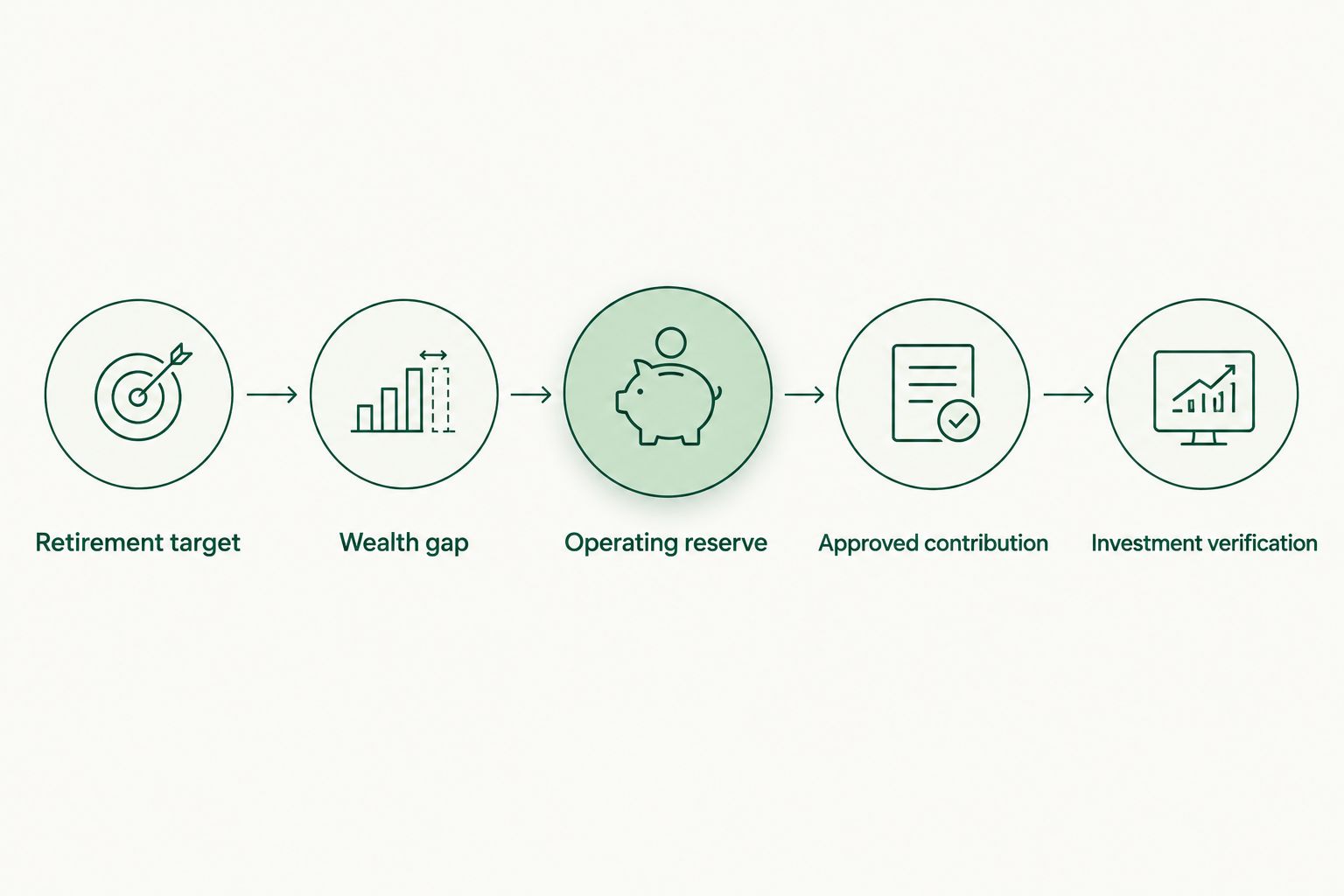
Instead of recalculating your retirement shortfall whenever cash builds up, use a wealth gap retirement plan workflow that turns your spending target, outside assets, and business cash flow into approved contributions and verified investments. This 2026 guide separates the retirement goal from the account setup so you do not mistake an opened account for a funded plan.
- A wealth gap retirement plan connects retirement spending, existing assets, business cash flow, and verified contributions.
- VIMSmallBusiness provides retirement-related financial planning for small business owners, not tax-return preparation.
- Keep business operating reserves separate from money approved for retirement contributions.
- Verify both the contribution and its investment; a transfer alone does not complete the workflow.
Why this matters
Your company value is not your retirement balance. A potential sale, an employee buyout, and money already invested outside the company have different timing and risks. Combining them into one number hides the decisions you need to make.
VIMSmallBusiness retirement planning is best suited to business owners who need to connect personal financial planning with treasury and succession decisions. Its financial planning services address those connected needs. The limitation is equally important: financial planning does not replace tax-return preparation, legal work, or an independent business valuation.
For your 2026 plan, define two separate outcomes: a retirement projection that identifies the shortfall and an operating process that funds approved accounts. Neither proves the other is complete.
Before you start
- Gather current records. Collect household spending, investment and retirement statements, business financials, debt schedules, employee information, and existing retirement-plan documents. Use matching statement dates where possible.
- Confirm access and responsibilities. You need authorized access to the funding account and retirement account, plus a CPA, payroll contact, or plan administrator where the contribution requires their review. Do not share passwords to create that access.
- Resolve the eligibility gotcha first. A retirement shortfall does not establish your permitted contribution. Business structure, eligible compensation, employees, existing plans, and contribution type affect what you can fund; confirm those details before scheduling transfers.
The bold field names below are labels to create in your own worksheet, not buttons in a particular financial application. Keep sensitive documents in an approved secure system rather than attaching them to an ordinary email.
Retirement target configuration
Start with the life the money must support. Do not start with whichever retirement account someone suggested.
- Create a worksheet named Retirement baseline. Enter Planning date, Target retirement date, and Household members. Date the baseline in 2026 and identify who maintains it.
- Add Essential spending and Flexible spending. Separate household spending from company expenses, and identify benefits the business currently pays that you would need to replace after leaving.
- Enter Expected income by source and start date. Distinguish documented benefits or contractual income from business distributions that depend on continued ownership and operations.
- Record Outside assets, Business interest, and Restricted assets separately. Identify debts and earmarked cash so the same money is not counted toward retirement and another obligation.
- Ask your planner to model the assets required to support the spending not covered by other income. Record inflation, investment-return, tax, and longevity assumptions explicitly; a projection is not a promised outcome.
Expected result: a dated retirement target with its assumptions visible. You should be able to explain what the target includes without referring to a business valuation headline.
A spending target expressed in today's purchasing power must be compared with assets on a consistent basis. Mixing today's spending with future inflated balances creates a misleading shortfall.
Wealth gap configuration
The wealth gap is the difference between projected retirement resources and the resources required under the same assumptions. It is a planning estimate, not a bank balance.
- Create Base case and Business sale case columns. In the base case, show retirement resources without relying on an uncompleted sale. In the sale case, identify the transaction assumptions separately.
- Enter Existing retirement assets, Other investable assets, and Planned contributions. Mark whether each amount is current or projected; do not subtract a current balance from a future target without adjusting the model.
- For a potential sale, enter Estimated net proceeds, Expected receipt date, and Source of estimate. Separate cash at closing from deferred payments. Coordinate tax assumptions with your CPA and transaction assumptions with the appropriate professionals.
- Record Remaining gap for each case. Ask the planner to show how changes in retirement timing, household spending, savings, and sale proceeds affect that gap.
- Choose the next action. Increase approved savings, revise spending, reconsider timing, or address the transition plan. Avoid solving every shortfall by assuming higher investment returns.
Expected result: a shortfall you can trace to specific assumptions, plus an action you control. Keep the 2026 baseline intact when testing alternatives so revisions remain visible.
Do not count your business twice. If the projection includes sale proceeds, it must also reflect the loss of distributions associated with the ownership you sell.
Contribution and reserve configuration
A planning target tells you what you want to save. A contribution review determines what the account permits; a cash-flow review determines what the business can support.
- Create a Funding register with Account owner, Contribution type, Tax year, Approved amount, Deadline, and Responsible person. Obtain confirmation from the relevant CPA, payroll contact, or plan administrator before funding.
- Prepare a rolling 12-month cash forecast. Include payroll, estimated taxes, debt payments, seasonal purchases, and committed capital spending. This is a proposed planning horizon, not a required reserve size.
- Set Operating reserve floor from the forecast and business obligations. Exclude restricted cash and amounts owed to others. A high bank balance is not evidence that all the money is available.
- Set Base contribution and Review contribution. Use the base amount only when recurring cash flow supports it; review additional funding after confirming tax obligations and reserve coverage.
- Assign approval and stop rules. Pause additional funding when the reserve floor is breached, compensation changes, or an administrator needs to reassess the contribution.
Expected result: every proposed contribution has an eligible account, an approved amount, a funding source, and an accountable person.
VIMSmallBusiness treasury management and financial planning address the relationship between business cash and personal goals. The trade-off is coordination: an advisor, CPA, payroll team, and administrator can have different responsibilities. Record who approves each action rather than assuming someone else has done it.
Transfer and investment configuration
An account application, a contribution, and an investment purchase are different events. Verify each separately.
- Complete the required account or plan setup with the provider. Confirm ownership, authorized access, required documents, and any employer procedures before sending money.
- Establish the approved funding method. Confirm whether the contribution requires payroll processing, an employer payment, or another provider-supported method. Do not treat a personal bank transfer as interchangeable with a payroll election.
- Make the approved contribution and record Transfer reference, Submission date, Contribution year, and Amount received. Match the receiving record to the funding instruction.
- Confirm the investment instruction separately. Check whether incoming money remains in cash or follows an existing investment election. Apply the agreed investment approach rather than assuming the account invests deposits automatically.
- Reconcile the funding register with account records. Schedule a review within 30 days of the first contribution as an internal control, not as a statement about provider processing times.
Expected result: the receiving account shows the correct contribution classification, and the money follows the documented investment decision.
For this workflow, call the plan implemented when those checks pass. Do not call retirement fully funded merely because an account received money; long-term sufficiency remains dependent on spending, timing, contributions, and uncertain investment results.
Recalculate whenever business cash flow changes
Best for: owners with seasonal revenue or uneven distributions. Use an event-driven review alongside scheduled contributions. This variant responds to actual cash conditions rather than forcing every month to look alike.
For 2026, establish a 90-day review cadence and add a review after a material business event. These are suggested controls, not regulatory deadlines. Define material events in your worksheet: a changed payroll obligation, a major purchase, a revised tax estimate, or a documented change in transition timing.
- Refresh the cash forecast and reserve requirement.
- Reconfirm compensation, eligibility, and remaining contribution capacity.
- Approve, reduce, or pause the next contribution.
- Update the retirement projection only when its inputs change.
Choose the funding pattern that fits the forecast:
| Funding pattern | Best for | Advantage | Limitation |
|---|---|---|---|
| Scheduled contributions | Owners with dependable recurring cash flow | Creates a repeatable funding process | Needs stop rules when cash flow weakens |
| Review-based contributions | Owners with seasonal or project-based receipts | Uses updated obligations before approving funding | Requires active reviews and deadline tracking |
| Base plus review | Owners with recurring income and uneven additional cash | Combines consistency with reserve checks | Needs reconciliation to prevent excess funding |
Neither pattern changes contribution rules. A contribution schedule is a cash-management choice, not permission to exceed an account's limits.
Include outside commitments in the review. Rental property can contribute income to a retirement projection while still requiring cash for repairs, debt service, or capital calls. Accounting for passive real estate liquidity needs keeps property reserves from being counted again as money available for retirement contributions.
Troubleshooting
The wealth gap remains large after contributions
Check the assumptions before changing the investment strategy. Confirm whether household spending, retirement timing, business proceeds, or future savings changed. A permitted contribution can still fall short of the amount your retirement projection requires.
Record the unresolved gap rather than hiding it with an unsupported return assumption. Decide which controllable input to revisit next.
The business balance is high, but funding strains cash flow
Rebuild the available-cash calculation around obligations. Remove money committed to payroll, taxes, debt, customer obligations, and planned purchases before approving an additional contribution.
Pause the review-based contribution if necessary. Do not confuse the account balance with distributable cash.
The contribution appears in cash rather than investments
Check the account's investment election and transaction records. Confirm whether an additional instruction is required, then follow the approved investment approach.
Do not send another contribution to fix an investment-allocation issue. The money has arrived; the unresolved step is how it is held.
The contribution year or type is wrong
Contact the provider or administrator promptly and involve the CPA or payroll contact responsible for the instruction. Preserve the original records and obtain the appropriate correction procedure before moving money again.
Changing a worksheet entry does not correct the receiving account's records.
A sale estimate makes the plan look funded
Separate estimated transaction value from spendable proceeds. Revisit debt repayment, transaction expenses, taxes, timing, and deferred-payment risk with the relevant professionals.
Keep the no-sale base case visible. A buyer discussion does not fund your retirement account.
Customize your workflow
Expand the process by assigning responsibilities, not by adding more unreviewed calculations. Keep one funding register and one current assumptions record; multiple competing versions make approvals difficult to verify.
Use a simple handoff:
- You: confirm spending priorities, approve transfers, and disclose business changes.
- Financial planner: maintain the retirement projection and coordinate investment decisions within the agreed scope.
- CPA or payroll contact: confirm the tax and compensation details relevant to their work.
- Plan administrator or provider: confirm plan procedures, account records, and correction requirements.
The PreciseFP-to-funded-plan workflow connects the information-gathering stage with implementation. Use that next if missing or inconsistent records are slowing decisions.
VIMSmallBusiness is a fee-only fiduciary and SEC-registered RIA serving Northern Colorado business owners. Educational workflows remain separate from personalized financial advice, and the firm does not prepare tax returns. Owners in Loveland, Fort Collins, Berthoud, and the wider region still need their own account, compensation, and business facts reviewed.
FAQ
What is a wealth gap retirement plan?
A wealth gap retirement plan connects the difference between projected retirement resources and required resources to specific funding decisions. It uses spending, existing assets, future contributions, retirement timing, and documented assumptions rather than business value alone.
Does opening a retirement account mean my plan is funded?
No. Opening an account establishes the account, but you must separately verify approved contributions and investment instructions. Whether retirement is sufficiently funded remains a projection, not an account-opening milestone.
Should I count my business sale toward retirement?
Show a potential business sale as a separate planning case rather than treating estimated value as available cash. Distinguish estimated net proceeds, payment timing, and the business income that ends after a sale.
Can I automatically transfer excess business cash into retirement?
Automate only an approved contribution process that respects account rules and business reserve requirements. Compensation changes, employee eligibility, payroll procedures, and contribution limits still require review.
What should I do if my retirement contribution stays in cash?
Check the account's investment election and transaction records before taking further action. A completed contribution does not necessarily trigger an investment purchase, so verify the documented investment instruction separately.
How often should I update my retirement wealth gap?
Update the projection when meaningful inputs change, such as spending, retirement timing, compensation, or expected sale proceeds. A proposed 90-day cash-flow review can support contribution decisions without requiring a full projection rebuild each time.
Can VIMSmallBusiness coordinate retirement and business planning?
Yes. VIMSmallBusiness provides financial planning, treasury management, investment management, and business transition or succession planning for small business owners. Tax-return preparation and legal work remain separate professional responsibilities.
One last thing
The missing step is often verification, not another projection. Before increasing your 2026 savings target, trace the latest approved contribution from the business cash decision to the receiving account and its investment record. That check tells you whether the workflow actually reached its destination.