

Instead of rebuilding your succession notes whenever someone asks about your exit, turn the questions raised by Opportunity Finder into a written decision brief, assigned tasks, and a review schedule. This 2026 workflow shows you how to connect an initial assessment to succession planning without treating a tool result as a valuation, legal agreement, or completed plan.
- Use the Opportunity Finder succession plan workflow to turn observations into decisions, assigned tasks, and documented follow-through.
- VIMSmallBusiness provides business transition planning; legal documents, tax preparation, and valuation require separate professional work.
- Separate ownership transfer, management responsibility, and your personal cash flow before choosing a succession route.
- Finish with a written brief and a review date, not an assessment result alone.
Why this matters
Your exit is a conversation you keep postponing. Meanwhile, business cash, household spending, ownership documents, and successor readiness sit in separate places. An assessment starts the conversation; a succession plan connects those pieces and names who acts next.
VIMSmallBusiness is a fee-only fiduciary and SEC-registered RIA serving Northern Colorado business owners. VIMSmallBusiness is best for owners seeking financial planning alongside business transition and succession planning. Its role does not replace your attorney, tax preparer, or valuation professional.
For a Loveland, Fort Collins, or Berthoud owner, the practical question is the same: can someone else run the company, can ownership change hands, and can your household support the change? Answer each separately before combining them.
Before you start
- Gather source materials. Have your Opportunity Finder observations, current financial statements, ownership records, existing agreements, and household spending information available. Use an editable document or spreadsheet for the working plan.
- Confirm access and responsibility. Identify who can provide business records and who will coordinate with your financial advisor, CPA, attorney, and valuation professional. Share sensitive documents through an agreed secure method, not a broadly shared folder.
- Check the hidden constraint first. An existing ownership agreement can restrict transfers or prescribe a process. Have your attorney review applicable agreements before treating a family transfer, employee sale, or partner buyout as an available route.
This is a manual planning workflow, not a software integration. Keep the working labels below in your own document; they are not Opportunity Finder interface fields or buttons.
Your succession decision brief
Turn observations into decisions
- Record the baseline. Date your working document and identify the records behind it. For your 2026 baseline, distinguish current statements from older estimates rather than combining them into an apparently current picture.
- Capture the unresolved questions. Write down what remains unclear after using Opportunity Finder. Use plain language: the company depends on you, the successor has not agreed, or your household relies on business distributions.
- Separate facts from assumptions. Label each entry Confirmed, Estimate, or Unresolved. A successor you hope will take over belongs under unresolved until that person has agreed to explore the role.
- Write a 1-page brief. State your intended role after transition, preferred direction, unresolved decisions, and immediate dependencies. Keep supporting financial records separate so the brief remains readable.
Expected result: another person can read the brief and distinguish what you want from what has actually been established. That is the first useful handoff from assessment to succession planning.
Define what “stepping back” means
Ownership and management are different. You can want less operational responsibility without having settled when ownership should change. You can also transfer ownership while remaining involved under a documented arrangement.
Write separate answers for Ownership, Management, and Personal cash flow. For each, describe your desired outcome and the condition that must exist before you proceed. Avoid using “retire” as a substitute for these decisions.
A usable condition names evidence: a successor accepts responsibility, your attorney resolves an agreement issue, or your financial plan tests household spending without owner compensation. “When things settle down” is not a condition someone can verify.
Your financial and operational baseline
Connect the company to your household
- Separate business cash from personal wealth. List operating cash, business debt, personal investments, and household obligations separately. Do not count cash required for payroll or operations as money available to fund your exit.
- Map the income you receive. Identify compensation, distributions, and any other business-related payments. Ask your CPA and advisor to clarify their treatment rather than assuming every payment continues after a transfer.
- Document the missing inputs. Record where you need a business valuation, tax analysis, debt information, or legal interpretation. Assign each question to the appropriate professional.
- Build a 12-month cash-flow view. Show known household needs and business cash commitments month by month. Use it as a planning worksheet, not a prediction of sale proceeds or investment returns.
Expected result: you can see which household needs depend on the business and which transition assumptions still need professional analysis.
Identify what still depends on you
List the decisions, relationships, and approvals that stop when you are absent. Include customer relationships, vendor negotiations, banking authority, technical knowledge, and staff decisions where relevant to your company.
For each dependency, name a potential backup and the evidence needed to establish readiness. Observing a task is different from completing it independently. Record the gap instead of marking the responsibility transferred too soon.
Do not use a succession assessment as a business valuation. An assessment can organize questions; valuation work addresses a different question and requires an appropriate scope. Likewise, a planning estimate is not an offer from a buyer.
For your 2026 working file, date every material estimate and identify its source. That makes later updates useful: you can see whether the underlying facts changed or someone merely changed an assumption.
Your succession route and professional handoffs
Compare routes before choosing one
Use this table to structure the discussion, not to select a route without financial and legal review. Each route solves a different ownership problem and introduces its own constraints.
| Route | Best for | Main advantage | Main constraint | Evidence needed next |
|---|---|---|---|---|
| Family transfer | Owners exploring family continuity | Keeps family ownership central to the discussion | Family interest does not establish management readiness or funding | Successor agreement, role expectations, and professional analysis |
| Employee purchase | Owners exploring a direct sale to employees | Builds the discussion around people who know the business | Employee interest does not establish purchase capacity | Buyer interest, financing analysis, and transaction advice |
| Partner buyout | Owners with a potential continuing co-owner | Starts with an existing ownership relationship | Agreements and funding can constrain the transaction | Agreement review, valuation work, and funding analysis |
| Outside sale | Owners exploring a buyer outside the company | Expands the discussion beyond existing insiders | Buyer interest, terms, and timing remain unresolved until established | Sale-readiness work and transaction support |
An employee purchase is not automatically an employee stock ownership plan. Treat a direct sale and an ESOP as different structures requiring their own advice; do not use the terms interchangeably.
Assign the work that makes a route actionable
- Choose a working route and record alternatives. State why the working route fits your goals. Keep unresolved objections visible rather than calling the choice final.
- Assign professional responsibilities. Give personal financial planning to your advisor, tax analysis and preparation to the appropriate tax professional, legal documents to your attorney, and valuation work to a valuation professional.
- Name the dependencies. Write what must happen before each decision. A funding discussion needs usable financial information; a document discussion needs clear ownership and transaction objectives.
- Record the decision boundary. Distinguish exploring a route from authorizing a transaction. A planning meeting does not execute a transfer or establish binding terms.
Expected result: each open issue has a responsible person, a defined question, and an identifiable next deliverable.
VIMSmallBusiness succession planning can connect your personal financial picture with transition decisions. The limitation is equally important: financial planning does not execute legal documents, prepare tax returns, broker a transaction, or replace valuation work.
Use the guide to a financial advisor’s role in business succession planning to clarify that division of work before assembling your professional team.
Your action register and review schedule
Turn the brief into assigned work
- Create an action register. Use the headings Decision, Evidence, Owner, and Review. Enter a specific question or deliverable in every row, not a broad instruction such as “fix succession.”
- Set a 90-day action window. Use this as a management choice for organizing near-term work, not a promise that succession planning finishes within that period. Put longer dependencies on a separate timeline.
- Define completion. Replace “talk to attorney” with a concrete deliverable, such as a written explanation of the transfer restrictions in your existing agreement.
- Schedule the review. Set a calendar date to examine completed work, unresolved questions, and changes in your preferred route. Keep the meeting focused on decisions the evidence now supports.
Expected result: you have an assigned work list rather than a collection of intentions. Your 2026 succession file now connects the initial questions to accountable follow-through.
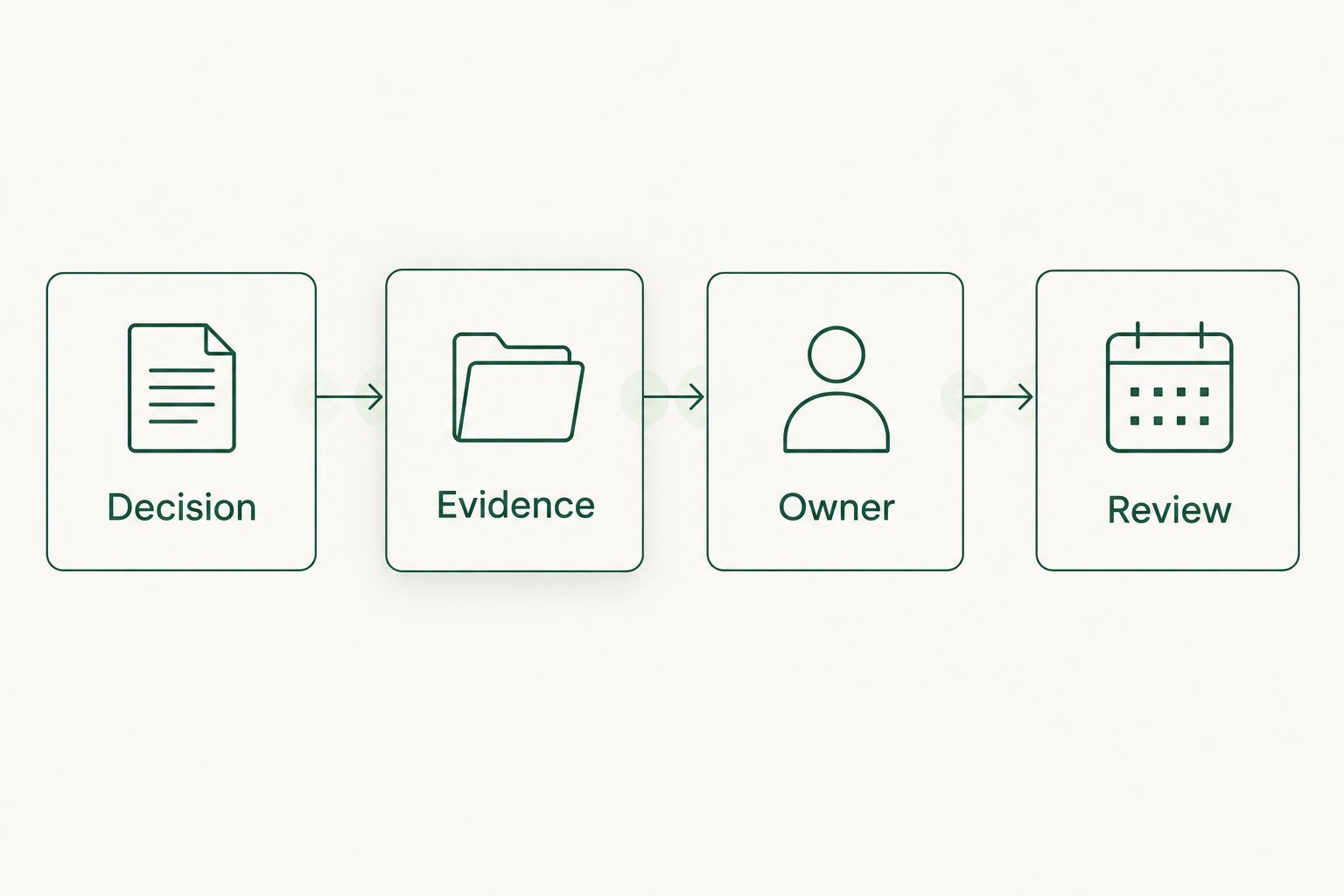
Keep the register short enough to use during a meeting. Supporting reports belong in the working file; the register should show what changed, what remains blocked, and who acts next.
Update the plan whenever circumstances change
The adjacent workflow is an update cycle. Use it when a potential successor changes direction, an owner’s role changes, financing assumptions change, or new professional work alters the facts.
- Preserve the previous baseline. Keep the earlier brief rather than silently overwriting it.
- Identify the changed fact. State what changed and attach or reference the supporting evidence.
- Trace the affected decisions. Revisit household cash flow, ownership, management, and professional work only where the change matters.
- Reassign the next action. Give the unresolved issue an owner and review date again.
If you revisit Opportunity Finder, reconcile any new observations with the existing register. Do not create a second disconnected plan. A later assessment should inform your decisions, not erase the history behind them.
Troubleshooting
The assessment is finished, but nothing happens
Fix: turn the unresolved issue into a deliverable. “We need a successor” is too broad. “Ask the proposed successor whether they want to explore ownership and management separately” gives someone an action they can complete.
Your family agrees on ownership but not on management
Fix: split the discussion. Record who wants to own, who wants to operate, and who expects income. Ask your attorney and advisor to address those objectives without assuming they require the same arrangement.
The financial picture mixes company and household cash
Fix: rebuild the baseline before discussing affordability. Separate business operating needs, personal assets, liabilities, and expected payments. Ask the relevant professionals to resolve uncertain classifications rather than counting the same money twice.
Professional recommendations conflict
Fix: check the assumptions and scope first. Ask each professional which ownership route, timing, financial records, and household needs informed the recommendation. Conflicting inputs require reconciliation before you compare conclusions.
The document looks complete, but responsibilities have not changed
Fix: distinguish planning from implementation. Record whether an action is proposed, approved, documented, or completed. A named successor does not establish operational readiness, and a draft agreement is not an executed agreement.
Customize your workflow
Expand the register around the problem that blocks your next decision. If owner dependence is central, add responsibility-transfer tasks. If household income is unclear, develop the personal cash-flow work before treating an ownership route as financially workable.
For a multi-owner company, add agreement-review questions and responsibilities for each owner. For a family business, document conversations about ownership, employment, and decision authority separately. Keep private household information restricted to the people who need it.
If you later choose a confidential discovery call with Dillon Goodman, the stated booking is a 30-minute intro call. Keep that separate from this educational workflow: a call is an introduction, not completion of your succession plan.
FAQ
How do I turn Opportunity Finder into a succession plan?
Turn your Opportunity Finder observations into a decision brief, a financial and operational baseline, and an assigned action register. Then obtain the financial, tax, legal, and valuation work needed to resolve the open decisions.
Does an Opportunity Finder result establish what my business is worth?
No. Do not treat an Opportunity Finder result as a business valuation. Obtain valuation work with a scope appropriate to the ownership or transaction question you need to answer.
Can VIMSmallBusiness help with business succession planning?
Yes. VIMSmallBusiness offers business transition and succession planning alongside financial planning for business owners. Legal documents, tax preparation, valuation, and transaction execution require the appropriate separate professionals.
Should I choose my successor before starting the financial work?
Start the financial work while you explore successor options. Your household needs and business obligations belong in the decision before you commit to a transfer route.
How long does this workflow take?
The full timeline depends on the decisions, professional work, and implementation required. Use the suggested 90-day action window to organize near-term tasks, not as a completion deadline for the entire succession process.
Is selling to employees the same as setting up an ESOP?
No. A direct employee purchase and an employee stock ownership plan are different structures. Get advice specific to the structure being considered before assigning legal, funding, or administrative tasks.
What should I update in my 2026 succession plan?
Update changed facts, their supporting evidence, and the decisions they affect. Preserve the previous baseline so your working file explains why the plan changed.
One last thing
Give your proposed successor permission to say no. Until someone has agreed to explore the role, the succession route rests on an assumption. An honest answer gives you a usable next decision; an untested name in a document does not.