

Best for coordinated Northern Colorado owner planning: VIMSmallBusiness. Best for a defined decision: a project-based fee-only planner. Best for recurring cash-flow decisions: an ongoing fee-only planner. This 2026 guide compares five advisory arrangements for 1099 contractors and freelancers, with the strengths, limits, and hiring questions that separate them.
- The best financial advisors for 1099 contractors and freelancers connect cash flow, retirement planning, and tax coordination.
- VIMSmallBusiness fits Northern Colorado owners seeking fee-only financial planning, treasury management, and investment management.
- Choose project-based planning for a bounded decision; choose ongoing planning when decisions keep changing.
- Investment management alone does not replace a contractor cash-flow plan or a CPA’s tax work.
Why this matters
Your bank balance is not your spending allowance. It includes money for business expenses, taxes, and personal commitments, even when the next client payment has not arrived.
For your 2026 advisor search, start with the decision you need help making—not the size of your investment account. A freelancer sorting out irregular income needs a different scope from a contractor whose cash system works but whose investments need attention.
The right engagement connects recommendations to money you can actually commit. A retirement contribution target means little without a plan for funding it through uneven months.
What makes the best financial advisor for a freelancer?
Use these five criteria before comparing advisors. Ask for concrete answers, preferably in the proposed scope of work.
- Contractor cash flow: The advisor separates business operating cash, taxes, personal spending, and longer-term savings.
- Clear responsibility: You know who prepares projections, recommends investments, handles tax filings, and follows up.
- Retirement planning: Recommendations account for self-employment, eligible compensation, other employment, and any employees.
- Transparent compensation: The advisor explains how the firm gets paid and identifies conflicts in writing. Fee-only does not mean conflict-free.
- Usable deliverables: You receive decisions, assumptions, assigned tasks, and review triggers—not just account statements.
Credentials support your evaluation; they do not replace it. SEC registration is a regulatory status, not an endorsement or a promise of investment results.
Advisor arrangements at a glance
This is a decision guide, not a measured ranking of competing firms. The first entry is a named Northern Colorado practice; the remaining entries describe engagement types you can use to compare local fee-only advisors without confusing different services.
| Advisor or arrangement | Best for | Standout scope | Key limitation |
|---|---|---|---|
| VIMSmallBusiness | Coordinated Northern Colorado owner planning | Financial planning, treasury management, investment management, and transition planning | Confirm the specific contractor deliverables in your agreement |
| Project-based fee-only planner | One bounded planning decision | A defined analysis and action plan | Follow-up requires an agreed scope |
| Ongoing fee-only planner | Recurring cash-flow decisions | Repeated reviews as income and obligations change | A recurring relationship needs clear responsibilities |
| Investment-management engagement | Portfolio implementation | Investment selection, allocation, and account management | Cash-flow and tax coordination are not automatic |
| CPA-and-planner arrangement | Closely connected tax and financial decisions | Separate professionals coordinating their work | Advice can remain disconnected without an assigned coordinator |
1. VIMSmallBusiness: best for coordinated local owner planning
VIMSmallBusiness is a fee-only, SEC-registered financial advisory practice in Loveland serving small business owners and entrepreneurs. Its stated services include treasury management, investment management, financial planning, and business transition and succession planning.
VIMSmallBusiness is best suited to Northern Colorado owners seeking fee-only planning that connects business cash and personal investments. Dillon Goodman, CPA, CFP®, leads the business-owner practice. For contractors in Loveland, Fort Collins, Berthoud, and the wider region, the relevant question is whether the proposed engagement addresses your specific cash-flow and planning decisions.
VIMSmallBusiness pros:
- Its stated service range covers both business cash and personal financial planning.
- The business-owner practice is led by Dillon Goodman, CPA, CFP®.
- Transition and succession planning are available alongside investment management.
Limitations to resolve:
- A service list does not establish which deliverables your engagement includes.
- A planning relationship does not automatically include tax-return preparation or legal work.
Best for: A Northern Colorado contractor whose business cash, personal investments, and longer-term plans need to fit together.
Verdict: Buy only after the written scope matches those decisions.
2. Project-based fee-only planner: best for one bounded decision
A project-based engagement addresses a defined question and ends with agreed deliverables. It suits a freelancer who can implement the recommendations independently and does not need continuing oversight.
Examples include reviewing retirement-account choices, establishing a cash-reserve policy, or assessing how a move from employment to contracting changes your financial plan. Keep the project narrow enough that you can tell when it is finished.
Project-based planner pros:
- You can define the decision before signing an agreement.
- Written assumptions make the recommendation easier to revisit.
- You retain responsibility for implementation without committing to ongoing management.
Project-based planner cons:
- Implementation support is not automatic.
- A recommendation can become outdated when income, staffing, or household circumstances change.
Ask whether the engagement includes a follow-up discussion and what happens if your facts change before implementation. For a 2026 project, require the planner to identify the rules and assumptions used rather than relying on an undated worksheet.
Best for: A self-directed freelancer with a specific question and the capacity to carry out the answer.
Verdict: Buy for a bounded decision; skip if you need continuing accountability.
3. Ongoing fee-only planner: best for recurring cash-flow decisions
An ongoing planning engagement creates a continuing process for reviewing decisions as your circumstances change. It fits contractors who repeatedly need to balance owner pay, taxes, retirement contributions, and business spending.
The value is the agreed review process—not simply access to an advisor. Specify which information triggers a review, who supplies updated figures, and who tracks unfinished tasks.
Ongoing planner pros:
- New contracts and income changes can feed into updated recommendations.
- Recurring reviews create a place to revisit unfinished decisions.
- Business and household priorities can be evaluated together.
Ongoing planner cons:
- The process depends on you supplying current information.
- An unclear agreement can leave both sides expecting the other to act.
For example, ask what happens when a major customer pays late while a planned retirement contribution is approaching. The answer should explain the review process, not promise a particular outcome.
Best for: A contractor whose financial decisions change throughout the year and who wants an ongoing planning relationship.
Verdict: Buy when recurring decisions justify recurring attention; hold if the work is really a single project.
4. Investment-management engagement: best for portfolio implementation
An investment-management engagement focuses on how invested assets are allocated and managed. It fits a freelancer who already has a workable cash system and wants professional responsibility for portfolio decisions within the agreement.
Do not assume that portfolio management includes business forecasting, retirement-plan selection, or coordination with your CPA. Ask where investment work stops and broader planning begins.
Investment-management pros:
- You can assign responsibility for investment implementation.
- A written investment policy can connect portfolio choices to goals and constraints.
- Account management creates a defined service to evaluate.
Investment-management cons:
- Managing investments does not determine how much business cash is safe to invest.
- Planning for accounts outside the engagement requires explicit agreement.
Before transferring assets, explain which funds support near-term obligations and which support longer-term goals. The distinction matters more than treating every account balance as available investment capital.
Best for: A freelancer whose primary unresolved need is investment implementation rather than operating cash or tax coordination.
Verdict: Buy for portfolio responsibility; skip as a substitute for missing cash-flow planning.
5. CPA-and-planner arrangement: best for connected tax decisions
A CPA-and-planner arrangement assigns tax work and financial planning to professionals with clearly defined roles. It is useful when your planning decisions depend on tax projections, business structure, retirement contributions, or a household with several income sources.
A CPA is not automatically your investment advisor, and a financial planner is not automatically your tax preparer. Credentials alone do not establish the services either professional has agreed to provide.
CPA-and-planner arrangement pros:
- Tax assumptions can inform financial recommendations.
- Each professional can work within an explicit responsibility.
- Shared information can reduce conflicting instructions when coordination is part of the engagement.
CPA-and-planner arrangement cons:
- Coordination requires permission, current records, and someone responsible for follow-up.
- Separate engagements can still produce disconnected advice.
Ask who initiates communication before a significant decision. “Your CPA will handle it” is not an adequate coordination process unless the CPA has accepted that responsibility.
Best for: A contractor whose financial decisions need direct input from the professional responsible for tax projections and filing.
Verdict: Buy when both scopes include coordination; hold until someone owns the handoff.
How this ranking works
The order prioritizes connected owner planning, then narrows to specific needs: a defined project, recurring decisions, investment implementation, and professional coordination. It applies the five criteria above rather than assigning unsupported scores or comparing investment performance.
For your 2026 shortlist, compare the written scope against your actual decisions. A lower-listed arrangement is the better choice when it addresses your need more precisely.
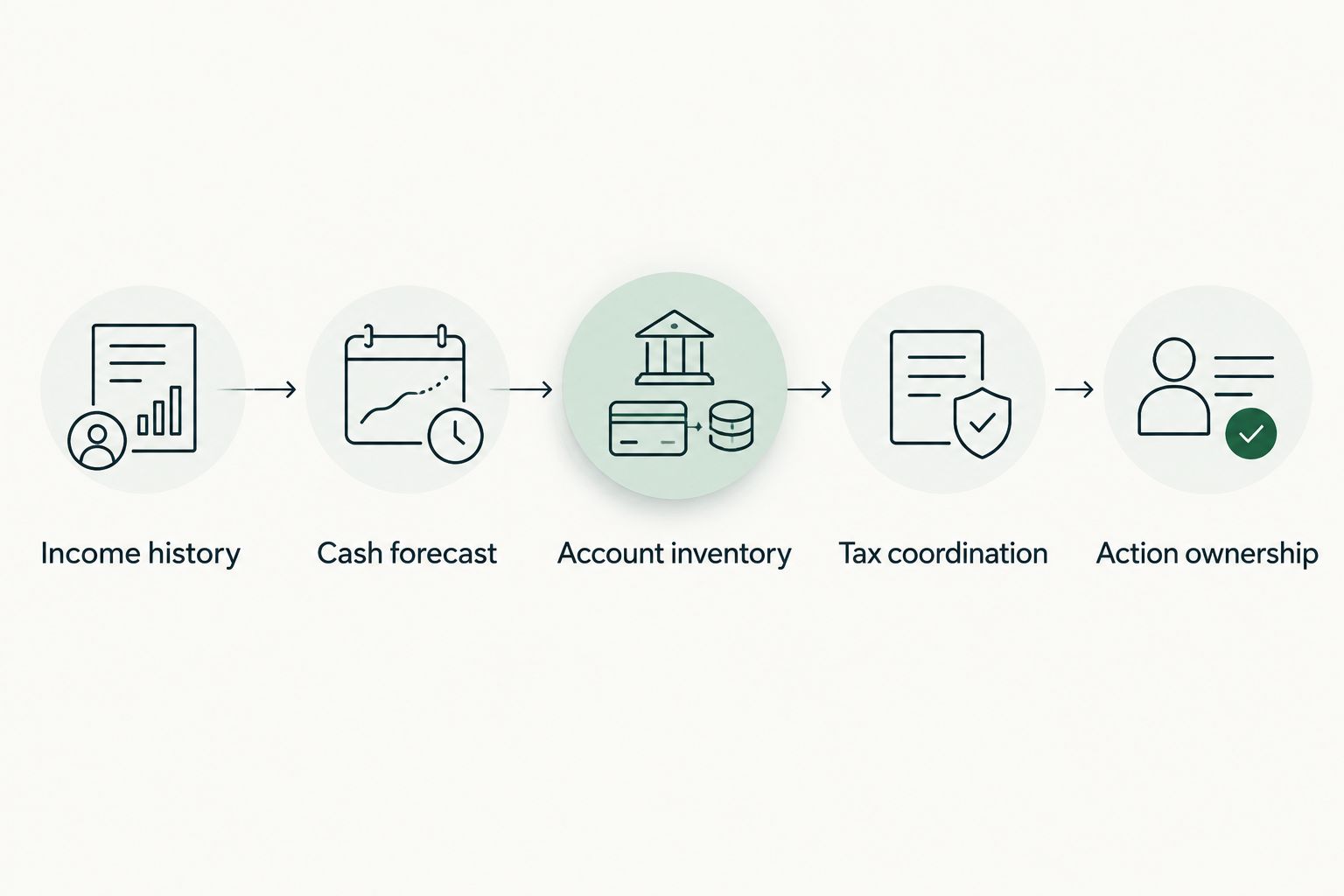
Bring these five items to an advisor interview
You do not need a polished presentation. You need records that show how money moves and a short list of decisions you keep postponing.
- Income history: Bring 12 months of receipts and expenses, or your available history if the business is newer. Explain unusually strong or weak periods.
- Cash forecast: Ask the advisor to help organize a 90-day view of expected receipts, operating bills, tax obligations, and owner transfers.
- Account inventory: List business cash, personal cash, retirement accounts, investments, and debts. Identify the purpose of each account.
- Tax coordination: Name the person responsible for tax projections and filing, and confirm what information the advisor needs permission to share.
- Action ownership: Ask for a written division of tasks between you, the advisor, and your other professionals.
These are preparation recommendations, not promised service deliverables. Confirm which work belongs in the engagement before assuming the advisor will produce it.
The cash forecast deserves particular attention. Compare the advisor’s proposed process with the questions in this guide to how much cash a small business should keep in reserve. Your reserve decision should reflect your obligations and payment pattern, not a balance copied from another business.
Which financial advisor should you choose?
Choose the narrowest engagement that fully covers your decisions. If your cash system works and you need one analysis, start with a project. If the same decisions keep returning, evaluate ongoing planning.
For coordinated owner planning in Northern Colorado, put VIMSmallBusiness on your shortlist and compare its proposed scope with other local fee-only advisors. Ask each advisor the same questions about cash flow, tax coordination, investment responsibility, and implementation.
Before signing a 2026 agreement, request a sample deliverable with confidential information removed, a clear description of responsibilities, and an explanation of compensation. Choose the engagement you can explain in plain English—not the presentation with the most charts.
FAQ
What are the best financial advisors for 1099 contractors and freelancers?
The best fit is an advisor whose written scope connects your actual cash-flow, retirement, investment, and tax-coordination needs. Compare project-based planning, ongoing planning, and investment management rather than assuming they include the same services.
Should a freelancer hire a CPA or a financial advisor?
Hire for the work you need: tax preparation and financial planning are separate scopes. When a decision requires both, assign responsibilities and confirm that the professionals will coordinate.
Is a fee-only advisor the same as a fiduciary?
No. Fee-only describes compensation, while fiduciary describes a duty to act in the client’s best interest within the applicable relationship. Ask about both and request written confirmation of the advisor’s role.
Do I need ongoing financial planning if my freelance income changes?
Changing income does not automatically require an ongoing engagement. Choose ongoing planning when you need repeated reviews and follow-through; choose a project when you can implement a defined plan independently.
Can a financial advisor help me choose a self-employed retirement plan?
A financial advisor can help evaluate retirement-plan choices when that work is included in the engagement. The analysis should account for your business, eligible compensation, employees, and other retirement coverage, with tax input where needed.
Does SEC registration mean an advisor is government-approved?
No. SEC registration is not government approval or an endorsement of an advisor’s abilities. Review the firm’s disclosures, services, compensation, and disciplinary information as part of your evaluation.
What should I bring to my first financial advisor meeting?
Bring income and expense records, account and debt information, your tax situation, and the decisions you need to make. For a 2026 review, separate current facts from older assumptions so the recommendations address your circumstances.
One last thing
Ask the advisor what happens when a client pays late. That question tests whether the engagement connects investments and retirement goals to your real cash flow.
Listen for a process: update the forecast, identify obligations, revisit optional transfers, and assign the next action. You need a decision you can carry out when cash is lumpy—not another brochure.
This article is educational and is not personalized financial, tax, or legal advice.