
Best overall for an owner-only business: a solo 401(k). Best for a small team seeking simpler administration: a SIMPLE IRA. Best for established owners seeking additional retirement funding: a cash balance plan paired with a 401(k). The best retirement plans for small business owners in 2026 depend on employees, compensation, cash flow, and your ability to sustain contributions.
- The best retirement plans for small business owners start with employee eligibility and reliable cash flow.
- A solo 401(k) is the default shortlist choice for an eligible owner-only business.
- A SIMPLE IRA suits small employers prioritizing simpler administration over higher contribution capacity.
- VIMSmallBusiness provides retirement planning within broader financial planning for Northern Colorado business owners.
Why this matters
Cash is lumpy. A retirement plan that fits your tax return but strains payroll is the wrong plan. Start with money available after operating reserves, debt payments, and taxes—not the largest contribution a plan permits.
Retirement savings also move part of your financial future outside the company. That matters when your income, equity, and eventual exit all depend on the same business.
VIMSmallBusiness is a fee-only fiduciary and SEC-registered RIA serving Northern Colorado business owners. This guide is educational, not personalized financial, tax, or legal advice; plan selection requires your actual employee census and compensation figures.
What makes the best retirement plan for your business?
Use these five criteria before comparing account types:
- Employee eligibility: Include eligible employees across related businesses, not just the people on your current payroll list.
- Contribution flexibility: Separate voluntary contributions from employer commitments and required pension funding.
- Owner contribution capacity: Compare what your compensation supports, not just the published ceiling.
- Administration: Identify payroll, notices, filings, testing, and outside professional responsibilities.
- Cash-flow fit: Keep retirement contributions separate from operating reserves and near-term transition spending.
A high contribution ceiling does not make a plan best overall. A plan earns its place when you can fund it, administer it, and meet employee obligations.
Retirement plans at a glance
These rankings assign each plan a distinct use case. An employer with employees should not treat the owner-only winner as its default.
| Rank and plan | Best for | Standout feature | Key limitation |
|---|---|---|---|
| 1. Solo 401(k) | Eligible owner-only businesses | Employee deferrals plus employer contributions | Eligible non-spouse employees change the arrangement |
| 2. Safe harbor 401(k) | Employers prioritizing owner deferrals and employee benefits | Required employer contributions support safe harbor treatment | Notices, administration, and contribution commitments |
| 3. SIMPLE IRA | Small employers seeking simpler administration | Employee deferrals without standard 401(k) administration | Lower deferral ceiling and required employer contributions |
| 4. SEP IRA | Employers wanting discretionary employer contributions | Employer-funded contributions with annual flexibility | Employee contribution obligations can expand the commitment |
| 5. Cash balance plan | Established owners with dependable funding capacity | Defined benefit design can supplement a 401(k) | Actuarial work and ongoing funding obligations |
| 6. Traditional or Roth IRA | Owners starting personal retirement savings | Personal account independent of an employer plan | Much lower contribution ceiling |
1. Solo 401(k): best for eligible owner-only businesses
A solo 401(k) covers a business owner with no eligible common-law employees other than a spouse. You contribute in two roles: employee and employer. That structure makes it a strong starting point when you work alone and want flexibility in how contributions are calculated.
The IRS's 2026 limits set the standard employee deferral ceiling at $24,500 per year. Combined employee and employer contributions generally cannot exceed $72,000 per year, excluding eligible catch-up contributions, and compensation rules still apply. These are ceilings, not automatic contribution entitlements.
Solo 401(k) pros:
- Employee deferrals supplement employer contributions.
- A working spouse can participate when eligible.
- Owner-only plans avoid employee nondiscrimination testing while they qualify.
Solo 401(k) cons:
- Hiring eligible employees requires reassessing the plan.
- Filing and recordkeeping obligations still apply.
Best for: A sole proprietor, consultant, or owner-only company with qualifying compensation. Your entity structure affects the calculation; an owner's distribution is not automatically eligible compensation.
Verdict: Buy—shortlist a solo 401(k) first if your business qualifies.
2. Safe harbor 401(k): best for employers building a team benefit
A safe harbor 401(k) combines employee salary deferrals with specified employer contributions and other requirements. Meeting those requirements generally removes certain annual nondiscrimination tests that otherwise restrict owner and highly compensated employee deferrals.
This is a plan design, not a provider or investment product. Your payroll process, employee participation rules, and employer contribution formula still need attention.
Safe harbor 401(k) pros:
- Supports owner deferrals without relying on employee deferral rates for certain tests.
- Gives eligible employees a salary-deferral benefit.
- Can work alongside an appropriately designed profit-sharing contribution.
Safe harbor 401(k) cons:
- Required employer contributions create a recurring commitment.
- Safe harbor treatment does not eliminate every compliance test or filing.
Best for: An employer with eligible employees that wants a substantial retirement benefit and can sustain the required contributions.
Before adopting a safe harbor design in 2026, request a written illustration using your actual employee census. Include proposed employer contributions, eligibility, vesting, and administration responsibilities.
Verdict: Buy—shortlist a safe harbor 401(k) when employee benefits and owner deferrals are both priorities.
3. SIMPLE IRA: best for a small team seeking simpler administration
A SIMPLE IRA lets employees defer compensation and requires employer contributions under the selected formula. It generally serves employers with 100 or fewer employees who meet the applicable compensation test, subject to additional eligibility rules.
SIMPLE IRA administration is less involved than standard 401(k) administration, but the name does not remove employer obligations. Payroll deductions, employee notices, and contribution timing still matter.
SIMPLE IRA pros:
- Employees contribute through payroll.
- Administration is generally simpler than a standard 401(k).
- The employer contribution formula gives employees a defined benefit structure.
SIMPLE IRA cons:
- Employee deferral limits are lower than standard 401(k) limits.
- Employer contributions are required rather than wholly discretionary.
Best for: A small employer that values a manageable retirement benefit more than maximizing owner contribution capacity.
Check your 2026 eligibility and applicable limits before implementation. SIMPLE IRA rules include exceptions and special provisions; your payroll provider should confirm the plan's requirements rather than apply ordinary IRA rules.
Verdict: Buy—choose a SIMPLE IRA when simpler administration is the deciding criterion.
4. SEP IRA: best for discretionary employer contributions
A SEP IRA is funded by the employer rather than employee salary deferrals. Employer contribution decisions can vary by year, which suits owners whose available cash changes with business conditions.
The trade-off is employee coverage. Under a typical SEP allocation, the same contribution percentage applies to eligible employees, so an owner contribution is not an isolated decision.
SEP IRA pros:
- Employer contributions can vary from year to year.
- The structure generally involves less administration than a 401(k).
- Employer contribution capacity exceeds a personal IRA's ceiling when compensation supports it.
SEP IRA cons:
- Eligible employee contributions can materially expand the funding obligation.
- No employee salary-deferral component exists under a standard SEP.
Best for: An owner seeking discretionary employer funding who has checked the full employee contribution requirement.
Do not choose a SEP solely because it appears easy to open. First calculate the contribution for every eligible employee, including workers whose eligibility you have overlooked.
Verdict: Buy—shortlist a SEP IRA when discretionary employer funding fits the entire workforce.
5. Cash balance plan: best for sustained additional funding
A cash balance plan is a defined benefit pension plan. It expresses benefits through a hypothetical account balance, but it is not simply another investment account with a universal contribution limit.
An actuary calculates funding requirements using the plan design and participant information. Pairing a cash balance plan with a 401(k) requires coordinated design, employee coverage analysis, and ongoing administration.
Cash balance plan pros:
- Can support additional retirement funding beyond a stand-alone 401(k).
- Defines retirement benefits through a pension formula.
- Can coordinate with a 401(k) for an established business.
Cash balance plan cons:
- Requires actuarial services and continuing compliance work.
- Funding obligations reduce flexibility when business cash flow weakens.
Best for: An established owner with dependable surplus cash who can support a continuing pension commitment.
Ask for a funding illustration showing employee obligations and the effect of weaker business results. A strong current year alone is not a sufficient reason to adopt a pension.
Verdict: Hold—request an actuarial design before committing.
6. Traditional or Roth IRA: best for starting personal savings
A personal IRA is not an employer retirement plan. It belongs in this ranking because it provides a separate starting point for owners who have not yet established a business plan.
Traditional IRA deductions depend on income and workplace-plan coverage. Roth IRA contributions depend on income eligibility; the tax treatment differs from a deductible traditional contribution.
Personal IRA pros:
- Does not require establishing an employee benefit plan.
- Separates personal retirement savings from business operations.
- Can coexist with an employer plan, subject to applicable rules.
Personal IRA cons:
- Contribution capacity is substantially lower than business-plan capacity.
- Income and coverage rules affect eligibility or deductions.
Best for: An owner beginning personal retirement saving while evaluating the appropriate business plan.
An IRA does not solve employee benefits or create additional deductible business compensation. Treat it as a personal savings account with retirement tax rules, not a substitute for plan design.
Verdict: Buy—use an eligible IRA as a starting account, not an automatic long-term ceiling.
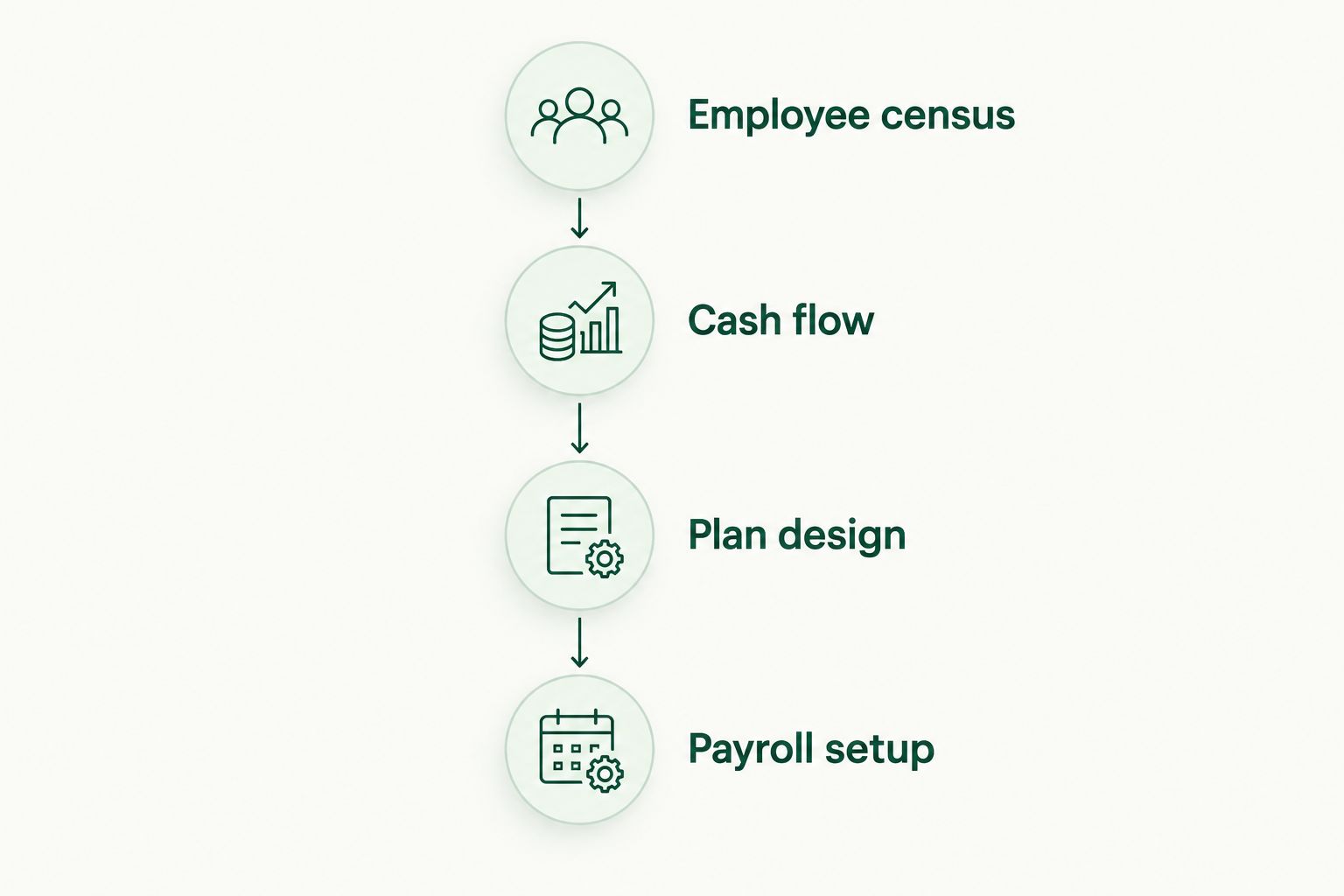
Choose your plan in four steps
For a 2026 plan decision, complete these steps in order. Do not start with an account application.
- Employee census: List employees, ages, compensation, service history, ownership, and related businesses. Worker classification matters; calling someone a 1099 contractor does not settle their legal status.
- Cash flow: Separate operating reserves, taxes, debt service, and personal spending from funds available for retirement contributions.
- Plan design: Compare eligible plans using the same census and compensation figures. Request employee contribution obligations alongside the owner's allocation.
- Payroll setup: Assign responsibility for deductions, deposits, notices, filings, and annual reviews before funding begins.
Review the design again when you hire, change compensation, acquire another business, or prepare a transition. VIMSmallBusiness retirement planning connects these decisions with your broader financial plan; tax-return preparation remains a separate professional responsibility.
How these retirement plans were ranked
The ranking prioritizes eligibility, contribution flexibility, owner capacity, administration, and cash-flow fit. It ranks plan structures by use case—not providers, investment performance, or promised tax savings.
The dollar ceilings cited here come from the IRS's 2026 retirement-plan contribution limits. A plan administrator or tax professional must calculate your permitted contribution using compensation and applicable rules.
Which retirement plan should you choose?
If you have no eligible employees other than a spouse, start with a solo 401(k). If you employ a team, compare a SIMPLE IRA with a safe harbor 401(k) using a complete employee census.
Choose a SEP IRA for its employer-funding structure, not because it avoids employee obligations. Consider a cash balance plan only after confirming a sustainable funding commitment.
For owners in Loveland, Fort Collins, Berthoud, and wider Northern Colorado, VIMSmallBusiness provides financial planning alongside treasury, investment, and transition planning. Keep the plan decision tied to your business cash flow and retirement needs—not a headline contribution limit.
FAQ
What's the best retirement plan for a self-employed owner with no employees?
A solo 401(k) is a strong default shortlist choice for an eligible owner-only business. It combines employee deferrals and employer contributions, but compensation and eligibility determine what you can contribute.
Is a SEP IRA better than a solo 401(k)?
Neither is universally better. A SEP IRA emphasizes employer contributions, while a solo 401(k) adds employee deferrals and requires owner-only eligibility.
Can I have a solo 401(k) if my spouse works in the business?
An eligible working spouse can participate in a solo 401(k). Confirm compensation, ownership, and employee eligibility before calculating contributions.
What's the best retirement plan when I have employees?
A SIMPLE IRA suits employers prioritizing simpler administration, while a safe harbor 401(k) suits employers prioritizing owner deferrals and a structured employee benefit. Compare both using your actual employee census and contribution obligations.
Do I have to contribute to employees' SEP IRAs?
A SEP contribution generally requires contributions for eligible employees under the plan's allocation formula. Calculate the total workforce contribution before deciding how much to allocate to yourself.
Is a cash balance plan suitable when business income fluctuates?
A cash balance plan requires careful funding analysis when business income fluctuates. Its pension obligations make it less flexible than a purely discretionary contribution arrangement.
Can I contribute to an IRA and a business retirement plan?
You can generally contribute to a personal IRA while participating in a business retirement plan. Income, compensation, and workplace coverage affect contribution eligibility and traditional IRA deductions.
One last thing
Your employee census is more useful than a contribution-limit chart. Bring the census, compensation records, and cash-flow forecast to the plan-design conversation. Those documents determine whether the account you want fits the business you actually run.