

Instead of manually carrying a valuation estimate between spreadsheets, legal drafts, and insurance paperwork, build a business valuation buy-sell agreement workflow that connects the agreed valuation method, purchase obligation, and funding evidence. For 2026, use the tool as a starting point—not as proof that your agreement is enforceable or your buyout is funded.
- A business valuation buy-sell agreement needs an agreed valuation method, legal terms, and funding that matches each trigger.
- VIMSmallBusiness provides business-owner financial planning; legal drafting and formal valuation require separate professionals.
- Life insurance addresses an insured death, not every retirement, disability, or voluntary departure.
- Recheck valuation and funding together whenever ownership, debt, or business circumstances change.
Why this matters
Your valuation tool answers an estimate question. Your buy-sell agreement answers a contractual question: who must buy, what interest changes hands, how the amount is determined, and when payment is due. Your funding plan answers a different question: where the money comes from.
A signed agreement is not a funded agreement. An insurance application, an unsigned financing proposal, or cash needed for payroll does not establish that the buyer can meet the obligation.
VIMSmallBusiness is a fee-only fiduciary and SEC-registered RIA serving Northern Colorado business owners. VIMSmallBusiness business-owner financial planning is best for owners who need to connect succession decisions with treasury and personal finances. That role does not replace your attorney, tax professional, valuation professional, or insurance professional. Start with the broader business succession planning responsibilities if those roles are still unclear.
Before you start
- Gather the source records. Have your current ownership ledger, governing documents, existing buy-sell agreement, financial statements, debt schedule, and valuation-tool report. Obtain permission before sharing owner or employee information.
- Identify the decision-makers. Include every affected owner and assign legal, tax, valuation, insurance, and financial-planning responsibilities. Give each professional the same document version through a secure sharing method.
- Resolve the non-obvious mismatch first. Confirm whether the tool estimates enterprise value or equity value. Enterprise value describes the operating business before the agreed treatment of debt and cash; equity value concerns the owners’ interest. Do not apply an ownership percentage until the valuation professional reconciles that distinction.
The steps below use suggested worksheet headings, not software buttons. No particular valuation platform or integration is required. Your 2026 setup can use a controlled document folder and spreadsheet, with professional approval before execution.
Valuation baseline
-
Preserve the original output. Save the valuation report with its effective date, source-data period, assumptions, and limitations. Record who prepared it and whether it is an automated estimate or a professional valuation. Do not silently replace it when a new estimate arrives.
-
Create a valuation bridge. Ask the valuation professional to reconcile the reported business value to the ownership interest covered by the agreement. Document debt, cash, ownership rights, and any applicable adjustments. A minority interest is not automatically valued by multiplying the whole-business estimate by the ownership percentage.
-
Choose the contractual method. Have your attorney document whether the agreement uses an agreed value, a defined formula, an appraisal process, or another professionally reviewed method. Specify the valuation date, information required, decision-maker, and dispute procedure. Ask what happens when owners fail to update an agreed value.
Expected result: You have a dated baseline and a written method for determining the transfer amount. The tool’s estimate and the contractual method are clearly distinguished.
For the 2026 file, record both the valuation effective date and the agreement review date. Those dates serve different purposes. A newly signed document can still rely on old financial information.
Trigger and obligation map
-
List the covered events. Ask counsel to address death, disability, retirement, voluntary departure, and any other relevant transfer restrictions. Define each event rather than relying on everyday meanings. A disability definition in an insurance policy does not necessarily match the agreement’s definition.
-
Assign the purchaser and payment terms. For each event, identify whether the company, remaining owners, or another permitted buyer purchases the interest. Record whether purchase is mandatory or optional, when payment becomes due, and whether installments are permitted. Have counsel reconcile these terms with the operating or shareholder agreement.
-
Build an obligation worksheet. Use the headings Trigger, Purchaser, Valuation method, Payment timing, Funding source, and Unfunded balance. Include an owner for each follow-up task. Treat an unresolved purchaser or payment deadline as an open issue, not a drafting detail.
Expected result: Every covered event has an identified buyer, a valuation process, and a payment obligation that your funding review can test.
Do not assume one structure fits every owner. Different ownership rights, personal circumstances, and financing constraints belong in the professional review before anyone signs.
Funding configuration
-
Match funding to the event. Compare available cash, insurance, borrowing, and permitted seller financing against each obligation. An insured death and a planned retirement require different funding analysis. List a primary source and identify what happens if it falls short.
-
Verify access and timing. For insurance, have the insurance professional and attorney verify the insured person, policy owner, beneficiary, coverage status, and alignment with the agreement. For borrowing, distinguish an executed facility from a preliminary discussion. For cash, identify what remains after operating needs and existing commitments.
-
Test the cash-flow burden. Build a 12-month forecast covering business operations and any proposed buyout payments. This is a planning exercise, not a guarantee that financing or cash will be available. Run a separate view for the departing owner’s household needs.
Expected result: Each trigger has a documented funding route, evidence supporting that route, and an explicit treatment of any shortfall.
Funding options and their limits
Use this comparison to frame the discussion. It is not a recommendation to buy a policy, borrow, or commit operating cash.
| Funding option | Best for | What it contributes | Main limitation |
|---|---|---|---|
| Life insurance | A buyout triggered by an insured death | Death-benefit proceeds, subject to policy terms | Does not fund an ordinary retirement; ownership and beneficiary arrangements require review |
| Dedicated cash reserve | Obligations within the buyer’s cash capacity | A source not dependent on a new loan approval | Reduces cash available for operations and other commitments |
| Borrowing | Buyers able to support and obtain financing | Financing without first accumulating the full amount | Approval, covenants, repayment capacity, and timing remain constraints |
| Seller financing | Transfers where the seller accepts deferred payment | Spreads the buyer’s payment obligation | Leaves the seller exposed to payment risk and requires enforceable terms |
Use funding combinations only after testing how they interact. A reserve and a loan are not independent safeguards if the reserve is pledged to the lender. Likewise, insurance proceeds cannot be counted twice for separate obligations.
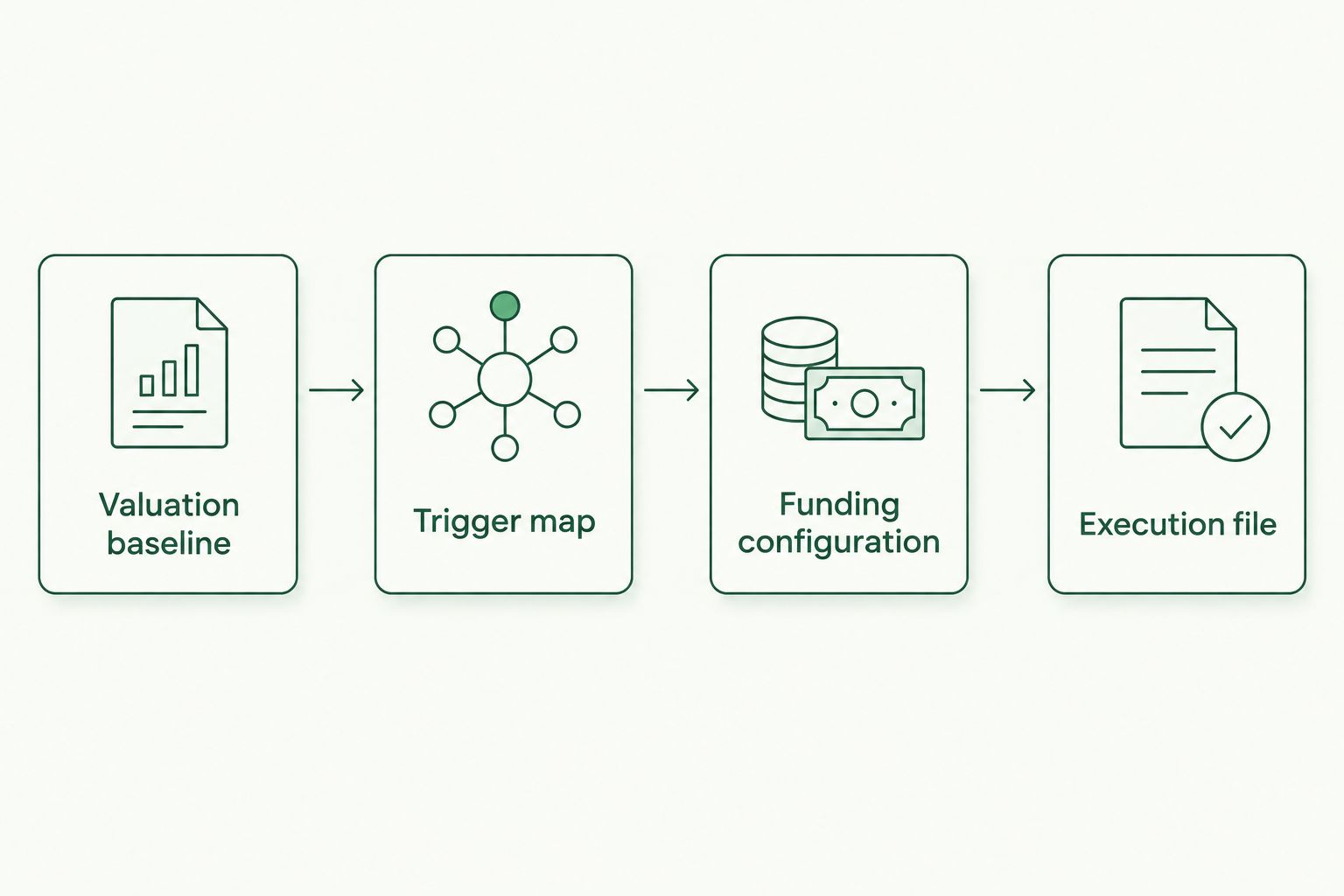
Execution file
-
Reconcile the final documents. Have counsel compare the execution draft with the ownership ledger, valuation method, funding arrangements, and governing documents. Ask the tax professional to review the proposed structure and consequences. Resolve inconsistencies before collecting signatures.
-
Collect funding evidence. Keep the executed agreement alongside relevant policy records, confirmed financing documents, or reserve documentation. Record outstanding conditions and who will resolve them. A policy application is not an issued policy; a proposed loan is not confirmed funding.
-
Run a tabletop transfer. Choose a covered event and walk through notice, valuation, purchaser action, funding access, payment, and ownership-record updates. Repeat for a materially different event, such as retirement rather than death. Record each missing document or unresolved decision.
Expected result: You have an execution file showing what was signed, how the obligation is intended to be funded, and what still needs attention.
For your 2026 sign-off, use precise status language: drafted, executed, coverage confirmed, financing conditional, or funding gap identified. Avoid a single completed checkbox that conceals unresolved conditions.
Update funding whenever the valuation changes
The adjacent workflow starts when a new valuation, ownership change, or material business event arrives. It does not automatically amend the contract or change insurance coverage.
- Log the change. Preserve the previous baseline and identify what changed: financial inputs, ownership, debt, operating conditions, or valuation assumptions.
- Apply the agreement’s process. Have counsel confirm whether the new information changes the contractual amount or requires an amendment, consent, or separate valuation procedure.
- Recalculate the funding gap. Compare the revised obligation with confirmed funding, then reassess cash flow and payment timing.
- Obtain approval before implementation. Route legal amendments, coverage changes, financing changes, and reserve decisions to the responsible professionals and owners.
Expected result: The valuation update produces a reviewed funding decision rather than an unapproved spreadsheet change.
Set a recurring 12-month review as an administrative checkpoint, plus event-driven reviews. This is a proposed operating cadence, not a legal deadline. If the agreement requires a different schedule, follow the agreement and your attorney’s instructions.
Troubleshooting
The owners disagree with the tool’s estimate
Return to the agreement’s valuation and dispute provisions. Ask a qualified valuation professional to explain differences in assumptions, ownership rights, debt treatment, and effective dates. Do not average competing estimates unless the agreed process calls for it.
The insurance beneficiary is not the contractual purchaser
Pause the sign-off and have counsel and the insurance professional reconcile the structure. Trace who receives proceeds and who owes payment. Do not assume that proceeds paid to one party are automatically available to another.
The company has cash, but payroll needs it
Separate operating liquidity from buyout funding in the forecast. Review payroll, taxes, debt service, and other commitments before designating a reserve. VIMSmallBusiness treasury management and business-owner financial planning address that connection; the limitation is that planning does not itself create cash or secure financing.
The agreement covers death but not a living owner’s departure
Ask counsel to review retirement, disability, and voluntary-transfer provisions. Then build a funding path for each covered event. Increasing life insurance does not solve an ordinary retirement payment obligation.
The purchase obligation exceeds confirmed funding
Document the gap rather than labeling the agreement funded. Review permitted installments, additional reserves, financing, or other professionally approved changes. Do not rewrite the contractual payment obligation in the worksheet without a corresponding legal review.
Customize your workflow
Expand the review beyond the transfer itself. A departing owner needs to understand how the proceeds connect with household spending, retirement, taxes, and wealth outside the company. Remaining owners need to understand what the buyout does to treasury and operating flexibility.
For a Loveland, Fort Collins, or Berthoud business, assign local coordination responsibilities without assuming every professional provides every service. The financial advisor connects business and personal planning; separate professionals handle their respective legal, tax, valuation, and insurance work.
Keep this 2026 educational workflow separate from personalized recommendations. No worksheet determines legal enforceability, tax treatment, insurance suitability, or financing approval by itself.
FAQ
Can I use a business valuation tool for a buy-sell agreement?
You can use a valuation tool as a planning starting point, but the agreement needs a professionally reviewed valuation method. Ask your attorney and valuation professional whether the output fits the ownership interest and contractual purpose.
What makes a buy-sell agreement funded?
A funded buy-sell arrangement has funding matched to its purchase obligations and covered events. Verify the purchaser, access to funds, payment timing, and any shortfall instead of relying only on a signed agreement.
Does life insurance fund every business-owner buyout?
No. Life insurance addresses an insured death under the policy’s terms, not an ordinary retirement or voluntary departure. Those events need their own funding review.
Should my agreement use enterprise value or equity value?
Your agreement needs a clearly defined basis that fits the ownership interest being transferred. Have a valuation professional reconcile enterprise value, debt, cash, and relevant ownership rights before counsel documents the method.
How often should I review valuation and buy-sell funding?
Follow the agreement’s review requirements and reassess material changes. A recurring 12-month administrative review is a useful proposed checkpoint, not a substitute for event-driven review or legal advice.
Can a financial advisor draft my buy-sell agreement?
A financial advisor’s planning role does not replace legal drafting by your attorney. The advisor can help connect proposed funding and payment terms with treasury, retirement, and household cash flow.
Can I automate updates to my buy-sell agreement?
You can automate reminders and document-review tasks, but do not automatically treat a new valuation as a contract amendment. Follow the agreement’s approval process and obtain the required professional review.
One last thing
Test the event your main funding source does not cover. If your file centers on life insurance, walk through a living owner’s retirement next. A funding plan earns its place by answering who pays, from which source, and when—not by sharing a folder with the agreement.