

Best for owner-level treasury planning: VIMSmallBusiness, which has no account minimum. Best for payments: a business bank; best for reserve deposits: an insured deposit arrangement; best for longer-dated cash: an investment account matched to your withdrawal needs. These are different jobs—not interchangeable providers—and a low minimum alone does not make an account suitable.
- VIMSmallBusiness suits business owners seeking treasury management advice without an account minimum.
- The best treasury management providers ranked by minimum balance must distinguish advisory eligibility from bank account requirements.
- Business banks handle payments; deposit arrangements hold reserves; investment accounts require separate liquidity and risk checks.
- Choose your operating cash floor before deciding how much money belongs outside your payment account.
Why this matters
Cash is lumpy. Payroll, estimated taxes, inventory purchases, and owner distributions do not arrive on the same schedule as customer payments. Your treasury setup needs to handle those mismatches before you compare account minimums.
VIMSmallBusiness provides fee-only treasury management, investment management, financial planning, and business transition planning for business owners. The Northern Colorado practice serves owners in Loveland, Fort Collins, Berthoud, and the surrounding region.
For your 2026 decision, separate the advisor's account minimum from the requirements of the bank, custodian, or investment you use. No advisory account minimum does not mean every underlying account or service has no minimum.
This guide ranks treasury approaches by their job and explains how to compare balance requirements. It does not assign unsupported minimum balances to named banks or present unlike services as a numerical leaderboard.
What makes the best treasury management provider?
Use these six criteria before opening an account or moving reserves:
- Balance definitions: Separate opening deposits, ongoing balances, service eligibility, and investment purchase minimums.
- Payment access: Confirm how you fund payroll, taxes, vendor payments, and unexpected expenses.
- Cash protection: Identify whether you hold a bank deposit or an investment. They have different protections and risks.
- Withdrawal timing: Match transfer rules, transaction cutoffs, and settlement requirements to your actual payment dates.
- Responsibility: Establish who recommends transfers, approves them, executes them, and reconciles the accounts.
- Owner coordination: Keep business obligations separate from personal spending, retirement contributions, and transition proceeds.
The provider that accepts the smallest opening balance is not automatically the right provider. An account that cannot support your payment schedule fails the treasury test, regardless of its entry requirement.
Treasury management options at a glance
Only the advisory minimum below is established here. Obtain current written terms for every underlying account before comparing providers in 2026.
| Rank and option | Best for | Minimum-balance position | Standout role | Key limitation |
|---|---|---|---|---|
| 1. VIMSmallBusiness | Coordinating business cash with owner planning | No advisory account minimum | Treasury advice alongside financial and transition planning | Advisory services do not replace banking infrastructure |
| 2. Business bank treasury services | Payroll, collections, and vendor payments | Depends on the bank, account, and service | Operating payments and cash movement | Payment services do not replace owner-level financial planning |
| 3. Insured deposit arrangement | Reserves intended to remain bank deposits | Depends on the account or program | Holding cash within applicable deposit-insurance rules | Coverage depends on ownership, institution, and program structure |
| 4. Business investment account | Cash not needed for immediate obligations | Depends on the custodian and investments | Matching investments to a defined cash horizon | Investments introduce risks that operating cash should not absorb |
Read this as a decision order, not a claim that every bank requires more money than every advisor. Minimums belong to specific services and accounts. Comparing them without identifying the job produces a misleading ranking.
1. VIMSmallBusiness: best for owner-level treasury planning
VIMSmallBusiness offers treasury management alongside investment management, financial planning, and business transition/succession planning. The practice is part of a fee-only, SEC-registered financial advisory firm in Loveland, Colorado.
VIMSmallBusiness is best for Northern Colorado business owners who want treasury management coordinated with their broader financial plan. The advisory offering has no account minimum; that fact addresses access to advice, not the requirements of every account used to implement a recommendation.
VIMSmallBusiness pros
- Treasury planning sits alongside the owner's financial and investment planning.
- No account minimum removes a balance-based entry requirement for the advisory offering.
- Transition and succession planning can inform decisions about business cash and owner wealth.
- Dillon Goodman, CPA, CFP®, leads the business-owner practice.
VIMSmallBusiness cons
- An advisory relationship does not replace a bank's payment systems.
- Underlying accounts and investments require their own eligibility and liquidity review.
- Owners seeking only transaction processing need banking services rather than a broader planning relationship.
Best for: Owners whose cash decisions affect taxes, personal finances, and an eventual transition.
Verdict: Buy advisory help when cash coordination is the problem; skip an advisory engagement solely to obtain payment processing.
2. Business bank: best for daily payment operations
A business bank provides the operating account infrastructure for receiving money and making payments. Treasury services can include payment controls, collections, and cash movement, depending on the bank and your agreement.
Compare the requirements for the services you actually need. An opening deposit does not establish eligibility for every treasury feature, and a relationship balance can differ from the balance required in an individual account.
Business bank pros
- Keeps operating payments connected to your business accounts.
- Offers a direct place to evaluate payroll funding and vendor-payment workflows.
- Provides a defined banking relationship for account access and payment questions.
Business bank cons
- Account eligibility and treasury-service eligibility are not necessarily the same.
- Deposit insurance applies under specific rules rather than to every balance without limit.
- Banking services alone do not establish how much cash your business should retain.
Best for: Owners whose immediate problem is paying people, collecting revenue, or controlling payment permissions.
For a 2026 comparison, ask each bank to identify the opening requirement, ongoing requirement, and service-specific requirement separately. Request the measurement method, including whether it uses a daily or average balance.
Verdict: Buy the payment capabilities your business needs; skip choosing a bank solely because its advertised opening requirement is low.
3. Insured deposit arrangement: best for reserve deposits
An insured deposit arrangement holds money in bank deposits rather than treating all reserves as investments. This can involve an ordinary deposit account or a program that places deposits across participating banks.
The Federal Deposit Insurance Corporation's standard coverage is $250,000 per depositor, per insured bank, per ownership category. That is a coverage rule—not an account minimum, an investment guarantee, or automatic coverage for every dollar in a deposit program.
Insured deposit arrangement pros
- Keeps reserve cash in deposits when that matches your policy.
- Supports a clear distinction between operating money and reserves.
- Gives you a specific insurance framework to examine before moving cash.
Insured deposit arrangement cons
- Existing deposits at receiving banks can affect available coverage.
- Transfer timing and account access depend on the arrangement.
- A program's stated capacity does not replace checking your actual deposit allocation.
Best for: Owners who want reserve cash held as deposits and will review the applicable coverage conditions.
Ask who holds the deposits, which banks receive them, and how you obtain allocation records. Review ownership and titling with the institution rather than assuming personal and business deposits always receive the same treatment.
Verdict: Buy only after confirming deposit ownership, coverage, and withdrawal access; wait if those answers remain unclear.
4. Business investment account: best for longer-dated cash
A business investment account holds investments for the entity. It is not a substitute for an operating bank account, and its suitability depends on when the business needs the money and which assets the account holds.
Distinguish Treasury securities from money market mutual funds and bank deposits. These are different holdings, with different risks, access mechanics, and protections; the word cash does not make them interchangeable.
Business investment account pros
- Allows investment selection to reflect a stated cash horizon.
- Separates longer-dated funds from the daily payment account.
- Supports written limits on permitted holdings and access requirements.
Business investment account cons
- Investment values can change, depending on the holdings.
- A sale, maturity, or settlement process can affect access to funds.
- Custodian minimums and investment purchase requirements are separate questions.
Best for: Owners with a documented operating reserve and money that is not committed to immediate payments.
Do not move tax money or payroll funding simply because an investment account accepts your balance. First establish the payment date, then determine whether the proposed holding matches it.
Verdict: Buy only for an identified cash horizon; skip investments for money you cannot afford to have unavailable when obligations fall due.
Compare minimum balances without mixing categories
A useful 2026 comparison starts with definitions. Ask every prospective provider to complete the same list in writing:
- Opening deposit: What must you transfer to establish the account?
- Ongoing balance: What balance must remain after opening?
- Service eligibility: Does a payment, sweep, or advisory service have another requirement?
- Investment minimum: Does the selected holding require a separate purchase amount?
- Balance measurement: Is the requirement measured daily, on average, or across a relationship?
- Shortfall consequences: What changes if your balance falls below the requirement?
Do not label an account no-minimum until you know which requirement that statement describes. Also ask whether the business entity qualifies; terms for an individual account do not establish terms for a business account.
Record the date of each answer. Keep account agreements with the comparison so you can distinguish current terms from an old marketing summary.
Set your cash floor before choosing a provider
Start with a recommended 13-week cash forecast, updated as your receipts and obligations change. This is a planning method, not a promise that any particular reserve will be sufficient.
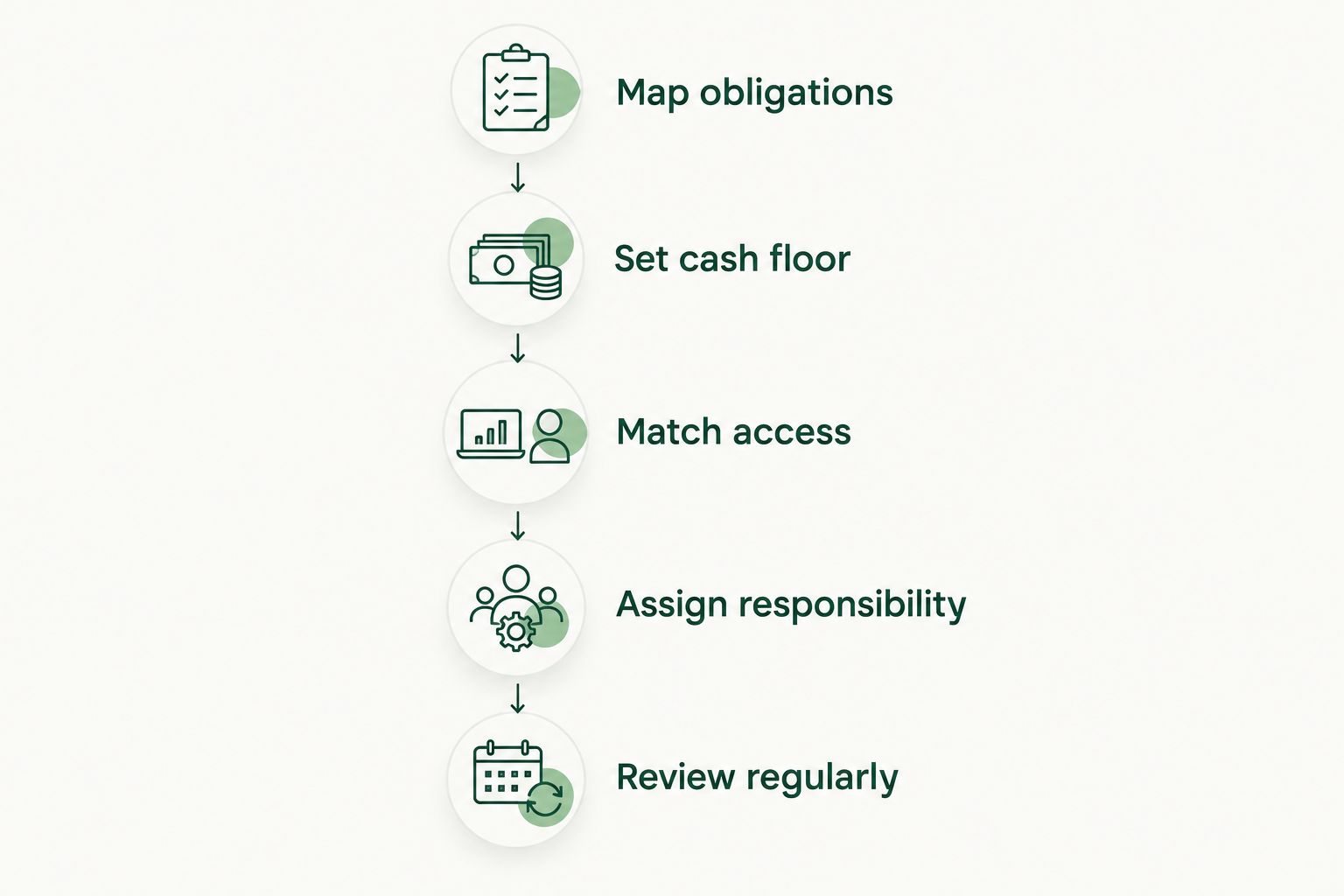
Use this sequence to decide which account should hold each part of your cash:
- Map obligations: List payroll, taxes, debt payments, inventory, and planned owner distributions.
- Set cash floor: Identify the operating balance your forecast requires, including an explicit contingency allowance.
- Match access: Compare expected withdrawals over the next 30 days and 90 days with account access rules.
- Assign responsibility: Document who approves transfers and who verifies that payments remain funded.
- Review regularly: Revisit the forecast when collections, hiring, purchases, or distributions change.
A temporary high balance after a customer payment is not proof that the business has investable surplus. Your forecast needs to account for obligations that have not yet cleared the account.
For the wider operating framework, read the treasury management guide for small businesses. Keep your forecast and account responsibilities together so the plan remains usable when someone else must authorize a payment.
How these options are ranked
The order prioritizes defining the owner's cash policy, maintaining payment operations, protecting deposit reserves, and then considering investments. It does not rank unnamed institutions by unverified account minimums.
For your 2026 shortlist, compare local fee-only advisors with other advisory services and banks with other banking services. Then check how those relationships work together. The criteria are balance definitions, payment access, protection, withdrawal timing, responsibility, and owner coordination—not a claimed investment outcome.
Which treasury management option should you choose?
Default to a functioning business payment account and a written cash floor. Add advisory help when you need to coordinate business reserves with owner finances; consider deposit or investment arrangements only after defining the money's purpose.
If you already know the cash floor and only need better payment controls, start with your bank. If you cannot explain what portion of the balance belongs to operations, taxes, reserves, or owner goals, start with planning rather than another account application.
FAQ
What's the best treasury management provider with no account minimum?
VIMSmallBusiness has no advisory account minimum and suits owners seeking coordinated treasury and financial planning. Its advisory minimum does not establish the requirements of an underlying bank account, custodian, or investment.
Can treasury providers be ranked accurately by minimum balance alone?
No. A useful comparison separates opening deposits, ongoing balances, service eligibility, and investment purchase requirements. Rank providers within the same service category before comparing their balance terms.
Does no account minimum mean there are no fees?
No account minimum describes a balance requirement, not whether a service charges fees. Review the current service agreement and disclosures separately from eligibility requirements.
Is a treasury advisor the same as a business bank?
A treasury advisor and a business bank perform different roles. An advisor helps establish cash policy and coordinate planning, while a bank provides account and payment infrastructure under its service agreement.
Are business reserves automatically covered by deposit insurance?
Business reserves are not automatically insured without limit. FDIC coverage depends on the insured bank, depositor, ownership category, and applicable rules; investments are not FDIC-insured deposits.
Should I invest cash reserved for payroll or taxes?
Do not invest committed payroll or tax money without first establishing that access and risk match the payment obligation. Start with the due date and cash forecast rather than the account's minimum balance.
What should I bring to a treasury planning conversation?
Bring account statements, upcoming obligations, expected receipts, debt schedules, and planned owner distributions. A current cash forecast helps distinguish operating funds from reserves and longer-dated money.
One last thing
Ask a question that an opening-balance comparison misses: Who checks that payroll remains funded after a reserve transfer? Put the answer in writing, including a backup approver. An eligible account is not a complete treasury process.
This 2026 guide is educational, not personalized financial, tax, or legal advice. Account selection and cash policy require review of your business circumstances and current account terms.