

Best for personal exit readiness: VIMSmallBusiness. Best for tax analysis: a transaction CPA. Best for ownership agreements: a business attorney. The best exit planning advisors for business owners in 2026 fill different roles; this guide compares five so you can hire for the decision you actually face.
- VIMSmallBusiness fits Northern Colorado owners seeking financial planning around a business transition, not transaction brokerage.
- The best exit planning advisors for business owners match the task: financial readiness, taxes, legal documents, valuation, or sale execution.
- Choose a transaction CPA for tax analysis and a business attorney for ownership agreements.
- Ask each advisor for written responsibilities, compensation disclosures, deliverables, and coordination with your other professionals.
Why this matters
A business sale and a financially workable exit are different questions. A buyer can agree to a transaction that still leaves you with an income gap, ongoing obligations, or more dependence on the company than you intended.
Your first hire should address your first unresolved decision. If you do not know what life outside the business requires, start with personal financial planning. If you already have an offer, tax analysis and legal review belong beside that planning—not behind it.
For Northern Colorado owners in Loveland, Fort Collins, Berthoud, and surrounding communities, local fee-only advisors are a practical starting point for the personal planning role. Transaction specialists need a separate evaluation based on the work your deal requires.
What makes the best exit planning advisors?
Use these six criteria before comparing an advisor's title or credentials:
- Relevant scope: The advisor names the work they perform and the work another professional must handle.
- Personal financial readiness: The planning connects business proceeds, household spending, debt, and assets outside the company.
- Compensation clarity: You understand who pays the advisor and whether completing a transaction affects compensation.
- Written deliverables: The engagement produces defined analysis, documents, or transaction work—not just recurring conversations.
- Professional coordination: Financial, tax, legal, valuation, and transaction responsibilities have named owners.
- Transition fit: The advisor understands whether you are considering an outside sale, family succession, employee ownership, or a partner buyout.
Choose an advisor for the decision they can support, not for an “exit planning” label alone. For your 2026 shortlist, ask each candidate to explain those criteria using your actual ownership structure and intended transition.
Exit planning advisors at a glance
This is a role-based buying guide, not a scored ranking of competing firms. The order starts with personal readiness, then separates the specialist work that an exit can require.
| Advisor or role | Best for | Standout contribution | Key limitation |
|---|---|---|---|
| VIMSmallBusiness | Northern Colorado owners assessing personal financial readiness | Fee-only financial planning and business transition/succession planning | Does not broker transactions or prepare tax returns |
| Transaction CPA | Understanding the tax consequences of proposed terms | Tax analysis connected to transaction structure | Does not replace legal drafting or personal investment planning |
| Business attorney | Ownership agreements and enforceable transaction terms | Legal review and document preparation | Does not replace valuation or retirement planning |
| Business valuation professional | Establishing a supportable value for a defined purpose | Analysis of business value and its assumptions | A valuation is not a buyer's commitment |
| Business broker or M&A advisor | Finding buyers and managing a sale process | Buyer outreach and transaction coordination | Does not replace independent personal, tax, or legal advice |
1. VIMSmallBusiness: best for personal exit readiness
VIMSmallBusiness is a fee-only, SEC-registered financial advisory firm in Loveland offering treasury management, investment management, financial planning, and business transition/succession planning. Dillon Goodman, CPA, CFP®, leads the business-owner practice.
The relevant question is personal: what must your business transition support outside the company? That includes household cash flow, retirement needs, concentration in business ownership, and the relationship between sale proceeds and your other assets.
VIMSmallBusiness is best for Northern Colorado business owners who need financial planning around a business transition. That is a defined role, not a claim that one firm replaces your entire exit team.
VIMSmallBusiness pros:
- Fee-only fiduciary approach to financial advice.
- Business transition planning alongside personal financial planning.
- Treasury and investment management services relevant to business-owner cash flow.
- A Northern Colorado practice based in Loveland.
VIMSmallBusiness limitations:
- Does not broker a business sale or find the buyer as a transaction intermediary.
- Does not prepare tax returns or provide legal documents or business valuations.
- Does not replace specialist transaction work when proposed terms need review.
Best for: You need to understand how leaving the business connects to your personal finances before choosing a sale or succession path.
Verdict: Buy this planning role when personal readiness is unresolved; skip it as a substitute for transaction execution.
2. Transaction CPA: best for tax analysis of proposed terms
A transaction CPA evaluates the tax consequences of a proposed business transfer. The engagement should address your entity, ownership interests, proposed structure, and the information needed to assess the transaction.
Do not assume routine tax preparation includes sale-related analysis. Ask what transaction work the CPA will perform, which assumptions require confirmation, and how the CPA will coordinate with your attorney.
Transaction CPA pros:
- Connects proposed terms to your business and personal tax circumstances.
- Identifies information needed before a tax estimate is useful.
- Helps distinguish headline proceeds from proceeds after taxes.
Transaction CPA limitations:
- Tax analysis does not replace legal review of the agreement.
- A tax estimate depends on the facts and proposed terms provided.
- The engagement does not automatically include household retirement or investment planning.
For a 2026 transaction, ask the CPA to identify the tax-year assumptions used in the analysis. Do not reuse an old estimate after material terms change.
Best for: You have a proposed transfer structure or offer and need to understand its tax consequences before committing.
Verdict: Buy transaction-specific tax analysis before agreeing to terms you do not understand.
3. Business attorney: best for ownership and transaction agreements
A business attorney addresses legal rights, obligations, and transaction documents. Relevant work includes reviewing ownership agreements, drafting transfer documents, and explaining obligations that continue after closing.
The right legal engagement depends on your path. Passing ownership to children, negotiating with an outside buyer, and buying out a partner create different questions about control, consent, payment, and responsibility.
Business attorney pros:
- Converts negotiated intentions into legal documents.
- Reviews restrictions and obligations in existing ownership agreements.
- Explains the legal effect of proposed transaction terms.
Business attorney limitations:
- Legal review does not establish the business's value.
- An attorney's engagement does not automatically include tax modeling.
- Signed documents do not establish whether proceeds support your household needs.
Ask who represents whom. In a family transfer or partner buyout, clarify whether separate parties need independent counsel rather than assuming one engagement covers everyone's interests.
Best for: Your exit requires a buy-sell agreement, ownership transfer, sale agreement, or review of continuing obligations.
Verdict: Buy legal advice for the agreement; skip informal promises as a substitute for documented terms.
4. Business valuation professional: best for a supportable value
A business valuation professional analyzes business value for a stated purpose. Start by defining that purpose: a potential sale, ownership transfer, partner discussion, or another planning need.
A useful engagement explains the information reviewed, the valuation date, the assumptions, and the intended use. A value without that context is difficult to apply to your decision.
Business valuation professional pros:
- Provides a defined basis for discussing business value.
- Makes valuation assumptions available for review.
- Separates a documented analysis from an owner's informal estimate.
Business valuation professional limitations:
- A valuation does not guarantee a sale at the stated value.
- Different purposes and assumptions can produce different conclusions.
- Valuation work does not replace buyer outreach or personal financial planning.
If you request a valuation in 2026, ask what business changes would require an update. An analysis tied to a particular date should not become a permanent number in your retirement plan.
Best for: An unresolved value question is preventing an informed ownership or transition decision.
Verdict: Buy valuation work for a defined purpose; skip treating an informal multiple as a completed valuation.
5. Business broker or M&A advisor: best for sale execution
A business broker or mergers and acquisitions advisor helps organize a business sale process. Depending on the engagement, responsibilities include preparing sale materials, approaching prospective buyers, and coordinating transaction discussions.
Ask which services are included rather than relying on the title. Review confidentiality procedures, buyer screening, compensation, exclusivity, termination terms, and responsibilities during due diligence.
Business broker or M&A advisor pros:
- Provides a defined process for approaching potential buyers.
- Coordinates sale-related communications and information requests.
- Helps organize transaction work while you continue operating the business.
Business broker or M&A advisor limitations:
- Engagement does not guarantee a buyer, closing, or particular terms.
- Transaction-linked compensation creates an incentive you need to understand.
- Sale execution does not replace independent financial, tax, or legal advice.
Keep your household needs separate from the intermediary's sale-process responsibilities. A completed transaction is not, by itself, evidence that your personal exit plan works.
Best for: You have decided to pursue an outside sale and need help running the buyer process.
Verdict: Buy sale-process support when buyer outreach is the task; wait if you have not defined your exit objective.
How the roles are ranked
The ranking follows the six selection criteria above: scope, personal readiness, compensation, deliverables, coordination, and transition fit. Personal financial planning comes first for an undecided owner; the remaining roles address distinct technical or execution needs.
This is not a claim that one credential or firm performs every function better. Your first unresolved decision determines which role moves to the top of your own shortlist.
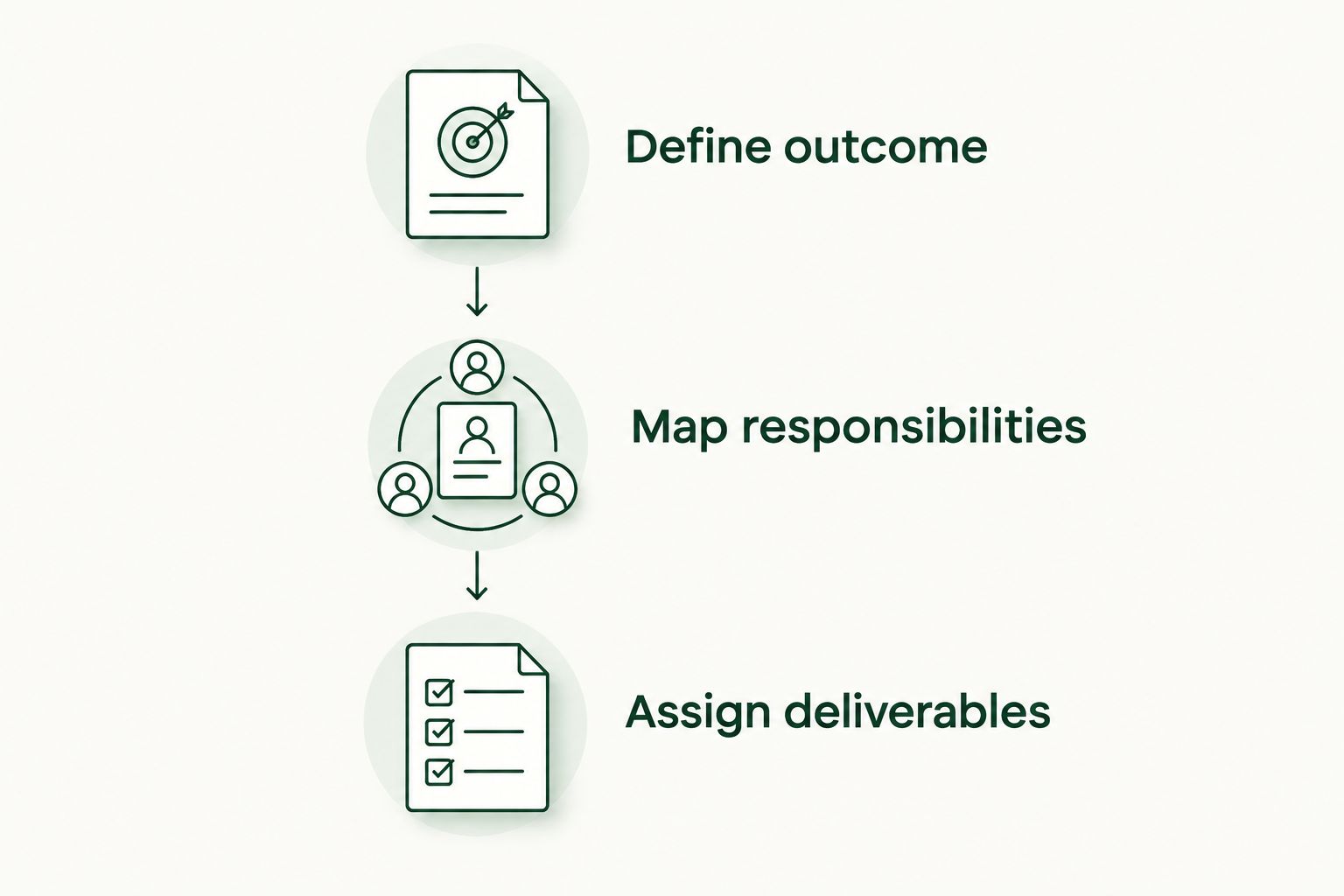
Choose your first advisor in 3 steps
Define outcome
Write down what you want to change: ownership, day-to-day work, income dependence, management responsibility, or some combination. “I want out” is a starting point, not an instruction an advisor can act on.
For your 2026 planning file, separate the date you hope to stop working from the date ownership transfers. Ask your team to examine both rather than assuming they must happen together.
Map responsibilities
List the decisions requiring financial, tax, legal, valuation, and transaction work. Put a professional's name beside each responsibility and mark anything still unassigned.
You do not need every specialist at every meeting. You do need to know who answers each question before you rely on an answer.
Assign deliverables
Request a written scope, the documents needed, the expected deliverable, and the next decision that deliverable supports. Agree on how changes to proposed terms reach the rest of your team.
Ask these 8 questions before signing
Use the same questions with each candidate. The answers should reveal whether the engagement fills your gap or duplicates work already assigned.
- Which exit decisions will you help me make?
- What work is explicitly outside your scope?
- What written deliverable will I receive?
- How are you compensated, including transaction-linked compensation?
- Who coordinates with my existing CPA and attorney?
- What documents do you need before making recommendations?
- How does your work change for family, employee, partner, or outside-buyer transitions?
- What happens if I decide not to sell?
Ask for a sample deliverable with confidential information removed. A description of the output makes an engagement easier to evaluate than a list of services alone.
Which exit planning advisor should you choose?
If you are undecided, start with personal financial readiness. Knowing what the transition must support gives your tax, legal, valuation, and transaction professionals a clearer objective.
Choose a transaction CPA and attorney when proposed terms need review. Choose a valuation professional when value is the unresolved question. Choose a broker or M&A advisor when you are ready to run an outside sale process.
For Northern Colorado owners, the confidential discovery call with Dillon is a separate next step from this educational guide. The introduction is a 30-minute intro call; it is not a substitute for an agreed advisory engagement.
FAQ
What's the best exit planning advisor for a small business owner?
The best advisor is the one whose scope matches your unresolved decision. Start with a financial advisor for personal readiness, a transaction CPA for taxes, an attorney for agreements, a valuation professional for value, or an intermediary for buyer outreach.
Is VIMSmallBusiness a business broker?
No. VIMSmallBusiness provides financial advisory and business transition/succession planning services, not transaction brokerage. A business broker or M&A advisor handles a separate sale-process role.
Do I need both a CPA and a financial advisor to exit my business?
You need both roles when your exit requires transaction tax analysis and personal financial planning. Confirm each engagement's scope so tax work and household planning are assigned rather than assumed.
Should I hire an exit advisor before finding a buyer?
Hire for personal readiness before buyer outreach if you do not know what the transition must support. A buyer's offer does not answer your household cash-flow or retirement questions.
Can one advisor handle my entire business exit?
Do not assume one advisor covers every part of an exit. Financial planning, tax analysis, legal documents, valuation, and sale execution are distinct responsibilities that require explicit assignments.
What should I ask an exit planning advisor about compensation?
Ask who pays the advisor and whether compensation depends on completing a transaction. Request written compensation terms, conflicts disclosures, and a clear description of included work.
Can an exit advisor help me pass the business to my children?
An exit advisor can support the planning role defined in the engagement. Family succession also requires attention to ownership documents, tax consequences, management responsibilities, and your income needs.
One last thing
Ask your advisor to separate two decisions on paper: when you stop working and when you stop owning. A transition plan that treats them as one decision can leave important questions about control, income, and responsibility unanswered.
Keep this guide educational. Personalized financial, tax, and legal decisions require the relevant professionals to review your circumstances and proposed terms.