

Yes. A family business can have more than one successor, with several family members sharing ownership, management responsibilities, or both. The arrangement needs clear decision rights, compensation rules, and an exit process; dividing ownership does not, by itself, decide who runs the company.
- For family business multiple successors planning, separate ownership, leadership, and compensation before allocating shares.
- Shared ownership does not require shared daily management; name who decides and who provides oversight.
- Document deadlock and buyout rules before transferring control, not after a disagreement.
- VIMSmallBusiness provides financial planning and business transition planning for small business owners.
Can a family business have more than one successor?
Yes, but start by answering what each person is succeeding to: your ownership interest, your operating job, or your authority over major decisions. Those responsibilities do not have to pass to the same people.
Your broader succession planning for family businesses should connect those choices to your retirement needs and the company's cash flow.
| Succession structure | Best for | Main advantage | Main limitation |
|---|---|---|---|
| Shared ownership, designated leader | Families whose successors want ownership but have different operating skills | Gives daily decisions a clear owner | Other owners need defined oversight and information rights |
| Shared ownership, divided leadership | Successors with distinct responsibilities and a workable decision process | Assigns operating authority by function | Decisions crossing functions need an agreed resolution process |
| Family ownership, outside management | Families that want ownership without running daily operations | Separates management hiring from family membership | Owners still need to oversee management and agree on priorities |
Choose the operating structure before treating equal shares as the solution. Have your attorney review what your entity documents, ownership restrictions, and applicable law permit.
Why this matters
You are handing over more than a title. Someone must approve spending, manage employees, protect treasury cash, and decide how much money stays inside the business.
Family members also bring different household needs. An active successor might prioritize equipment and hiring, while an inactive owner wants distributions; neither preference resolves the company's actual cash requirements.
For your 2026 succession plan, record these competing needs separately. A useful plan explains how decisions get made when reasonable people disagree, not just when everyone agrees.
Shared ownership with a designated operating leader
Best for: successors who want to own together but do not want identical jobs. Name the person responsible for daily operations, then identify decisions that require broader owner approval.
The designated leader needs usable authority. Requiring every owner to approve routine purchases leaves responsibility with the leader but control elsewhere.
Other owners need boundaries too: access to financial reports, a defined meeting process, and clarity about decisions reserved for them. Your attorney should document these arrangements rather than leaving them as family understandings.
The advantage is clear operating accountability. The trade-off is that family members must accept different levels of daily influence, even when their economic interests are similar.
Shared ownership with divided leadership responsibilities
Best for: successors with distinct skills who can respect defined responsibilities. One person might lead operations while another leads sales, with each accountable for agreed business outcomes.
Write down where those responsibilities overlap. A sales commitment affects production, and an equipment purchase affects cash flow; neither decision belongs entirely inside a single department.
The advantage is that successors can contribute different strengths. The limitation is the need for a final decision process when priorities collide.
Do not assume co-leadership means every decision needs unanimous agreement. Ask counsel to distinguish delegated authority, owner votes, and matters requiring a different approval standard.
Family ownership with outside management
Best for: families that want to retain ownership but lack willing operating successors. Hiring management lets the family consider leadership candidates beyond its own members.
Ownership still involves work. Family owners must agree on management oversight, reporting, capital needs, and the process for replacing a leader.
The advantage is flexibility in choosing operating skills. The limitation is that outside management does not settle disagreements among owners about distributions, growth, or selling the company.
Before choosing this structure, include management compensation and oversight responsibilities in the financial plan. Retaining ownership is not the same as stepping away from every decision.
Why the right arrangement varies
The right successor structure depends on the people, documents, and financial obligations involved. Assess these factors before selecting a model:
- Willingness to lead: Confirm who actually wants operating responsibility rather than assuming family membership equals interest.
- Demonstrated capability: Compare the work each successor can perform with the responsibilities the business needs covered.
- Owner income needs: Identify which households expect compensation, distributions, or payments connected to a transfer.
- Business cash demands: Account for payroll, working capital, debt obligations, and reinvestment before discussing discretionary payouts.
- Existing restrictions: Have counsel review governing documents, agreements, and any profession-specific ownership requirements.
- Exit preferences: Discuss what happens when an owner wants liquidity but the remaining owners want to continue.
These factors belong in the same conversation. A leadership arrangement that works operationally still needs a workable financial structure.
How do you put multiple successors into a workable plan?
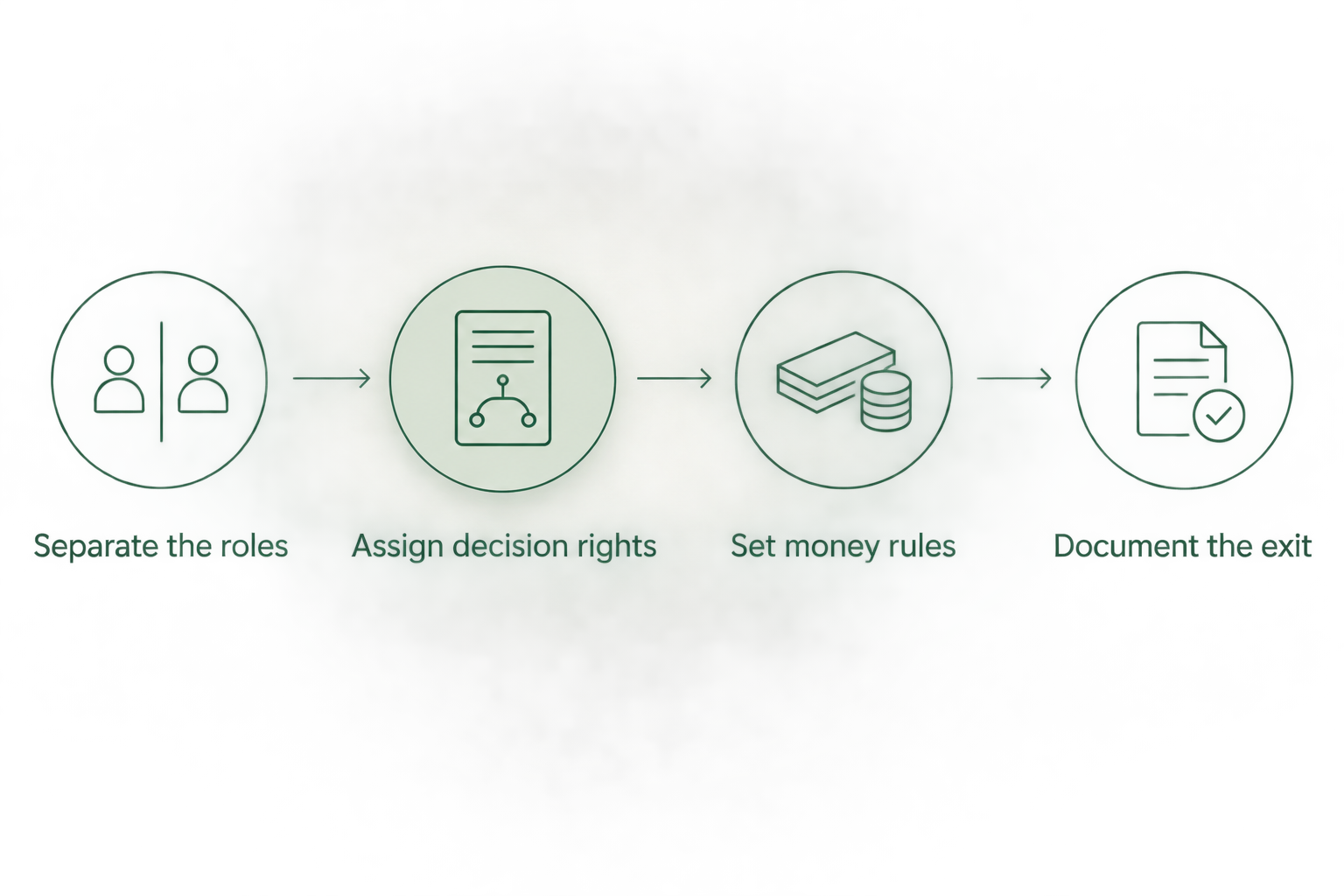
Use the following sequence to turn a family conversation into decisions your professional team can document. These are planning steps, not a substitute for legal drafting or individualized tax advice.
Separate the roles
List the responsibilities you currently hold as an employee, manager, owner, and family member. Then assign a proposed successor to each business responsibility without allocating ownership yet.
This exercise exposes gaps. If everyone wants ownership but nobody wants responsibility for collections, staffing, or customer problems, you have not identified a complete operating succession.
Assign decision rights
Create a decision list covering routine spending, borrowing, hiring senior staff, distributions, and a potential sale. Identify who proposes, approves, and carries out each decision.
Avoid vague phrases such as shared control. Ask who can authorize a payment when the other successor is unavailable, and who resolves a disagreement about a major commitment.
Set money rules
Separate pay for work from returns on ownership. Compensation should have an agreed basis connected to the role; ownership distributions need their own policy and legal review.
Use your 2026 operating budget to discuss these obligations together. Include your own post-transition income needs rather than assuming the business can fund every household request after the transfer.
Document the exit
Ask your attorney to address departures, disability, death, ownership transfers, and unresolved disputes. Coordinate the agreement with valuation and financial planning work so the payment obligations receive attention alongside the legal language.
An exit process needs more than a promise to be fair. The parties need to understand how a value is determined, who can purchase an interest, and how an obligation would be funded.
Test the handover
Let successors make decisions within clearly defined authority before you step back completely. Review their decisions against the responsibilities you assigned, not against whether they copy your personal management style.
Write down when you retain approval rights and when those rights end. Otherwise, successors can hold the titles while you remain the person employees approach for every important answer.
How should you handle ownership, pay, and family expectations?
Treat ownership, employment, and inheritance as separate decisions. A child working in the business has job responsibilities; a child holding an ownership interest has rights and obligations under the relevant documents.
An inactive owner is not automatically entitled to an operating salary simply because an active owner receives one. Likewise, an active successor's compensation does not answer how ownership distributions should work.
Discuss fairness in concrete terms. Ask whether the family means equal ownership, equal inherited value, equal voting power, or equal opportunity to participate; those are different objectives.
Have your estate attorney and tax professional review the proposed transfers together. Entity structure, transfer terms, and estate documents need coordinated attention before anyone signs.
How do you change authority without creating competing bosses?
Your successors need authority that employees can recognize. If staff can overturn a successor's decision by asking you privately, the formal handover and the working reality are different.
This is where cultural change in family businesses becomes part of succession: reporting lines and everyday habits must match the authority written into the plan. Announce who handles which decisions, and follow the same route yourself.
For the 2026 handover, document which meetings you attend as an adviser rather than as the final decision-maker. Keep family concerns out of employee reporting channels and give owners a separate place to discuss ownership issues.
The goal is not to remove your experience. It is to define when successors seek your advice and when they are responsible for deciding.
What happens if successors disagree or someone wants out?
Build the disagreement process before relying on shared ownership. A useful starting checklist contains 6 questions:
- Who decides when operating responsibilities overlap?
- Which matters require broader owner approval?
- What happens when a required vote cannot be reached?
- How does an owner request a departure?
- How is the departing interest valued under the agreement?
- What resources would fund a purchase without ignoring operating cash needs?
Use your 2026 plan to test these questions against realistic situations, not assumed investment returns or hoped-for growth. Consider a prolonged disagreement, an owner who stops working, and a proposed departure during a cash-flow squeeze.
Your attorney should determine the legal mechanisms. Your financial planner can help assess how proposed obligations interact with business cash flow and your personal financial needs.
Can siblings own equally if only one runs the business?
Yes. Siblings can share ownership while assigning daily management to a designated leader, subject to the applicable documents and legal requirements.
The arrangement needs separate rules for employment compensation, ownership distributions, and oversight. Equal economic interests do not answer every question about authority.
Does every successor need to work in the company?
No. Ownership and employment are different roles, although entity documents and applicable professional rules need review.
An inactive owner still needs to understand the investment, its risks, and the agreed reporting and decision process. Do not describe an ownership interest as guaranteed household income.
Should you transfer ownership before testing shared leadership?
Test defined responsibilities before making an irreversible commitment. Let each proposed successor demonstrate the work and decision-making the future role requires.
Ask your professional team to review transfer timing separately. A leadership trial does not establish the legal or tax treatment of an ownership transfer.
Where financial planning fits
VIMSmallBusiness serves small business owners who need financial planning alongside business transition and succession planning. The practice is a fee-only fiduciary and SEC-registered RIA serving Northern Colorado, including Loveland, Fort Collins, and Berthoud.
VIMSmallBusiness's business transition planning addresses the financial side of the handover; it does not replace your attorney, tax preparer, or valuation professional. Keep those responsibilities explicit when assembling your team.
If you want a separate conversation about your circumstances, contact VIMSmallBusiness about a confidential discovery call with Dillon Goodman. The educational decisions above remain useful whether or not you engage an adviser.
FAQ
Can a family business have more than one successor?
Yes. A family business can have multiple successors sharing ownership, management, or both. Define decision rights, compensation, oversight, and exit procedures before transferring control.
What's the best structure when siblings have different skills?
A designated leader or clearly divided operating responsibilities can match different skills. Choose between them by identifying who can do the work and how overlapping decisions will be resolved.
Does equal ownership mean equal salaries?
No. Ownership and employment are separate roles. Establish compensation for work separately from the policy for ownership distributions, with professional review.
Can an inactive family member inherit part of the business?
An inactive family member can hold an ownership interest when the entity structure, governing documents, and applicable law permit it. Have counsel review the proposed transfer before making commitments.
How do you prevent deadlock between family successors?
Define the decision process and deadlock procedure in advance. Ask counsel to document approval rights and a resolution process, and assess the financial implications of any proposed buyout.
Can you keep ownership while your children manage the business?
Yes, ownership and management can be separated. Document the authority delegated to your children and identify which decisions you retain, subject to legal review.
Can a financial adviser replace the succession attorney?
No. Financial planning does not replace legal drafting or individualized tax advice. Coordinate the financial plan with your attorney, tax professional, and any valuation specialist involved.
One last thing
Before you allocate ownership, ask every proposed successor to write down who should decide on hiring, borrowing, distributions, and a sale. Compare the answers without trying to reach immediate agreement.
Different answers identify decisions the plan still needs to resolve. Keep that list with your 2026 succession documents, assign responsibility for each open question, and review it before signing transfer agreements. A shared family intention is a starting point, not an operating instruction.