

Hire a family member only if that person can meet the same role requirements and accountability standards you would set for an outside manager. Hire an outside manager when the business needs experience your family candidate has not demonstrated. Choose the person who can run the business—not the person you feel most obligated to appoint—and treat any ownership transfer as a separate decision.
- Hire family member vs outside manager for business: choose demonstrated management ability, not family status.
- Family members need written authority, performance expectations and a workable removal process, just like outside managers.
- Separate management succession from ownership succession; running the company does not automatically require owning it.
- Vital Investment Management provides business transition and succession planning for small business owners.
Should I hire a family member or an outside manager?
Hire the candidate who meets the job requirements and accepts clear accountability. Neither family membership nor an outside résumé substitutes for evidence that someone can lead your employees, manage cash flow and make difficult decisions without your daily intervention.
Use this comparison for your 2026 hiring decision. If the appointment is part of your departure, connect it to your broader succession planning for family businesses, rather than treating it as an isolated vacancy.
| Decision point | Family member | Outside manager |
|---|---|---|
| Best for | A qualified relative who wants the role and accepts independent oversight | A defined leadership need requiring demonstrated experience outside the family |
| Evidence to request | Results, references and examples of decisions—not familiarity alone | Relevant results, references and examples of learning an unfamiliar business |
| Potential advantage | Firsthand knowledge of the company, if the relative has worked in it | Experience from other organizations, if relevant to your needs |
| Main constraint | Separating employment decisions from family expectations | Learning your operations and earning authority with employees |
| Accountability test | Can you address poor performance without making exceptions? | Can you delegate without reversing decisions behind the manager's back? |
| Ownership question | Decide employment and ownership separately | Define the management role without assuming an equity transfer |
Why this matters
You are choosing who gets to make decisions when you are not in the room. That includes decisions about employees, customer commitments, spending and problems you currently handle yourself.
A family appointment is not automatically a succession plan. An outside hire is not automatically an exit. Your plan needs to explain what changes hands, what stays with you and how the company operates when you step back.
Family member: best for a qualified, willing successor
A family member is a sound choice when the person wants the actual job, has demonstrated the required skills and accepts the same performance standards as other employees. Ask directly about the work—not whether the person wants to preserve the family legacy.
Start with evidence. What has the candidate managed? Which difficult personnel decisions have they handled? What happens when a customer challenges them or cash flow forces a trade-off?
The advantage is relevant company knowledge when that knowledge exists. A relative who has worked across operations, customer relationships and financial reporting brings a different starting point from one who has only observed the business at family gatherings.
The constraint is your willingness to manage the relationship professionally. Before hiring, decide who evaluates performance, who resolves disagreements and what happens if the appointment fails. Do not make continued employment an unspoken condition of family harmony.
Recommendation: appoint the family member only when qualifications and accountability both pass scrutiny.
Outside manager: best for a defined experience gap
An outside manager is a sound choice when you can name the leadership experience the company needs and verify that the candidate has it. Define the gap before recruiting: managing supervisors, improving reporting, overseeing operations or reducing your involvement in customer decisions.
Ask for examples that match the job. A candidate's previous title does not explain the authority they held, the resources available to them or the decisions they personally made.
The advantage is relevant experience beyond your company when the candidate can demonstrate it. The constraint is the work required to transfer knowledge and authority. Document the operating details that currently live in your head, including exceptions, commitments and unresolved problems.
An outside manager cannot become accountable for decisions you continue to control informally. Tell employees which decisions belong to the manager and which still require your approval.
Recommendation: hire the outside manager when the experience fits and you are ready to delegate the corresponding authority.
Why the right hiring choice varies
Your family tree does not define the job. Your operating needs do.
Use these factors to explain your 2026 decision in writing, rather than defending it through personal preference:
- Candidate readiness: Separate demonstrated skills from skills the candidate still needs to develop. Do not assign full responsibility while quietly retaining all difficult decisions.
- Business needs: Identify the work that needs leadership now. A strong salesperson is not automatically prepared to supervise operations or oversee treasury decisions.
- Owner readiness: State which responsibilities you will release. If you intend to remain the operating decision-maker, recruit for that structure honestly.
- Family expectations: Clarify whether relatives expect employment, ownership, income or a voice in major decisions. Those are different requests.
- Cash flow: Test the leadership structure against payroll, working capital, debt obligations and owner withdrawals. Write down which commitments the business must support.
- Accountability: Identify who evaluates the manager and who can change the arrangement. Avoid a structure in which everyone gives instructions but nobody owns the decision.
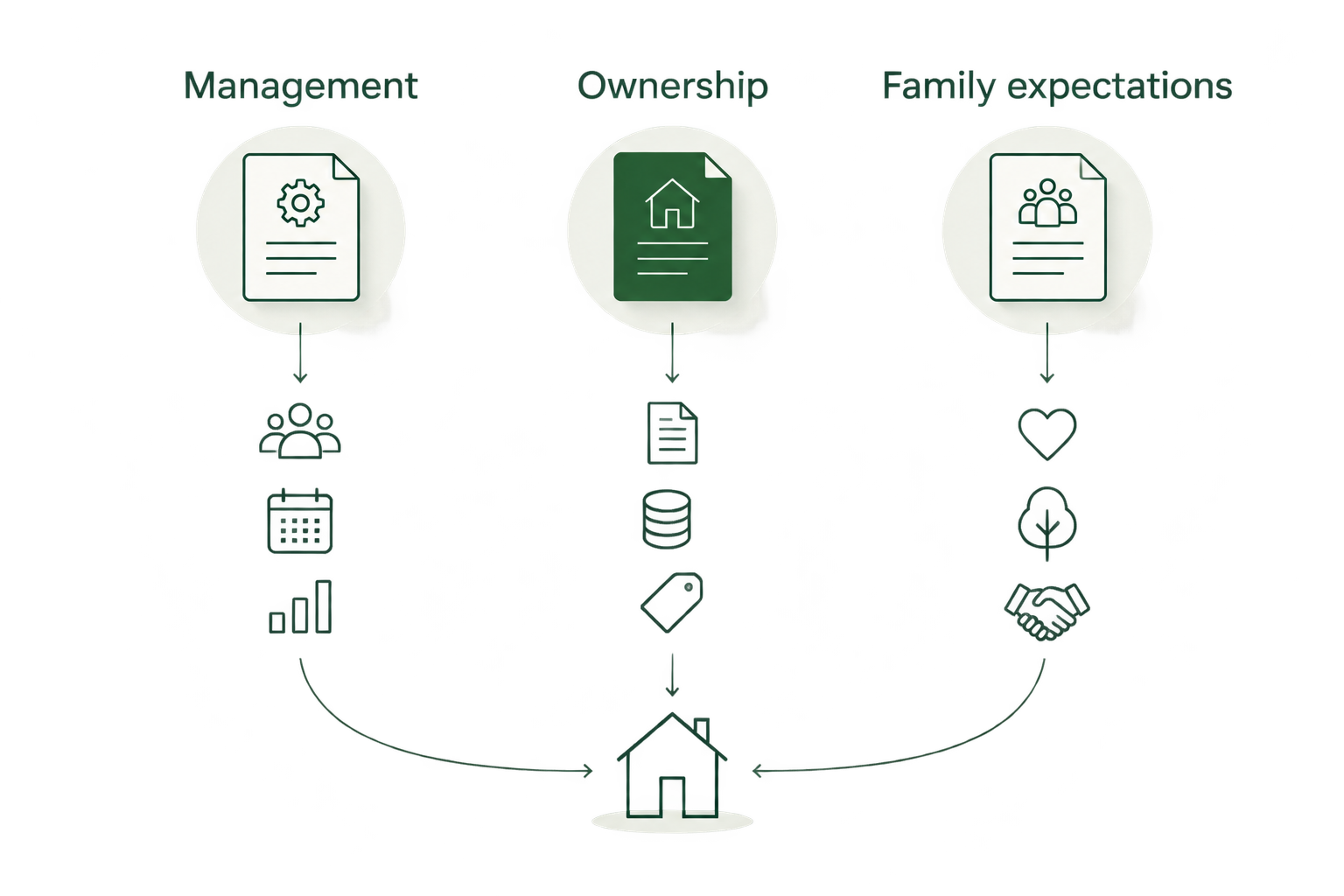
Separate management, ownership and family expectations
Management authority is not the same as ownership. Hiring your daughter to run operations does not, by itself, settle whether she receives shares. Hiring an outside manager does not, by itself, decide whether you retain or sell the company.
Write separate instructions for each area:
- Management: Who hires, supervises, approves spending and runs daily operations?
- Ownership: Who holds the ownership interests, and which decisions require owner approval?
- Family expectations: What have you promised, what remains undecided and who needs clarification?
Have your attorney review the documents governing authority and ownership. Keep a hiring discussion from becoming an accidental promise about inheritance, equity or a future sale.
Ask 8 questions before choosing either candidate
Use the same interview questions for both candidates. Record specific examples and unresolved concerns; a shared standard makes the decision easier to explain without claiming either candidate is perfect.
- What decisions have you owned? Ask for decisions made personally, not results credited to an entire department.
- How have you handled weak performance? Look for an explanation of expectations, feedback and follow-through.
- How would you learn our cash flow? Ask what reports, commitments and operating details the candidate would review.
- What requires owner approval? Compare the candidate's expectations with the authority you intend to delegate.
- How would you handle disagreement with me? Establish a process that does not invite employees to choose sides.
- Which skills do you still need? Require a candid development plan rather than confidence alone.
- What happens if the role does not work? Discuss reassignment or departure before either becomes necessary.
- Do you want management, ownership or both? Surface expectations early, especially when a family member sees the appointment as a promised inheritance.
For your 2026 candidate review, distinguish an unanswered question from a failed requirement. Seek further evidence where it exists; do not fill the gap with optimism or family pressure.
Make the decision in 4 steps
Define the job
Write a role description before choosing the person. Include the decisions the manager owns, the information they receive and the matters reserved for you.
Describe success through observable work: timely financial reporting, documented customer commitments, completed staffing decisions and adherence to approved spending authority. Set targets from your business records, not from a generic succession template.
Compare the evidence
Evaluate both candidates against the same requirements. Check references and ask each candidate to explain how they would handle an actual operating problem, without disclosing confidential information unnecessarily.
If neither candidate meets a critical requirement, revise the search or create a development role. Do not lower the standard simply because you want the decision finished.
Confirm the financial fit
Review the proposed structure with your financial and tax professionals. Include compensation obligations, owner income needs, working capital and any contemplated ownership transaction.
For a 2026 leadership change, use current financial records and document the assumptions behind the plan. A manager appointment and a funded retirement plan solve different problems; connect them without confusing them.
Document the handoff
Record reporting lines, approval limits, review expectations and the process for resolving disagreements. Have appropriate professionals review employment and ownership documents before you sign.
Then communicate the structure to employees. If staff can bypass the manager and obtain a different answer from you, correct the process rather than blaming the manager for unclear authority.
Check what the appointment means for your own finances
Your company needs a capable manager. You also need a clear view of the income and capital you expect to take from the business after delegating.
List the withdrawals your household depends on, any obligations tied to a future transfer and the business cash needed to support operations. Ask whether those assumptions still fit if you remain an owner but stop working in the company. Keep investment decisions separate from money the business needs for near-term commitments.
Vital Investment Management is a fit for Northern Colorado owners seeking fee-only business succession planning. The firm is a fee-only fiduciary and SEC-registered RIA in Loveland, serving small business owners with financial planning and transition planning.
That is a financial-planning role, not a substitute for hiring judgment. Vital Investment Management does not prepare tax returns or provide legal advice; use your tax and legal professionals for those responsibilities. Owners in Loveland, Fort Collins, Berthoud and wider Northern Colorado should keep those professional roles clear.
Can I keep ownership and hire an outside manager?
You can retain ownership while hiring someone else to manage daily operations. Define the manager's authority within your governing documents and any applicable agreements, with legal review where needed.
Also define your own role. Retaining ownership does not require intervening in every staffing or customer decision; write down which decisions remain yours and respect the boundary you establish.
Should my child work elsewhere before joining the business?
Prior outside employment is evidence to evaluate, not a substitute for evaluating the candidate. Ask what the experience taught your child and how it applies to the role you need filled.
If your child lacks a required skill, define how they will develop it before receiving the associated authority. Do not use an impressive employer name—or familiarity with your company—as proof of readiness.
What if neither candidate is ready?
Keep the permanent appointment open rather than assigning authority to an unprepared candidate. Define an interim reporting structure, continue recruiting or give a developing candidate a narrower role with explicit supervision.
Update your 2026 succession plan to reflect the actual arrangement. A named successor who cannot yet perform the job is not the same as an operating handoff.
FAQ
Is it better to hire family or someone outside the business?
Hire the candidate who meets the role requirements and accepts clear accountability. Use the same evidence, interview questions and performance standards for a relative and an outside candidate.
How do I avoid favoritism when hiring a family member?
Define the job and selection standards before deciding who gets it. Document the candidate's qualifications, reporting line and performance expectations, and apply those standards after hiring.
Does my child need to own the business to manage it?
A management appointment does not automatically require an ownership transfer. Define employment authority separately from ownership rights and have your attorney review the arrangement.
How do I give an outside manager enough authority?
Document the decisions the outside manager controls and the matters reserved for you. Communicate those boundaries to employees and stop informal workarounds that contradict them.
What should I do if a family manager performs poorly?
Use the documented performance process rather than making an exception because of the relationship. Address the work problem directly and obtain appropriate employment-law advice before changing the arrangement.
Can a financial advisor choose my successor for me?
Choosing the successor remains your business decision. Vital Investment Management provides financial and business succession planning, which is distinct from deciding whom to hire or obtaining legal and tax advice.
Should I promise ownership to persuade someone to take the manager role?
Do not promise ownership without a separate, documented ownership decision. Review the financial, tax and legal implications with the appropriate professionals before making a commitment.
One last thing
Before announcing the appointment, write down what happens when you and the new manager disagree. Include who decides, how employees receive the final instruction and which matters stay private.
If you cannot describe how disagreement works, you have not finished defining authority. Resolve that gap before handing over the title, whether the person receiving it shares your surname or not.