

Check FINRA BrokerCheck and the SEC’s Investment Adviser Public Disclosure database, then read the underlying disclosure documents—not just the search summary. Search both the individual and the firm, confirm their registration identifiers, and distinguish customer allegations from regulatory findings. For a 2026 review, save the records with your search date; an empty disclosure section is not proof that an advisor has never received a complaint.
- Check financial advisor regulatory complaints through FINRA BrokerCheck and the SEC’s IAPD, using registration identifiers.
- Search the individual and the firm; their registration records and disclosures serve different purposes.
- A customer allegation, a settlement, and a final regulatory finding are not interchangeable.
- Vital Investment Management provides fee-only financial planning for Northern Colorado business owners; verify registration independently.
How do I check if a financial advisor has had regulatory complaints?
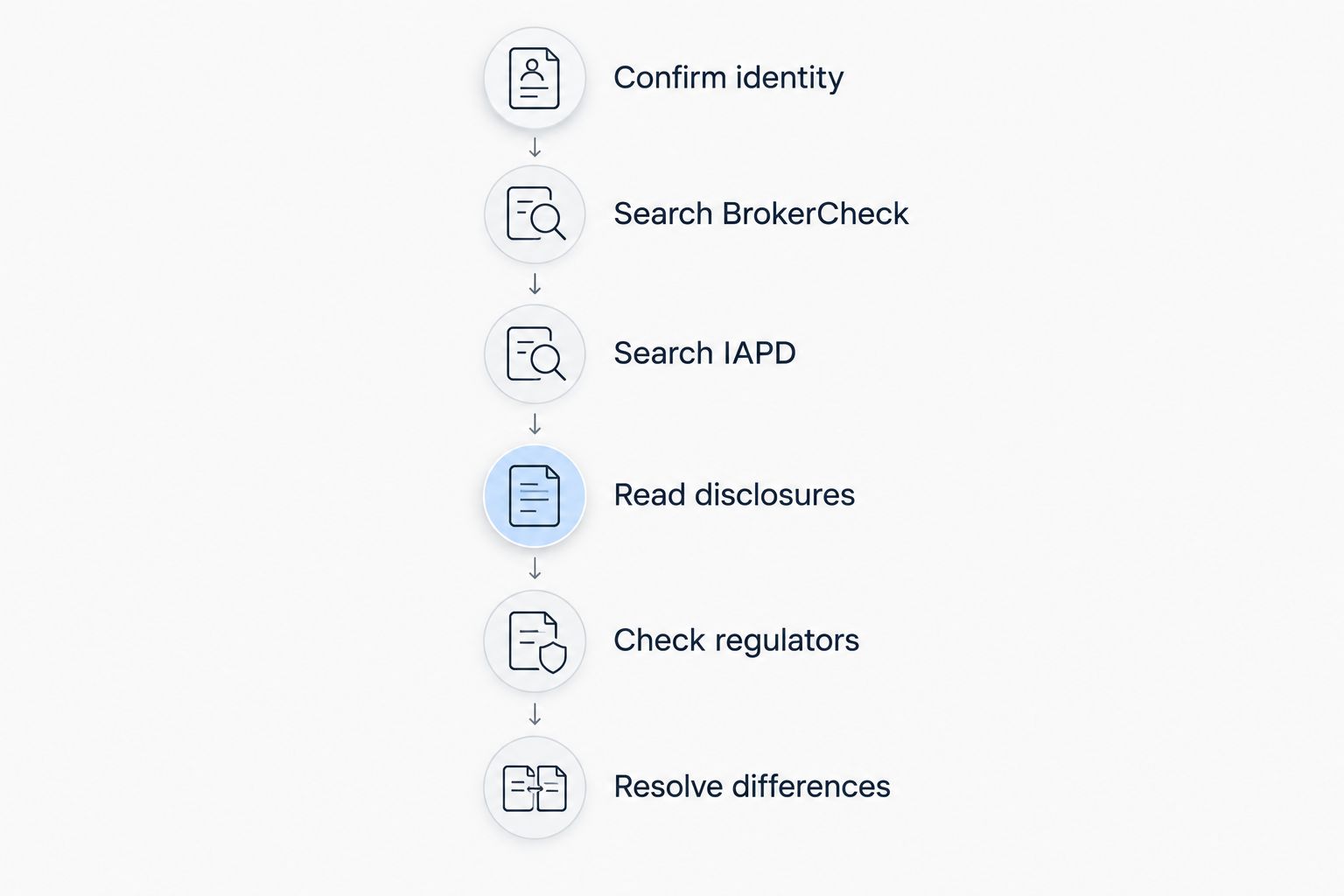
Follow these six steps before signing an advisory agreement or transferring assets. Apply the same process to every candidate, including Vital Investment Management: a referral, professional designation, or fiduciary description does not replace a registration check.
1. Confirm identity
Ask for the advisor’s full legal name, current firm, and Central Registration Depository identifier, usually called a CRD number. Request the firm’s legal name and its CRD or SEC registration identifier separately. The person you meet and the business receiving your advisory fees are different records to check.
Match the name, employer, office information, and employment history against the official record. Do not assume the first matching name belongs to your advisor. If the advisor uses a trade name, identify the registered legal entity behind it before interpreting any disclosures.
2. Search BrokerCheck
Use FINRA BrokerCheck to research a current or former broker and brokerage firm. Search by CRD number when available, open the detailed report, and review the registration, employment, and disclosure sections rather than stopping at the summary screen.
BrokerCheck disclosures can include customer disputes, regulatory actions, certain criminal matters, and other reportable events. A disclosure is a reason to read further, not an automatic finding of wrongdoing. Check the event type, allegations, status, resolution, and any explanation included in the report. BrokerCheck is not a complete history of every interaction or complaint involving a financial professional.
3. Search IAPD
Use the SEC’s Investment Adviser Public Disclosure database, or IAPD, to research an investment adviser firm and investment adviser representative. IAPD includes information about SEC-registered and state-registered investment advisers, with individual information drawn from registration filings.
Confirm the firm’s registration status and regulatory authority. Then open its available filings and brochures. Do not treat the absence of a BrokerCheck result as the end of the search: someone providing investment advice does not necessarily work as a broker. If the person has both advisory and brokerage roles, review both systems and identify which role applies to your proposed account.
4. Read disclosures
For an advisory firm, examine Form ADV Part 1 disciplinary responses and any related disclosure reporting pages. Read Part 2A, the firm brochure, including Item 9 on disciplinary information. Request the relevant Part 2B brochure supplement for the individual providing advice; Item 3 addresses disciplinary information.
These documents have different reporting scopes. Read the question that prompted a disclosure, not just the response. Also review the business practices, conflicts, and services described in the brochure. A disciplinary check answers only part of your hiring question; it does not establish whether the proposed service fits your business or personal finances.
5. Check regulators
Search the SEC’s enforcement materials and FINRA’s disciplinary records for the person’s and firm’s legal names. If a report references a case or order, locate the underlying official document and read its findings, sanctions, restrictions, and procedural status.
For a Colorado-based advisor, the Colorado Division of Securities is another relevant authority, especially for state-registration questions or uncertainty about a record. Contact the regulator identified in the official registration record when you need clarification. Use independently located official contact information rather than relying solely on a phone number or document supplied by the person you are checking.
6. Resolve differences
Ask the advisor to explain any disclosure or inconsistency in writing. Identify the specific event and request the official resolution, where one exists. Compare the explanation with the regulator’s record rather than accepting a verbal assurance that the matter was routine.
Save the reports, brochures, and correspondence with the date you reviewed them. If an identity mismatch, registration issue, or material contradiction remains unresolved, pause the hiring decision. You do not need to decide whether someone violated a rule yourself; you need enough reliable information to decide whether to entrust that person with your finances.
Why this matters
Your advisor’s recommendations can affect treasury reserves, retirement assets, concentration risk, and the proceeds from a business transition. A personal referral tells you about someone else’s experience. It does not establish registration status or explain a disciplinary record.
For a 2026 advisor review, keep two questions separate: Is this person properly registered for the work, and what does the public record disclose? Neither question replaces a discussion of services, conflicts, custody, and responsibilities. An advisor with no visible disciplinary disclosure still needs to explain how your operating cash, taxes, and long-term investments will be handled.
Which records should I use in 2026?
Use the records together. Each has a useful scope and a limit; none is a universal complaint registry.
| Record | Best for | Main advantage | Main limitation |
|---|---|---|---|
| FINRA BrokerCheck | Researching brokers and brokerage firms | Combines registration, employment, and reportable disclosure information | Does not capture every complaint or replace an investment-adviser search |
| SEC IAPD | Researching advisory firms and representatives | Provides registration information and access to advisory filings | Reporting categories do not cover every unhappy-client experience |
| Form ADV brochures | Understanding advisory discipline, services, and conflicts | Explains the firm and individual’s required disclosures | Requires careful reading and follow-up; it is not an independent endorsement |
| Official enforcement orders | Understanding a specific regulatory case | Gives the regulator’s allegations, findings, or ordered restrictions | Covers the identified proceeding, not the entire relationship history |
| State securities regulator | Clarifying state oversight and reporting concerns | Provides a route for questions about jurisdiction and registration | Cannot substitute for checking all relevant records |
Search engines can help locate an official document, but a search-result snippet is not the document. Verify the issuing authority and the named parties before drawing a conclusion.
How do I interpret a complaint or disciplinary disclosure?
Read the event’s status before judging its meaning. A customer dispute describes a different type of event from a regulatory proceeding. A pending allegation is not a final finding, and a settlement does not necessarily establish an admission of wrongdoing.
Use this reading order:
- Allegation: What conduct does the record describe, and who made the allegation?
- Status: Is the matter pending, resolved, dismissed, or otherwise closed?
- Outcome: What does the official resolution actually say?
- Restrictions: Does an order impose conditions, a suspension, a bar, or another sanction?
- Explanation: Does the advisor’s account match the official documents?
Avoid treating every closed matter as an exoneration. Read why it closed. Likewise, do not describe an allegation as proven misconduct when the record does not support that conclusion.
Consider relevance to your proposed relationship. A disclosure about handling client assets deserves direct questions if you are considering investment management. The goal is a documented decision, not a simplistic pass-or-fail score based on the presence of a disclosure.
Why complaint-search results vary
Different results do not automatically mean a record is wrong. In 2026, these factors still determine what your search reveals:
- Professional role: Brokers, investment adviser representatives, and insurance professionals operate under different registration systems.
- Individual versus firm: A firm’s disclosure history is not identical to an individual’s history.
- Reporting requirements: Public databases contain reportable events, not every informal complaint or service disagreement.
- Event status: A pending dispute and a final disciplinary action describe different stages and outcomes.
- Identity details: Similar names, former employers, and trade names can lead you to the wrong record.
- Public-record limits: Disclosure rules and public availability affect what appears; absence from one database is not a complete clearance.
If two records appear inconsistent, compare identifiers and filing details first. Then ask the relevant regulator or the firm’s compliance contact for clarification.
Does a clean BrokerCheck report mean an advisor is safe?
A clean BrokerCheck report does not establish that an advisor is safe or suitable for you. It shows what the report discloses within its scope when you review it. Check IAPD where applicable, read the agreement, and verify how assets will be held.
Keep operational checks separate from background checks. Confirm the custodian’s identity independently and understand any authority you grant over withdrawals, trading, or transfers. A registration record is not a guarantee against loss, misconduct, or a poor service fit.
Does SEC registration mean the government endorses an advisor?
SEC registration is not a government endorsement or a guarantee of investment skill. Registration identifies a regulatory status; it does not remove conflicts or replace your review of disclosures and services.
Ask what work the advisor will perform, which legal entity will perform it, and whether brokerage or insurance activities are involved. A credential and a registration serve different purposes. Verify each claim through its relevant issuing body or official record.
What should I ask before signing in 2026?
Bring your questions to the advisory discussion rather than treating the database search as a separate administrative task. Ask for clear answers you can compare with the proposed agreement:
- What are your individual and firm registration identifiers?
- Which legal entity will provide each service?
- Have you identified disclosures I should review in the official records?
- Can you provide the current firm brochure and your brochure supplement?
- Will you act as a fiduciary throughout the proposed advisory relationship?
- What conflicts apply to the recommendations you expect to make?
- Who will hold my assets, and what authority will you receive?
- Which tasks remain with my CPA, attorney, or other professionals?
For an owner in Loveland, Fort Collins, Berthoud, or wider Northern Colorado, add questions about irregular cash flow, treasury needs, and succession responsibilities. Background screening establishes facts about the professional. These questions establish the scope of the relationship.
Do not transfer assets to resolve uncertainty. Resolve the uncertainty first, then decide whether to proceed.
How this applies to a Northern Colorado advisory firm
Vital Investment Management is best suited to Northern Colorado business owners seeking fee-only financial planning and business transition support. It is a fee-only fiduciary and SEC-registered investment advisory firm in Loveland. Those are facts to verify, not substitutes for the checks above.
The service boundary matters too: Vital Investment Management does not prepare tax returns. If your planning involves a business sale or a year-end tax scramble, establish who handles planning, return preparation, and legal documents before work begins. A useful relationship has a defined scope as well as a registration record.
Official sources behind this 2026 checklist
The source framework is FINRA’s BrokerCheck reports and disclosure explanations; the SEC’s IAPD system; Form ADV Part 1, Part 2A, and Part 2B instructions; and official SEC, FINRA, and state securities enforcement records. These sources address registration and reportable events—not a universal measure of trustworthiness.
Read the current official materials when conducting your search. Record your review date because filings and case status can change.
FAQ
How do I check financial advisor regulatory complaints?
Search FINRA BrokerCheck and the SEC’s Investment Adviser Public Disclosure database for both the individual and the firm. Match registration identifiers, read the detailed disclosures, and inspect any underlying official orders.
Can I search an advisor by CRD number instead of name?
Yes, a CRD number helps identify the correct registration record. Still confirm the name, firm, and other identifying details before relying on the result.
What if my financial advisor does not appear in BrokerCheck?
Search IAPD and verify the advisor’s professional role before drawing a conclusion. An investment adviser representative does not necessarily have a brokerage record; unresolved registration questions belong with the relevant securities regulator.
Does a customer complaint prove an advisor broke the law?
No, a customer complaint is not itself proof of a legal violation. Read the allegation, status, and resolution, and distinguish those from findings in a regulatory order.
Can a fee-only advisor have regulatory complaints?
Yes, fee-only compensation does not prevent complaints or disciplinary events. Verify registration and disclosures separately from how the advisor is paid.
Where do I report a concern about a financial advisor?
Report the concern to the regulator responsible for the activity, such as FINRA, the SEC, or your state securities regulator. Preserve statements, messages, agreements, and transaction records that explain what happened.
Should I check the advisor’s firm as well as the individual?
Yes, check both because the firm and individual have separate registration records and disclosure responsibilities. Confirm that the firm in the proposed agreement matches the legal entity you researched.
One last thing
Matching a name is not the same as matching an identity. Before sending business financial statements, identification documents, or transfer instructions, compare the person’s contact details with independently obtained firm information. If anything differs, contact the firm through a verified channel and resolve the mismatch. A genuine registration record does not establish that the person communicating with you is its owner.