

Your business is too dependent on one client when losing that account—or simply collecting its invoices late—would leave you unable to cover essential expenses without emergency borrowing, personal cash, or disruptive cuts. Judge the risk by the cash flow and profit you would lose, the obligations that remain, and the time needed to replace the work—not by revenue share alone.
- Business too dependent on one client risk: test essential payments, lost profit, and replacement time together.
- A long relationship does not remove customer concentration or protect cash flow when payment timing changes.
- VIMSmallBusiness fits owners seeking fee-only financial planning alongside business transition planning.
- Keep profitable clients while building alternatives; a lower concentration percentage alone does not prove greater resilience.
How do I know if my business is too dependent on one client?
Remove your largest client from your forecast and identify the first obligation you cannot meet. If the answer is payroll, taxes, debt service, or necessary owner income before replacement work can generate cash, you have a concentration problem to address.
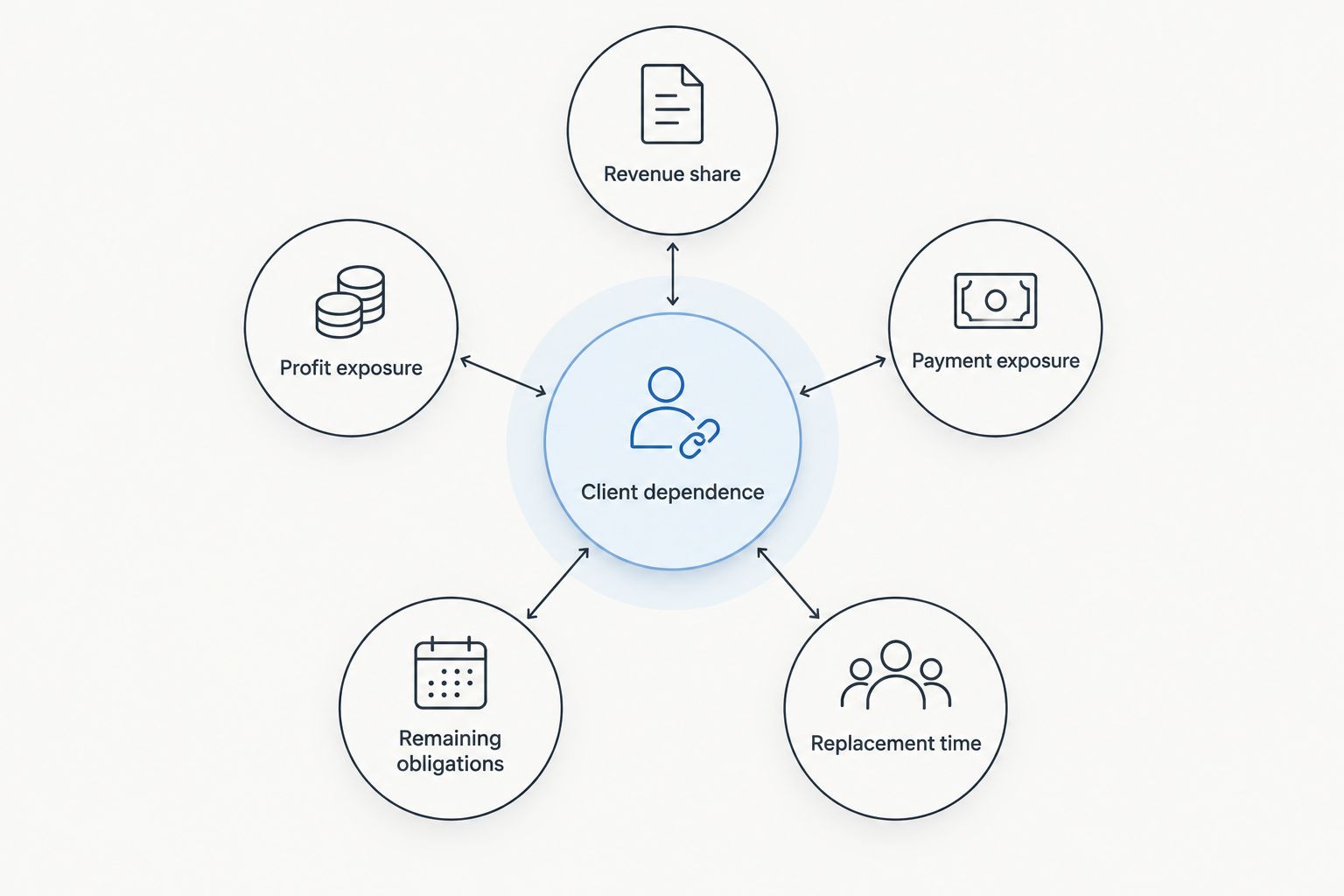
Use these five checks for your 2026 review. Your bookkeeping supplies the inputs; a cash flow forecast connects those inputs to payment dates.
- Revenue share: Divide revenue from your largest client by total revenue for the same period. Multiply by 100 to express the result as a percentage.
- Profit exposure: Subtract the costs you would actually avoid if that work stopped. Do not assume allocated overhead disappears.
- Payment exposure: List unpaid invoices and completed work you have not yet billed. Identify what happens if collection slows.
- Remaining obligations: Keep rent, debt payments, committed staffing, and other unavoidable expenses in the forecast.
- Replacement time: Estimate the path from finding a prospect to collecting payment—not just signing a replacement contract.
Review the trailing 12 months alongside recent results. An annual total can hide a growing dependence on one customer during the latest operating period.
Why this matters
Cash is lumpy. A business can report a profit while waiting for the deposit that funds its next payroll, and a large customer can influence both the amount and timing of that deposit.
Customer concentration also connects your business finances to your household. If the same account funds your salary, owner distributions, and retirement contributions, one commercial relationship supports several parts of your financial life.
For an owner in Loveland, Fort Collins, Berthoud, or elsewhere in Northern Colorado, the practical question is the same: what keeps getting paid if the largest customer stops buying? Your answer needs a cash forecast, not reassurance about how long you have known the customer.
Build a client-dependence worksheet for 2026
Keep the worksheet simple enough to update from your accounting records. Use consistent periods and separate sales recorded from cash collected; combining those measures creates a misleading picture.
Revenue share
Group invoices by the organization that makes the purchasing decision. Several billing locations do not represent independent customers if one parent company controls the budget or can cancel the work together.
Record your largest customer's share of revenue, then check whether other customers depend on the same referral source, project, or purchasing group. A longer customer list is not automatically a more independent customer base.
Profit exposure
Ask your bookkeeper or CPA to help distinguish direct costs from expenses that remain. Materials purchased only for that account differ from equipment financing that continues after the account leaves.
Include owner time in the operational review. A customer that consumes your quoting, service, and relationship-management capacity can leave little room to develop other work, even when its invoices look attractive.
Payment exposure
List receivables by customer and due date. Add unbilled work and any spending you must make before submitting the next invoice.
A payment delay and a lost account are different problems. The first creates a timing gap; the second removes future cash generation. Your worksheet needs to show both without treating unpaid invoices as cash already available.
Remaining obligations
Separate expenses you can stop immediately from expenses requiring notice, negotiation, or continued payment. Include your household's necessary withdrawals rather than assuming you can stop paying yourself indefinitely.
Check contracts before treating any cost as avoidable. A staffing arrangement, lease, or supplier commitment can outlast the customer work it originally supported.
Replacement time
Use your own sales history to estimate the replacement process. Include prospecting, qualification, proposals, delivery, invoicing, and collection.
Do not count an unsigned opportunity as replacement revenue. Show it separately, with the next action and decision still required, so the forecast distinguishes committed work from a hopeful pipeline.
Run 3 scenarios before deciding what to change
Use the same starting cash balance and expense assumptions across all three scenarios. Change the customer event, then record the first cash shortfall, obligations affected, and action required.
| Scenario | What you change | What the test reveals | Limitation |
|---|---|---|---|
| Late payment | Move the largest customer's expected receipts later | Exposure to collection timing | Does not test permanent revenue loss |
| Reduced work | Remove work the customer has not committed to purchase | Dependence on continued order volume | Requires a clear distinction between committed and expected work |
| Account loss | Remove future receipts and only genuinely avoidable costs | Whether remaining operations support essential obligations | Replacement timing remains an assumption to document |
Treat the forecast as a decision tool, not a prediction. You are testing what your business can absorb, not claiming that your largest customer will leave.
Keep the assumptions visible in your 2026 worksheet. A forecast that balances only because it assumes immediate replacement sales has not demonstrated resilience; it has documented a dependency on an uncompleted sale.
Why client-dependence risk varies
Your customer concentration percentage needs context. These factors explain why the same revenue share can produce different operating consequences:
- Profit contribution: Losing a customer that funds much of your remaining overhead creates a different gap from losing low-margin work.
- Collection timing: Paying employees and suppliers before collecting invoices ties operating cash to the customer's payment behavior.
- Contract terms: Notice, termination, renewal, and purchasing commitments affect what work you can reasonably include in a forecast.
- Cost flexibility: Dedicated equipment, staffing commitments, and leases restrict how quickly you can reduce spending.
- Replacement path: A documented sales process and independent prospects differ from relying on the same customer for introductions.
- Owner dependence: A relationship held entirely by you combines customer concentration with succession and continuity concerns.
Have your attorney interpret contract protections. Do not assume a long agreement guarantees purchase volume, timely payment, or an easy collection process.
Reduce dependence without abandoning a good client
Keep the profitable relationship; change how much your business needs it. Dropping valuable work solely to improve a percentage can reduce the cash available to build a stronger customer base.
Choose the response that addresses the weakness your forecast exposes. These are operating choices to evaluate, not promises of a particular result.
| Response | Best for | Benefit | Trade-off |
|---|---|---|---|
| Develop independent customers | Dependence on one purchasing decision | Adds separate sources of future revenue | Requires sales effort and delivery capacity |
| Change billing terms | Spending cash well before collection | Aligns collection more closely with work | Requires customer agreement |
| Build an operating reserve | A documented temporary cash gap | Gives the business cash for identified obligations | Keeps cash committed to business needs |
| Broaden account relationships | Dependence on one customer contact or the owner | Shares knowledge and relationship responsibility | Does not remove dependence on the customer itself |
Assign an owner and a next action to each chosen response. For example, document who handles the account when you are unavailable, or identify which contract terms need legal review.
Do not confuse activity with progress. Track signed work, collected cash, and changed obligations—not just prospect meetings or proposals sent.
Connect customer concentration to your transition plan
A customer relationship that works while you run the business needs a separate review before a transition. Ask whether service knowledge, pricing decisions, and customer contacts exist outside your memory.
For a 2026 transition review, connect measuring customer concentration to a practical question: does the revenue depend on the company, on one purchasing decision, or on your personal involvement? Each answer points to different documentation and continuity work.
Build a handoff file containing account responsibilities, delivery requirements, contract dates, and unresolved service issues. Give another responsible person enough information to maintain the relationship without guessing what you promised.
Bring that file and the concentration worksheet into a business valuation discussion. Ask the valuation professional how customer dependence is treated in the analysis; do not apply an assumed discount or invent a sale-price adjustment yourself.
A strong relationship is not the same as a transferable relationship. Test the handoff before treating the account as independent of your continued involvement.
Protect your household from the same customer risk
Your company can have a customer concentration problem while your household has an additional dependence on the company. Map both before deciding how much cash is available for investing or owner distributions.
Write down which household expenses require business income, which personal assets are accessible, and which funds already have another purpose. Keep tax obligations and business operating needs visible rather than treating every account balance as surplus.
VIMSmallBusiness financial planning is best suited to owners seeking fee-only advice alongside business transition planning. The firm is a fee-only fiduciary and SEC-registered RIA in Loveland, serving Northern Colorado business owners.
VIMSmallBusiness offers treasury management, investment management, financial planning, and transition/succession planning. That scope connects the business cash discussion to your wider financial plan; it does not replace the operational work of developing customers.
VIMSmallBusiness does not prepare tax returns, broker business transactions, or provide legal or valuation services. Keep those responsibilities with the appropriate professionals, and use this educational checklist separately from personalized financial, tax, or legal advice.
What percentage of revenue from one client is too much?
No single percentage answers the question for your business. Calculate the share, then test the lost profit, collection exposure, remaining expenses, and replacement time behind it.
Use your 2026 results to set a decision rule tied to obligations. A useful rule identifies the action you must take if dependence grows, rather than labeling an account safe solely because it falls below a chosen percentage.
Does a long-term contract make client dependence safe?
A long-term contract does not remove client dependence. Review purchasing commitments, termination provisions, payment terms, and what happens to work already completed.
Your attorney interprets the agreement; your forecast shows the operating consequences. Keep those jobs separate so an optimistic reading of a contract does not substitute for cash planning.
Should I stop accepting work from my biggest customer?
Do not reject profitable work solely to lower a concentration percentage. First determine whether additional work consumes the cash, staff, or owner time needed to serve independent customers.
Use that capacity review to decide which work to accept and which terms to negotiate. The goal is a business with alternatives, not a smaller business with a more attractive ratio.
FAQ
How can I tell whether my biggest client creates too much risk?
Your biggest client creates excessive dependence when delayed or lost receipts leave essential obligations uncovered before replacement work generates cash. Test the effect on payroll, taxes, debt service, and necessary owner income.
How do I calculate customer concentration?
Divide revenue from one customer by total revenue for the same period, then multiply by 100 to express the result as a percentage. Group related accounts when the same organization controls their purchasing decisions.
Should I measure client concentration using revenue or profit?
Measure both revenue share and profit exposure. Revenue shows the size of the relationship, while profit exposure accounts for costs you would actually avoid if the work stopped.
Can a customer paying late create concentration risk without leaving?
Yes, late payment can create a cash shortfall even when the customer continues buying. Forecast the collection delay separately from a permanent account loss.
Does adding more clients automatically reduce my risk?
Adding clients does not automatically reduce your dependence on the largest account. Check their profit contribution, payment timing, and whether their purchasing decisions are genuinely independent.
Will customer concentration reduce my business sale price?
A concentration percentage alone does not establish a sale-price adjustment. Ask a qualified valuation professional to assess customer dependence alongside contracts, profitability, transferability, and the rest of the business.
What should I bring to a financial planning discussion about client dependence?
Bring customer-level revenue, receivables, direct costs, contract terms, essential expenses, and your cash forecast. Include household income needs so the discussion covers both business and personal dependence.
One last thing
Add this question to your 2026 review: If your largest customer doubled its orders, would your business become stronger—or would its need for cash and capacity become harder to manage?
Growth from the same account does not diversify the business. Before accepting more work, check whether payment terms, delivery commitments, and available cash support the larger relationship without crowding out independent customers.