

Yes. You can set up a retirement plan as a 1099 contractor if you have qualifying self-employment income; your main choices include a solo 401(k), SEP IRA, or personal IRA. The right choice depends on your net earnings, employees, other retirement accounts, and cash flow—not the amount printed on a Form 1099. This guide explains how to choose and fund a plan in 2026 without treating money reserved for taxes as retirement savings.
- 1099 contractor retirement plan options include a solo 401(k), SEP IRA, and personal IRA; choose based on earnings and employees.
- A solo 401(k) fits eligible owner-only businesses seeking employee deferrals plus employer contributions.
- A SEP IRA offers discretionary employer contributions but requires attention to eligible employees.
- VIMSmallBusiness provides fee-only retirement planning for Northern Colorado business owners; tax-return preparation is outside its services.
Can a 1099 contractor set up a retirement plan?
You do not need a separate employer to sponsor your retirement savings. As a self-employed contractor, you can establish a business retirement plan yourself or contribute to a personal IRA, subject to eligibility rules. A sole proprietorship can qualify; forming an LLC is not a prerequisite.
Start with the decision below. For the broader connection between savings, taxes, and uneven earnings, see the retirement planning guide for 1099 contractors.
| Plan | Best for | Main advantage | Main limitation |
|---|---|---|---|
| Solo 401(k) | Owner-only businesses seeking employee and employer contributions | Combines elective deferrals with employer contributions | Employee eligibility and plan administration require attention |
| SEP IRA | Contractors prioritizing discretionary employer contributions | Employer contributions can change with business earnings | Eligible employees generally receive the same contribution percentage |
| Traditional IRA | Contractors seeking a personal retirement account | Does not require adopting a business retirement plan | Deductibility depends on income and workplace-plan coverage |
| Roth IRA | Eligible contractors seeking qualified tax-free withdrawals | Qualified distributions receive favorable tax treatment | Contributions are not deductible, and income limits apply |
These are account structures, not investment recommendations. Opening an account does not determine what you should invest in, and a tax advantage does not eliminate investment risk.
Why this matters when your income is irregular
Cash is lumpy. A strong invoice month can sit next to a slow collection month, while estimated taxes and business expenses keep arriving. Choosing the largest advertised contribution limit does not solve that timing problem.
Your retirement plan should work with your treasury needs, not compete with them. Separate operating cash, tax reserves, and money available for long-term savings before deciding how much to contribute.
For 2026, the IRS sets different contribution ceilings for different accounts. Those ceilings are legal maximums, not recommended savings targets, and your earnings can limit contributions below the headline amounts.
Solo 401(k): employee deferrals plus employer contributions
Best for: an eligible owner-only business that wants both contribution methods. A solo 401(k), also called a one-participant 401(k), lets you contribute as both employee and employer. A working spouse can also participate when the plan's requirements are met.
The IRS's published 2026 retirement-plan limits set the regular employee elective-deferral limit at $24,500 per year. The combined defined-contribution limit is $72,000 per year, excluding eligible catch-up contributions and subject to compensation rules. You cannot automatically contribute the combined maximum just because you open the account.
The employee contribution feature is useful when an employer-only formula would restrict how much you can save. But you must track deferrals made through other employers, follow the plan document, and meet applicable reporting requirements.
A solo 401(k) is not permanently an owner-only arrangement if your workforce changes. Before hiring, check when employees become eligible and whether the plan must change.
Decision: Consider a solo 401(k) when you qualify for owner-only treatment and will maintain its administrative requirements. Do not choose it solely because the maximum looks large.
SEP IRA: discretionary employer contributions
Best for: contractors who want an employer-funded arrangement with flexible annual funding. A SEP IRA uses employer contributions rather than the employee elective deferrals available under a solo 401(k). You can decide whether to contribute for a particular year, subject to the plan's rules.
The IRS's 2026 SEP contribution ceiling is $72,000 per year, but your actual maximum also depends on eligible compensation or adjusted self-employment earnings. For a sole proprietor, calculating that amount requires adjustments; applying a percentage directly to gross customer payments is incorrect.
The main trade-off appears when you have employees. If you contribute under a standard SEP arrangement, eligible employees generally must receive the same contribution percentage as you do. The contribution decision therefore affects more than your own retirement account.
A SEP can suit uneven business results, but flexibility does not remove calculation work. Confirm earnings, eligibility, and funding instructions before sending money.
Decision: Consider a SEP IRA when employer-only contributions fit your savings goal. Reassess the arrangement before adding eligible employees or assuming every dollar of business profit supports a contribution.
Personal IRA: separate from a business retirement plan
Best for: contractors who want a personal retirement account without adopting an employer plan. Traditional and Roth IRAs both require eligible compensation, but their tax treatment differs. You can also have an IRA alongside a business retirement plan when you meet the applicable rules.
The IRS's 2026 regular IRA contribution limit is $7,500 per year, shared across your traditional and Roth IRAs, excluding eligible catch-up contributions. Opening separate accounts does not multiply that allowance.
A traditional IRA contribution is not automatically deductible. Your income, filing status, and retirement-plan coverage—including a spouse's coverage where relevant—affect the deduction rules.
Roth IRA contributions are not deductible, and direct contribution eligibility depends on income. Qualified Roth withdrawals are tax-free, but not every withdrawal satisfies the qualification rules.
Decision: Consider a personal IRA when its contribution capacity and tax treatment fit your situation. Do not assume that choosing a Roth account is always better than taking an available deduction.
Why your retirement-plan choice varies
The same account does not fit every contractor. Review these five factors before comparing providers:
- Net earnings: Your contribution calculation starts with eligible earnings, not gross deposits or the total reported on Forms 1099.
- Employees: Hiring can create eligibility and contribution obligations. Calling someone a contractor does not settle worker classification.
- Other plans: Employee deferrals made through another job affect the room available for solo 401(k) deferrals.
- Cash flow: A contribution that leaves you short for estimated taxes or operating expenses is not a workable funding decision.
- Tax treatment: Current deductions, Roth eligibility, and future withdrawal rules affect the choice. Compare them with your broader tax situation.
Your business structure matters within the earnings calculation. A sole proprietor uses adjusted self-employment earnings, while an S corporation owner generally bases retirement contributions on eligible W-2 compensation—not shareholder distributions.
How do you set up a contractor retirement plan?
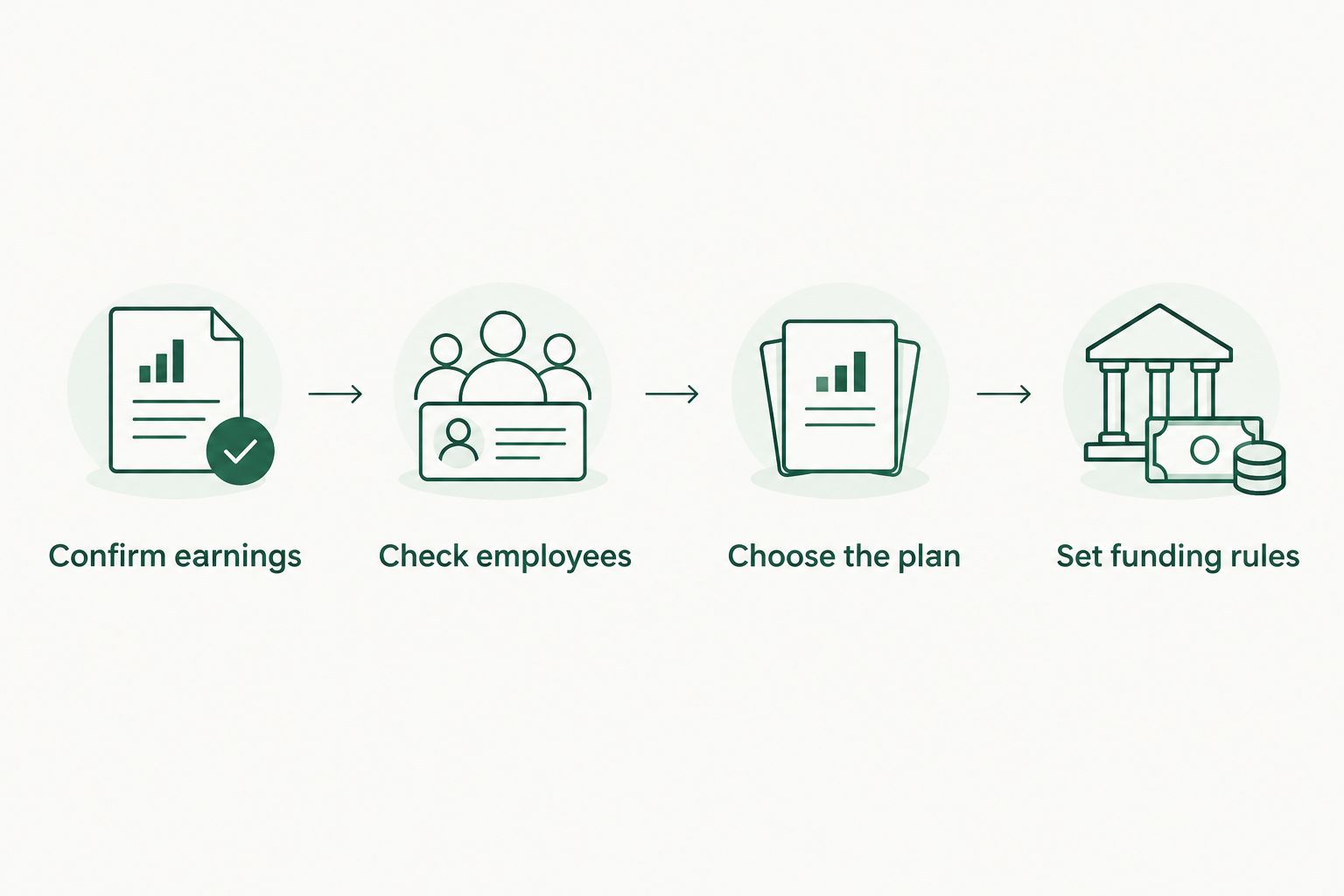
Use this sequence before moving money. It separates the decision to adopt a plan from the decision about how much you can afford to fund.
- Confirm earnings. Gather your current profit-and-loss statement, business structure, and estimated eligible compensation. Reconcile customer receipts with deductible business expenses rather than relying on bank deposits alone.
- Check employees. List workers, ownership interests, and any spouse working in the business. Ask the plan provider or administrator to assess eligibility before adopting owner-only treatment.
- Choose the plan. Compare contribution methods, tax treatment, investment choices, recordkeeping, and required filings. Request the provider's current service terms rather than assuming every account includes the same support.
- Set funding rules. Confirm adoption, election, and contribution deadlines for your circumstances. Document the contribution year and contribution type, then reconcile the final amount with your tax professional.
Opening an account and making a valid contribution are separate tasks. Keep the adoption documents and contribution records, and verify that the receiving institution codes each deposit correctly.
A provider can explain its account-opening process, but that does not establish your tax deduction. Keep responsibility clear: who calculates the maximum, who handles required filings, and who checks contributions made elsewhere.
Can you contribute if you also have a W-2 job?
Yes. Having a workplace retirement plan does not automatically prevent you from establishing a plan for a separate contracting business with qualifying earnings.
The $24,500 per year regular employee elective-deferral limit for 2026 generally applies across your 401(k) employee deferrals, rather than restarting for each employer. Employer-contribution limits require a separate analysis, particularly when businesses share ownership or are otherwise related.
Give your tax professional and plan administrator your workplace contribution totals before funding the contracting plan. Otherwise, each provider sees only part of the picture.
Can you fund a plan after a slow year?
Yes, if you still have qualifying earnings and follow the account's rules. Low revenue does not itself disqualify you, but low or negative eligible earnings can restrict or eliminate your permitted contribution.
For irregular income, establish a cash-flow process rather than committing every strong month to retirement. Keep a running estimate of profit, taxes, and business cash needs, then review the contribution amount before funding it.
Avoid treating retirement savings as a temporary business reserve. Withdrawals can create income taxes and additional taxes unless an exception applies; account access also depends on the plan's distribution rules.
Do you need an LLC to open a retirement plan?
No. A sole proprietor with qualifying self-employment income can establish an eligible retirement plan without forming an LLC.
An LLC is a legal structure, not a retirement-plan eligibility shortcut. Its tax treatment, your compensation, and your workforce determine which contribution rules apply.
Before opening the account, confirm the identifying information and documents the provider requires. Do not change your business structure solely to satisfy an assumption about retirement-account paperwork.
Where financial planning fits
VIMSmallBusiness is best for Northern Colorado owners seeking fee-only retirement planning alongside business cash-flow planning. The firm is a fee-only fiduciary and SEC-registered RIA based in Loveland, serving owners in Fort Collins, Berthoud, and the wider region.
That planning relationship can connect retirement contributions with treasury, investment management, and business transition decisions. The boundary is equally important: VIMSmallBusiness does not prepare tax returns, and financial planning does not replace the tax professional's contribution and deduction calculations.
If you want help connecting those decisions, you can contact the team about a confidential discovery call with Dillon Goodman, CPA, CFP®. Keep the educational comparison separate from the decision to hire an advisor.
FAQ
Can I open a retirement plan if I only receive 1099 income?
Yes, qualifying self-employment income can support a business retirement plan or personal IRA. Eligibility and contribution amounts depend on earnings and the account's rules, not simply receiving a Form 1099.
What's the best retirement plan for a contractor with no employees?
A solo 401(k) fits eligible owner-only businesses seeking employee deferrals plus employer contributions. A SEP IRA or personal IRA fits different funding and administrative needs, so compare the rules before choosing.
Can I contribute to a solo 401(k) and my employer's 401(k)?
Yes, but the regular employee elective-deferral limit generally applies across both plans. For 2026, that limit is $24,500 per year, excluding eligible catch-up contributions; employer contributions require separate analysis.
Does my retirement contribution use gross 1099 income?
No, gross 1099 income is not the contribution base for a sole proprietor. Business expenses and applicable self-employment adjustments affect the eligible earnings calculation.
Can I have both a Roth IRA and a contractor retirement plan?
Yes, if you meet the applicable eligibility requirements. Direct Roth IRA contributions have income limits, and traditional and Roth IRAs share the annual IRA contribution allowance.
What happens to my solo 401(k) if I hire employees?
Hiring employees requires reviewing their eligibility and the plan's obligations. An arrangement that qualifies as owner-only today does not automatically retain that treatment after your workforce changes.
Can VIMSmallBusiness prepare my tax return and calculate my deduction?
VIMSmallBusiness does not prepare tax returns. Its financial planning services can address retirement savings alongside business cash flow, while your tax professional confirms tax-return treatment and deductions.
One last thing
Do not confuse a contribution deadline with a planning deadline. Waiting until tax preparation leaves less time to resolve eligibility, election, or documentation questions, even when funding remains possible.
For your 2026 plan review, bring your earnings estimate, employee information, and contributions through other jobs. Decide who owns each calculation before making the deposit—not after an account statement exposes a mismatch.