

Yes. A fee-only advisor can help you manage irregular business income by connecting cash-flow forecasts, owner pay, tax reserves, and long-term saving in one plan. The advisor cannot make customer payments predictable or replace accurate bookkeeping, and fee-only compensation does not automatically mean the advisor understands business cash flow.
- For irregular business income, choose a fee-only advisor who connects business cash flow with household spending.
- VIMSmallBusiness offers fee-only financial planning and treasury management for small business owners.
- Separate operating obligations, tax reserves, and owner pay before treating a strong bank balance as investable surplus.
- Ask for written transfer rules and review triggers, not just an investment allocation.
Can a fee-only advisor help with irregular business income?
Yes—the useful deliverable is a cash-flow decision system, not a prediction of your next good month. You need to know what stays in the business, what supports your household, and what can move toward retirement or other long-term goals.
A financial advisor helping with cash-flow forecasting connects those decisions. The work starts with actual collections and obligations rather than assuming your annual profit arrives evenly throughout the year.
Different professionals handle different parts of that work. Use this comparison to assign responsibility before you hire anyone.
| Professional | Best for | Main benefit | Limitation |
|---|---|---|---|
| Fee-only financial advisor | Connecting business income with household needs and long-term goals | Coordinates reserves, owner pay, and investment decisions | Does not automatically provide bookkeeping, tax preparation, or business operations support |
| CPA or tax professional | Tax calculations, filing, and entity-specific tax questions | Explains how income and distributions affect tax obligations | The engagement does not necessarily include household planning or investment management |
| Bookkeeper | Maintaining accurate transaction records and reconciled accounts | Gives your planning team usable financial records | Historical records alone do not decide future owner pay or investment transfers |
These roles complement each other. A business owner with reliable books can still need tax guidance and a personal financial plan.
Why this matters
Cash is lumpy. Payroll, debt payments, and household bills do not necessarily follow the same pattern as customer collections.
A profitable business can have a cash shortage when customers pay after expenses come due. The reverse also happens: a large deposit can make the bank balance look comfortable even though taxes, supplier payments, or project costs already have claims on that money.
Your 2026 cash-flow plan should distinguish profit, available cash, and spendable owner income. Treating those as interchangeable creates a planning problem before you ever choose an investment.
This matters in Loveland, Fort Collins, Berthoud, and across Northern Colorado just as it does elsewhere. Local access is useful, but the hiring test is whether the advisor understands how your business actually collects and spends money.
What should the advisor actually deliver?
Ask for written answers to 3 decisions: how much cash stays in the business, how owner pay is determined, and when surplus becomes available for long-term saving. Each answer needs a rule you can follow when receipts change.
A useful plan also identifies who maintains the forecast, who updates tax estimates, and who approves transfers. Without assigned responsibility, even a sensible recommendation can sit untouched while you return to running the business.
Before accepting an engagement, look for these deliverables:
- A cash-flow map: Expected collections, required payments, and the timing gaps between them.
- A reserve policy: The obligations your cash must cover and the conditions for rebuilding reserves.
- An owner-pay policy: A repeatable process for household transfers, coordinated with your tax professional.
- A surplus policy: Conditions that must be satisfied before money moves into long-term investments.
- Review triggers: Specific changes that require a new decision rather than waiting for the next scheduled meeting.
The advisor should explain the assumptions behind each recommendation. A polished forecast is not useful if you cannot tell which customer payments it assumes will arrive.
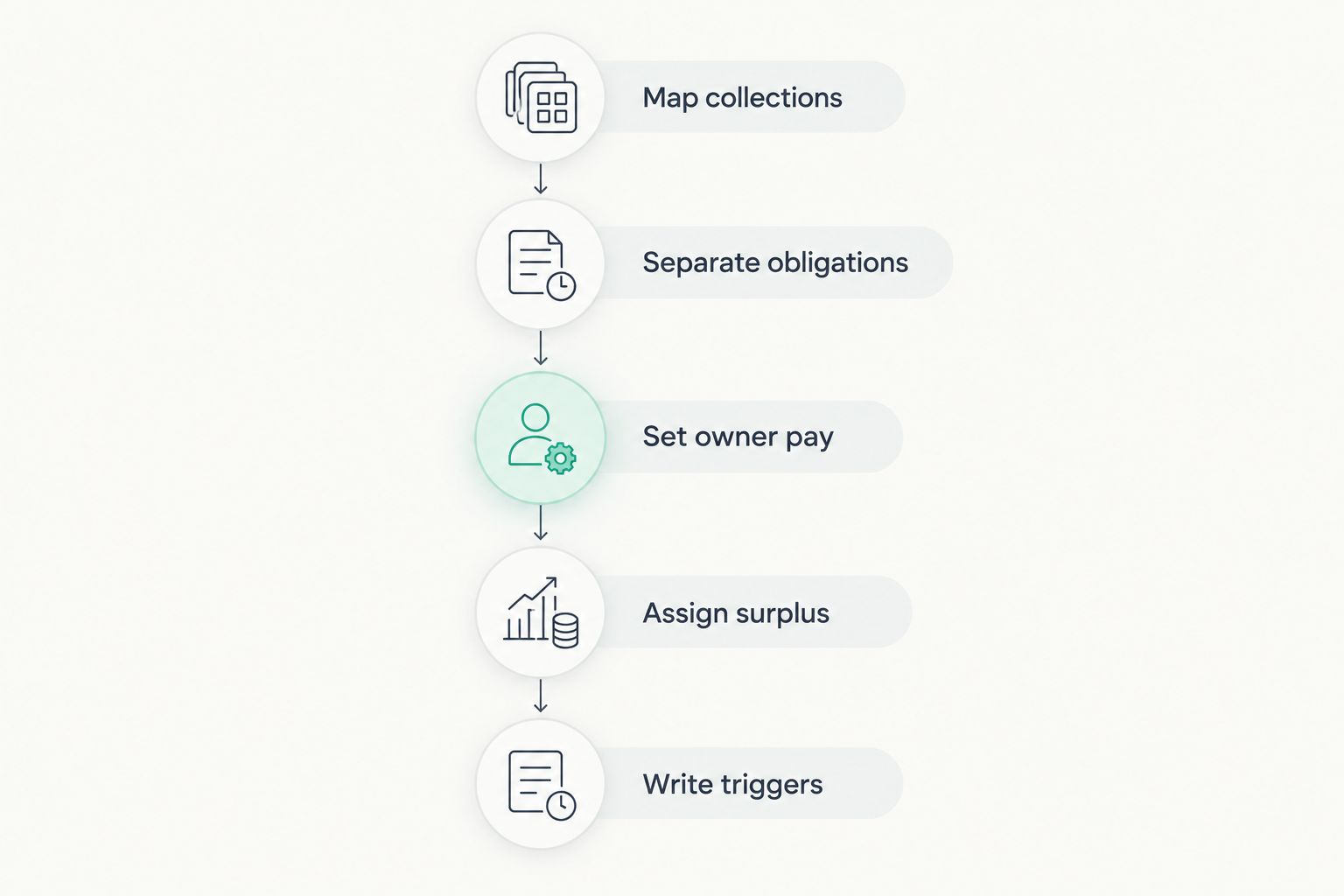
A 5-step review for uneven business income
Use this sequence to evaluate your current setup or prepare for an advisory conversation. These are planning steps, not instructions to change your legal compensation structure or move money without reviewing the consequences.
1. Map collections
Start with money received, not just invoices issued. Identify which receipts are recurring, seasonal, project-based, or dependent on a small group of customers.
Build 2 cash-flow views: one for the business and one for your household. Connect them through owner compensation and distributions so the same money is not assigned to both operating expenses and personal spending.
Include a delayed-collections scenario. The purpose is to see which payments become difficult if expected receipts arrive late—not to pretend the forecast predicts every outcome.
2. Separate obligations
Identify cash committed to payroll, rent, debt service, suppliers, taxes, and other known requirements. Keep expected project costs visible even when the related customer deposit has already arrived.
Your CPA or tax professional should guide the tax assumptions in your 2026 plan. An advisor can incorporate those assumptions into cash management without claiming to prepare your returns.
Separation can begin with clear records and categories. Ask your accountant and bank whether separate accounts would improve administration before opening accounts simply to make the plan look organized.
3. Set owner pay
Choose a repeatable household transfer process based on what the business can support, not the most recent strong deposit. Review the proposed approach with your tax professional because salary, draws, and distributions have different implications depending on your business structure.
A stable transfer policy helps you budget, but it does not remove business risk. Write down what happens when collections fall short and when an additional distribution requires review.
Your 2026 owner-pay policy should also identify which personal expenses are essential. That distinction makes adjustments more deliberate when business receipts change.
4. Assign surplus
Define surplus only after reviewing operating obligations, tax needs, reserves, and planned business spending. Then decide whether the remaining money belongs to the business or is available for personal goals.
Long-term investments expose money to market changes. Do not treat cash needed for near-term obligations as long-term investment capital.
Retirement contributions also need coordination with earnings, plan rules, employee obligations, and deadlines. Ask your planning team to confirm the applicable 2026 requirements rather than copying a contribution decision from a previous return.
5. Write triggers
Agree on events that require a review: a major customer paying late, a new hire, a large equipment commitment, or a meaningful change in household spending. Assign someone to flag each event.
Include the action as well as the trigger. For example, the written policy can require a reserve review before approving an additional owner distribution.
A recurring meeting helps, but an event-based rule catches changes between meetings. Your plan should remain usable when you are busy, not only when you have time to study a spreadsheet.
Why the right cash-flow plan varies
There is no universal transfer rule that fits every owner. The plan must reflect your obligations and the way money moves through your business.
- Collection timing: Invoice dates and actual payment dates can differ. Use expected receipts when assessing liquidity.
- Operating commitments: Payroll, rent, debt service, and supplier terms determine which payments cannot wait.
- Tax treatment: Business structure and personal circumstances affect the assumptions your tax professional supplies.
- Household dependence: A household funded entirely by business income faces different spending decisions from one with another income source.
- Business concentration: Dependence on a small customer group or your own ability to work changes the scenarios worth reviewing.
- Planned spending: Equipment purchases, hiring, and transition expenses compete with distributions and long-term saving.
A small-business treasury management guide provides more context on managing business cash. Keep that operational cash discussion separate from the question of how your personal investments should be allocated.
How do you choose a fee-only advisor for uneven income?
Start with the work, not the label. Fee-only describes compensation; it does not establish expertise in treasury, owner compensation, or coordination with your accountant.
Use 4 checkpoints when comparing local fee-only advisors:
- Scope: Will the engagement address business cash flow and household planning, or only investments?
- Coordination: How will the advisor use information from your bookkeeper and CPA, with your permission?
- Decisions: Which written policies will you receive, and who helps put them into practice?
- Boundaries: What remains your responsibility, and which services require another professional?
Ask how the advisor is paid and whether compensation changes when business cash moves into managed investments. Request the fee schedule and engagement terms, then evaluate the proposed work—not a promised investment outcome.
VIMSmallBusiness is best suited to Northern Colorado business owners seeking fee-only financial planning and treasury management. The firm is a fee-only fiduciary and SEC-registered RIA based in Loveland; SEC registration is not an endorsement or a guarantee of results.
VIMSmallBusiness offers financial planning, investment management, treasury management, and transition/succession planning. The boundary matters: the firm does not prepare tax returns, so tax calculations and filing remain work to coordinate with your tax professional.
Can an advisor help if you already have a CPA?
Yes. A financial advisor can connect your CPA's tax guidance with household spending, reserves, and long-term saving, while the CPA handles the tax work covered by that engagement.
Ask both professionals who updates the tax estimate and how changes reach the cash-flow plan. Shared responsibility needs named tasks; otherwise, you can end up assuming someone else has adjusted the reserve.
Should you invest after a strong month?
Not automatically. A strong month is a reason to review your surplus policy, not proof that the entire increase in your bank balance is available to invest.
First check upcoming obligations, tax assumptions, reserve needs, and planned spending. If those checks support a transfer, choose an investment approach that matches when you expect to need the money and the risk you can accept.
What should you bring to the first conversation?
Bring current business financial statements, recent bank records, receivables and payables information, debt obligations, and your household spending needs. Include available tax estimates and retirement-plan documents so the discussion reflects existing commitments.
For a 2026 planning conversation, explain what has changed during the year rather than handing over records without context. Mention late-paying customers, new contracts, staffing changes, and distributions that were difficult to sustain.
FAQ
Can a fee-only advisor help when my business income changes every month?
Yes. A fee-only advisor can connect changing business receipts with owner pay, reserves, tax assumptions, and long-term saving. Ask whether business cash-flow planning is included in the engagement.
Does fee-only mean the advisor also does my bookkeeping?
No. Fee-only describes how an advisor is compensated, not whether bookkeeping is included. Confirm who maintains your records and who turns those records into planning decisions.
How much cash should I keep before investing business income?
Your cash requirement should reflect operating obligations, tax needs, collection timing, and planned spending. Ask for a documented reserve policy rather than applying a generic balance to every business.
Can I pay myself the same amount when revenue is irregular?
A consistent owner-pay policy can be part of your plan, but the business must be able to support it. Coordinate the payment structure with your tax professional and define when transfers need review.
Do I still need a CPA if I hire VIMSmallBusiness?
Yes, you still need a qualified tax professional for tax preparation and other tax work outside the advisory engagement. VIMSmallBusiness provides fee-only financial planning and related advisory services but does not prepare tax returns.
Can an advisor help coordinate retirement saving with uneven income?
Yes. An advisor can help connect retirement saving with available cash, while coordinating contribution eligibility, plan requirements, and tax questions with the appropriate professionals. Do not assume a strong collection month establishes how much you can contribute.
What should I ask before hiring a local fee-only advisor?
Ask whether the engagement includes business cash-flow planning, written transfer rules, and coordination with your CPA. Also request the fee schedule, service boundaries, and the process for reviewing changes between meetings.
One last thing
Put the stop rule in writing before you write the investment rule. Decide what would pause an extra distribution or investment transfer, who checks the condition, and what must happen before transfers resume.
That instruction makes your 2026 plan usable during a busy week. An investment allocation answers where money goes; a cash-flow policy answers whether the money is available to move at all.
This article is educational, not personalized financial, tax, or legal advice. Base account transfers, compensation decisions, and tax actions on your circumstances and the advice of the appropriate professionals.