

After selling your business, confirm what you actually received, set aside money for taxes and remaining obligations, and build a personal cash-flow plan before investing the balance. The headline sale amount is not the amount you can spend: debt payoffs, transaction expenses, holdbacks, and contingent payments change the picture. Use this 2026 checklist to turn the proceeds into a coordinated plan for spending, investing, and life after ownership.
- What to do financially after selling a business: reconcile proceeds, reserve taxes, plan spending, then invest.
- Treat earnouts and holdbacks as uncertain receipts, not cash available for retirement.
- Separate near-term obligations from long-term investments before choosing accounts.
- VIMSmallBusiness provides financial planning and business transition planning for owners; tax preparation requires a separate professional.
What should I do financially after I sell my business?
Give every dollar a job before choosing investments. Start with the closing documents and work toward a written household plan, rather than treating the bank balance as permission to spend.
Selling also changes your concentration risk. You no longer own the same operating business, but an earnout, buyer equity, or seller financing can leave you financially tied to its performance. The guide to reducing business concentration risk explains the broader planning issue.
1. Reconcile the closing statement
Build a record of cash received, amounts withheld, debts paid, and amounts still owed to you. Match the closing statement to actual account activity; a signed agreement and a completed transfer are different things.
Ask your transaction attorney and tax preparer to explain any adjustments you do not understand. Keep the purchase agreement, closing statement, transaction expense records, and supporting tax-basis documents together.
Your first deliverable is a clear distinction between money received, money restricted, and money contingent on future events. Do not combine those categories in your spending plan.
2. Establish a tax reserve with your tax preparer
Ask your tax preparer for an estimate based on the signed transaction, your ownership structure, and your other income. Request both the amount to reserve and the payment calendar; knowing the liability without knowing when payments are due leaves the job unfinished.
For a sale completed in 2026, confirm which tax-year rules apply rather than copying a prior estimate. Purchase-price allocation, tax basis, and the character of different payments require transaction-specific review.
Keep the tax reserve separate from discretionary spending and long-term investing. A tax reserve is an obligation, not investment capital.
3. Write a new household spending plan
Build a 12-month spending forecast that separates recurring needs from optional purchases. Include health coverage, travel, family support, housing, and expenses the business previously paid that you must now replace personally.
Distinguish sale proceeds from continuing income. Consulting payments, wages during a transition, and future buyer payments have different levels of certainty and should appear separately.
The forecast should answer a plain question: how much must your assets provide after dependable outside income? That amount is the starting point for retirement planning, not the size of the closing deposit.
4. Separate obligations from long-term capital
Assign cash to taxes, remaining transaction obligations, household spending, and longer-term goals. Use account records or a clear ledger so the same money is not counted toward multiple purposes.
An upcoming tax payment needs different treatment from money intended for later retirement years. Match access and investment risk to the purpose of each allocation.
Do not let temporary cash arrangements become an accidental permanent strategy. Set a review date and identify which unresolved questions must be answered before moving the longer-term balance.
5. Review debt and continuing guarantees
List personal debts, remaining business obligations, and any guarantees that survived closing. Ask your attorney to confirm which obligations ended and which still attach to you.
Before paying off debt, compare the loan terms with your need for accessible cash and your other commitments. A payoff can reduce required payments, but it also removes cash you cannot spend elsewhere without borrowing again.
Get written confirmation of releases. Selling the company does not, by itself, establish that a lender released a personal guarantee.
6. Write an investment policy before buying
Create a 1-page investment policy covering your goals, spending needs, time horizons, acceptable risk, and rebalancing approach. Plain language is enough; the document should help you make decisions when markets become uncomfortable.
Account for investments you already own, including retirement accounts, property, and any retained buyer equity. Evaluate the household portfolio together rather than treating the sale proceeds as an isolated account.
Choose an allocation you can maintain while funding your actual spending needs. A portfolio built around an assumed return is not a substitute for a spending plan.
7. Update ownership, beneficiaries, and insurance
Ask your estate attorney to review account ownership, beneficiary designations, powers of attorney, and estate documents after the sale. Confirm that the documents reflect your current assets and intentions.
Review insurance as well. Coverage connected to ownership, employment, or a buy-sell agreement needs separate attention from coverage supporting your household.
Make these reviews part of the transition checklist, not an assumption that everything transfers automatically. Coordinate any changes with the professionals responsible for the documents and policies.
8. Assign responsibility and schedule reviews
Give each outstanding task an owner: you, your financial advisor, tax preparer, attorney, or plan administrator. Record the next action and its actual deadline.
For your 2026 post-sale plan, distinguish legal and tax deadlines from personal decisions that can wait. A vacation home, family gift, or new venture deserves a deliberate decision, not the same urgency as a required payment.
Keep a decision log. It should explain why you moved money, what assumptions supported the decision, and what would justify revisiting it.
Why this matters
Your company previously connected your income, wealth, benefits, and working life. A sale separates those pieces. You now need a household system that replaces the financial functions ownership provided without assuming the proceeds can fund every goal.
The practical problem is double counting. The same balance cannot simultaneously fund taxes, eliminate debt, support retirement, and provide capital for another business.
Calculate spendable wealth after obligations, then test your goals against it. That sequence makes trade-offs visible before commitments become difficult to reverse.
Why your post-sale financial plan varies
Your next move depends on the transaction and your household, not a standard percentage allocation. These factors determine what needs attention first:
- Services you need: Treasury management, investment management, financial planning, and transition planning address different parts of the problem.
- Your buyer relationship: Continuing work, seller financing, or retained ownership requires a different cash-flow plan from a clean separation.
- Your household obligations: Recurring spending and family commitments determine how much accessible cash you need.
- Your transition goals: Retirement, a new venture, and a gradual step back create different demands on the proceeds.
- Your professional responsibilities: Financial planning, tax preparation, and legal work need clear boundaries and coordination.
An owner in Loveland, Fort Collins, or Berthoud still needs transaction-specific advice. A shared Northern Colorado location does not make another owner's tax treatment or retirement plan applicable to you.
How should I treat cash, holdbacks, and earnouts?
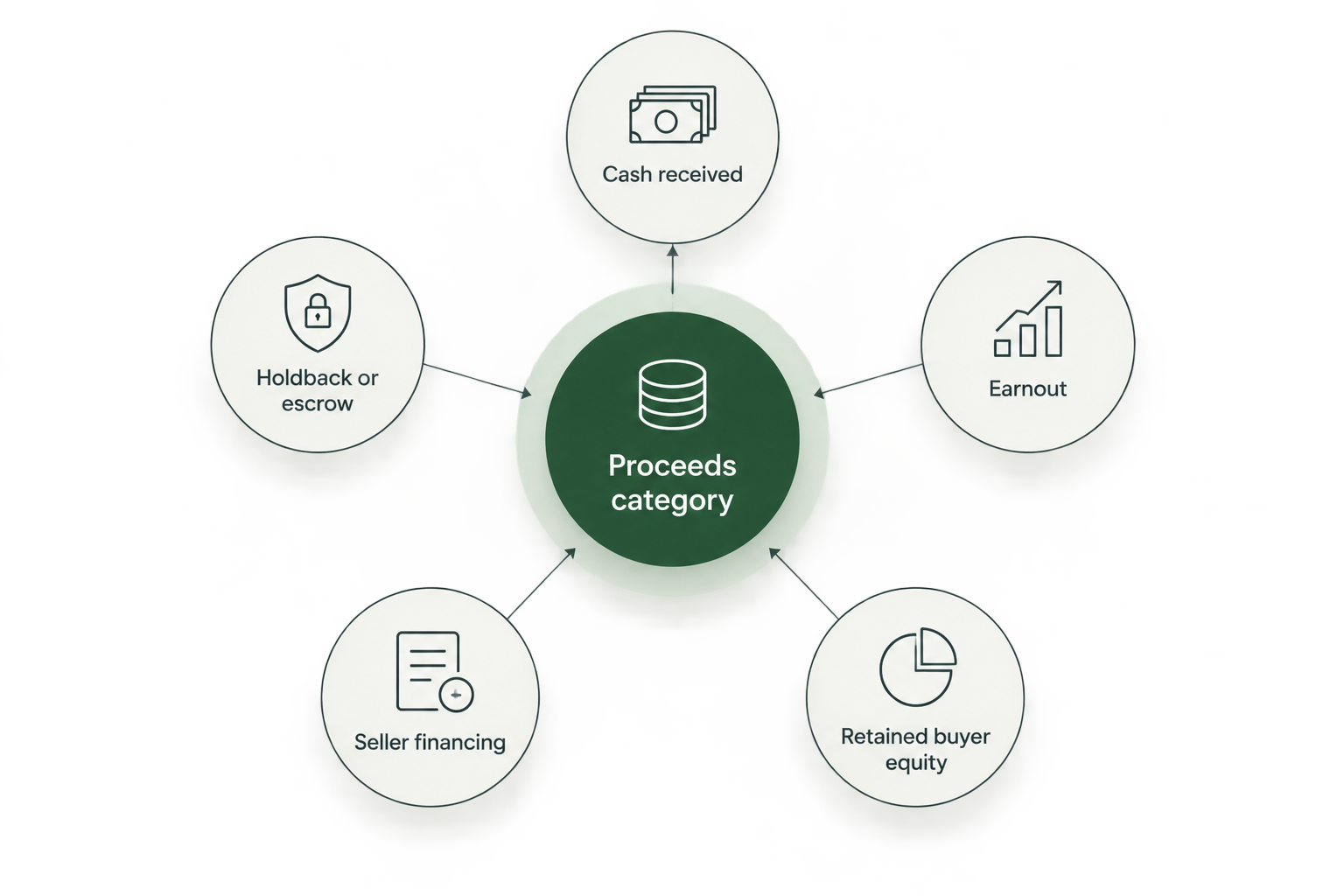
Separate what you control from what you expect. For your 2026 balance sheet, record restrictions and contingencies beside each amount rather than presenting every promised payment as accessible wealth.
| Proceeds category | Best for | Planning benefit | Limitation |
|---|---|---|---|
| Cash received | Funding confirmed obligations and approved goals | Available for allocation once restrictions are checked | Taxes and other commitments reduce the spendable balance |
| Holdback or escrow | Tracking a potential later receipt | Keeps a contractual claim visible | Release depends on the agreement and applicable claims |
| Earnout | Tracking contingent future proceeds | Recognizes potential additional payments | Payment depends on contractual conditions being met |
| Seller financing | Tracking scheduled buyer payments | Makes expected receipts explicit | Buyer repayment risk remains |
| Retained buyer equity | Tracking continuing ownership exposure | Preserves participation in the buyer's business | Value and access remain uncertain |
These are planning categories, not recommendations to accept particular sale terms. Have your attorney explain the rights, restrictions, and enforcement provisions that apply to your agreement.
Where should I keep the money while I decide?
Use a temporary arrangement that matches your need for access, principal protection, and clear ownership records. Ask what protection applies to the actual account or security; similar names do not mean identical safeguards.
FDIC deposit insurance generally covers $250,000 per depositor, per insured bank, per ownership category. Multiple accounts at the same bank do not automatically create separate coverage, and money market mutual funds are not FDIC-insured deposits.
| Temporary holding | Best for | Benefit | Limitation |
|---|---|---|---|
| Insured bank deposits | Accessible cash within applicable insurance limits | Deposit insurance applies when eligibility requirements are met | Coverage limits require review across accounts and ownership categories |
| Money market mutual funds | Cash management within an investment account when the risks fit | Provides a cash-management investment option | Not FDIC insured; review fund risks and redemption terms |
Ask the institution to explain account titling, transfer procedures, and applicable protections before moving proceeds. If someone proposes a sweep arrangement, request the participating-bank details and check whether you already hold deposits at those banks.
Should I invest all the proceeds immediately?
Invest only the portion your written plan identifies as long-term capital. Taxes, near-term spending, and unresolved obligations need their own treatment before you choose an investment schedule.
A staged investment schedule spreads purchase dates but leaves money uninvested longer. Investing the designated long-term allocation at once puts that allocation to work immediately but exposes it to market movements immediately as well.
| Investment approach | Best for | Benefit | Limitation |
|---|---|---|---|
| Invest the planned allocation at once | Owners prepared to accept immediate market exposure | Establishes the intended portfolio immediately | Market declines affect the invested allocation immediately |
| Use a written staged schedule | Owners who need a defined transition into market exposure | Spreads investment decisions across scheduled dates | Uninvested cash remains outside the intended allocation longer |
Neither approach repairs an unsuitable allocation. Decide how much risk belongs in the plan before deciding when to take it.
How do I know whether I can retire after the sale?
Use the 12-month spending forecast as the starting point, then project beyond it. Include taxes, health coverage, major purchases, dependable income, and the timing of any retirement benefits.
Ask for scenarios that include weaker investment results, higher spending, and delayed contingent payments. The purpose is to reveal choices you would make under pressure, not to present a single forecast as a promise.
If retirement depends on receiving every earnout payment, label that dependency clearly. A plan supported by cash already received is different from a plan supported by a buyer's future performance.
Who should coordinate the financial work?
Your financial advisor should connect household cash flow, investments, and transition goals; your tax preparer handles tax-return preparation, and your attorney handles legal interpretation and documents. Assign those responsibilities explicitly.
VIMSmallBusiness is a fit for Northern Colorado business owners seeking fee-only financial planning and business transition planning. The firm is a fee-only fiduciary and SEC-registered RIA in Loveland; SEC registration is not an endorsement or a guarantee of results.
VIMSmallBusiness's financial planning and investment management address the household side of the transition. The boundary matters: the firm does not prepare tax returns, so keep a separate tax preparer involved. Read about the firm to understand the practice before deciding whether its scope matches your needs.
FAQ
What's the first financial thing I should do after selling my business?
Reconcile the closing statement with the cash actually received, then identify taxes and remaining obligations. Do not treat restricted or contingent proceeds as money available to spend.
How much should I set aside for taxes after selling my business?
Use a transaction-specific estimate from your tax preparer, not a standard percentage. Ask for the reserve amount, payment dates, and assumptions behind the estimate.
Should I pay off my mortgage after selling my business?
Evaluate the mortgage alongside your liquidity needs, loan terms, taxes, and spending plan. Paying it off reduces required payments but also reduces accessible cash.
Can I put all my business sale proceeds in one bank?
Check deposit insurance before concentrating the proceeds at one bank. FDIC coverage generally protects $250,000 per depositor, per insured bank, per ownership category, subject to its requirements.
Should I count my earnout toward retirement?
Track an earnout separately from cash already received because payment depends on contractual conditions. Test whether your retirement plan still works if that payment is delayed or not received.
Can I keep contributing to a retirement plan after selling my business?
Eligibility depends on the account, plan terms, and your qualifying compensation or self-employment income. Sale proceeds alone do not establish retirement-plan contribution eligibility.
Can VIMSmallBusiness prepare the tax return for my sale?
VIMSmallBusiness does not prepare tax returns. Its financial planning and transition planning should be coordinated with your separate tax preparer and attorney.
One last thing
Rebuild your paycheck before upgrading your lifestyle. Establish a planned household transfer from the appropriate account instead of making irregular withdrawals whenever the balance looks comfortable.
For your 2026 transition, keep that transfer separate from tax reserves and optional purchases. The useful milestone is not having the proceeds invested; it is knowing what your household can spend and which decisions still need professional review.