

You need a buy-sell agreement review when a co-owner’s death, disability, retirement, or departure would leave uncertainty about who owns the business, who must buy the interest, or how the purchase gets funded. A sole owner also needs a documented transition arrangement when a specific successor is expected to buy the business; an agreement alone does not create a buyer or provide the cash.
- For co-owners asking do i need a buy-sell agreement, unresolved ownership, valuation, or funding questions warrant attorney review.
- A buy-sell agreement sets transfer rules; succession planning also addresses leadership and business continuity.
- Insurance can fund specified events, but it does not replace transfer terms or cover every departure.
- VIMSmallBusiness provides fee-only financial planning for Northern Colorado business owners; legal drafting belongs with your attorney.
How do I know if my business needs a buy-sell agreement?
Start with the ownership problem, not the document. If an owner left tomorrow, would everyone agree on the buyer, the valuation process, and the source of payment? An unresolved answer is a reason to involve your business attorney.
The financial side of a business partner buyout needs attention alongside the legal terms. An obligation to buy and an ability to pay are different things.
Use these 6 questions for your 2026 ownership review:
- Who can become an owner? Decide whether transfers to family members, trusts, employees, or outsiders require restrictions or consent.
- What events trigger a purchase? Identify which departures create an option to buy and which create an obligation.
- Who purchases the interest? Name the intended buyer rather than assuming the remaining owner or business will handle it.
- How is value determined? Establish a valuation process and a way to resolve disagreement.
- Where does payment come from? Identify funding for each covered event, not just death.
- What happens during a dispute? Address decision-making and operations while the transfer remains unresolved.
These are discussion questions, not a legal test. Your attorney determines whether a separate agreement, revisions to existing governing documents, or another arrangement fits your ownership structure and applicable law.
Why this matters
Your household income and business ownership are connected. A partner’s departure can affect distributions, borrowing capacity, management responsibilities, and the cash available to operate.
A buy-sell agreement addresses ownership transfer. It does not, by itself, tell employees who runs payroll, give a successor management experience, or replace lost customer relationships. Keep those continuity tasks in the wider succession plan.
For your 2026 planning file, separate the ownership decision from the operating decision. Someone can be qualified to manage the company without being the intended buyer, and an intended buyer can still need financing or training.
Which ownership situations call for a closer look?
Different ownership situations create different planning needs. Use the table to identify the question your attorney needs to answer, not to select a legal structure yourself.
| Situation | Best for this review | What a documented arrangement can address | Limitation to resolve |
|---|---|---|---|
| Multiple active owners | Co-owners who need clear departure rules | Purchase rights, obligations, valuation, and payment terms | An unaffordable obligation can strain the remaining business |
| Family ownership | Families separating inheritance from management | Permitted owners and transfer procedures | An ownership agreement does not resolve every estate or family issue |
| Sole owner with an intended buyer | Owners planning a defined successor purchase | Conditions and terms of a future transfer | Naming a successor does not establish financing or readiness |
| Sole owner without an identified buyer | Owners starting continuity planning | A framework for discussing a future sale or transition | A buy-sell agreement cannot supply a willing purchaser |
Co-owners: resolve the departure rules
When several people own a business, their personal timelines rarely match perfectly. One owner wants retirement income while another wants to reinvest; one becomes unable to work while another remains active.
Ask your attorney to distinguish ownership from employment. Leaving an operating role does not automatically answer whether someone must sell an ownership interest, and your documents need to address the distinction explicitly.
Family businesses: separate ownership from management
A child working in the company and a child outside it can have different roles and expectations. Decide who is permitted to hold an interest, who has voting authority, and how a departing family owner receives payment.
Coordinate those decisions with estate documents. A transfer restriction in a business agreement needs review alongside the owner’s intended inheritance arrangements, rather than being treated as a substitute for them.
Sole owners: identify the actual successor
If you own the entire company, there is no remaining partner automatically positioned to purchase it. Start by identifying whether a family member, employee, outside buyer, or another business is the intended purchaser.
Then test the arrangement. A person who can operate the company is not necessarily prepared to buy it, and a sale plan needs a path for both management and funding.
Why buy-sell agreement needs vary
The right terms depend on the business and its owners. Bring these factors to your legal and financial discussions:
- Ownership structure: The number of owners, voting rights, and permitted transfers affect which decisions require agreement.
- Triggering events: Death, disability, retirement, voluntary departure, and disputes present different questions about timing and payment.
- Valuation process: A stated value, formula, or appraisal process needs to fit the business and explain how disagreements are resolved.
- Funding capacity: Cash reserves, insurance, borrowing, and payments over time have different constraints.
- Household dependence: An owner’s need for income after leaving affects whether proposed payment terms meet personal planning needs.
- Existing documents: Operating agreements, shareholder agreements, estate documents, loan terms, and insurance arrangements need coordinated review.
Do not copy another company’s agreement and assume it fits. Even familiar language needs legal review against your entity, ownership rights, and intended transaction.
How should you review an existing agreement?
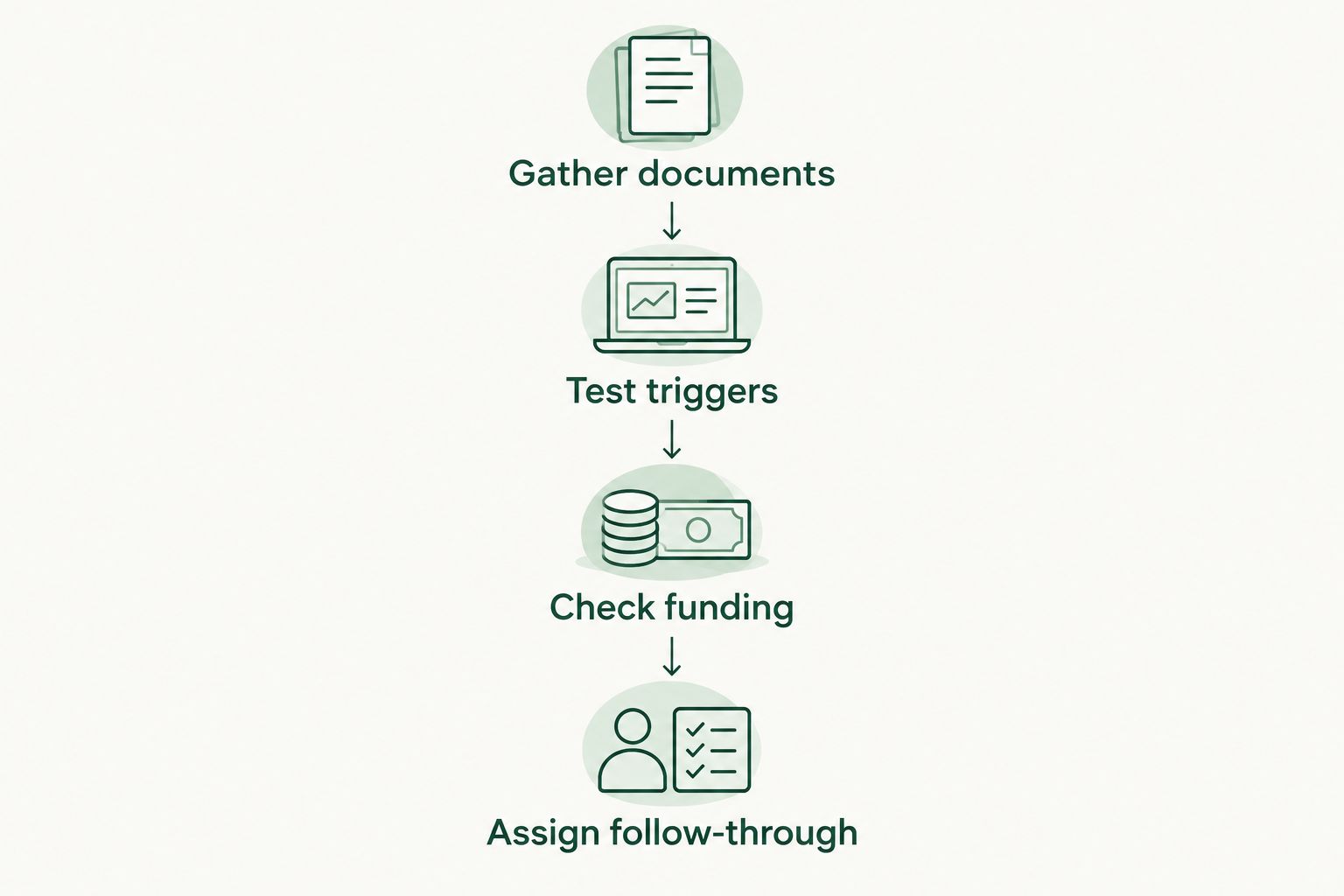
Use this 4-step review to turn a signed document into an actionable planning discussion. A signature confirms execution; it does not confirm that the terms still match your business.
Gather documents
Start with 3 document groups: ownership documents, financial records, and funding records. Include the signed agreement and amendments, current ownership information, business financial statements, and relevant insurance or financing documents.
Keep the actual signed versions together. An unsigned draft or an old ownership schedule can send the review in the wrong direction before anyone discusses valuation.
Test triggers
Walk through each event the agreement addresses. Ask what happens if an owner dies, cannot work, retires, leaves voluntarily, or wants to transfer an interest.
For each event, identify who acts, whether a purchase is required, and what happens while the transaction is pending. Ask your attorney about definitions and procedures rather than assuming everyday terms have a clear contractual meaning.
Check funding
Compare the purchase obligation with its intended funding source. Separate death-related funding from the resources available for retirement, disability, or a voluntary departure.
Then ask what remains for payroll, taxes, debt service, and ordinary operations after a buyout. Business cash cannot serve every purpose at once; show the competing uses in the cash-flow forecast.
Assign follow-through
Write down who handles legal revisions, valuation work, tax analysis, and financial modeling. Assign responsibility for obtaining documents and resolving open decisions.
Finish your 2026 review with a written action list. “The attorney has it” is not a completed funding decision, and “there is insurance” is not confirmation that the policy matches the agreement.
How do valuation and funding fit together?
A valuation process determines the obligation; funding determines whether the buyer can meet it. Review both together rather than settling a value and leaving payment for later.
Your agreement needs a method for determining value and handling disagreement. Ask who performs the valuation, what information they use, and what happens if an owner disputes the result. A current estimate is useful for planning, but it does not replace the agreement’s required procedure.
A business valuation for a sale also needs the right purpose and scope. A planning estimate and a valuation prepared for a specific transaction are not interchangeable simply because both produce a number.
For your 2026 funding review, compare these sources without assuming any is sufficient alone:
| Funding source | Best for | Benefit | Constraint |
|---|---|---|---|
| Business cash | Testing whether existing liquidity can support a purchase | Uses resources already held by the business | Reduces cash available for operations |
| Insurance | Evaluating funding for events a policy actually covers | Can provide proceeds for a covered claim | Coverage, exclusions, ownership, and beneficiary terms matter |
| Borrowing | Assessing a financed purchase | Can spread the cash demand | Depends on lender approval and repayment capacity |
| Payments over time | Evaluating a negotiated payment schedule | Spreads the buyer’s payment obligation | Leaves the seller exposed to repayment risk |
Insurance deserves its own check. Confirm that the insured person, policy owner, beneficiary, coverage terms, and intended purchase obligation fit together; do not assume that owning a policy establishes that match.
Does life insurance replace a buy-sell agreement?
No. Life insurance provides a potential funding source for a covered death; a buy-sell agreement establishes transfer rights and obligations. A policy does not independently decide who must sell, who must buy, or how the business interest is valued.
Death coverage also does not fund an ordinary retirement merely because the owner has decided to leave. Review the non-death triggers separately and identify their payment sources.
Do I still need a buy-sell agreement if I trust my partner?
Trust does not resolve ownership, valuation, or funding questions. A written arrangement gives owners a way to make those decisions together before a departure creates competing needs.
The discussion is practical, not accusatory. Ask whether both households understand the intended outcome and whether the business can support the promised payment structure.
Is a buy-sell agreement the same as a succession plan?
No. A buy-sell agreement addresses ownership transfer, while a succession plan also addresses leadership and continuity. You still need decisions about authority, customer relationships, access to records, and the successor’s preparation.
An agreement can be one part of that plan. It is not a substitute for training someone to run the company or documenting what happens during an owner’s absence.
Who should handle the work?
Your business attorney handles legal drafting and advice. Your tax professional evaluates tax treatment; a qualified valuation professional addresses valuation work when needed; your financial advisor examines personal financial needs and the proposed funding’s effect on cash flow.
VIMSmallBusiness is best for Northern Colorado owners seeking fee-only financial planning around a business transition. The fee-only fiduciary, SEC-registered RIA in Loveland provides financial planning and transition/succession planning, not legal drafting, tax-return preparation, or business valuation services.
For owners in Loveland, Fort Collins, Berthoud, and wider Northern Colorado, the useful financial question is blunt: can the intended transfer support the departing household without weakening the continuing business? VIMSmallBusiness financial planning addresses that question alongside your legal and tax professionals; it does not replace their advice.
FAQ
Do I need a buy-sell agreement if I have a business partner?
You need a legal review when a partner’s departure would leave ownership, valuation, or payment unresolved. Your attorney can determine whether existing documents address those issues or need revision.
Do I need a buy-sell agreement as a sole owner?
A sole owner needs to assess a documented purchase arrangement when a specific successor is expected to buy the business. Without an identified buyer, start with succession and continuity planning rather than assuming an agreement creates a sale.
Does my operating agreement already cover a partner buyout?
Your operating agreement might contain buyout provisions, but your attorney must assess their scope. Review the triggers, valuation process, purchaser, payment terms, and relationship to any separate agreement.
Can life insurance pay for every type of owner departure?
Life insurance does not fund every type of owner departure. A covered death and an ordinary retirement require separate funding analysis.
What happens if we cannot agree on the business value?
The agreement should specify a valuation process and a method for resolving disagreement. Ask your attorney and valuation professional to review that procedure before a transfer occurs.
When should I review an existing buy-sell agreement?
Review an existing agreement when ownership, intended successors, business finances, or funding arrangements change. Your 2026 review should compare the signed terms with the business you operate now.
Can a financial advisor write my buy-sell agreement?
Legal drafting belongs with your attorney, not your financial advisor. A financial advisor can examine household needs, funding resources, and the cash-flow consequences of proposed terms.
One last thing
Write the intended funding source beside every triggering event. A blank beside retirement or disability exposes a different problem from a blank beside death, even when the same agreement addresses all of them.
For your next owner meeting, bring that marked-up list instead of asking whether everyone still feels comfortable with the document. You will leave with specific decisions to assign. This article is educational, not personalized financial, tax, or legal advice.