

Yes. A financial advisor can help you plan for a seasonal cash flow dip by connecting your business forecast, cash reserves, owner draws, taxes, and personal spending. The limit is important: planning can expose a funding gap and organize your response, but it does not replace collections work, operating decisions, or a lender’s approval.
- Seasonal cash flow planning for small business starts with payment dates, not annual profit.
- VIMSmallBusiness serves Northern Colorado owners seeking treasury management and financial planning together.
- Protect operating cash before committing money to long-term investments or discretionary owner distributions.
- Assign forecasting, tax estimates, banking, and personal planning to named people.
Can a financial advisor help me plan for a seasonal cash flow dip?
A financial advisor can help you turn an expected slow season into a written funding plan. The useful output is not simply a forecast: it is a decision about which cash stays accessible, what spending changes, and how much you can draw without creating another shortfall.
Start with cash flow forecasting that follows actual receipts and payments. Your bank balance today does not show the payroll, supplier bills, and tax payments already competing for that money.
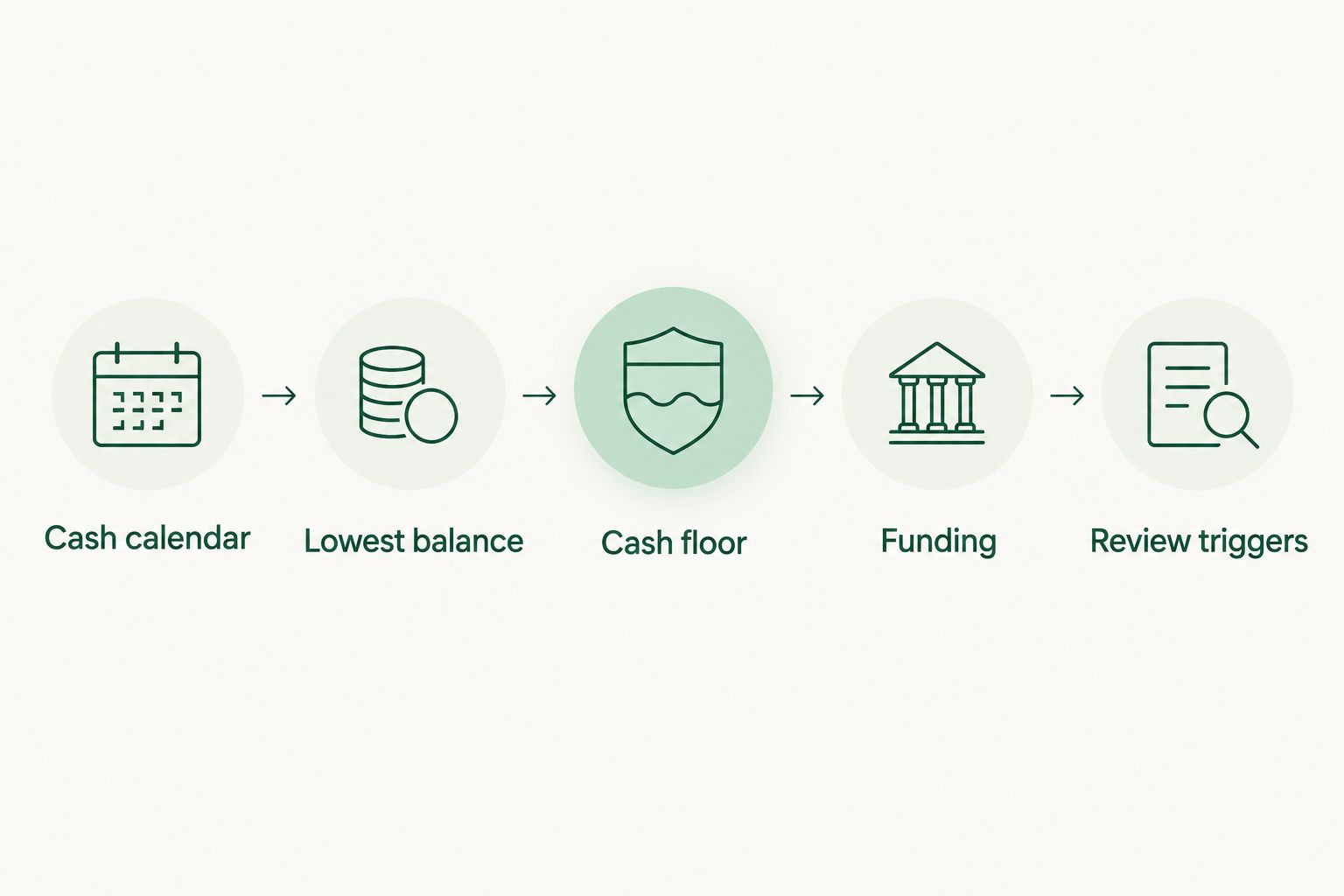
Use these steps to build your 2026 seasonal plan.
1. Build your cash calendar
List expected customer receipts beside the dates cash must leave the business. Include payroll, rent, debt payments, supplier commitments, insurance renewals, taxes, and owner distributions.
Use collection dates rather than invoice dates. A booked sale does not fund payroll until the payment arrives and becomes available.
Separate firm commitments from estimates. Signed orders, repeat customer patterns, and hoped-for sales should not carry the same weight in your forecast.
2. Find your lowest balance
Carry the opening cash balance through the calendar, adding receipts and subtracting payments. Identify the lowest projected balance and the obligations that fall immediately around it.
Plan around the lowest cash point, not the average balance. A profitable year can still contain a week when outgoing payments exceed available cash.
Exclude money you have already assigned to another purpose. Otherwise, the forecast treats the same dollars as available for payroll, taxes, and your household.
3. Set your cash floor
Define the balance you intend to protect after accounting for scheduled obligations. Base that floor on your business’s commitments, collection uncertainty, and access to other funding—not an unsupported rule about how many months every owner needs.
Write down what happens if the forecast crosses that floor. Possible actions include pausing discretionary distributions, delaying an optional purchase, or discussing financing with your bank before the shortfall arrives.
4. Match your funding
Decide which needs belong in operating cash and which require a separate funding discussion. Money needed for the slow season has a different job from money intended for long-term retirement spending.
Check access, settlement, transfer restrictions, and principal risk before choosing where to hold reserves. An account balance is not the same as cash available for a payment due today.
5. Set your review triggers
Name the person who updates the forecast and the events that require another look. A delayed customer payment, a changed payroll run, or an unexpected supplier demand should trigger a revision.
Compare actual receipts and payments with the forecast. Update the assumptions rather than carrying a known error into the next period.
Why this matters
Cash is lumpy. Your busy season can fill the bank account while creating commitments that remain after customer receipts slow down.
If you treat that temporary balance as surplus, you can distribute or invest money the business still needs. Your personal plan then becomes tied to an avoidable transfer back into the company.
For your 2026 plan, keep business liquidity and household needs visible together but accounted for separately. The decision is not just whether the company can survive the dip; it is whether your household can function without an unplanned draw during it.
Why seasonal cash needs vary
Your reserve requirement depends on the timing and flexibility of your obligations. These factors belong in the forecast rather than in a generic reserve benchmark:
- Collections timing: A customer who pays after payroll creates a funding gap even when the invoice is profitable. Track expected collection dates and overdue balances separately.
- Payroll commitments: Employee pay, payroll-related taxes, and payments to 1099 workers can fall on different schedules. Put the actual obligations on the calendar.
- Supplier terms: Deposits and advance inventory purchases consume cash before the related sale produces a receipt. Changes in payment terms alter the low point.
- Tax payments: Estimated payments and other business tax obligations compete with operating needs. Have your tax professional confirm the amounts and deadlines that apply to you.
- Owner draws: Household spending creates another demand on business cash. Distinguish a planned distribution from a transfer made because the personal account is running low.
- Funding access: An existing credit arrangement is different from a possible future approval. Reflect its actual terms and conditions rather than assuming the bank will cover any gap.
A seasonal pattern explains timing. It does not, by itself, establish that the underlying business is financially sound.
Which cash should cover the slow season?
Separate cash by purpose before comparing accounts or investments. The table below compares planning categories, not specific financial products.
| Cash category | Best for | Main benefit | Main limitation |
|---|---|---|---|
| Operating cash | Payments already scheduled | Keeps near-term obligations visible and funded | A large balance can look like surplus when commitments are not recorded |
| Seasonal reserve | The projected gap between receipts and payments | Prepares for a recurring timing mismatch | The target becomes stale when collections or expenses change |
| Contingency reserve | Disruptions outside the expected seasonal pattern | Adds a buffer beyond the base forecast | Tying up cash reduces what is available for other purposes |
| Long-term investment capital | Money not needed for operations or foreseeable obligations | Separates future personal goals from business spending | Market losses or access restrictions can conflict with short-term needs |
Do not count the same balance in multiple categories. A tax reserve cannot also be your full seasonal reserve unless the forecast explicitly shows that both obligations remain funded.
For your 2026 review, ask when each pool of cash will be needed before discussing investment choices. Yield is not a substitute for payment readiness.
What should your advisor coordinate with your bookkeeper and CPA?
Your bookkeeper supplies current transaction records and receivables information. Your CPA or tax preparer confirms tax estimates and tax treatment, while your bank explains payment services, account access, and lending terms.
Your financial advisor connects those business decisions with your household reserve, investment plan, retirement contributions, and longer-term goals. These responsibilities overlap, so assign an owner to each task rather than assuming someone else handles it.
Ask for a written division of responsibilities:
- Who updates expected customer collections?
- Who confirms payroll and supplier commitments?
- Who calculates tax estimates?
- Who approves owner distributions?
- Who checks that transfers will arrive before payments are due?
- Who tells the rest of the team when an assumption changes?
Do not ask a financial advisor to replace hands-on finance management that the business needs. Owners comparing internal finance support with fractional CFO services for UAE SMEs face the same scope question: who owns the operating forecast, and who connects it to the owner’s personal plan? For your Northern Colorado business, define those responsibilities under the accounting, tax, and banking requirements that apply locally.
How should you handle owner draws during a seasonal dip?
Set a draw policy before the slow season begins. It should identify what the business must fund first, how the forecast determines distributions, and what requires a pause.
Start with household essentials rather than assuming every personal transfer is fixed. Then test whether the business can support that draw while preserving its planned cash floor.
If the answer is no, identify the gap explicitly. Reducing optional household spending, retaining more busy-season cash, and reconsidering distribution timing are planning decisions; repeatedly transferring money back and forth without a record obscures the problem.
Keep the accounting treatment clear. Ask your CPA how owner contributions, compensation, distributions, or loans should be documented for your entity rather than treating every transfer as interchangeable.
Your 2026 distribution policy should also address retirement funding. Confirm contribution requirements and deadlines with your plan and tax professionals before changing planned deposits to solve an operating cash problem.
What should a useful seasonal planning engagement produce?
Ask for deliverables that help you make decisions, not just a meeting summary. You should be able to identify the expected low point, the cash assigned to cover it, and the action required if receipts slip.
A practical engagement scope includes:
- A cash calendar tied to current business records.
- A distinction between operating commitments, seasonal reserves, and long-term capital.
- A household spending plan that does not depend on unplanned business draws.
- Written assumptions about collections, taxes, and financing.
- Named responsibilities and review triggers.
VIMSmallBusiness is a fee-only fiduciary and SEC-registered financial advisory firm in Loveland serving business owners in Northern Colorado. VIMSmallBusiness fits owners seeking treasury management and personal financial planning together.
The scope limit matters as much as the fit. VIMSmallBusiness does not prepare tax returns, and an advisory plan does not replace bookkeeping, lending approval, or operating management. Confirm which forecast updates and coordination tasks are included before beginning an engagement.
How much cash should I keep for the slow season?
Keep enough accessible cash to cover your projected seasonal shortfall and the additional buffer your circumstances require. Derive the amount from your lowest forecast balance, payment commitments, and collection uncertainty rather than copying another company’s target.
If you cannot explain which obligations the reserve covers, revisit the forecast before moving cash into long-term investments.
Can a credit line replace my seasonal reserve?
A credit line is a funding tool, not automatically a replacement for cash reserves. Its usefulness depends on approval, borrowing conditions, repayment obligations, and whether funds remain accessible when you need them.
Test how repayment affects the next busy season. Borrowing solves a timing problem only when the cash plan supports the repayment as well as the initial draw.
What if the cash dip keeps getting worse?
Investigate whether the problem extends beyond seasonality when the forecast shows repeated gaps without a credible recovery. Review collections, pricing, margins, fixed commitments, and owner distributions with the people responsible for business finances.
Do not solve a recurring operating deficit solely by drawing down personal investments. First establish what changes would stop the deficit from repeating.
FAQ
Can a financial advisor help with seasonal cash flow if I already have a CPA?
Yes. A financial advisor can connect business cash needs with your household spending, reserves, investments, and retirement plan while your CPA handles the agreed tax and accounting work. Assign responsibility for the operating forecast explicitly.
What should I bring to a seasonal cash flow planning meeting?
Bring current bank balances, receivables, payables, payroll commitments, debt schedules, tax estimates, and your owner-draw history. Include household spending needs so the plan does not assume you can stop taking income indefinitely.
Should I invest business cash during the busy season?
Invest only after identifying money needed for operating commitments, the seasonal dip, taxes, and other foreseeable obligations. The right decision depends on when you need access and what risk that cash can bear.
How often should I update my seasonal cash flow forecast?
Update the forecast when actual collections or payments change the expected cash position. Set a review schedule that catches funding gaps before the affected payment dates, with additional reviews for material changes.
Can seasonal cash flow planning prevent every shortfall?
No. Seasonal cash flow planning identifies expected gaps and prepares responses, but unexpected events and inaccurate assumptions can still create shortfalls. Keep the forecast current and define contingency actions.
Can VIMSmallBusiness help Northern Colorado business owners with treasury planning?
VIMSmallBusiness offers treasury management and financial planning to small business owners in Northern Colorado. Confirm the forecasting, account coordination, and ongoing review responsibilities included in your engagement.
One last thing
A seasonal plan needs a refill rule, not just a withdrawal rule. Decide how incoming busy-season cash will rebuild reserves before you approve optional distributions or new long-term investments.
For your next 2026 cash review, put the reserve refill ahead of the surplus discussion. Otherwise, the business can finish a strong season without funding the next quiet one.