

Your estate planning cost as a business owner depends on the legal documents, ownership arrangements, tax analysis, and implementation your situation requires—not simply whether you need a will or trust. For your 2026 budget, get a written scope that separates attorney work from financial planning, valuation, tax preparation, and future updates; a document package does not necessarily include those services.
- Estate planning cost for a business owner depends on scope: compare legal drafting, succession planning, implementation, and ongoing reviews separately.
- VIMSmallBusiness fits Northern Colorado owners seeking financial planning coordinated with attorney-led estate planning.
- Ask who handles business ownership transfers, beneficiary changes, and follow-through before accepting a proposal.
- Compare written deliverables and exclusions, not a will package against a broader business succession engagement.
How much does estate planning cost for a business owner?
Your useful budget is the cost of completing the plan, not just signing the documents. Ask each professional to identify the work included, the work billed separately, and the person responsible for implementation.
Start by separating legal services from financial coordination. Understanding how a fee-only advisor helps with estate planning helps you avoid treating an advisory engagement as a substitute for an attorney.
Use this scope breakdown when requesting proposals in 2026:
| Workstream | What to ask the proposal to cover | Main limitation to clarify |
|---|---|---|
| Legal planning | Wills, trusts where appropriate, powers of attorney, and ownership-document review | Drafting does not necessarily include asset transfers or ongoing revisions |
| Financial coordination | Family cash flow, liquidity needs, beneficiaries, and wealth concentrated in the company | Financial planning does not replace legal drafting |
| Tax analysis | Tax consequences of the proposed ownership and inheritance arrangements | Planning advice and return preparation are separate services |
| Business valuation | The purpose, effective date, and intended use of any valuation | A planning estimate is not interchangeable with every formal valuation |
| Implementation | Approved ownership changes, account paperwork, and completion tracking | Responsibility can fall between professionals unless assigned |
| Ongoing review | Revisions after ownership, family, or legal changes | An initial engagement does not automatically include future work |
These are scope categories, not a recommendation to hire every specialist. Your attorney and existing advisers should identify which work your circumstances require before you authorize it.
Why this matters
Your business can be your family's largest asset without being cash your family can readily spend. An estate plan must address who receives the economic value, who can exercise control, and how household expenses connect to business distributions or a future sale.
Those questions cross professional boundaries. A signed trust does not, by itself, establish that your company's governing documents permit the ownership arrangement you intend.
For a Loveland, Fort Collins, or Berthoud owner comparing proposals, the practical question is straightforward: What will be finished, and what will still be your responsibility? Use the same question whether you choose local counsel or another qualified professional.
Separate the work before you compare proposals
Different engagements solve different problems. Use the following distinctions to decide what to request, rather than choosing a package from its name alone.
Personal estate documents
Best for: Establishing personal instructions and decision-making authority, with business ownership reviewed separately.
Ask your attorney which documents fit your family circumstances and state law. Explain that you own a business at the first meeting; do not assume a standard intake form captures co-owner restrictions, personal guarantees, or succession arrangements.
- Benefit: Creates a defined legal drafting assignment.
- Limitation: Does not necessarily resolve business control, transfer restrictions, or the family's need for liquidity.
Ask whether the engagement includes reviewing existing documents or replacing them. Also clarify whether execution guidance and follow-up questions are included.
Estate planning coordinated with business succession
Best for: Connecting inheritance decisions with who will operate, own, or buy the company.
A succession plan addresses the business transition; an estate plan addresses your personal legal arrangements. They overlap, but neither automatically completes the other.
- Benefit: Brings ownership, management, family income, and transition decisions into the same discussion.
- Limitation: Requires coordination and can involve separate legal, financial, tax, or valuation engagements.
For a family transfer, decide whether you intend to transfer ownership, management authority, or both. The distinction matters before anyone drafts instructions.
Review of an existing estate plan
Best for: Checking whether signed documents still match your current family, assets, and business structure.
Bring the actual documents, not just a summary of what you remember signing. Ask counsel to identify what remains usable, what needs revision, and which implementation tasks are incomplete.
- Benefit: Focuses the engagement on your current arrangements.
- Limitation: A review does not guarantee that existing documents can remain unchanged.
For a 2026 review, list changes since your last legal review. Include ownership changes, a move, a marriage or divorce, new beneficiaries, and any developing sale or succession plans.
Why estate planning costs vary for business owners
The work changes when the ownership, family, or implementation questions change. Ask professionals to explain which of these factors affect their proposed scope:
- Ownership structure: Co-owners, multiple entities, and governing agreements create documents and restrictions for counsel to examine.
- Succession intentions: Passing ownership to children presents different decisions from arranging a partner buyout or eventual sale.
- Family arrangements: Different beneficiaries, competing responsibilities, and unequal involvement in the company require clear instructions.
- Liquidity needs: Your family might inherit business value while still needing accessible funds for expenses and obligations.
- Tax and valuation requirements: A proposed transfer can require analysis beyond drafting personal estate documents.
- Implementation and maintenance: Ownership paperwork, beneficiary coordination, and later revisions are separate tasks unless expressly included.
Ask which factor changes the work—not simply why a proposal is higher. That keeps the conversation tied to deliverables and prevents you from paying for an undefined assignment.
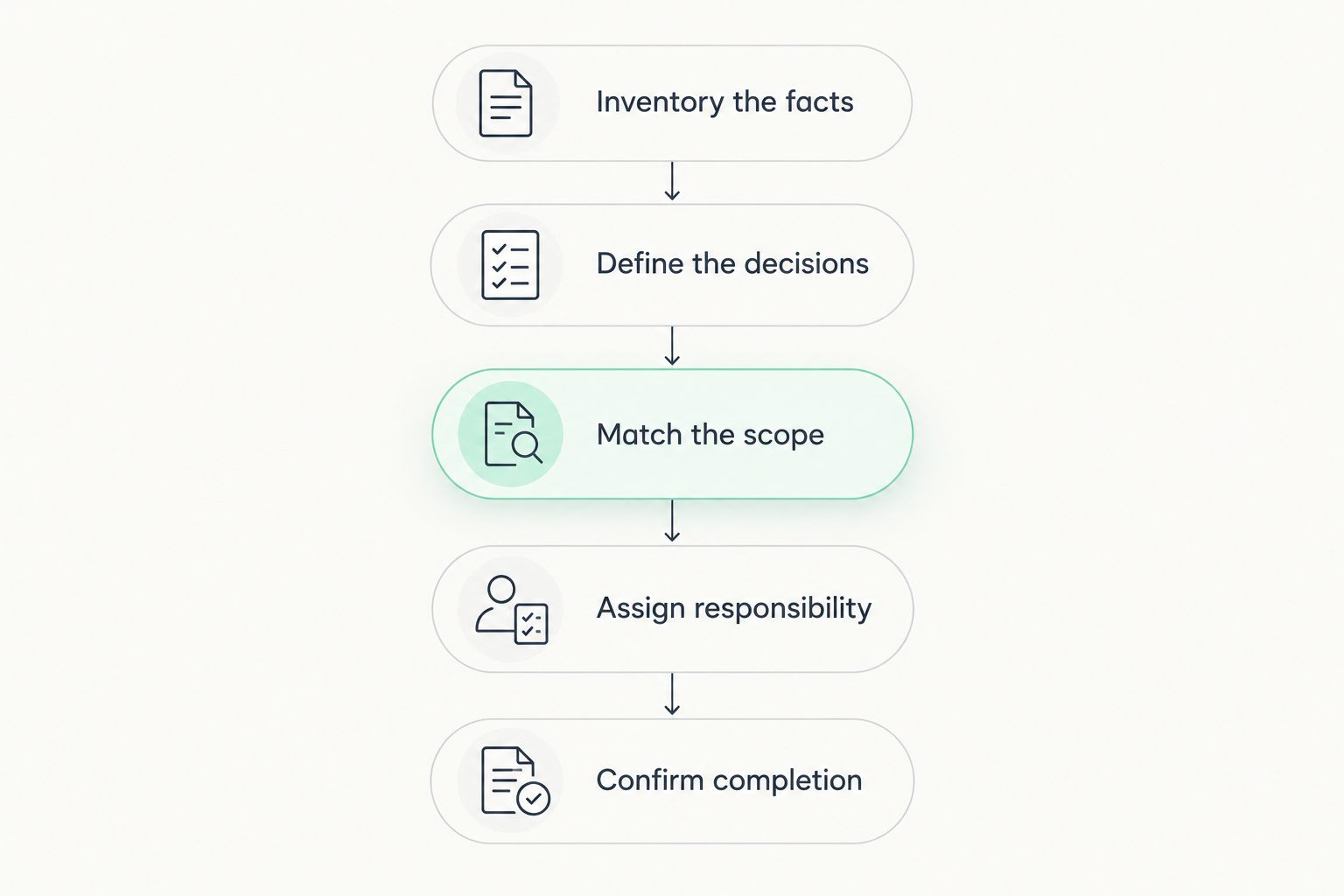
Compare proposals in 5 steps
Use these 5 steps to make proposals comparable. You are not trying to prescribe the legal solution; you are giving each professional the same facts and asking for a clear response.
1. Inventory the facts
Prepare a list of business entities, ownership interests, co-owners, personal assets, debts, and existing estate documents. Include operating agreements, shareholder agreements, and buy-sell agreements if you have them.
Mark anything uncertain. An ownership percentage you have not verified should not become an assumption in the plan.
2. Define the decisions
Write down who you want to inherit value, who you want to manage the company, and whether your family expects to retain or sell the business. Identify disagreements rather than hiding them behind a general instruction to be fair.
If those decisions remain open, ask whether the engagement includes helping you evaluate them before drafting begins.
3. Match the scope
Request proposals against the same written description. Compare document preparation, business-agreement review, meetings, revisions, implementation support, and exclusions.
Do not compare a personal-document engagement with a coordinated succession project as though they deliver the same result.
4. Assign responsibility
Name the person responsible for each legal, financial, tax, valuation, and administrative task. Ask how the professionals will exchange information with your permission.
Coordination is not complete merely because everyone receives the final documents. Someone must track unresolved questions and required actions.
5. Confirm completion
Ask what evidence shows the engagement is finished. Depending on counsel's instructions, that can include signed documents, accepted account paperwork, approved ownership records, and a list of remaining actions.
Leave with a completion list, not just a document folder. Keep copies where the authorized people can locate them.
Ask these 6 scope questions before signing
A useful 2026 proposal should make the boundaries understandable. Ask for written answers to these 6 questions:
- Which documents and existing agreements will you review? Identify whether business governing documents are included.
- Which deliverables will you prepare? Separate legal documents, financial analysis, tax work, and valuation work.
- What revisions are included? Clarify how changes after the initial draft are handled.
- Who implements the recommendations? Name the responsible person for each approved transfer or account change.
- What requires a separate engagement? Ask about additional professionals, tax preparation, and future legal work.
- What happens after signing? Establish how questions, incomplete tasks, and later reviews are handled.
A narrow engagement is not automatically a poor choice. It works when you understand the exclusions and have assigned the remaining work elsewhere.
The problem is an engagement you mistake for something broader. A clear boundary is more useful than a vague promise to handle everything.
Can a financial advisor replace an estate attorney?
A financial advisor does not replace the attorney responsible for legal advice and estate documents. Financial planning helps connect your ownership decisions with family cash flow, investments, liquidity, and retirement needs.
VIMSmallBusiness is a fee-only fiduciary and SEC-registered RIA serving Northern Colorado business owners. Its financial planning and business transition/succession services are distinct from attorney-led estate planning; the firm does not prepare tax returns.
VIMSmallBusiness fits Northern Colorado business owners who need financial planning coordinated with attorney-led estate planning. Confirm the advisory scope separately from legal drafting and tax preparation, including who is responsible for each deliverable.
Does a trust replace a business succession plan?
A trust does not automatically resolve business succession. Your attorney must consider the trust alongside company governing documents, ownership restrictions, and the transfer you intend.
Separate the roles before you compare proposals:
- A beneficiary receives benefits under the relevant arrangement.
- A trustee administers trust assets under the trust's terms and applicable law.
- A business manager runs company operations under the authority established for that business.
Those roles do not have to belong to the same person. Ask counsel to explain who exercises voting rights, who receives distributions, and who can make operational decisions under the proposed structure.
When should you review the plan again?
Use events, not just elapsed time, to prompt a review. Ask your attorney to establish an appropriate review schedule, then identify changes that require earlier attention.
For your 2026 records, keep 2 review triggers visible: a change in your family and a change in business ownership. More specific events include a new co-owner, a revised buy-sell agreement, an intended family transfer, or a developing sale.
Do not revise legal documents yourself to reflect those changes. Bring the updated facts to counsel and ask which documents, ownership records, or beneficiary instructions need attention.
FAQ
How do I get an accurate estate planning estimate as a business owner?
Get a written proposal based on your actual ownership, family circumstances, existing documents, and intended transition. Ask it to separate legal drafting, financial coordination, tax work, valuation, implementation, and future reviews.
Does an estate planning package include my business?
An estate planning package includes business-related work only when the engagement expressly covers it. Ask whether counsel will review governing agreements, transfer restrictions, and succession arrangements.
Do I need both a will and a trust if I own a business?
Business ownership alone does not determine whether you need both a will and a trust. An estate attorney should recommend documents based on your circumstances and applicable law.
Can my financial advisor prepare my estate documents?
A financial planning engagement is not a substitute for attorney-led legal drafting. Ask your advisor to coordinate financial information with the attorney responsible for your estate documents.
Will my estate plan tell my family who runs the business?
Your estate plan needs to align with the documents that establish business management and control. Ask counsel to distinguish inheritance rights from authority to operate the company.
Does VIMSmallBusiness prepare tax returns?
VIMSmallBusiness does not prepare tax returns. Its financial planning and business transition/succession services are separate from tax preparation and legal services.
What should I bring to an estate planning meeting in 2026?
Bring existing estate documents, business ownership records, governing agreements, an asset-and-debt list, and your intended succession arrangements. Identify uncertainties and unresolved family decisions before drafting starts.
One last thing
Inheriting business value and controlling the business are different outcomes. Before approving your plan, ask your attorney to explain both in plain language using your actual ownership documents.
Then ask one final question: what still needs to happen after signing? That answer tells you whether you are budgeting for documents or for the work needed to put them into effect.
This article is educational, not personalized financial, tax, or legal advice. Consult the appropriate professionals about your circumstances.