
It is smart to pay off business debt before investing when interest costs and repayment obligations put pressure on your cash flow—but not when an extra payment would leave you short for payroll, taxes, or essential operations. Protect operating cash first, review the loan’s prepayment terms, then compare debt reduction with your retirement and diversification needs. Investment returns are uncertain, and repaid principal is no longer cash you control.
- Pay off business debt before investing when debt strains cash flow, but protect payroll, taxes, and operating reserves first.
- Compare borrowing costs with investment risk—not an assumed market return.
- Extra principal payments do not necessarily reduce your next required loan payment.
- Vital Investment Management fits Northern Colorado owners seeking fee-only financial planning that connects business cash flow and personal goals.
Why this matters
Your bank balance is not the same as available surplus. Cash already committed to taxes, suppliers, payroll, or equipment cannot fund debt reduction and retirement at the same time.
Start with how much cash your business should keep in reserve, then decide what the remaining cash should do. The first decision is how much cash must stay accessible—not which investment to buy.
Is it smart to pay off business debt before investing?
Yes, when reducing debt addresses a more immediate financial obligation than investing does. No, when accelerated repayment would undermine operating liquidity or disregard an important personal planning need. Your 2026 decision should follow the loan contract and cash forecast, not a blanket rule that all debt is bad.
Use this order:
- Protect required payments. Account for payroll, taxes, suppliers, scheduled debt payments, and essential spending.
- Set your reserve. Base accessible cash on your collection cycle, seasonal needs, and known obligations.
- Review each loan. Check its rate, maturity, collateral, personal guarantee, and prepayment provisions.
- Compare competing goals. Separate business spending, personal retirement investing, and wealth outside the company.
- Allocate actual surplus. Choose accelerated repayment, investing, or a deliberate combination.
These choices solve different problems. None removes the need for a cash reserve.
| Approach | Best for | Main benefit | Main drawback |
|---|---|---|---|
| Accelerate debt repayment | Owners whose borrowing costs or loan terms take priority | Reduces outstanding principal and, subject to loan terms, future interest | Uses accessible cash; scheduled payments might not fall |
| Invest while making scheduled payments | Owners with adequate liquidity, manageable debt, and long-term personal goals | Builds assets outside the operating business | Investments fluctuate while repayment obligations remain |
| Split surplus between both | Owners balancing debt exposure with retirement or diversification needs | Makes progress toward competing goals | Debt falls more slowly than under a repayment-first approach |
Do not select the split approach simply because it feels balanced. Give each allocation a purpose and a condition for changing it.
When debt repayment should come first
Prioritize accelerated repayment when the loan terms create a burden you can reduce without weakening operating cash. Review variable-rate borrowing, upcoming maturities, collateral exposure, and personal guarantees separately. A manageable payment does not answer every question about the obligation behind it.
For your 2026 review, distinguish between reducing principal and improving monthly cash flow. An extra payment can reduce the balance without changing the next scheduled installment. Ask the lender how it applies additional principal and whether the payment schedule changes.
Read the payoff provisions before transferring money. Prepayment penalties, minimum-interest provisions, and other contractual terms affect the benefit of paying early.
Debt repayment also has a limit: it does not build a separate pool of retirement assets. If nearly all your wealth remains in the business, eliminating a loan does not by itself solve that concentration.
When investing alongside debt makes sense
Investing alongside debt fits a business with adequate reserves, sustainable scheduled payments, and a clear long-term investment purpose. The money must be genuinely available, rather than temporarily idle between customer collections and upcoming bills.
Separate business treasury decisions from personal investing. Money needed for operations belongs in a liquidity discussion; money available for long-term personal goals belongs in a broader financial plan. Moving money out of the company also requires attention to entity structure, distribution rules, and taxes.
Investing builds assets outside the company, but it introduces market risk. You still owe the lender even when an investment declines.
Do not justify the choice with an assumed portfolio return that conveniently exceeds the loan rate. Compare a contractual borrowing obligation with an uncertain investment outcome, and account for the time you can leave the investment untouched.
When splitting the surplus is appropriate
A split approach suits competing goals that both deserve funding after reserves and required payments are covered. You reduce selected debt while continuing a deliberate retirement or diversification plan.
Avoid an arbitrary allocation. Decide which debt receives extra principal, which investment goal receives funding, and what cash condition stops either transfer.
For example, connect extra payments to cash remaining after obligations and reserves—not to a strong sales month alone. Revenue booked is not necessarily cash collected, and collected cash is not necessarily surplus.
The drawback is slower debt reduction. If a loan maturity or repayment problem requires concentrated attention, splitting cash across goals does not resolve that problem by itself.
Why the right choice varies
The decision changes because your obligations, access to cash, and personal goals differ. Use these factors rather than a universal interest-rate cutoff:
- Cash-flow timing: Compare collection dates with payroll, supplier payments, taxes, and scheduled debt service. Lumpy collections require attention to timing, not just annual profit.
- Loan terms: Fixed or variable interest, maturity dates, prepayment provisions, collateral, and personal guarantees affect the repayment decision.
- Tax treatment: Interest deductibility depends on the facts and applicable limitations. Ask your tax professional to confirm treatment rather than assuming every interest payment creates the same tax benefit.
- Investment horizon: Money needed for a near-term obligation serves a different purpose from money committed to long-term retirement investing.
- Concentration and transition: Consider how much of your wealth depends on the company and how debt fits your succession or sale plans.
A tax deduction does not make borrowing costless. Likewise, owning investments does not make cash available on acceptable terms whenever the business needs it.
Build a cash allocation decision you can repeat
Create a written decision sheet for your 2026 cash review. The goal is a repeatable process, not a prediction about markets or sales.
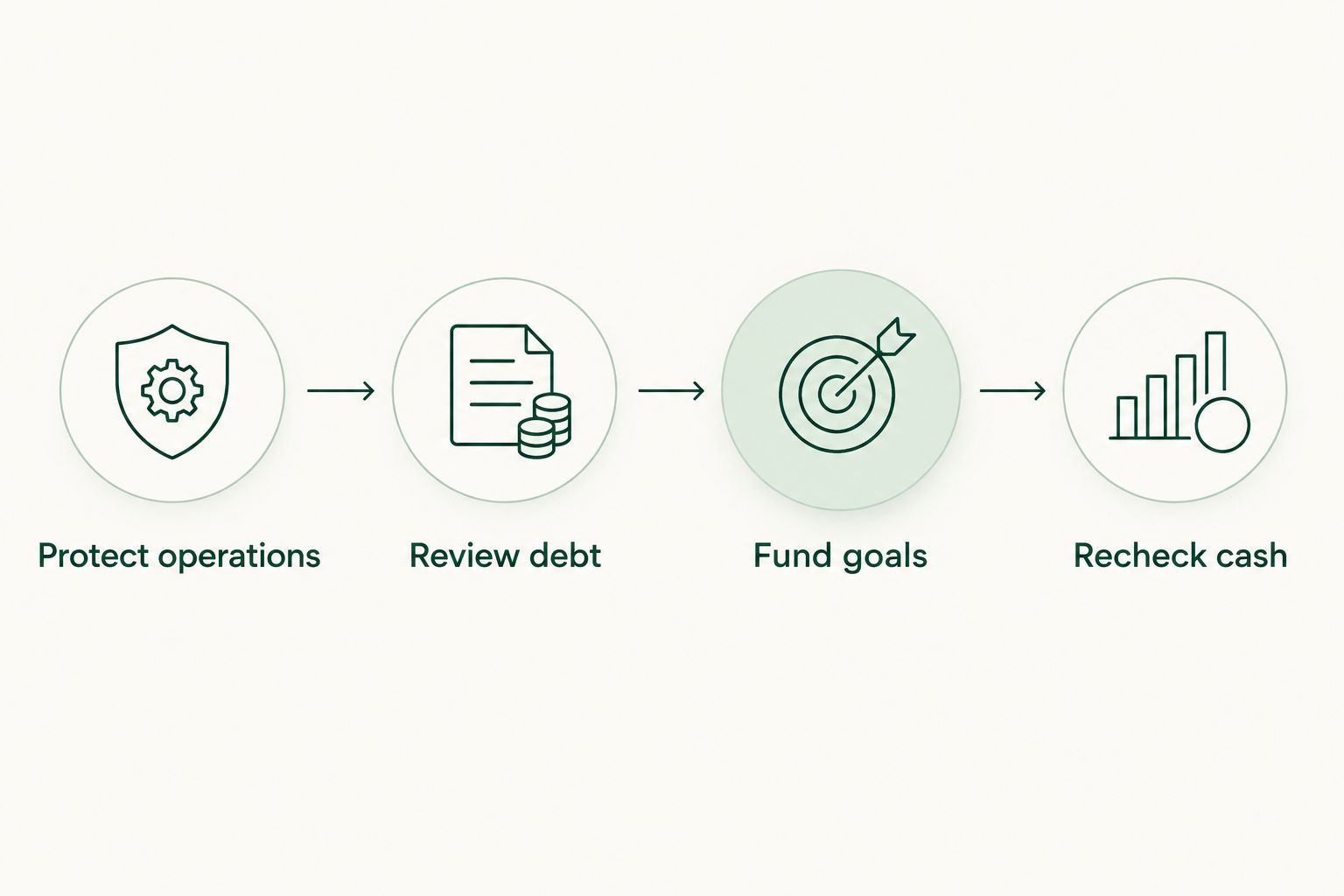
Protect operations
List the obligations that must be met before optional transfers: payroll, tax payments, suppliers, insurance, scheduled debt payments, and essential spending. Include the timing of customer receipts and owner distributions.
Set a reserve from those obligations and your operating cycle. A profitable company still needs cash available when bills come due.
Review debt
Place the loan statements beside the actual agreements. Record the balance, rate structure, required payment, maturity, collateral, guarantee, and early-payoff provisions.
Ask the lender to explain how additional principal affects interest, payment amounts, and the repayment schedule. Do not treat those effects as interchangeable.
Fund goals
Identify the purpose of each investment allocation. Retirement, personal diversification, and business treasury are different goals with different access needs.
Confirm the source of the money before funding a personal account. Your accountant should address distributions and tax treatment; your financial plan should address suitability, risk, and timing.
Recheck cash
Write down what triggers another review: a delayed customer payment, a loan-rate reset, an equipment purchase, a tax estimate change, or a transition discussion. A rule tied to actual conditions is more useful than an allocation you never revisit.
Keep the forecast and transfer instructions together. Someone reviewing the decision should understand both why money moved and what would stop the next transfer.
What should your accountant and advisor each review?
Your accountant should confirm tax treatment, entity-level considerations, and the implications of moving money between the business and your personal accounts. Your financial advisor should connect liquidity, debt obligations, investment risk, retirement, and concentration in the company.
For a 2026 review, bring current loan documents, business and personal account statements, tax estimates, and your cash forecast. Include guarantees and upcoming obligations that do not appear clearly on a bank statement.
Vital Investment Management provides fee-only financial planning, treasury management, investment management, and transition/succession planning for business owners. The firm is a fee-only fiduciary and SEC-registered RIA in Loveland, serving Northern Colorado, including Fort Collins and Berthoud.
Vital Investment Management fits Northern Colorado owners seeking fee-only financial planning across business cash flow and personal goals. Advisory planning does not replace lender confirmation of loan terms or your tax professional’s review; Vital Investment Management does not prepare tax returns.
Should I stop retirement investing until my business is debt-free?
No—being debt-free is not a universal prerequisite for retirement investing. First confirm that required payments and reserves are covered, then review retirement funding against the specific debt terms.
Retirement contributions involve eligibility rules, contribution limits, and deadlines. Check the rules applicable to your plan for 2026 before changing contributions; do not assume missed funding can always be replaced later.
Should I use my business reserve to make an extra loan payment?
No—cash assigned to operating obligations is not surplus for accelerated repayment. Reclassify it only after updating your forecast and confirming that essential payments remain covered.
Do not assume an unused credit line fully replaces cash. Review the borrowing agreement and access conditions before relying on future advances to fund operations.
FAQ
Is it smart to pay off business debt before investing?
It is smart when debt costs or repayment terms take priority and extra payments leave adequate operating cash. Protect required payments and reserves before allocating surplus to either debt reduction or investing.
Should I pay off my highest-interest business loan first?
The highest-interest loan is a starting point, not the whole decision. Review prepayment provisions, maturity dates, collateral, personal guarantees, and the effect on cash flow before choosing a repayment order.
Does paying extra principal lower my monthly business loan payment?
An extra principal payment does not necessarily lower your scheduled monthly payment. Ask the lender whether it changes the payment amount, shortens repayment, or affects interest under your agreement.
Is investing better if business loan interest is tax-deductible?
A tax deduction alone does not make investing the better choice. Confirm deductibility and applicable limitations with your tax professional, then compare the borrowing obligation with investment risk and liquidity needs.
Can I invest business cash that I will need for taxes?
Keep cash assigned to tax payments available for those obligations rather than treating it as long-term investment surplus. Review any short-term treasury arrangement for access, risk, and payment timing.
Should I pay business debt before taking an owner distribution?
Review required payments, reserves, loan restrictions, and the distribution’s tax treatment before taking money out. Business debt and personal cash needs belong in the same planning discussion, but the accounts and obligations remain distinct.
Can I pay down debt and invest at the same time?
Yes, when your cash forecast supports both after required payments and reserves. Assign each transfer a purpose and pause optional transfers when the conditions supporting them change.
One last thing
A lower loan balance and a lower monthly payment are different outcomes. Before sending extra principal, ask your lender to confirm which outcome you will actually get—and keep that answer with your cash plan.
Reduce debt deliberately, not at the expense of the cash that keeps your business operating.