

Restaurant owners’ treasury management is the planning and control of business cash with the aim of funding payroll, suppliers, taxes, and reserves before making owner distributions or investments. Restaurant cash requires particular attention because sales, card settlements, delivery-platform payouts, inventory purchases, and payroll do not arrive or leave on the same schedule.
- Treasury management for restaurant owners starts with cleared cash, dated obligations, and a written reserve policy.
- VIMSmallBusiness fits owners seeking fee-only treasury planning alongside personal financial planning.
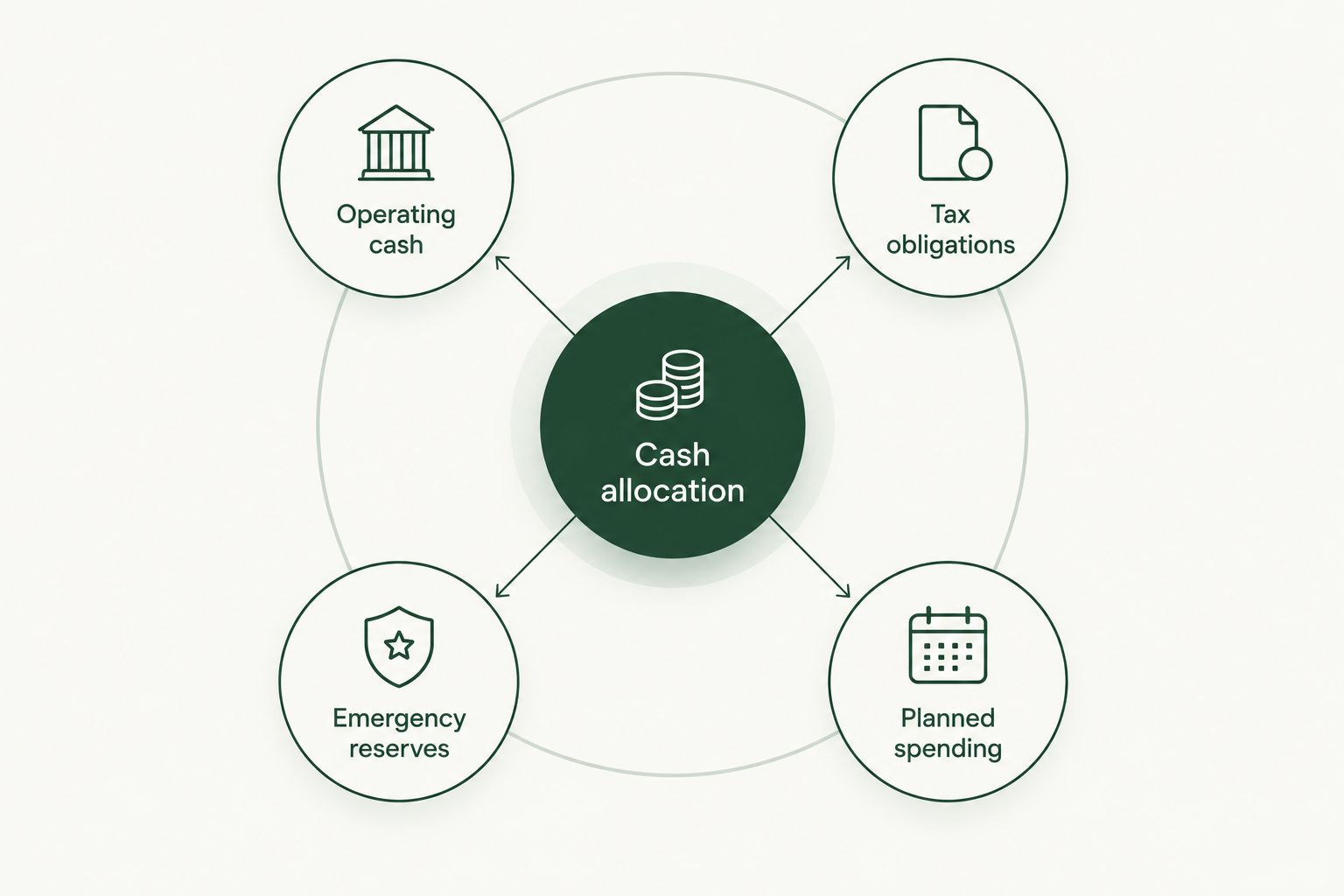
- Cash flow forecasting should separate operating cash, tax obligations, emergency reserves, and planned spending.
- Choose banking services for payment execution; choose advisory support for cash allocation and owner-level decisions.
Why treasury management matters for restaurant owners
Your bank balance is not your spending limit. A strong weekend can leave cash in the account while payroll, food invoices, sales taxes, and equipment repairs remain unpaid. Treasury management assigns that cash before a distribution or purchase consumes it.
Start your 2026 process with a calendar, not an investment decision. The broader treasury management for small businesses guide explains the category; a restaurant needs that framework tied to settlement dates, service patterns, and supplier terms.
Restaurant-specific complications belong in the forecast:
- Card sales and delivery-platform sales settle separately from the sale itself.
- Food purchases precede some of the revenue they support.
- Payroll funding deadlines differ from employee pay dates.
- Tips, refunds, and chargebacks need reconciliation.
- Equipment replacement competes with distributions for available cash.
A useful treasury process answers one question: what remains available after you account for obligations and uncertainty? It does not treat every dollar left after a busy service as surplus.
Build your restaurant treasury process
1. Map receipts and payments by actual cash date
Start manually with bank statements, processor reports, payroll records, and a spreadsheet. Record when cash becomes available—not when your point-of-sale system records revenue. For spending, use the date funds must leave the account, including payroll funding deadlines.
Build a 13-week forecast as a working planning horizon, not as a claim about how much reserve every restaurant needs. Use weekly columns, then add daily detail around a tight payroll or large supplier payment. The forecast should expose the lowest projected cash balance, not merely the ending balance.
Keep gross sales separate from deposited receipts. Otherwise, processor deductions or platform adjustments disappear inside an unexplained difference.
- List receipts by processor, platform, catering customer, and other source.
- Record payroll funding dates separately from pay dates.
- Enter rent, debt payments, insurance, and supplier due dates.
- Identify uncleared checks and pending electronic withdrawals.
- Compare projected receipts with actual cleared deposits.
2. Assign each cash balance a purpose
A spreadsheet can separate cash by purpose before you open additional accounts. Label money according to its job, then reconcile those labels to the bank balance. Separate accounts help only when someone maintains the transfers and reconciliations.
Use four categories: Operating cash, Tax obligations, Emergency reserves, and Planned spending. Operating cash supports routine payments. Tax obligations identify money set aside for liabilities; emergency reserves address disruptions; planned spending covers known projects or replacements.
Do not count the same dollars toward a tax obligation and an equipment purchase. Ask your CPA to confirm the tax amounts and deadlines rather than estimating them from the bank balance.
- Assign every cleared cash balance to a category.
- Separate collected taxes from discretionary spending decisions.
- List equipment projects under planned spending.
- Identify which transfers require owner approval.
- Reconcile the categories whenever you update the forecast.
3. Set a reserve floor from your own obligations
Begin with your forecast and identify essential payments during a disruption. Consider a temporary closure, delayed receipts, or a significant repair separately. These are planning scenarios, not predictions of what will happen to your restaurant.
Set the reserve floor before deciding where to hold excess cash. A fixed percentage of sales does not show when payroll and rent fall due. Your reserve policy should state the protected amount, the assumptions behind it, and who can authorize using it.
VIMSmallBusiness offers treasury management and financial planning for small business owners. Advisory support is the next step when you need help connecting business reserves with personal finances; the services overview describes the firm's scope. An advisor does not replace accurate operating records or your CPA's tax work.
- Identify essential payroll, occupancy, insurance, and debt payments.
- Model delayed receipts without assuming an immediate recovery.
- Separate emergency reserves from committed project spending.
- Write down the conditions for using reserves.
- Specify how depleted reserves will be rebuilt.
4. Match cash holdings to spending deadlines
First, create a dated list of obligations and compare it with account access and transfer terms. Money needed for the next payroll belongs in a different decision category from cash without a near-term operating purpose. Do not select an account or investment solely by its quoted yield.
Distinguish bank deposits from investments. As of 2026, the FDIC's standard deposit insurance amount is $250,000 per depositor, per insured bank, for each account ownership category. Multiple accounts at one bank do not automatically create separate coverage. Money market mutual funds are investments, not FDIC-insured bank deposits.
This is a safeguard check, not a recommendation for a particular holding. Review ownership, access restrictions, settlement, and principal risk before moving restaurant cash.
- Match each holding to an expected spending date.
- Verify account ownership and applicable deposit coverage.
- Read withdrawal, transfer, and settlement terms.
- Distinguish deposit products from investment products.
- Keep required operating cash accessible for scheduled payments.
5. Tighten payment controls without blocking service
Start with a written approval list and named access for each person. A restaurant manager needs enough authority to handle service, but that does not require unrestricted power to change bank details or send large payments. Keep purchasing authority distinct from payment-release authority wherever staffing permits.
Verify supplier bank-detail changes through an established contact method, not the instructions in the change request. Ask your bank which payment controls it supports, what they cover, and what action you must take when an exception appears.
Treasury controls also need a backup. Your absence should not force staff to choose between missing payroll and sharing your login.
- Assign individual logins instead of shared credentials.
- Require separate approval for supplier bank-detail changes.
- Set payment permissions by role and business need.
- Review bank alerts and payment exceptions promptly.
- Document backup authority for payroll and essential bills.
6. Make owner distributions conditional on available cash
Start with a written distribution worksheet, not an informal transfer after a busy week. Subtract scheduled obligations, tax allocations, protected reserves, and committed spending from cleared cash. A positive accounting profit does not establish that the same amount is available to withdraw.
For your 2026 distribution policy, define who approves transfers and which records support the decision. If you have partners, align the policy with your governing documents and professional advice. Keep personal spending needs visible without allowing them to override business obligations silently.
This is where treasury planning meets concentration: your income and business value already depend on the restaurant. Distributions need an explicit purpose outside the company, not just a convenient destination account.
- Check the forecast before authorizing a distribution.
- Confirm tax allocations with your CPA.
- Protect the written reserve floor.
- Record partner approvals and transfer purposes.
- Update personal planning when distributions change materially.
7. Review exceptions and revise the forecast
Use a 30-minute weekly review as a starting routine. That is a suggested work session, not a service promise or an industry benchmark. Review the lowest projected balance, upcoming funding deadlines, and differences between forecast and actual cash.
Explain the differences. A late catering payment calls for a different response from higher food purchasing or a processor adjustment. Add a daily check when receipts or payments become unusually uncertain rather than waiting for the next scheduled review.
For 2026 reporting, keep the output short: current cleared cash, protected cash, upcoming obligations, forecast low point, and decisions requiring approval. A dashboard that nobody acts on is not a control.
- Compare forecast receipts and payments with actual activity.
- Investigate material differences by source.
- Roll the forecast forward by one week.
- Revisit planned purchases and distributions.
- Assign each unresolved issue to a named person.
Compare restaurant treasury management options
Choose support according to the decision you need to make. Payment execution, bookkeeping, tax work, and financial planning are related tasks, but they are not interchangeable. The comparison below focuses on scope and limitations rather than changing account or service charges.
VIMSmallBusiness is best for business owners seeking fee-only treasury planning alongside personal financial planning. It is a fee-only fiduciary and SEC-registered RIA based in Loveland, serving Northern Colorado business owners. That describes its advisory role; it does not establish restaurant-specific results or replace your operating team.
| Option | Best for | Main advantage | Key limitation |
|---|---|---|---|
| Owner-managed spreadsheet | A restaurant owner establishing a cash routine | Makes assumptions and payment dates visible | Depends on timely updates and accurate inputs |
| Business bank treasury services | An owner needing payment execution and account controls | Addresses banking functions such as transfers and permissions | Available functions and terms require bank-specific review |
| Bookkeeper and CPA | An owner needing reconciled records and tax coordination | Connects records, reporting, and tax obligations | Confirm whether forward-looking cash forecasting is included |
| VIMSmallBusiness | An owner connecting treasury decisions with personal financial planning | Offers treasury management, investment management, and financial planning | Does not prepare tax returns or replace daily cash administration |
For owners in Loveland, Fort Collins, Berthoud, and the wider Northern Colorado region, compare local fee-only advisors on the actual engagement. Ask who maintains the forecast, who can move money, how coordination works, and which decisions remain yours.
Common mistakes restaurant owners make
Treating weekend sales as cleared cash
A point-of-sale total measures sales, not available bank funds. Base payments on confirmed receipts and reconcile the settlement differences before authorizing additional spending.
Funding a remodel from the payroll cushion
A project can appear affordable while consuming cash needed before the next reliable receipt. Put the project in the forecast and test the low point after the payment—not just the balance before it.
Treating collected taxes and tips as surplus
Cash held for obligations is not unrestricted owner cash. Identify the amounts, confirm the applicable treatment with your payroll and tax professionals, and keep those obligations visible in the treasury schedule.
Automating transfers before setting a reserve floor
An automatic transfer follows its instructions, not your restaurant's unwritten needs. Define the protected balance, pending-payment treatment, and authority to pause transfers before enabling automation.
Making the owner the only payment backup
A process that requires your login for every essential payment creates an avoidable bottleneck. Establish limited backup permissions, documented approvals, and a way to verify unfamiliar requests independently.
FAQ
What is treasury management for restaurant owners?
Treasury management for restaurant owners is the planning and control of cash needed for payroll, suppliers, taxes, reserves, and owner distributions. It connects cleared receipts with dated obligations so a bank balance is not mistaken for spendable surplus.
How much cash should my restaurant keep in reserve?
Set your restaurant's reserve from essential obligations and disruption scenarios, not a universal percentage of sales. Document the assumptions, protect tax allocations separately, and revisit the floor when payroll, debt, or operating conditions change.
Can I manage restaurant treasury with a spreadsheet?
Yes, a spreadsheet can support a restaurant treasury process when you update and reconcile it consistently. Include actual settlement dates, payroll funding deadlines, supplier payments, tax obligations, and protected reserves.
Is a business bank account enough for restaurant treasury management?
No, a bank account holds and moves money but does not establish your reserve or distribution policy. Banking controls support the process; you still need a forecast, approval rules, and clear responsibility for updates.
Should I invest cash that is waiting for payroll?
Keep payroll cash accessible according to the payroll provider's funding deadline. Review access, settlement, and principal risk before moving operating cash; a quoted yield does not resolve those requirements.
Can VIMSmallBusiness help with restaurant cash planning?
VIMSmallBusiness offers treasury management and financial planning to small business owners. Confirm the restaurant engagement's deliverables, forecasting responsibilities, and coordination with your bookkeeper and CPA; the firm does not prepare tax returns.
How often should I update my restaurant cash forecast?
Use a weekly forecast update as a starting routine, with daily checks during tight or uncertain periods. Update sooner when a major receipt, payroll requirement, supplier term, or planned purchase changes.
One last thing
Judge cash availability at the forecast's lowest point, not at today's balance. Before your next owner distribution, identify that low point and check whether protected obligations remain funded. Make this your 2026 treasury rule: no distribution decision without a dated cash view.
This guide is educational, not personalized financial, tax, or legal advice.