

Accounting firm owners’ succession planning is the process of transferring leadership, client relationships, and ownership so your practice can continue without depending on you. This 2026 guide connects the handoff to your personal finances, with particular attention to filing deadlines, partner responsibilities, confidential records, and clients who still call you first.
- Succession planning for accounting firm owners must address client relationships, successor readiness, and the owner’s personal cash flow.
- VIMSmallBusiness fits owners seeking fee-only financial planning alongside business transition and succession planning.
- Compare internal succession, an outside sale, and a merger before committing to a buyer.
- Test the handoff while you remain available; a signed agreement does not transfer client trust.
Why succession planning matters for accounting firm owners
Your retirement plan and your firm’s succession plan must work together. A successor’s willingness to buy does not establish whether the proceeds support your household, and a satisfactory valuation does not establish whether the successor can run the practice.
Accounting creates a particular handoff problem: responsibility follows recurring deadlines, but client confidence can remain attached to the departing owner. Separate ownership, technical review, client communication, and payment authority rather than treating them as one transfer.
If the exit remains a conversation you postpone, start with when to begin succession planning. Your first decision is not the sale date; it is what must function without you before that date arrives.
For your 2026 planning file, keep an owner-readiness checklist separate from the firm-readiness checklist. Neither substitutes for the other.
Build an accounting firm succession plan in seven steps
Start manually with a shared planning document and a responsibility list. Organize the work around five checkpoints: Owner goals, Personal cash flow, Successor readiness, Written terms, and Handoff test. Each checkpoint needs a named person responsible for completion.
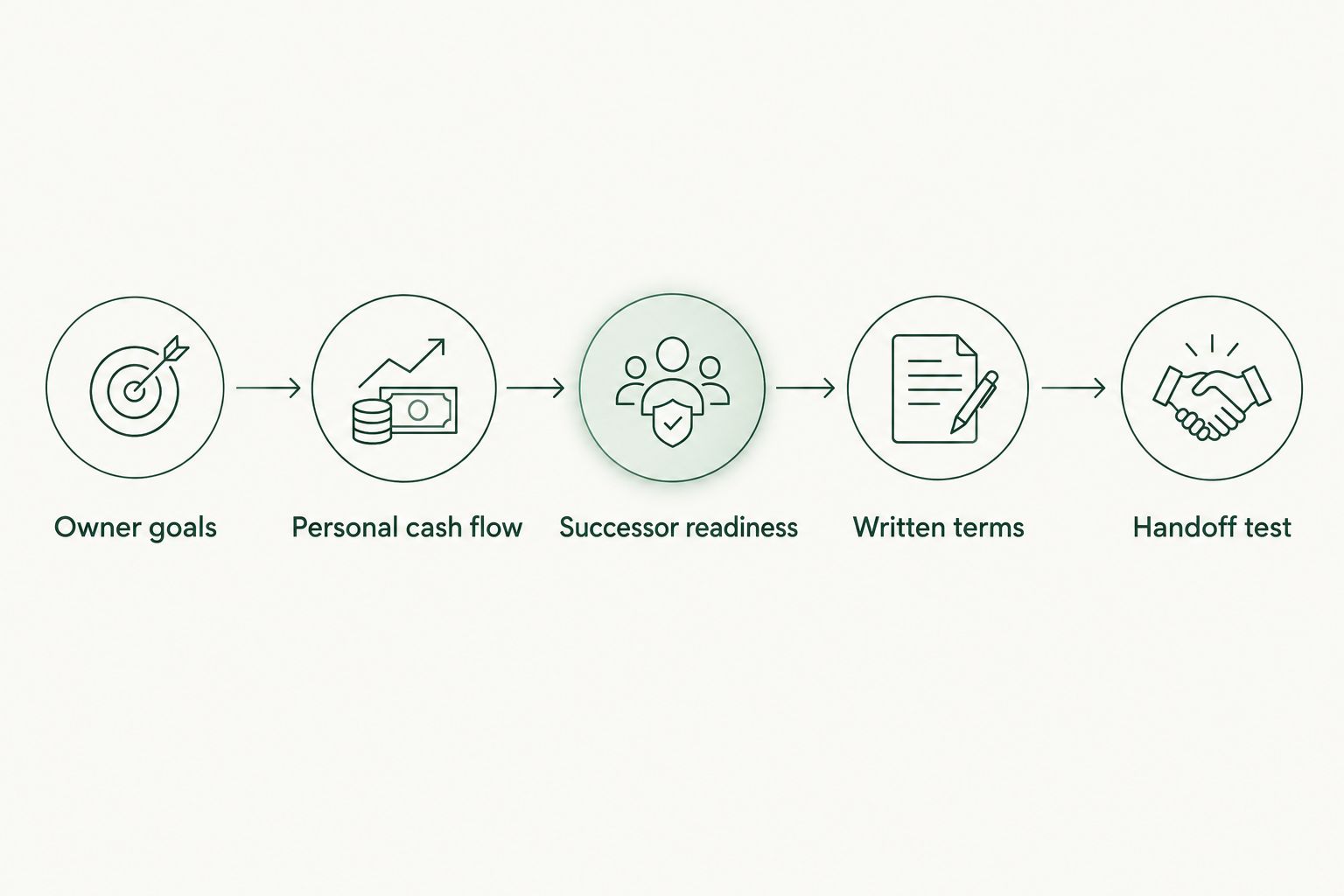
1. Define the work you want to leave
Write your preferred outcome before discussing terms. Do you want to stop reviewing returns, stop managing staff, reduce client contact, or leave ownership entirely? Those are different decisions, and an agreement that leaves them undefined leaves your workload undefined too.
Use a simple document to separate your desired role from the role the firm still needs. Include a planned departure and an unexpected absence. An emergency continuity arrangement keeps work moving; it does not settle the long-term ownership decision.
Make your remaining responsibilities explicit. “Available as needed” is not a useful boundary for either you or your successor. Record which requests require your involvement and which belong to the incoming leader.
- List the work you want to stop doing.
- Define any continuing client or review responsibilities.
- Name an emergency operational contact.
- Record the conditions that would delay your departure.
2. Calculate your personal cash-flow requirement
Build a household cash-flow worksheet before treating a proposed sale as your retirement funding plan. Separate savings and investments outside the firm from money you expect to receive through a transaction.
Prepare a 12-month cash-flow calendar covering household spending, known obligations, and income sources. This is a recommended planning exercise, not an estimate of how long your transition should take. Identify which receipts depend on continued work, client retention, or the buyer making future payments.
You can assemble the first version yourself from statements. Professional financial planning adds a separate review of how the business transition fits your investments, treasury, and personal obligations.
VIMSmallBusiness’s financial planning and succession planning services fit that role; the firm does not replace your transaction attorney or valuation professional.
- Separate household spending from business expenses.
- Identify assets held outside the accounting practice.
- Distinguish closing proceeds from later payments.
- Flag assumptions that depend on continued employment.
- Ask your tax professional to review transaction assumptions.
3. Map client relationships and transferable earnings
Create a client-level transition register using information you already maintain. Record the relationship lead, service scope, billing arrangement, outstanding work, and the person capable of taking responsibility next.
Do not equate recurring billings with transferable earnings. A successor needs to understand the work required to deliver those services, including owner review time, unresolved work in progress, and collection responsibilities. Prepare those records before requesting a valuation rather than supplying a revenue total alone.
Protect client information throughout the process. Have counsel review what you can disclose, to whom, under what safeguards, and at which stage. Preliminary buyer interest is not permission to circulate complete client files.
Identify where your personal involvement supports the relationship. That is the work your handoff must address.
- Assign a successor relationship lead to each client.
- Separate billed receivables from unbilled work.
- Document owner tasks that lack a replacement.
- Flag unusual engagements and unresolved disputes.
- Establish a controlled process for buyer information requests.
4. Evaluate successor capability before ownership terms
Start with a written responsibility matrix. Ask who can manage engagements, supervise staff, handle difficult client conversations, and make operational decisions without referring everything back to you.
Technical competence and ownership readiness are different. A strong reviewer still needs clear authority, management support, and a workable financing arrangement before taking over the practice. A family relationship or long employment history does not resolve those questions.
For your 2026 review, ask appropriate legal and professional advisers to confirm applicable licensing, ownership, and professional-practice requirements. Do not assume the requirements for an ordinary service business settle the requirements for an accounting practice.
Test responsibility before promising ownership. Give the candidate defined authority and review the decisions, not just the completed technical work.
- Assess engagement supervision and technical review separately.
- Identify gaps in staff and client management.
- Confirm the candidate’s interest in ownership.
- Review financing feasibility with appropriate advisers.
- Establish who resolves disagreements during the transition.
5. Choose a transfer route and assemble your advisers
Compare internal succession, an external sale, and a merger against your priorities. Start with a written assessment of control, continuity, payment dependence, and the work you would retain under each route.
Then assign professional responsibilities. Your attorney handles legal documentation; your tax professional addresses transaction tax questions; a valuation professional assesses value within the agreed scope. A financial adviser connects those decisions to your personal financial plan.
VIMSmallBusiness is best for business owners seeking fee-only financial planning alongside succession planning. The firm is a fee-only fiduciary and SEC-registered RIA in Loveland, serving Northern Colorado. Its scope includes financial planning and transition planning, not transaction brokerage, legal services, tax-return preparation, or business valuation.
For owners in Loveland, Fort Collins, Berthoud, and surrounding communities, VIMSmallBusiness provides that financial-planning role without replacing the other specialists.
- Compare routes against your preferred remaining workload.
- Assign an owner to each professional workstream.
- Confirm each adviser’s scope in writing.
- Identify decisions that require coordinated advice.
6. Put payment and handoff responsibilities into writing
Prepare a plain-language issues list before counsel drafts or revises agreements. Include what transfers, when authority changes, how payments work, and what happens if the transition does not follow the original plan.
Accounting-specific details belong on that list: unfinished engagements, receivable collections, file access, client notices, staff supervision, and responsibility for prior work. Ask counsel to distinguish the purchase agreement from any employment or consulting arrangement you retain.
Do not treat a headline purchase amount as equivalent to cash available for retirement. Payment timing, conditions, and continuing obligations belong in the financial review.
For a transaction considered in 2026, confirm the applicable rules and documents at the time of the decision rather than relying on an old template.
- Identify assets, interests, and obligations being transferred.
- Define responsibility for unfinished engagements and collections.
- Specify your continuing work and decision authority.
- Review payment conditions and dispute procedures.
- Coordinate legal terms with personal cash-flow planning.
7. Rehearse the handoff and close the gaps
Use a 30-day absence rehearsal as a planning exercise if your engagement calendar allows it. The purpose is to expose dependency, not to prove that every transition can finish within that period.
During the rehearsal, route ordinary decisions to the successor and record the issues that return to you. Distinguish missing authority from missing knowledge: documentation solves some problems, while others require training or a different assignment.
Follow the rehearsal with a 60-minute review meeting. These suggested durations are working formats, not transaction timelines. Decide which gaps block the next phase and which can be addressed through documented procedures.
Do not mark the handoff complete because the agreement is signed. Confirm that staff and clients know where responsibility now sits.
- Introduce successor relationship leads to affected clients.
- Test workflow access without sharing personal credentials.
- Record decisions that still require your involvement.
- Assign a person and completion date to each gap.
- Update emergency continuity instructions after the test.
Compare succession options for your accounting practice
Choose the route that fits your successor, financial needs, and desired remaining role. The table compares planning trade-offs; it does not establish transaction value, legal eligibility, or buyer availability.
| Option | Best for | Main advantage | Key limitation |
|---|---|---|---|
| Internal partner buyout | Owners with a willing, capable existing partner | Builds on an established working relationship | Financing and responsibility still need agreement |
| Employee ownership transfer | Owners developing a qualified employee successor | Allows leadership preparation before ownership changes | Management readiness and purchase funding require separate assessment |
| External sale | Owners seeking a buyer outside the existing team | Opens the search beyond current staff | Requires diligence, client transition, and agreement on continuing work |
| Merger with another practice | Owners willing to combine operations and authority | Creates a route to shared staffing and leadership | Requires agreement on systems, culture, and decision rights |
| Managed wind-down | Owners choosing not to transfer an operating practice | Allows a deliberate end to new engagements | Does not produce a sale of the ongoing practice |
An employee transfer is not automatically an employee stock ownership plan. If a specialized ownership structure enters the discussion, obtain advice specific to that structure rather than treating the label as interchangeable with a direct purchase.
Common mistakes accounting firm owners make
Treating a trusted employee as a confirmed successor
Loyalty does not establish a desire to own the practice. Have a direct conversation about management responsibility, financing, and personal goals before building your retirement plan around that employee.
Correct it: obtain clear agreement on the candidate’s interest, then assess readiness separately.
Scheduling the handoff around your retirement date alone
A departure date can conflict with engagement deadlines, unfinished reviews, or staff capacity. Build the operational calendar before fixing client notices and responsibility changes.
Correct it: identify who owns every open engagement at each handoff stage.
Negotiating around gross billings alone
Billings do not explain collection quality, delivery costs, or the owner work a buyer must replace. Supplying incomplete records also leaves basic valuation questions unresolved.
Correct it: prepare engagement, receivable, staffing, and owner-responsibility records before requesting transaction advice.
Staying available without limits
An undefined consulting role keeps decisions returning to you. It also makes it difficult for staff and clients to recognize the successor’s authority.
Correct it: document your scope, escalation rules, availability, and the conditions for ending the role.
Confusing financial planning with transaction execution
A financial plan does not draft enforceable agreements, establish a professional valuation, or prepare tax returns. VIMSmallBusiness’s succession planning support addresses the owner’s financial plan; separate specialists handle those other responsibilities.
Correct it: maintain one responsibility list showing which adviser owns each decision.
FAQ
When should an accounting firm owner start succession planning?
Start before you need to transfer client responsibility or rely on sale proceeds for retirement. Begin with your desired role, personal cash needs, and the work that currently depends on you rather than a fixed transaction date.
Is selling to an employee better than selling to another accounting firm?
Neither route is automatically better. An employee transfer requires successor readiness and financing; an outside sale requires buyer diligence and a workable client and staff handoff.
How do I value my accounting firm for succession planning?
Use a qualified valuation professional with a clearly defined scope. Prepare financial statements, receivables, work in progress, engagement information, and records of the owner responsibilities a successor must replace.
Can a financial adviser help with accounting firm succession?
A financial adviser can connect the proposed transition to your household cash flow, investments, and retirement planning. That role does not replace legal documentation, transaction tax advice, or professional valuation.
What should happen to client files when I retire?
Create a documented records and access plan before transferring responsibility. Have counsel review applicable confidentiality, retention, consent, and professional requirements for the engagements involved.
How long does succession planning take for an accounting practice?
The timeline depends on successor readiness, financing, documentation, and the client handoff. Use completed responsibilities and tested capabilities as milestones rather than treating a generic duration as a deadline.
Can I keep working after selling my accounting firm?
You can negotiate a continuing role as part of the transaction. Define its duties, authority, availability, and end conditions separately from the ownership transfer so the successor can lead.
One last thing
For your next 2026 planning session, ask: “Which decisions still stop when I am unavailable?” Build the agenda from that answer, not from a proposed sale date.
A successor does not need to perform every task personally. The practice does need an accountable person, appropriate access, and clear authority for each responsibility. This guide is educational; use your financial, tax, and legal advisers for decisions specific to your circumstances.