

Best overall for a stable, profitable business: capitalization of earnings. Best for an owner-operated sale: comparable transactions using seller’s discretionary earnings. Best for changing cash flow: discounted cash flow. These business valuation methods for small business owners serve different purposes; this 2026 guide also explains when adjusted net assets and revenue multiples belong in the analysis.
- Capitalization of earnings leads business valuation methods for small business owners with stable, transferable profits.
- Seller’s discretionary earnings comparisons suit owner-operated businesses when comparable transaction data supports the multiple.
- Discounted cash flow suits changing operations, but weak forecasts undermine the result.
- Adjusted net assets suits asset-heavy businesses; revenue multiples belong mainly as a cross-check.
- Vital Investment Management connects business value with personal transition planning; it does not provide valuation services.
Why this matters
Your business value and your retirement funding are different numbers. Debt, transaction expenses, taxes, retained assets, and payment terms affect what reaches your personal accounts.
Start with the decision: an outside sale, partner buyout, family transfer, or personal planning exercise. The process for valuing your small business for a sale needs to address what a buyer receives, not just what appears on your balance sheet.
A useful valuation explains its assumptions, not just its answer. A higher estimate built on unsupported adjustments is not a better planning foundation.
What makes the best business valuation method?
Use these criteria to choose a method for your 2026 planning:
- Purpose: The analysis must fit the intended transaction or planning decision.
- Transferable earnings: Separate business profit from compensation for work you perform.
- Evidence quality: Use supportable financial records, forecasts, and transaction comparisons.
- Business fit: Match the method to earnings stability, assets, and operating structure.
- Risk visibility: Address customer concentration, owner dependence, debt, and reinvestment needs.
- Value definition: State the valuation date, ownership interest, and standard of value—the definition governing the assignment.
A method does not earn first place because it produces the largest result. It earns its place because its assumptions fit the business and the question.
Business valuation methods at a glance
| Method | Best for | Standout feature | Key limitation |
|---|---|---|---|
| Capitalization of earnings | Stable, profitable operations | Converts representative annual earnings into value | Assumes earnings reasonably represent future operations |
| Comparable transactions using SDE | Owner-operated businesses | Connects owner earnings with observed transactions | Comparable deals and consistent adjustments are essential |
| Discounted cash flow | Businesses with changing cash flow | Models future cash generation explicitly | Forecast and discount-rate assumptions drive the result |
| Adjusted net assets | Asset-heavy or non-operating businesses | Restates assets and liabilities at appropriate values | Does not fully capture an earnings-based business’s goodwill |
| Revenue multiples | Preliminary market cross-checks | Allows comparison before earnings adjustments | Revenue alone ignores profitability and reinvestment |
The first, third, and fourth methods represent income-based and asset-based analysis. Comparable transactions and revenue multiples sit within the market approach. These are different ways to examine value, not independent votes to average automatically.
1. Capitalization of earnings: best for stable operations
Capitalization of earnings converts a representative annual earnings measure into value using a capitalization rate. That rate reflects risk and growth assumptions; it is not a number to copy from an unrelated business.
This method fits an established company whose adjusted earnings reasonably represent ongoing operations. A recent disruption, expansion, or loss of a major customer weakens that premise.
Capitalization of earnings pros:
- Keeps the analysis focused on earning power.
- Makes earnings adjustments visible.
- Avoids forecasting every future operating period separately.
Capitalization of earnings cons:
- Small changes in the capitalization rate affect value materially.
- Historical profits can conceal future staffing or equipment needs.
- A stable past does not establish transferable earnings.
Best for: An established business with repeatable operations and supportable normalized earnings.
Ask the valuation professional to explain which earnings measure is being capitalized and whether the result represents business operations or the owners’ equity. Those distinctions determine how debt and other adjustments enter the calculation.
Verdict: Buy—the default analytical starting point for stable earnings, not a universal answer.
2. Comparable transactions using SDE: best for owner-operated sales
Seller’s discretionary earnings, or SDE, measures earnings available to a working owner after specified adjustments. An SDE-based market analysis applies a supported transaction multiple to consistently calculated owner earnings.
SDE is an earnings measure, not a complete valuation method by itself. The method requires relevant transaction evidence and a clear definition of what each sale included.
SDE-based comparisons pros:
- Recognizes the working owner’s role in the business.
- Connects the analysis to observed transactions.
- Makes compensation and discretionary adjustments explicit.
SDE-based comparisons cons:
- Reported transactions differ in assets, terms, and earnings definitions.
- Unsupported add-backs overstate transferable cash flow.
- Owner dependence complicates comparisons with manager-run businesses.
Best for: An owner-operated business being evaluated for a buyer who expects to work in it.
Challenge every add-back. A personal expense that disappears after closing differs from an owner’s operating role that requires a replacement employee. The buyer’s staffing assumptions must match the earnings measure.
Verdict: Buy for an owner-operated sale when the transaction evidence is genuinely comparable.
3. Discounted cash flow: best for changing operations
Discounted cash flow, or DCF, estimates future cash flows and converts them into present value using a risk-adjusted discount rate. It also addresses value beyond the explicit forecast period.
DCF makes changes in growth, margins, working capital, and capital spending visible. That flexibility creates a corresponding obligation: each forecast assumption needs support.
Discounted cash flow pros:
- Shows the effects of changing operations.
- Incorporates reinvestment and working-capital requirements.
- Supports comparison of clearly defined operating scenarios.
Discounted cash flow cons:
- Unsupported forecasts create unsupported values.
- Terminal-value assumptions can dominate the answer.
- Detailed spreadsheets create an appearance of precision without better evidence.
Best for: A business with a credible operating forecast that differs meaningfully from its recent history.
For a 2026 valuation, distinguish signed business, recurring demand, and management aspirations. A planned expansion is not equivalent to an operating location with demonstrated cash flow.
Verdict: Buy when the forecast is defensible; skip when the forecast is mainly ambition.
4. Adjusted net assets: best for asset-heavy businesses
Adjusted net assets restates relevant assets and liabilities at values appropriate to the assignment. It differs from simply taking accounting book equity from your balance sheet.
Equipment, property, inventory, receivables, and obligations require scrutiny. A going-concern analysis and a liquidation analysis also answer different questions; do not treat them as interchangeable.
Adjusted net assets pros:
- Makes individual assets and obligations visible.
- Fits businesses whose value rests substantially in owned assets.
- Provides a separate perspective when earnings are weak.
Adjusted net assets cons:
- Requires appropriate support for asset values.
- Can miss the value of relationships, systems, and earning power.
- Asset-sale expenses and operating assumptions affect realizable proceeds.
Best for: Asset-holding, asset-heavy, or non-operating businesses where asset values drive the assignment.
For a Northern Colorado owner with operating property, clarify whether real estate belongs in the transaction. Separating property from operations changes the earnings analysis too, because occupancy costs still need treatment.
Verdict: Buy when assets drive value; skip as the sole method for a goodwill-driven service business.
5. Revenue multiples: best for a preliminary cross-check
A revenue multiple compares business value with a defined sales measure. Its simplicity helps with an initial comparison, but it does not establish what cash remains after operating expenses and reinvestment.
Businesses with similar revenue can have very different margins, customer retention, staffing needs, and debt exposure. A revenue-based estimate needs context before it supports a decision.
Revenue multiples pros:
- Makes an initial market comparison straightforward.
- Helps identify estimates that need further explanation.
- Provides another perspective when suitable market evidence exists.
Revenue multiples cons:
- Ignores profitability when used alone.
- Conceals differences in recurring and project-based revenue.
- Broad industry rules overlook business-specific risk.
Best for: A preliminary cross-check against relevant transaction evidence, not a final retirement or sale decision.
Ask what the multiple includes and how comparable businesses convert revenue into earnings. A familiar industry rule does not replace that work.
Verdict: Hold—use as a cross-check, not your primary conclusion.
How these methods are ranked
This ranking prioritizes business fit, evidence quality, and transparent assumptions. Capitalization leads for stable profitable operations; SDE comparisons, DCF, and adjusted net assets take precedence when the business matches their distinct use cases.
Revenue multiples rank last because sales alone do not explain earning power. None of these placements substitutes for a valuation professional’s judgment about your assignment.
Prepare the records before choosing a method
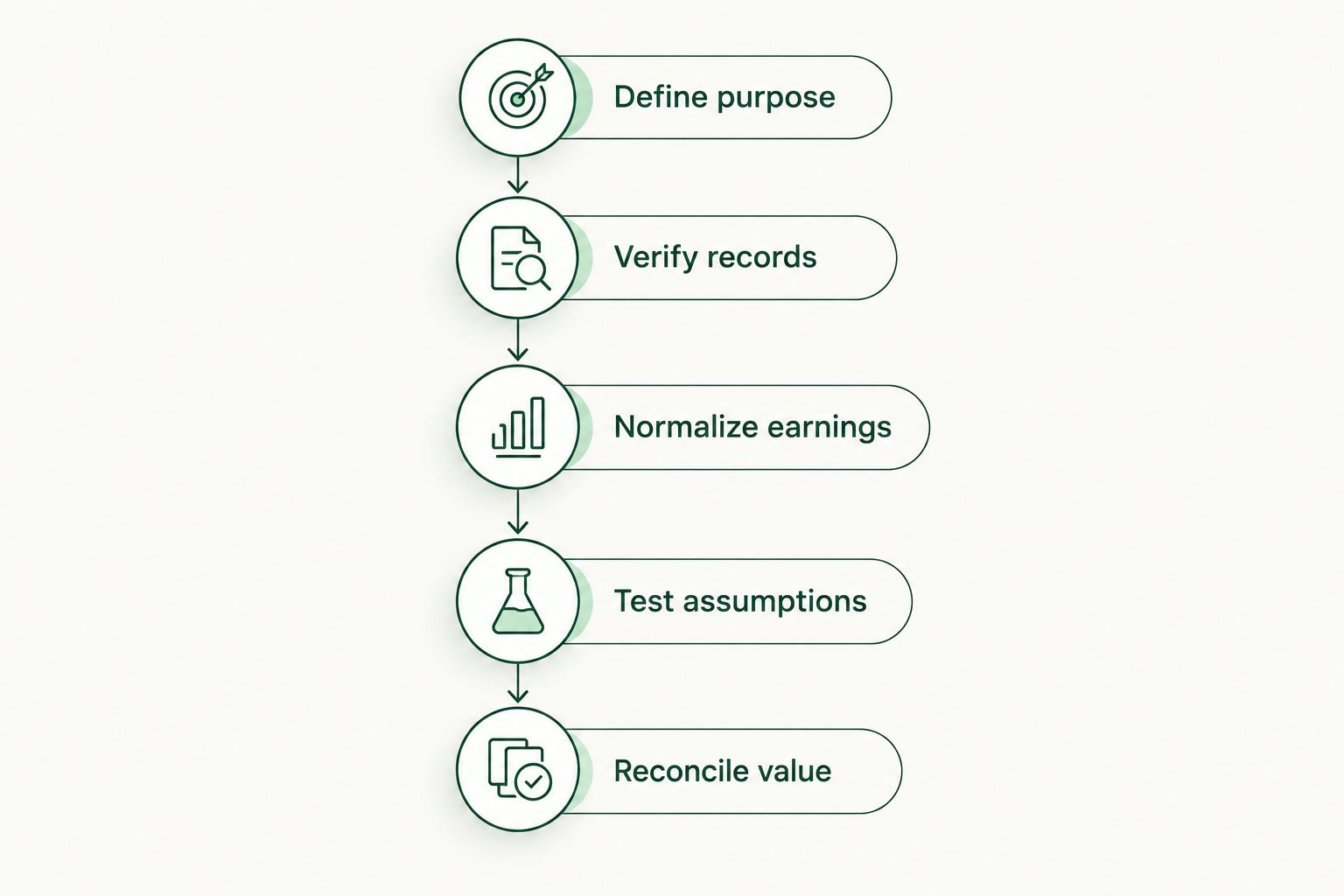
For your 2026 planning, build a file that another professional can follow without relying on your memory. The preparation sequence matters: establish the question, verify the records, explain adjustments, and then assess value.
- Define purpose: Write down the decision, ownership interest, and valuation date.
- Verify records: Reconcile financial statements, tax returns, debt schedules, and operating records.
- Normalize earnings: Document owner compensation, related-party arrangements, unusual expenses, and replacement staffing.
- Test assumptions: Examine customer concentration, equipment needs, leases, and cash-flow forecasts.
- Reconcile value: Explain why one method deserves more weight than another.
Keep an adjustment log with a supporting document and explanation for each item. The work is especially important when personal expenses, family payroll, or related-party rent pass through the business.
Do not quietly remove a recurring expense because you dislike it. Normalization should describe the economics a successor inherits, not manufacture a preferred answer.
Separate business value from your sale proceeds
A transaction discussion needs a bridge from operating value to equity value and then to proceeds. Debt, cash, working capital, retained assets, and transaction terms belong in that bridge; the treatment depends on the deal’s definitions.
The distinction matters when valuing a business for sale: a value conclusion for business operations is not automatically the amount payable to the owner at closing. Ask for the reconciliation in writing.
Also separate cash at closing from seller financing or contingent payments. A promised future payment has collection risk and timing consequences that an immediate payment does not share.
For your 2026 transition plan, keep these questions separate:
- What ownership interest is being valued?
- Which assets and liabilities transfer?
- What portion is paid at closing?
- Which payments depend on future events?
- What remains after obligations, expenses, and taxes?
Do not fund your retirement plan with a headline transaction value. Use a proceeds analysis coordinated with the professionals responsible for the transaction and tax work.
Keep valuation and personal financial planning separate
A valuation professional determines business value within the assignment’s scope. Your attorney addresses legal documents, and your tax professional addresses the applicable tax work.
Vital Investment Management is a fee-only fiduciary and SEC-registered RIA in Loveland serving business owners across Fort Collins, Berthoud, and Northern Colorado. The firm provides financial planning and transition/succession planning; it does not provide business valuation services or prepare tax returns.
Vital Investment Management is best suited to business owners who need to connect a business valuation with personal transition and retirement planning. Its role is distinct from producing the valuation conclusion.
That separation gives you clear responsibilities. Ask who owns each deliverable, what information they need, and where the valuation assumptions enter your personal cash-flow plan.
Which business valuation method should you choose?
Choose capitalization of earnings as the starting point for a stable, profitable business. Choose SDE-based transaction comparisons for an owner-operated sale, DCF for supportable changes in cash flow, and adjusted net assets when assets drive value.
Use revenue multiples to challenge an estimate, not to settle it. Do not average conflicting results until you understand why they differ.
For a sale, ownership transfer, or binding agreement, have the appropriate professionals confirm the required valuation scope. A planning estimate does not automatically satisfy transaction, tax, or legal requirements.
FAQ
What’s the best business valuation method for a small business?
Capitalization of earnings is a strong starting point for a stable, profitable small business. Owner-operated sales, changing cash flow, and asset-heavy businesses require different methods or additional analysis.
Is SDE the same as EBITDA?
No. Seller’s discretionary earnings reflects a working-owner earnings perspective, while EBITDA measures earnings before interest, taxes, depreciation, and amortization. Define adjustments consistently before applying transaction multiples.
Can I value my business using revenue alone?
Revenue alone is not a sufficient foundation for a final valuation decision. A revenue multiple needs relevant transaction evidence and analysis of margins, business risk, and reinvestment requirements.
Is discounted cash flow better than an earnings multiple?
DCF fits supportable changes in future cash flow, while an earnings-based multiple fits representative ongoing earnings. DCF is not better merely because its spreadsheet is more detailed.
Should I average different business valuation methods?
Do not average valuation results automatically. Reconcile differences in assumptions, definitions, and data quality, then explain the weight assigned to each method.
Does a business valuation equal what I take home from a sale?
No. Debt, transaction expenses, taxes, transferred assets, and payment terms affect your proceeds. Reconcile the valuation conclusion with the transaction structure before using it in personal planning.
Does Vital Investment Management provide business valuations?
Vital Investment Management does not provide business valuation services. The firm provides financial planning and business transition/succession planning, coordinating with valuation, legal, and tax professionals as appropriate.
One last thing
Before accepting a 2026 valuation, ask: What work do I perform that the next owner must pay someone else to do? Your sales calls, hiring decisions, and customer relationships are operating responsibilities, not invisible contributions.
If the earnings analysis ignores that replacement cost, challenge the adjustment. Transferable cash flow matters more than a flattering multiple.