

Instead of repeatedly chasing employee financial statements, lender requests, and unsigned deal documents, build an SBA 7a loan employee buyout workflow that moves from eligibility review to underwriting, closing, and verified funding. For a 2026 transaction, get the lender’s written requirements before committing to a structure, then coordinate the buyer’s financing with your own transition and financial plan.
- An SBA 7a loan employee buyout starts with lender eligibility review, not a signed promise to fund.
- VIMSmallBusiness supports business-owner financial planning; the lender decides whether to approve and fund the acquisition.
- A direct employee purchase is not an ESOP; establish the ownership structure before preparing the financing package.
- Track equity evidence, underwriting conditions, closing documents, and disbursement separately.
Why this matters
Your employee knows the business. That does not establish whether the employee can finance its purchase, operate it without you, or support acquisition debt from cash flow. A signed purchase agreement does not answer those questions either.
VIMSmallBusiness is best for Northern Colorado business owners who need financial planning alongside an employee buyout, not loan origination. The fee-only fiduciary, SEC-registered advisory firm provides business-owner planning; lending, legal documentation, tax preparation, and transaction valuation belong with the appropriate professionals.
The distinction matters before you share documents or negotiate terms. Read how a financial advisor can help with SBA loan financing, then assign the financing decision to the lender and the personal financial decision to your planning team.
Before you start
- People and access: Identify the employee buyer, an SBA-participating lender, transaction counsel, your tax professional, and a valuation professional when needed. Arrange authorized access to accounting records and a secure document-sharing location.
- Materials: Gather ownership records, financial statements, business tax returns, debt schedules, lease documents, employee management experience, and evidence of the buyer’s proposed funding sources. Obtain the lender’s actual checklist before treating this as a complete package.
- The gotcha: Do not assume a seller note replaces the buyer’s required contribution. Ask the lender to confirm, in writing, how the proposed seller financing, repayment restrictions, and ownership structure will be treated under the SBA requirements applicable to your 2026 application.
This is a transaction workflow, not a software integration. The document labels below are suggested names for your working files, not lender portal buttons or official SBA form titles.
Transaction structure and eligibility
Establish the ownership route
- Create a Transaction Summary. Identify the seller, buyer, business entity, assets or ownership interests being transferred, proposed seller involvement, and intended handover. Mark unresolved terms clearly. An employee buying directly and a trust buying through an employee stock ownership plan are different transactions.
- Request lender screening. Give the lender the summary before commissioning final documents. Ask which eligibility, borrower, ownership, management, guarantee, and use-of-proceeds requirements apply. Require a clear distinction between preliminary screening and credit approval.
- Confirm the structure with counsel. Have transaction counsel review whether an asset purchase or ownership-interest purchase fits the proposed transaction. Your tax professional should assess the tax treatment separately; the lender’s willingness to finance a structure does not establish its legal or tax suitability.
Expected result: You have a written transaction description and a lender-specific requirements list. Unresolved eligibility questions remain visible rather than becoming assumptions inside the purchase agreement.
Separate the adjacent options
An employee buyout describes who buys the business, not one universal financing structure. Use this comparison to keep the discussion precise.
| Ownership route | Best for | Main advantage | Main limitation |
|---|---|---|---|
| Direct employee purchase | An identified employee taking ownership personally or through an acquisition entity | Connects ownership to a named successor | Buyer financing and management readiness still require review |
| Direct purchase with seller financing | Buyer and seller evaluating a lender-permitted deferred payment component | Allows part of the consideration to be deferred | Seller retains repayment exposure; lender restrictions govern treatment |
| ESOP transaction | Owners evaluating employee ownership through a retirement-plan trust | Creates a distinct employee ownership structure | Requires specialized feasibility, legal, valuation, and administration work |
Do not choose an ESOP simply because the buyer is an employee. Establish the ownership objective first, then have the appropriate specialists evaluate the structure. This guide follows the direct employee purchase route.
Financing package and cash-flow review
Build the lender-ready file
- Create a Document Register. List each requested item, its owner, reporting period, upload date, and status. Keep one current version of each file. Submit sensitive documents through the lender’s approved channel rather than circulating identity records and tax returns through ordinary email.
- Reconcile the business records. Explain differences among tax returns, accounting statements, bank activity, and management reports. Identify proposed adjustments to earnings separately. Do not treat owner expenses, replacement compensation, or unusual revenue as accepted underwriting adjustments until the lender reviews them.
- Document buyer readiness. Provide the employee’s management responsibilities, relevant experience, proposed operating role, and requested personal financial information. Record the source of the buyer’s contribution with supporting evidence. Let the lender specify acceptable documentation and treatment.
Expected result: The lender can trace each submitted figure to a source, identify missing information, and evaluate the employee as an owner rather than merely as a familiar member of staff.
Test operating cash after the handover
Prepare a 12-month cash-flow forecast as a planning exercise, using the business’s actual operating cycle. Separate customer collections, payroll, taxes, supplier payments, capital spending, working capital, and the proposed debt payments supplied by the lender.
Then prepare a 13-week cash forecast for the handover period. The annual view tests the operating plan; the weekly view shows whether payroll and supplier payments collide with delayed collections. Neither replaces the lender’s underwriting model.
Account for work you currently perform without a separate salary line. If the buyer needs a replacement salesperson, manager, or bookkeeper, include that expense rather than assuming your contribution disappears without consequence.
For the 2026 forecast, identify which figures are historical, contracted, or assumptions. Ask the lender how it calculates debt-service coverage and which adjustments it accepts. Do not insert a generic coverage threshold and call the transaction financeable.
Record a downside case as well: slower collections, a customer departure, or an unexpected operating expense. These are planning scenarios, not predictions. Show which payments become difficult and what management would change.
Underwriting conditions and transaction documents
Keep approval separate from completion
- Create a Conditions Register. Copy every lender condition into a tracker, identify the responsible person, and record the evidence required to clear it. Separate unresolved underwriting questions from items required before closing and obligations that continue afterward.
- Align the financing and purchase documents. Have counsel compare the purchase agreement, financing terms, seller note if applicable, lease arrangements, and transition obligations. Financing contingencies and closing conditions should reflect the actual transaction rather than a generic template.
- Complete the required valuation and diligence. Ask the lender which valuation work it requires and who must perform it. Counsel and the buyer’s advisers should address contracts, liabilities, licensing, leases, and other transaction-specific issues. A lender’s review does not replace the buyer’s diligence.
Expected result: Each open condition has a named owner and an identifiable completion standard. The purchase documents and financing package describe the same transaction.
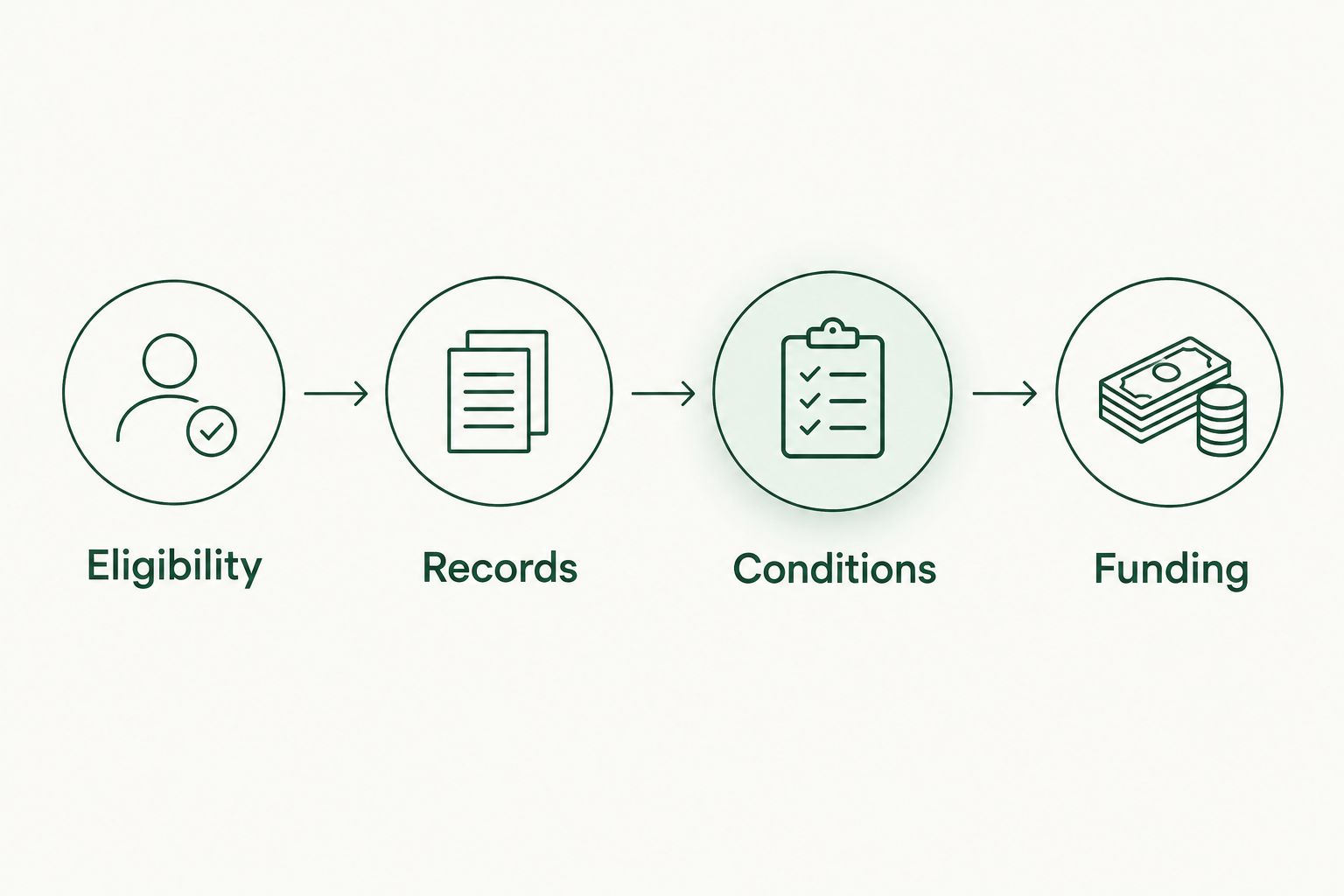
Use a simple sequence to prevent premature handoffs: Eligibility, Records, Conditions, Funding. Each stage should have its own completion evidence; uploading a file is not evidence that the lender accepted it.
Protect the seller’s separate financial decision
Your business can be financeable while the proposed exit still fails your personal plan. Review the amount and timing of proceeds, retained obligations, tax estimates prepared by your tax professional, and the household spending the transition must support.
Treat any seller note separately from cash received at closing. Deferred payments expose you to the buyer’s future ability to pay. Do not build essential household spending around an assumption that every scheduled payment will arrive.
VIMSmallBusiness provides financial planning and transition/succession planning for business owners in Loveland, Fort Collins, Berthoud, and wider Northern Colorado. That role complements the transaction team; it does not replace legal advice, tax preparation, valuation, lending, or ESOP administration.
Closing controls and funded handover
Verify completion before transferring control
- Reconcile the closing package. Have counsel and the lender confirm the required signatures, contribution evidence, closing conditions, and disbursement instructions. Resolve inconsistencies between the final documents and the approved financing structure before proceeding.
- Verify payment instructions independently. Confirm instructions through a trusted contact method already established with the closing professional. Do not rely solely on a newly received email announcing changed banking details. Follow the closing team’s verification process.
- Confirm funding and transfer. Obtain confirmation from the responsible closing professional that disbursement and ownership transfer occurred as documented. Preserve signed agreements, settlement records, and evidence of payment. Then activate the agreed operating handover.
Expected result: You can distinguish an approved loan, a signed closing package, an actual disbursement, and a completed ownership transfer. The transaction is not labeled funded merely because documents were signed.
Build an Ownership Handover checklist covering bank authority, payroll access, accounting permissions, customer communication, vendor contacts, insurance coordination, and your remaining responsibilities. Transfer access through approved processes; do not hand over shared passwords as a substitute for changing authorized users.
Set a 30-day review as your own operating checkpoint, not an SBA requirement. Compare actual collections, payroll, working capital, and debt payments with the forecast. Assign unresolved handover items and document the end of any temporary seller support.
Second workflow: a staged employee buyout
A staged transfer is a separate structure, not a workaround for an unfundable full acquisition. If you intend to retain ownership initially, send that plan to the lender before reusing the complete-buyout package.
- Map ownership at each stage. Identify who owns what before closing, immediately afterward, and after any later transfer. Distinguish a future intention from a binding purchase obligation.
- Request a fresh eligibility review. Ask the lender which 2026 SBA requirements apply to the proposed partial ownership change, retained ownership, guarantees, and later transfers. Do not assume the initial review covers a revised deal.
- Document control and future decisions. Have counsel address management authority, distributions, disagreements, future purchase terms, and departure events. Rebuild the cash-flow forecast around the actual payment obligations.
Best for: Owners and employees evaluating a gradual transfer where continued shared ownership serves a defined purpose. Its advantage is a phased handover; its limitation is continued financial and governance entanglement. Use this route only after lender and legal review.
Troubleshooting
- The lender keeps requesting revised statements. Reconcile the records before uploading another version. Add a short explanation of each change and identify the current file in the Document Register.
- The employee understands operations but has no ownership plan. Document who will handle treasury, hiring, financial reporting, and customer relationships after closing. Include replacement costs in the forecast.
- The financing assumes the seller note counts as equity. Stop treating that assumption as settled. Obtain written lender guidance on its treatment and revise the funding plan before signing inconsistent documents.
- The forecast works annually but payroll cash runs short. Rebuild the 13-week forecast using collection dates and payment dates, not just booked revenue and expenses. Discuss working-capital needs with the lender.
- Signing is complete but proceeds have not arrived. Check the Conditions Register and contact the responsible closing professional. Confirm what remains outstanding rather than releasing control based on an expected disbursement.
Customize your workflow
Expand the process around the business’s actual weak point. Customer concentration calls for a retention and management handover plan. Seasonal receipts call for closer working-capital review. Heavy dependence on you calls for documented delegation before ownership changes.
Keep a single shared transaction tracker, but restrict access to sensitive personal and business records. Your bookkeeper does not automatically need the employee buyer’s personal financial statement, and the buyer does not automatically need your household planning documents.
Use the treasury management guide for small businesses to develop the cash-management side of the handover. Keep that operating work separate from the seller’s retirement and investment decisions.
FAQ
Can an employee use an SBA 7(a) loan to buy my business?
An employee acquisition can be considered for SBA 7(a) financing, subject to lender approval and applicable SBA requirements. The lender must evaluate the buyer, business, ownership structure, and proposed uses of funds.
Does an employee buyout have to be an ESOP?
No. An employee can purchase a business directly without an employee stock ownership plan. An ESOP uses a retirement-plan trust and requires a different specialist team and transaction process.
Can my seller note replace the employee’s contribution?
Do not assume a seller note replaces the employee’s required contribution. Ask the lender to confirm its permitted treatment, documentation, and repayment restrictions for the proposed transaction.
What documents should I gather before approaching a lender?
Start with ownership records, financial statements, business tax returns, debt schedules, lease documents, and a transaction summary. The employee buyer should prepare management experience and funding-source information, then follow the lender’s specific checklist.
How long does an SBA-financed employee buyout take?
There is no single reliable timeline for every employee buyout. Ask the lender and counsel to build a schedule around underwriting, valuation, diligence, required consents, document preparation, and unresolved closing conditions.
Can VIMSmallBusiness approve or arrange my employee’s SBA loan?
VIMSmallBusiness provides business-owner financial planning and transition/succession planning, not lending. The lender makes financing decisions, while the appropriate legal, tax, and valuation professionals handle their respective work.
When is an employee buyout actually funded?
Treat the buyout as funded after the responsible closing professional confirms the required disbursement occurred. Loan approval and signed documents alone do not establish that proceeds were paid or ownership transferred.
One last thing
The most useful closing question is not whether the loan was approved; it is who has confirmed that every required payment and ownership transfer occurred. Put that person’s name in your tracker before closing day.
For your 2026 transition file, keep the seller’s financial plan beside the deal checklist, not buried inside it. Financing answers whether the employee can complete the purchase. Your plan answers whether the transaction supports the life you intend to lead after the business.