

Law firm partner succession planning is the process of transferring leadership, ownership, and client responsibilities with the aim of supporting firm continuity and your financial independence. Start by separating your retirement needs from the firm's ability to fund a buyout; client choice, professional obligations, and partner agreements make this different from an ordinary business exit.
- Succession planning for law firm partners must connect client continuity, ownership transfer, and retirement cash flow.
- Vital Investment Management suits Northern Colorado owners seeking fee-only financial planning alongside separate legal and tax counsel.
- A signed buyout agreement does not establish that the firm can fund payments.
- Test successor readiness and delayed-payment scenarios before committing to your exit date.
Why succession planning matters for law firm partners
Your retirement date is not a client transition plan. A successor needs authority, working relationships, and the financial capacity to take over. You need a household plan that distinguishes dependable resources from payments still owed by the firm.
Law firm ownership also combines roles that do not necessarily transfer together: equity partner, relationship partner, supervising attorney, and manager. Giving up one role does not settle the others. Your 2026 plan should state which responsibilities change, who accepts them, and what remains yours.
The decision about when to start succession planning comes before selecting a retirement date. Begin while you can still introduce successors, resolve agreement gaps, and adjust your personal savings without depending on a completed transaction.
For partners in Loveland, Fort Collins, Berthoud, and wider Northern Colorado, local financial planning belongs alongside counsel familiar with the applicable professional rules—not in place of that counsel.
Build your law firm succession plan in seven steps
1. Separate your personal exit goals from the firm's needs
Start with a document you can prepare yourself. Write down the work you want to stop, the work you want to retain, and the household spending your next phase must support. Review those goals with your spouse or other affected household members before negotiating partner terms.
Distinguish retirement from reduced hours. An advisory role still needs defined duties, compensation terms, and an end point. Otherwise, you risk leaving management meetings while remaining responsible for unresolved work.
Use a 12-month household spending baseline as a planning exercise, not a prescribed retirement budget. Separate essential spending from discretionary spending, and identify expenses currently paid through the practice that your household would assume.
Close this step with a written decision sheet:
- Name the responsibilities you want to leave.
- Describe any continuing role and its boundaries.
- Record essential and discretionary household spending separately.
- Identify resources outside your law firm interest.
- Mark your preferred exit date as provisional.
2. Read the governing agreements before discussing a value
Gather the partnership or operating agreement, amendments, compensation arrangements, debt documents, and any existing buy-sell provisions. Read them together. An informal understanding between partners is not a substitute for consistent documents.
Ask qualified counsel to identify what happens upon retirement, disability, death, disagreement, or departure. Confirm whether different events produce different valuation methods or payment terms. Also establish who has authority to approve a successor and change the agreement.
Keep an issue log rather than attempting your own legal interpretation. Your aim is to identify decisions, assign them to the right professional, and avoid negotiating against assumptions that the documents do not support.
Complete these checks:
- Identify transfer restrictions and approval requirements.
- Locate valuation and payment provisions.
- Record guarantees and obligations that require review.
- Ask counsel about client choice, confidentiality, and applicable professional rules.
- Assign each unresolved provision to a named decision-maker.
3. Map client continuity separately from ownership
Build a confidential transition register using your firm's approved systems. For each matter or relationship, identify the responsible attorney, proposed successor, upcoming obligations, and communication decisions requiring review. Do not move confidential client information into a personal planning spreadsheet.
A successor's equity interest does not establish client acceptance. Plan introductions and responsibility changes around the client's needs and applicable obligations, with counsel determining required notices, permissions, and other safeguards.
You can organize the register internally. For the separate financial side, Vital Investment Management offers business transition and succession planning alongside financial planning. That support does not replace legal review, a valuation professional, or the firm's responsibility for client matters.
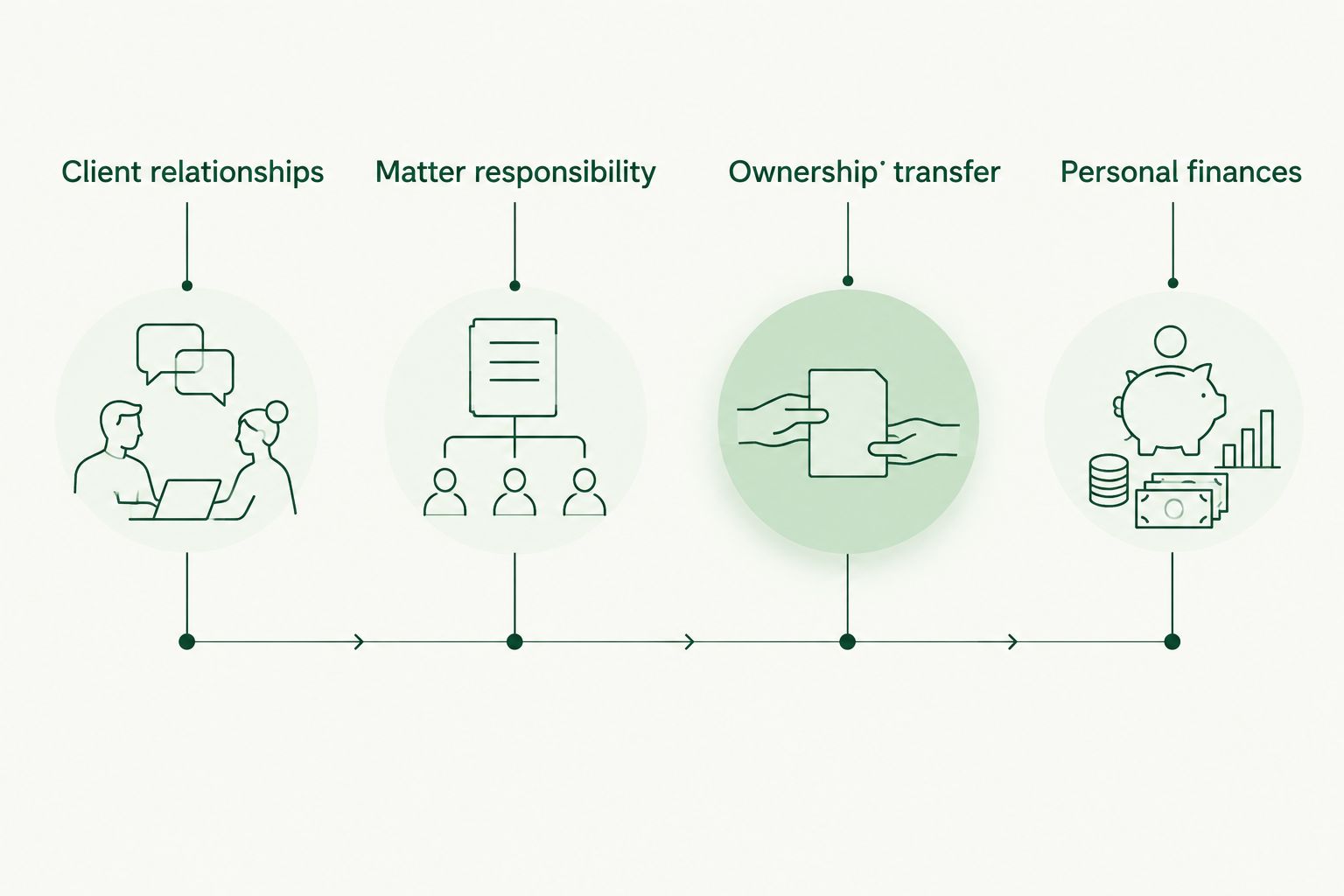
Use these headings for the transition register:
- Client relationships: identify relationship owners and proposed introductions.
- Matter responsibility: assign supervision and upcoming work.
- Ownership transfer: record decisions requiring partner approval.
- Personal finances: keep household planning outside client records.
4. Test successor readiness through actual responsibilities
List the work your successor must perform without you. Include staffing, billing decisions, collections, client communication, and management—not just legal capability or seniority. Discuss whether the proposed successor actually wants those duties.
Set a 90-day responsibility trial as an internal planning exercise. Assign defined tasks, retain appropriate supervision, and review what the successor completed, escalated, or left unresolved. This is a way to find training needs, not a universal transition deadline.
If several partners will divide your work, identify one accountable person for each responsibility. Shared ownership of a task often leaves unanswered questions about who decides when colleagues disagree.
Make the trial specific:
- Assign responsibility for a defined management task.
- Specify the decisions the successor can make.
- Establish escalation and supervision boundaries.
- Review billing and collection responsibilities.
- Record training needs before expanding authority.
5. Test whether the buyout is fundable
Separate the value discussion from the payment discussion. A valuation addresses an ownership interest under stated assumptions; a funding plan addresses how payments will occur. Neither replaces the other.
Prepare a cash flow worksheet from existing records before commissioning additional analysis. Separate operating cash, receivables, liabilities, and amounts requiring special treatment. Have counsel and accounting professionals determine the correct treatment of client funds, work in progress, and partner capital.
For a 2026 decision, request three cash flow scenarios: payments arrive as agreed, payments arrive late, and payments stop. These are stress tests, not forecasts. Show the effects on both your household and the continuing firm's operations.
Vital Investment Management's succession planning role sits on the financial planning side; it does not broker transactions or provide legal, tax, or valuation services.
Finish the funding review with these actions:
- Obtain an appropriate independent valuation when needed.
- Separate purchase payments from compensation for continuing work.
- Test operating cash after proposed buyout payments.
- Identify financing dependencies and approval conditions.
- Ask counsel to address default, security, and dispute provisions.
6. Connect the exit to your retirement cash flow
Build a household cash flow schedule that distinguishes earned income, outside assets, and contingent buyout payments. Do this manually first using statements and your spending baseline. Keep assumptions visible so your advisers can challenge them.
Do not treat an unpaid buyout balance as cash already available for retirement. A payment obligation still depends on the payer's ability and willingness to meet its terms. Your plan should show what changes if those payments arrive later than expected.
Vital Investment Management is a fee-only fiduciary and SEC-registered RIA in Northern Colorado. Its financial planning and investment management services address the personal planning work, while tax and legal questions remain with the appropriate professionals.
For your 2026 retirement worksheet:
- Separate essential spending from optional spending.
- List liquid assets apart from the practice interest.
- Identify household cash needs during the transition.
- Review retirement accounts and beneficiary designations.
- Model delayed buyout payments without assuming investment returns.
7. Coordinate taxes, documents, and implementation
Bring the same draft terms to your legal, accounting, valuation, and financial planning professionals. Conflicting assumptions create avoidable rework: one adviser should not model an equity payment while another treats the same payment as compensation.
The distinction matters because tax planning for law firm owners must address the proposed payment structure and timing, not just the headline transaction amount. Ask your tax professional to explain the treatment of each payment category before you accept terms. Vital Investment Management does not prepare tax returns.
Create a 2026 implementation calendar with dependencies rather than a single closing date. Client communications, financing, agreement amendments, management changes, and personal account decisions need their own owners and completion evidence.
Close the planning process with these controls:
- Circulate one consistent set of proposed terms.
- Assign legal drafting and tax analysis separately.
- Record approval requirements and unresolved conditions.
- Schedule client communications through the firm's approved process.
- Set review dates after material staffing or financial changes.
Compare succession routes for law firm partners
Choose a route based on successor readiness, client continuity, and payment capacity. No route removes the need for agreement review or personal financial planning. These are planning options, not recommendations to enter a particular transaction.
| Option | Best for | Main advantage | Key limitation |
|---|---|---|---|
| Internal partner buyout | Firms with willing, prepared continuing partners | Keeps ownership discussions within the existing partnership | Successor funding and payment capacity still need testing |
| Associate succession | Firms developing future owners internally | Allows responsibility to transfer before ownership | Requires interest, readiness, and a workable ownership path |
| Merger or external transfer | Firms evaluating an outside organization | Creates another route when internal succession is unsuitable | Culture, client arrangements, and applicable rules require review |
| Phased retirement | Partners reducing work before a final departure | Separates responsibility changes into manageable stages | Ambiguous authority can keep the departing partner involved indefinitely |
| Orderly wind-down | Firms without a viable continuing successor | Focuses planning on completing or transferring obligations | Does not create a continuing buyer for the practice |
Compare written terms rather than labels. A phased retirement can still leave you financially dependent on the firm, while an internal buyout can transfer ownership before client responsibilities have changed.
Common mistakes law firm partners make
Confusing client relationships with transferable ownership
A client relationship is not an asset you can simply assign without considering client choice and applicable obligations. Keep client continuity decisions separate from the ownership agreement, then coordinate both workstreams through counsel.
Negotiating value before testing payment capacity
A negotiated amount does not establish affordability. Review the continuing firm's cash flow and your household's dependence on the payments before treating the agreement as a retirement solution.
Leaving an advisory role undefined
Remaining available sounds simple until colleagues disagree about authority, workload, or compensation. Specify duties, supervision, decision rights, and the conditions that end the role.
Treating a family estate plan as the firm's succession plan
Your estate documents and firm agreements address different decisions. Ask your estate counsel and partnership counsel to reconcile ownership provisions, authority, and beneficiary intentions rather than assuming one document controls everything.
FAQ
When should a law firm partner start succession planning?
Start before you need a fixed departure date. You need time to review agreements, test successor readiness, introduce client relationship changes appropriately, and assess personal finances.
What's the first step in succession planning for law firm partners?
Separate your personal exit goals from the firm's continuity needs. Write down the responsibilities you want to leave, your household spending needs, and the resources you hold outside the practice.
Is an internal partner buyout better than an external transfer?
An internal buyout fits when continuing partners are willing, prepared, and financially able to proceed. An external route requires a separate assessment of the receiving organization, proposed terms, client arrangements, and applicable professional rules.
Can a retiring partner keep working part time?
A continuing role belongs in the plan only when its duties, authority, compensation, and end conditions are defined. Have counsel review the arrangement alongside the ownership transfer and client responsibilities.
How do I know whether my law firm can fund my buyout?
Test proposed payments against the continuing firm's cash flow and obligations. Review delayed-payment and stopped-payment scenarios with the appropriate financial, accounting, and legal professionals.
Can a financial adviser handle the entire law firm succession?
A financial adviser does not replace legal counsel, a tax professional, or a valuation specialist. Financial planning connects your retirement needs and outside assets to the proposed transition terms.
Do I need to retire completely to create a succession plan?
No; succession planning can support reduced hours, a management handoff, or a later ownership exit. Define each change separately so your colleagues and clients are not left guessing about responsibility.
One last thing
Before accepting a transition proposal, ask who decides a staffing dispute, approves a payment exception, and handles an unexpected client issue after you leave. If the answer is still you, your responsibilities have not fully transferred. Put those decisions in the plan before calling the exit complete.
This guide is educational and is not personalized financial, tax, or legal advice.